
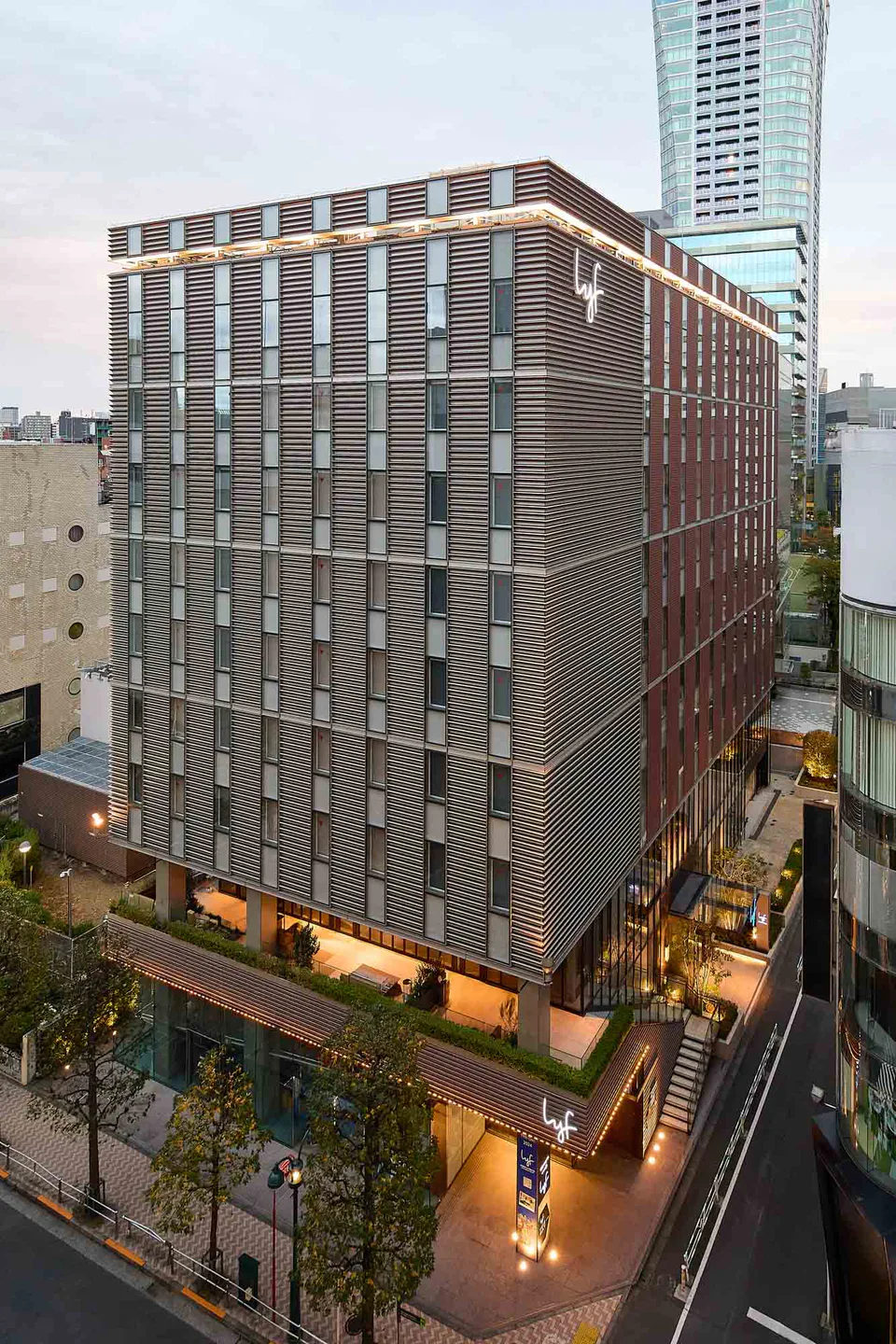
The best reason to sleep at lyf Shibuya Tokyo is the ability to step back from Udagawacho without making a train journey. Shibuya PARCO is across the street; an afternoon of shops, cafés or Harajuku can turn into a bag drop before dinner. The trade is visible in the room plan. The two double studios measure 12 m², and even the twin is 13 m². For one light-packing guest who returns to the district several times, that can be a sensible exchange. For two travellers with large cases who mostly leave Shibuya each day, the address may be a costly way to buy a small bedroom. Shinjuku versus Shibuya as a Tokyo base should come before the hotel rate comparison.
A stay near PARCO is useful only if Shibuya features in the actual itinerary. Imagine a day around Center-gai or MIYASHITA PARK, a return to unload shopping, then an evening meal nearby. The hotel saves a cross-city journey and provides a reset point. Now imagine consecutive Disney, Hakone and Kamakura days with returns after 22:00: the neighbourhood is little more than the final walk to sleep. A Disney-base decision and Kamakura as a Tokyo day trip expose how quickly those days consume the location benefit.
↔ Scroll table left or right
Stay pattern | Likely fit | What to test |
Solo, light bag, several Shibuya evenings | Strong | Does the studio serve mainly sleep and a short reset? |
Couple with large luggage | Conditional | Can either person move around an open case in 12–13 m²? |
Four friends using one room | Conditional | Check bathroom queue, beds and everyone’s bags |
Disney, Hakone and Kamakura dominate | Weak location premium | Are you paying to return late rather than enjoy Shibuya? |
Shopping is a major purpose | Mixed | Bag-drop access is useful; purchases then occupy the small room |
The station estimate begins at the exit, not the platform
The property is at 4-3 Udagawacho, facing PARCO along Organ-zaka. Its location information places Shibuya Station around seven minutes away on foot, with the Hachiko side or A6b exit useful depending on the line. PARCO is roughly one minute from the hotel and MIYASHITA PARK around four minutes. These are local walking estimates. Arriving at a Shibuya train platform with two suitcases still involves the large interchange, ticket gates, vertical movement, a suitable exit and then the street walk.
That distinction matters most on the first and last day. A solo traveller with a backpack will experience the seven-minute street leg differently from a family entering the station through a distant operator or handling strollers. An airport arrival also has a rail route and luggage transfer before reaching Shibuya. Narita, Ueno and Shinjuku as bases and where first-time visitors should stay in Tokyo put the station question into the wider city decision.
For shopping or evening plans, the address is genuinely distinctive. You can return from PARCO with bags rather than carrying them onward, then walk out again. But the saving is not automatic just because the booking says “Shibuya.” Count actual occasions when you will use that second short walk. A location used twice on a day can earn more than a fashionable district seen only after the shops have shut. Shopping-oriented Tokyo hotel areas provides a more useful comparison than a bare room rate.
↔ Scroll table left or right
Expected Shibuya returns during the stay | How the address earns its place |
None or one | The PARCO location is mostly an arrival and departure walk; compare a room with more floor space elsewhere |
Two or three | Bag drops or an evening reset may help, but weigh them against the small bedroom on every night |
Four or more | Repeated short returns make the location more useful, particularly with light luggage and plans close to the hotel |
Twelve square metres changes the daily routine
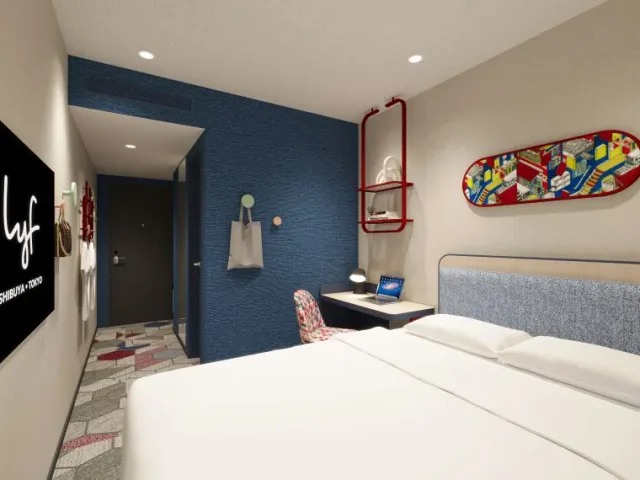
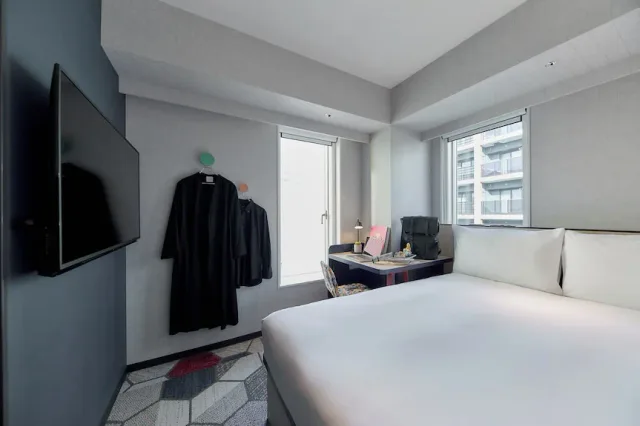
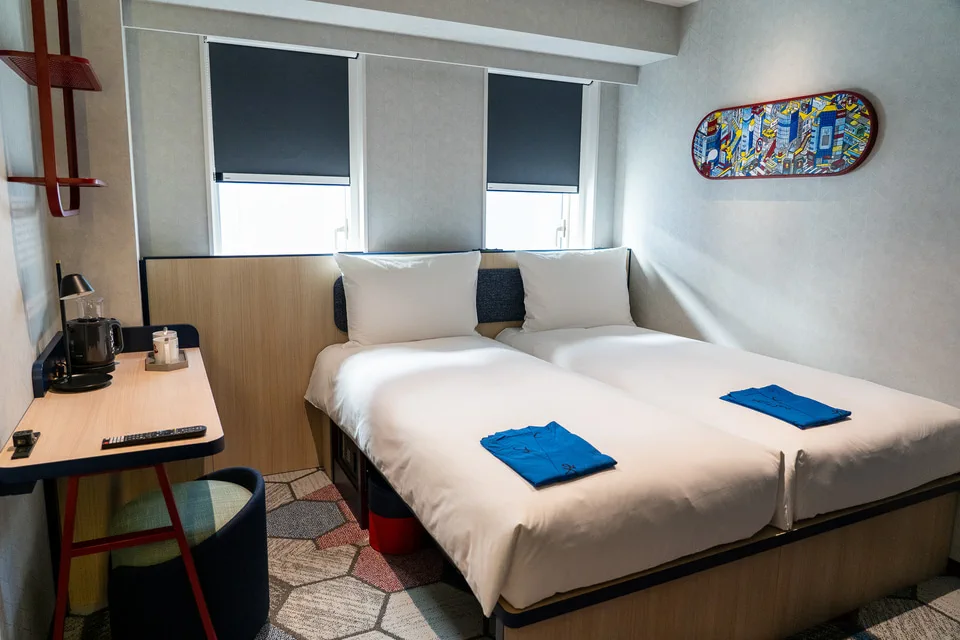
The current room list gives One of a Kind and One of a Kind Plus as 12 m² studios for up to two, Side by Side as a 13 m² twin for up to two, All Together as 22 m² for up to four, and Two of a Kind as a 24 m² two-bedroom choice for up to four. Occupancy capacity is not the same as comfortable floor space. A solo traveller with one case can keep much of the room clear. A pair with separate long-haul luggage can quickly lose the only circulation area when both bags are open.
↔ Scroll table left or right
Booked category | Listed area and capacity | Useful comparison |
One of a Kind / Plus | 12 m², up to two | Best tested against a solo/light-bag routine |
Side by Side | 13 m², up to two | Separate beds, still very limited bag floor space |
All Together | 22 m², up to four | One group booking; bathroom and bag sharing still matter |
Two of a Kind | 24 m², up to four | Two-bedroom layout can separate sleep without creating a large apartment |
A compact studio works when the private room has just three jobs: showering, charging and sleeping. It is harder to recommend for three hours of laptop work, repeated repacking, an evening in with takeout, or two people trying to dress around open suitcases. The small room is not inherently a bad product; the mistake is buying the lowest displayed category for a trip whose actual room use demands more. Hotel Niwa Tokyo room-space trade gives a different central-Tokyo benchmark. Shibuya Excel versus Shinjuku Blossom is relevant if a larger room or transport access may be worth paying for.
Shopping makes the space equation change during the trip. The same room can feel easy on check-in day and cramped by night four after shoes, gifts and clothing accumulate. Quick returns to drop purchases make lyf’s location useful, yet each return moves more objects into the 12 m² studio. If purchases are central to the stay, decide where the bags will be kept once they reach the hotel. Luggage forwarding within Japan can help before an onward city, but it cannot turn a crowded room into a larger one.
Four guests share a room, not four private routines
The 22 m² All Together and 24 m² Two of a Kind categories admit up to four guests. Two of a Kind separates the sleeping areas, which can matter to friends who keep different hours, but one reservation still leaves a shared bathroom rhythm and luggage to place. Price per person looks attractive only when everyone agrees on bed arrangement, morning shower timing, privacy and the amount of gear they will carry. Four-person Tokyo hotel choices concerns another trip pattern, but illustrates why legal capacity is not the whole comfort question.
One 24 m² two-bedroom unit can be right for a short, social city stay with modest bags. It can be wrong when one traveller works late, another needs quiet, everyone has a full suitcase, or the group wants separate bathrooms. In that case, two conventional rooms elsewhere may cost more but solve the daily queue. Set the same guest count and bed setup when comparing rates. Do not divide a headline room price by four before checking what the fourth person will actually sleep on.
Shared rooms do some jobs a small bedroom cannot
The amenities list names BOND as a shared kitchen, CONNECT as a social and coworking lounge, WASH & HANG as the laundrette and BURN as the gym. The current property information lists CONNECT, laundry and gym around the clock. The guest cheat sheet says the BOND induction hob is available 06:00–23:00. A guest can move laptop work, a basic meal or a laundry cycle out of a compact bedroom. The shared areas are part of how this hotel’s small-room model functions.
↔ Scroll table left or right
Shared feature | What it can move out of the bedroom | What remains private-room pressure |
BOND kitchen | Simple meal preparation | A private place for dinner with your own group |
CONNECT lounge | Laptop or social time | Quiet personal workspace on demand |
WASH & HANG laundry | Some spare clothes in the suitcase | The suitcase itself and waiting for a machine |
BURN gym | Exercise outside the room | Floor area for luggage or an extra person |
These facilities expand functional space, not exclusive space. The lounge is not a guaranteed private office, the kitchen is used by other guests, and a load of washing still takes time. A traveller who wants a sofa and bathroom entirely to themselves after sightseeing may prefer a larger ordinary hotel room. Someone happy to work among others and eat out can make the 12 m² studio feel more viable. lyf Tenjin small-room comparison shows the same general concept in a different city, with property details that should not be copied across.
There is an on-site restaurant, TO THE HERBS, with breakfast currently listed from 07:00 to 10:00 and last entry 09:30. That adds an option but does not mean every booking includes breakfast. The shared kitchen may suit a different morning routine. For a very early excursion, compare what time you must actually leave the building against restaurant hours before paying for a meal plan. Tokyo day trips compared is useful if several departures will consume hotel mornings.
Late arrival has a separate door rule
The hotel currently lists check-in from 15:00 and checkout before 11:00. Its guest sheet says the entrance is locked from midnight to 05:00 and resident guests use their key card to enter. That card rule explains re-entry after a night out; it is not a promise that a first-time arrival can show up unannounced at 02:00 and complete registration. If an international flight makes a late check-in plausible, tell the property the expected arrival time and confirm the procedure. Narita after-hours lodging choice can change the first-night location entirely.
The property has a 24-hour reception listing, yet reception coverage and a locked exterior door answer different questions. A traveller already holding a room key has a straightforward way back in; a new guest still needs an agreed check-in route. For an itinerary with a long shopping night, the door rule is manageable. For an uncertain airport arrival, it is a reason to settle the first-night logistics before buying a non-flexible rate.
Seven site scores for a Shibuya-centred stay
Dimension | Site score | What matters at this hotel |
|---|---|---|
Location | PARCO is across the street, but the station walk begins only after leaving the large interchange. | |
Room | The 12–13 m² studios suit light packing; four-person parties need the 22–24 m² categories. | |
Cleanliness | Aggregated guest cleanliness is 9.1/10, consistent with the current hotel rating. | |
Service | The aggregated staff category is 9.6/10; first-time arrival during the locked-door hours still needs coordination. | |
Facilities | BOND kitchen, CONNECT lounge, WASH & HANG laundry and BURN gym give small rooms useful shared space. | |
Food | Breakfast runs 07:00–10:00 at the restaurant, while the shared kitchen is the flexible alternative. | |
Value | The aggregated value category is 8.6/10; the location premium works best with repeated Shibuya returns. | |
Overall | A strong fit for light-packing Shibuya days, less convincing when large cases or distant day trips dominate. |
The seven scores and overall judgement are out of ten. The room score reflects the published areas, while cleanliness and service draw on aggregated guest categories. A couple with two big cases will feel the bedroom every morning even if they use the lounge; a four-person group should compare the exact larger category with two conventional rooms. A seven-day Tokyo route shows how many days remain in Shibuya after other attractions are fixed.
Match the booking to the way you will use Shibuya
Before comparing rates, fix the exact One of a Kind, Side by Side, All Together or Two of a Kind category, the number of guests, bed arrangement, taxes, payment schedule and cancellation deadline. Two offers under the same hotel name can describe very different amounts of space. A cheap 12 m² room is no substitute for a quoted 24 m² two-bedroom category if four people are travelling. Tokyo hotels chosen for shopping and Shinjuku versus Shibuya are useful alternatives if the location premium is the main question.
I would choose lyf for a solo or lightly packed traveller who will return to Shibuya repeatedly and is comfortable shifting work or meals into common space. I would price a different room or hotel for two large cases, a four-person group with conflicting routines, or a stay built mainly from distant day trips. If the date includes Disney and an early transfer to Hakone, Tokyo hotel area versus Disney hotel and Tokyo-to-Hakone train options may do more for comfort than a PARCO address.
For dates when the Shibuya location genuinely helps, compare hotel rooms around Shibuya PARCO with the specific category and cancellation rules selected. The right purchase is the room whose private space and shared facilities match the party’s daily routine, not the first rate returned under the hotel name.
Other hotel and route comparisons
sequence MIYASHITA PARK: · lyf Tenjin Fukuoka · JR East Hotel · Tokyo Dome Hotel: · Lotte Hotel Busan · SHIBUYA SKY Tickets · Centara Grand Hotel · Mitsui Garden Hotel · teamLab Planets Tokyo · Zentis Osaka: Is · Tokyo Solo Hotels: · Premier Hotel -CABIN- · THE LUIGANS Spa · MiraCosta Harbor Room · Mitsui Garden Hotel · Cross Hotel Osaka:.