
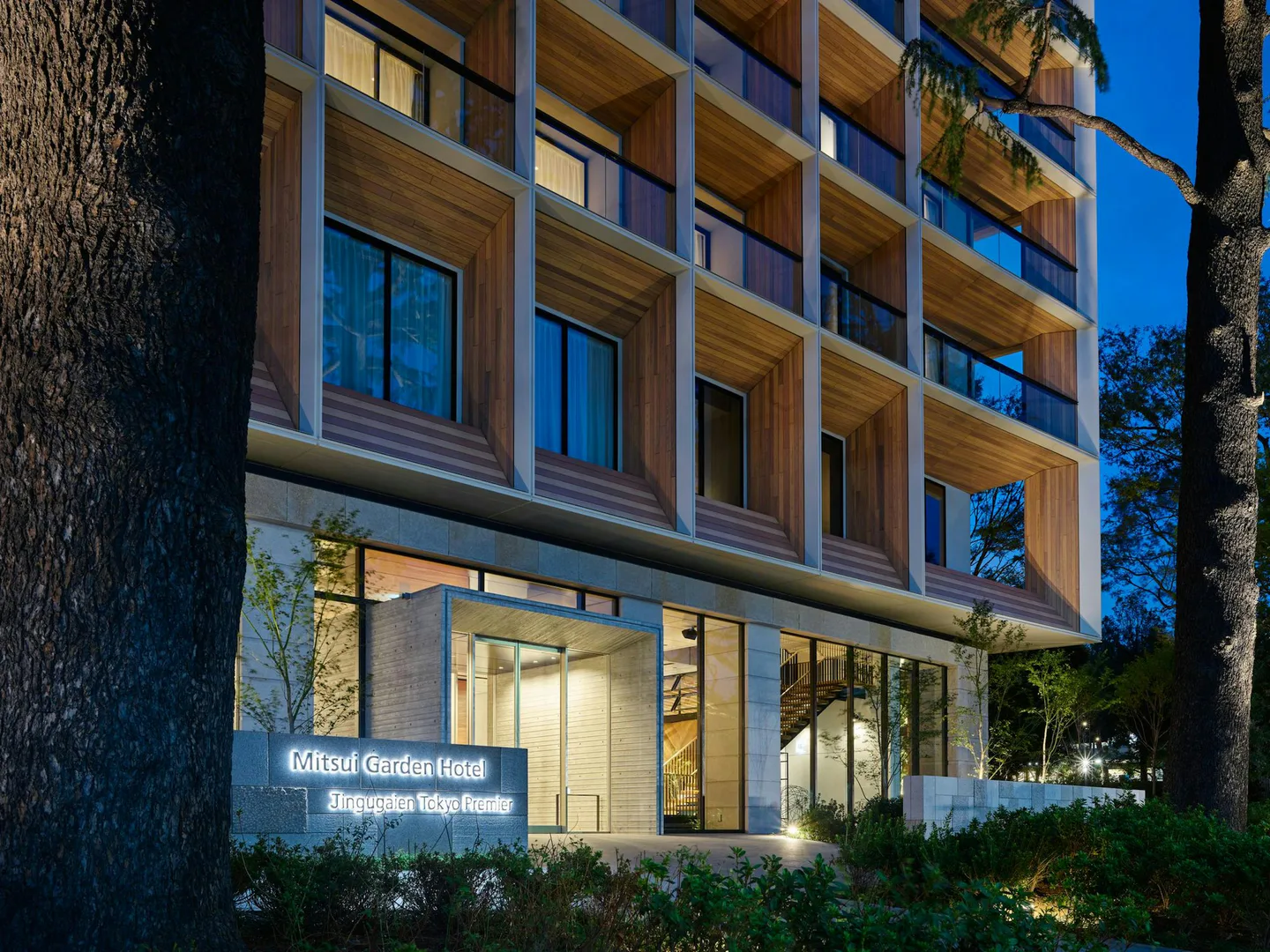
A National Stadium event can make this hotel’s location unusually valuable for one night. Its entrance is roughly a minute from Kokuritsu-Kyogijo Station, while JR Sendagaya and Shinanomachi are within walking distance. After a crowded event, the return is a short walk instead of another train ride. That advantage is specific to the Gaien and Sendagaya side of Tokyo; it does not automatically make the address the best base for five days across the whole city. Compare first-time Tokyo hotel areas.
The building brings its own reasons to stay: every guest room has a balcony, room sizes in the published range run from 18.5 to 50.9 m², and registered guests can use the second-floor bath without another charge. These are separate purchases in practical terms. A balcony is standard, a stadium-facing room is not; a bigger floor plan may improve a long stay, while a bath premium means little if the hours never match your day.
↔ Scroll table left or right
Trip use | How the hotel fits | Useful reason | What could change the answer |
National Stadium event and Gaien time | Strong for one night | An easy walk after the venue empties | A multi-night itinerary mainly across eastern Tokyo |
Several west-central Tokyo days | Consider as a full base | Oedo and nearby JR stops serve different routes | Frequent Ueno, Tokyo Station or Maihama days |
Two adults with luggage | Compare a Twin quote | 24.7 m² offers more area than 18.5 m² Double | A better-located larger room costs about the same |
Three adults | Check Superior Corner Twin or two rooms | Listed triple occupancy uses a sofa bed | All three travellers need regular beds |
Airport-focused overnight | Compare another rail base | The hotel airport routes include a transfer | A stadium event makes walking home decisive |
You are paying mainly for a stadium-facing view | Book by exact room category | Some rooms are explicitly stadium-side, while many lower categories face Shinjuku / railway / expressway | You assumed “balcony” automatically meant stadium view |
A stadium-adjacent hotel has a particular kind of value
The hotel places Kokuritsu-Kyogijo on the Toei Oedo Line about one minute away, JR Sendagaya about five minutes away and JR Shinanomachi about six. Its route guide puts the Oedo ride from Shinjuku at around four minutes. The first number describes a very short final walk from one station; it does not turn this address into Shinjuku Station or put every JR line on the doorstep. See the station and airport access routes.
National Stadium, Tokyo Metropolitan Gymnasium, Meiji Jingu Gaien and Sendagaya plans fit this map well. Aoyama and Harajuku can also combine with a west-central Tokyo stay. Frequent Tokyo Station, Ueno, Maihama or Shinkansen departures ask for a separate route check because this hotel is not a major JR interchange.
One concert or match gives a strong reason for one night. An event plus two Gaien-side days can make several nights coherent. If the remaining four days of a longer stay are on the opposite side of Tokyo, the event should be weighed against the daily travel it cannot shorten.
When the wider Tokyo hotel area is still undecided, mark the attractions and rail departures first. Then see whether the Kokuritsu-Kyogijo, Sendagaya and Shinanomachi triangle serves them better than a Shinjuku or Tokyo Station address. Compare Shinjuku versus Shibuya as a base.
The event-night decision is different from the whole-stay decision
For a stadium event, walking back to the hotel avoids the immediate post-show platform crowd. That benefit is especially tangible if the event ends late, the party includes children or someone cannot stand comfortably in a long station queue. The hotel’s location earns its keep at precisely that moment.
The question for a four-night reservation is whether the same location helps on the other three mornings and evenings. A perfect 22:00 event exit cannot by itself make repeated trips to Ueno, Tokyo Station or Disney efficient. Price the event night and the rest of the trip as different travel problems. Compare Tokyo Station versus Shinjuku.
A split stay can be rational with carry-on bags and a clear route onward. Several large cases or young children change the calculation: checkout, bag storage, another check-in and a disrupted afternoon may cost more effort than riding to the stadium once from an established base. Compare Tokyo event accommodation planning.
Balcony access and stadium outlook are separate choices
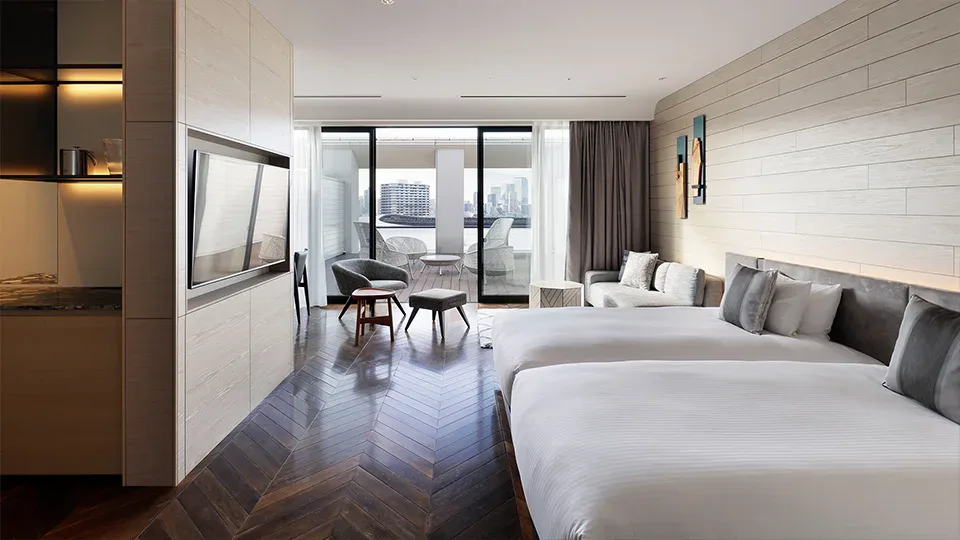
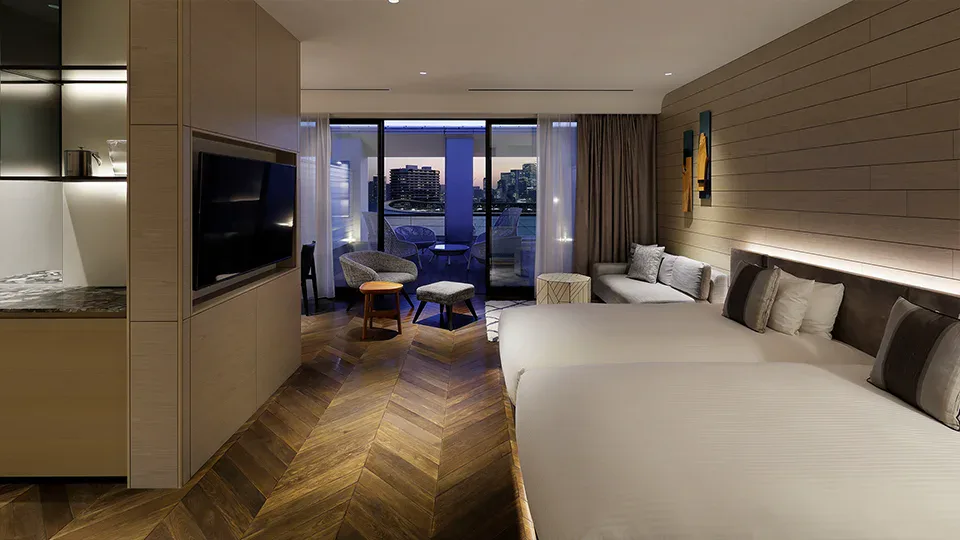
Every published room category has a balcony. That gives even an entry room an outside edge unusual for central Tokyo. It does not guarantee that the balcony looks toward Japan National Stadium; orientation varies by category and sometimes by assigned room. See the balcony and outlook information.
The room inventory describes several materially different outlooks:
Standard Double: 18.5 m², with a Shinjuku-side railway and expressway outlook.
Standard Queen: 22.0 m² and a 1,640 mm bed, also oriented towards Shinjuku.
Standard Twin: 24.7 m² and two beds; the assigned outlook can differ.
Superior Corner Twin: 30.0 m², with a mini-kitchen only in the corresponding variant.
Deluxe Twin: 38.0 m² and a category listed on the National Stadium side.
Junior Suites: 46.5–50.9 m², with stadium-facing views in the published room range.
Ask whether you need to step outside at all, whether a particular view is worth paying for, and how much indoor room you need. The first benefit comes with every category. Stadium-facing outlook is specified for selected higher categories, so a request note on a standard room should not be treated as a view guarantee. Compare another Tokyo hotel with a balcony.
A Standard Double or Queen can still give the balcony break you wanted. If watching the stadium from the room is part of the occasion, choose a category whose listing explicitly promises that side, then confirm the exact booked category before paying.
Bed, floor area and room function do not rise together
The entry 18.5 m² Standard Double is a poor universal benchmark. Its compact size may suit a single event night, while a long stay with two large cases or a third adult needs a different comparison. The hotel has distinct upgrades for a wider bed, separate beds, a third sleeper, a kitchenette and a stadium view. See the guest-room and luggage details.
↔ Scroll table left or right
Category | Published room and occupancy | What the price buys |
Standard Double | 18.5 m²; two-person maximum | Compact room with balcony on the Shinjuku side |
Standard Queen | 22.0 m²; two-person maximum; 1,640 mm bed | Wider bed and more interior area, Shinjuku-side orientation |
Standard Twin | 24.7 m²; two 1,230 mm beds | Separate beds and about 34% more published area than Double; view varies |
Superior Corner Twin | 30.0 m²; up to three with sofa bed | A mini-kitchen exists in one configuration; check the exact version |
Deluxe Twin | 38.0 m²; two-person maximum | Larger twin room on the stadium side |
Junior Suite | 46.5–50.9 m²; two-person maximum | Substantial space and a stadium-facing category |
A Standard Twin has 24.7 m², which is 6.2 m² above the Standard Double—about one-third more published area. The two 1,230 mm beds and added space can matter more to two long-haul travellers, especially if two large suitcases must remain open over several nights, than jumping straight to a suite. Published area is not a measurement of free floor around furniture, so inspect the room photos as well. Compare a larger Oshiage room.
The 30 m² Superior Corner Twin can take three, using a sofa bed with two regular beds. That solves listed capacity, not the problem of giving three adults equal mattresses. If that distinction matters, price two rooms or a different hotel. The 38 m² Deluxe Twin is for two and carries a stadium-side view; size alone does not make it the triple option.
The kitchenette serves a stay pattern, not a status level
The hotel lists two Superior Corner Twin versions at 30 m², one with a mini-kitchen and one without. The equipment is useful for light food preparation on a longer booking, but the floor-area figure itself does not tell you which variant has it.
A family making breakfast for a child, or two adults spending four or five nights and storing simple food, may use that feature repeatedly. If nearly every meal is already planned outside, compare the regular Superior price and the route instead of assuming the mini-kitchen will earn its supplement. Compare Tokyo family hotel-room choice.
Count likely in-room meals or snacks before choosing the variant. If the number is zero, the cooking area is not a reason to upgrade; a better bed configuration or more useful outlook may be.
Bath access is included, but the usable hours matter
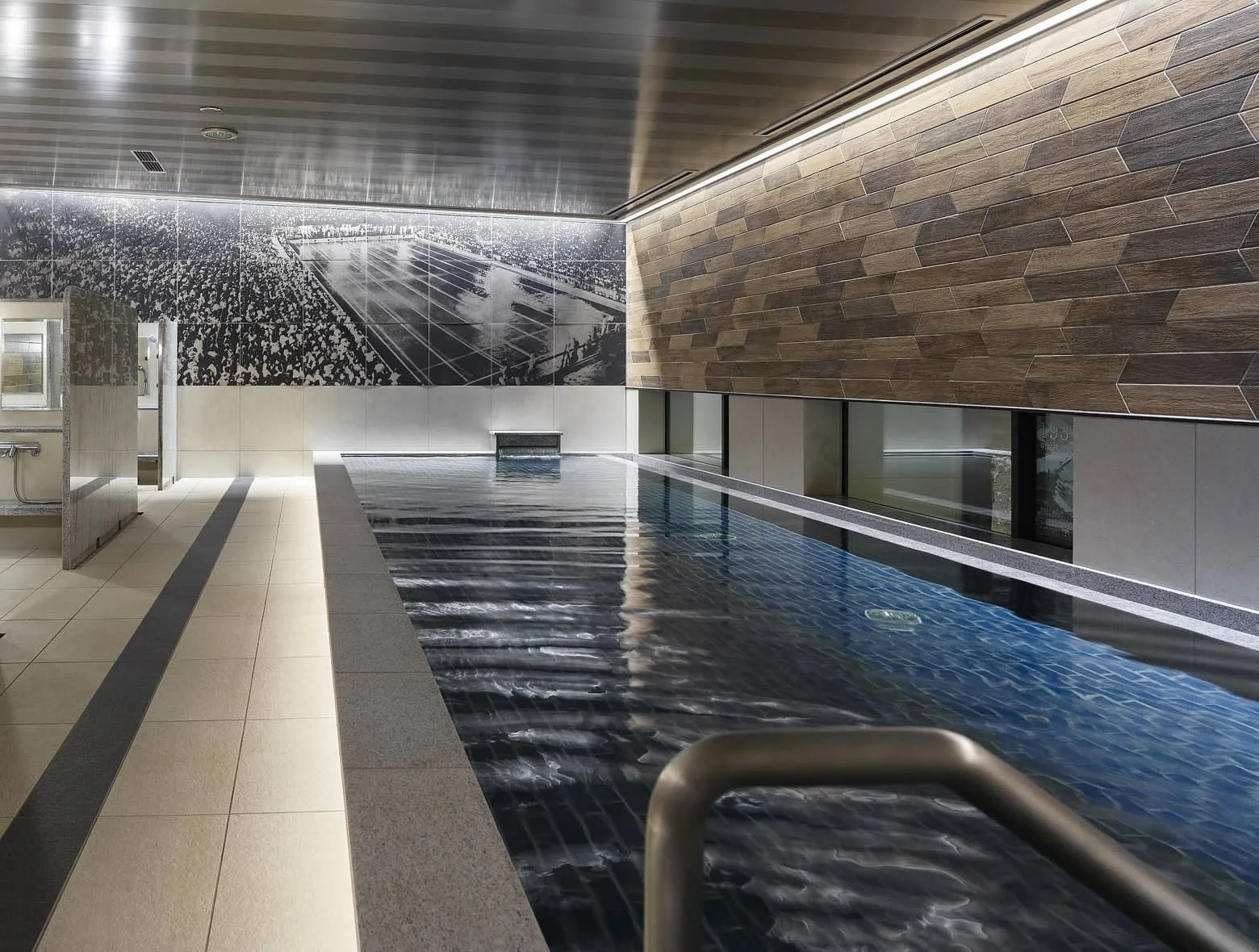
The second-floor large public bath is reserved for guests and costs no additional admission. Current hours are 15:00–25:00 and 06:00–09:00. A traveller coming back from an event before 01:00 could bathe that night, then again before breakfast; someone departing before 06:00 has no morning window. See the guest bath hours and entry policy.
The hotel has removed its body-art and tattoo restrictions for the bath. Guests should still follow the bath’s other conditions, including the rule against entering under the influence of alcohol. A familiar assumption about public baths elsewhere in Japan should not be applied to this property without reading its current policy.
Use the actual schedule, not the existence of a bath, in the room-price comparison:
Back before 01:00 after an event: the evening bath is usable.
Unhurried morning after 06:00: a second bath visit can fit.
Return after 01:00 or leave before 06:00: that session is unavailable.
No interest in shared bathing: do not count this amenity in the room premium.
A guest who will bathe after sightseeing may find this included facility more useful than a marginal room upgrade. Another who avoids shared bathing, returns after closing or always leaves early should remove it from the value calculation. The same hotel amenity can have very different practical worth on two itineraries. Compare a public-bath hotel near Sapporo Station.
Breakfast needs its own ¥3,850 decision
RISTORANTE & BAR E’VOLTA serves a Japanese-Western buffet from 07:00 to 10:30, with last entry at 10:00. The published price for a staying guest is ¥3,850. It is an optional meal cost to add to the room quote, not a benefit to assume is included in every rate. See the breakfast hours and price.
A slow post-event morning or a local Gaien day gives time to sit through breakfast. Before an early train, flight or timed attraction, the same meal can force a later departure; that would work against the location benefit for which you chose the hotel. It may instead be abandoned after payment. Compare the breakfast-included rate with the room-only rate for the date and morning you actually have.
This matters most on a short stay: a bath session and a long breakfast could make the hotel itself a meaningful part of the night, but only if neither collides with the next booking. A room chosen for its location should not turn the following morning into a sprint.
The airport route has a final transfer
Haneda access in the hotel directions runs through Daimon and the Oedo Line. For Narita, the directions use Shinjuku and Oedo after Narita Express or an airport bus. Both are workable railway or bus chains, yet neither is a single vehicle that drops guests at the hotel door. Compare Haneda late-arrival hotel choice.
The transfer weighs more heavily after a late flight with heavy bags than after a daytime arrival with one case. If that final handover is the hardest part of the trip, compare a base on the chosen airport route before assigning extra value to the National Stadium proximity. Compare Narita or Haneda’s final transfer.
A Shinjuku-ku postal address should not stand in for a Shinjuku Station transport plan. Confirm the actual airport service, connection and last walk, especially when arrival time is tight.
For large suitcases, choose the station by the whole route
The Oedo stop is the closest on foot, while JR Sendagaya and Shinanomachi can remove a rail transfer on particular journeys. A pair of 29-inch suitcases may make a slightly longer surface walk preferable to stairs and another platform change. Map the journey from the train you will use, not just the shortest hotel-to-station number. Compare luggage forwarding decisions.
The hotel can receive luggage sent ahead if the parcel identifies both the stay dates and guest name in the form required by the property. It also has coin laundry on the second floor. These services make a multi-night stay easier to manage, though they do not change which rail lines serve the neighbourhood.
For a three- to five-night booking, write down the first major station each day. Repeated Kokuritsu-Kyogijo, Sendagaya or Shinanomachi starts support the choice; repeated Tokyo Station, Ueno and Maihama starts are a reason to compare a JR-centred alternative. Compare Tokyo Station hotel comparison.
How the answer changes with stay length
For a single night tied to a National Stadium event, the walk after the show may be the decisive feature. A deliberate Gaien or Sendagaya visit the next day extends the usefulness without needing a whole-city argument.
Across two nights, an event plus Aoyama, Harajuku or another western-central outing lets the same geography help twice. The balcony and guest bath may also receive actual use rather than appearing only in the amenities list. Compare Aoyama’s Nezu Museum visit.
Over three to five nights, test each day’s station and evening return. If only the event benefits from this location, compare one hotel change with one journey back after the show. Either can win depending on bags, children and the rest of the route. Compare the Tokyo three-, four- or five-day route.
On a longer stay, the room category grows more consequential. The 18.5 m² Double that works for an event night may become awkward after a week of luggage and laundry. A 30 m² room with the correct mini-kitchen variant can serve a family or longer visit in a different way, even though stadium access has not changed. Compare Mitsui Garden Hotel Ueno versus NOHGA.
Where another base or room type wins
JR-heavy first visit: a base near Tokyo Station, Ueno or another useful JR hub may shorten more days.
Shinjuku or Shibuya nightlife most evenings: a room there removes repeated late returns.
Airport buffer night: select by the actual flight route and luggage transfer.
Three adults who need equal beds: the listed triple uses a sofa bed, so compare two rooms or another property.
Stadium-view priority: reserve a category that explicitly promises that orientation rather than trusting a generic balcony listing.
The strongest case combines repeated Gaien-side travel with a specific hotel feature the party will use. An event visitor may value the walk home; a longer-stay guest may instead value the balcony, bath, larger twin layout or mini-kitchen. Check which of these is real in the exact category offered for your dates.
For one event night, this address can be unusually efficient. For an ordinary first Tokyo trip, it is not automatically interchangeable with a Shinjuku or Tokyo Station base. Compare the nearest usable station for each day, then price the room that fits your luggage and sleeping arrangements. Compare a Shinagawa rail base.
The published range contains three different premiums that are easy to conflate: every-room balcony access, selected stadium-side views and more interior floor area. Spend for the one that changes the trip; the name of a higher category alone does not establish its value.
Remove the stadium event from the calendar as a final test. If Gaien activities, room layout and bath still make the booking attractive, the hotel can serve as the main base. If the answer changes completely, consider it for the event night and compare the rest of the stay elsewhere.
For a stadium night, compare the exact room category and cancellation terms before reserving. See rooms around National Stadium.
For a multi-night stay, compare room-only and breakfast-included rates. The ¥3,850 guest buffet price matters only on mornings when you can use it.
A lower room quote farther away should be tested against the final rail trip after the event and the routes needed on the other days.
Seven site scores for the stadium-side stay
Dimension | Site score | Evidence for this stadium-side choice |
|---|---|---|
Location | Kokuritsu-Kyogijo makes a post-event walk short, while airport and cross-city routes still require transfer checks. | |
Room | The published 18.5–50.9 m² range has meaningful differences in beds, balconies and kitchenettes; the name alone does not guarantee a stadium view. | |
Cleanliness | The current aggregated cleanliness category is about 9.0/10. | |
Service | The aggregated staff category is about 8.9/10. | |
Facilities | The guest public bath and rooftop terrace add use beyond the room, but bath hours must fit the event finish. | |
Food | E’VOLTA has a bakery and live-kitchen breakfast from 07:00; its ¥3,850 guest price is a separate decision. | |
Value | The premium is easier to defend for a stadium event or repeated Gaien-side travel than for a single central-Tokyo transfer. | |
Overall | A particularly useful event-night stay when the booked room layout and its view are checked separately. |
The /10 marks treat this as a National Stadium or Gaien stay. Cleanliness and Service reflect aggregated guest categories; route, room, bath, breakfast and value marks are site judgments based on published conditions.
Other Tokyo base decisions
Where to Stay in Tokyo for First-Time Visitors · Shinjuku vs Shibuya · Tokyo Station vs Shinjuku · Where to Stay for Tokyo Events
Hotel information for the booking decision
The property publishes the station routes, room and balcony descriptions, guest-bath rules and current breakfast price on its hotel pages. Confirm the selected category, meal inclusion and travel-date terms when the rate is shown.
Related guides: Mitsui Garden Hotel Osaka Premier Review: Is Nakanoshima Worth the Trade-off? · Hotel Hankyu RESPIRE OSAKA: Is a 3-Minute Osaka Station Walk Worth the High-Rise Trade-Off? · Lake Biwa Otsu Prince Hotel: Is the 36.2m² Lake View Worth the Shuttle? · Mitsui Garden Hotel Fukuoka Gion: Is the 26.6 m² Triple Room Worth It for 3 Adults? · Mitsui Garden Hotel Fukuoka Gion vs THE BLOSSOM HAKATA Premier: Better for 3 Adults? · Mitsui Garden Hotel Ueno: Is the 6-Minute Walk from the Skyliner Worth It? · Hotel Metropolitan Tokyo Marunouchi: Is Tokyo Station Access Worth It Before an Early Shinkansen? · Hakata Station Hotel Comparison: Forza vs Blossom Chuo vs THE BLOSSOM Premier · Hotel Sonia Otaru: Is a Canal-View Room and Rooftop Onsen Worth the 8-Minute Station Walk? · Miyako Hotel Hakata: Is a Direct Hakata Station Connection Worth the Premium?