
An 18 m² room can work for two people at Hotel Niwa Tokyo over three to five nights, but the answer depends less on the number of nights than on what happens every evening. A pair who travel with carry-ons, leave the hotel after breakfast and use the shared lounge to read or plan can live comfortably with a compact sleeping space. Two large cases, daily shopping and a wish to relax privately in the room put different pressure on the same floor. The first room to compare in that case is the 24 m² Superior, not automatically the largest suite.
Hotel Niwa's current room names matter: the 18 m² one-bed room is now listed as Queen, while the 24 m² one-bed upgrade is Superior King. The two-bed alternatives are Twin and Superior Twin. Older room charts may say Standard Double, Superior Double or Comfort Twin. Match area and bed measurements to a current category before comparing rates. Choosing a Tokyo base should come before spending on more floor area if your daily routes would be easier from another district.
↔ Scroll table left or right
| Stay pattern | Room to price first | Why |
|---|---|---|
| One or two light packers, one or two nights | 18 m² Queen or Twin | Little time for cases and purchases to compete for the floor. |
| Two adults, three to five nights, moderate luggage | 18 m² and 24 m² side by side | The extra area may remove a repeated evening bottleneck. |
| Two large cases and shopping-heavy evenings | 24 m² Superior King or Superior Twin | More room to unpack and move without constant resets. |
| Three travellers or a hard room-space requirement | 30 m² Deluxe Twin or a different property | The Deluxe can take an extra bed on request; capacity needs confirmation. |
What the six-square-metre difference actually buys
The jump from 18 to 24 m² is six square metres, or one-third more published area. That does not mean one-third more empty floor. Bed, bathroom and furniture layouts occupy part of the total. A useful test is whether two tasks will demand the same clear patch of floor: one person opening a case while another needs to dress, sort purchases or reach the bathroom. If one case stays shut, the small room may require little compromise. If two cases remain open all evening, that conflict repeats after every day out.
↔ Scroll table left or right
| Repeated evening task | 18 m² room | What 24 m² changes |
|---|---|---|
| Two carry-ons closed after unpacking | Usually manageable for a couple who are out most of the day. | Extra space may add little practical value. |
| Two medium cases opened in turn | One short reset may be enough. | Less need to move a case before the other person crosses the room. |
| Two large cases plus shopping bags | Daily floor competition is likely. | More margin, although actual case clearance is not guaranteed. |
| One guest at a desk while the other packs | The compact setup can feel busy. | Work, packing and movement are easier to separate. |
| Both want private downtime after 21:00 | The shared lounge cannot replace the room. | The larger room earns its premium every evening. |
This is a routine test, not a claim to have measured the empty floor in an assigned room. A photograph shows beds and design, but cannot prove that two 28-inch cases will remain open without blocking the walkway. Guests with a desk-heavy itinerary should also distinguish the Queen, which lists a writing desk, from the 18 m² Twin's more compact furniture arrangement. Mets Premier Akihabara's 17 m² room provides another example of how a small area can be justified by a different location advantage.
Current room names and bed sizes
↔ Scroll table left or right
| Current category | Published area | Bed specification | Reason to consider it |
|---|---|---|---|
| Queen | 18 m² | One 160 cm bed | Compact couple stay with a writing desk. |
| Twin | 18 m² | Two 95 cm beds | Separate beds without paying for more room area. |
| Superior King | 24 m² | One 184 cm bed | Wider bed, writing desk and a larger daily operating margin. |
| Superior Twin | 24 m² | Two 105 cm beds | Two travellers who need separate beds and more space over several nights. |
| Deluxe Twin | 30 m² | Two 120 cm beds; extra bed on request | A hard three-person or larger-room requirement. |
| Premium Twin | 36 m² | Two 120 cm beds | Separate shower and jetted bath are part of the higher-category spend. |
The earlier article used the labels Standard Double, Superior Double and Comfort Twin. Current property listings show Queen, Superior King and Deluxe Twin in those positions. The size and bed measurements above are the reliable comparison; do not choose a room from an older label without matching it to the live reservation description. At 30 m² the Deluxe adds a different capacity option, while the 36 m² Premium includes a separate shower and jetted bath. Those are real feature changes, but paying for them purely because 18 m² sounds small can skip the sensible 24 m² breakpoint.
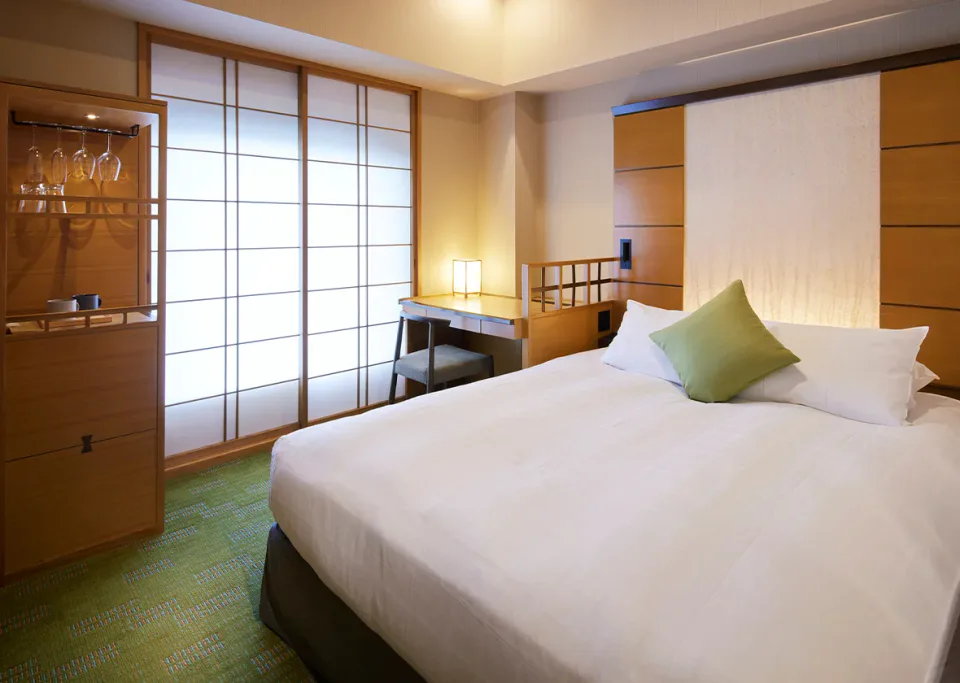
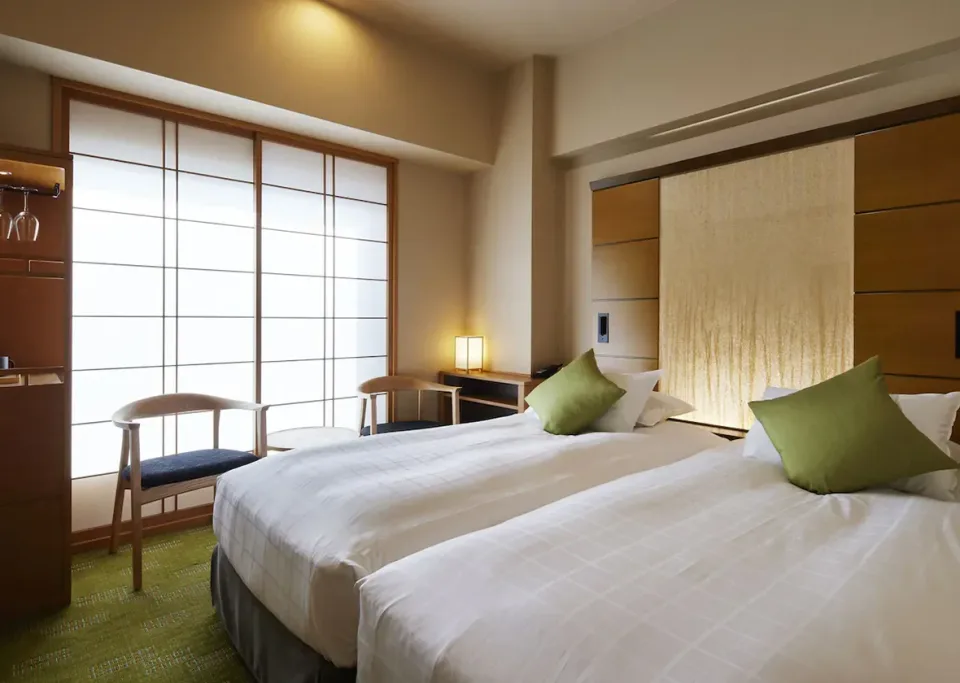
The one-bed room photograph shows a large bed, shoji-style screen and desk; the second depicts a twin setup. They show the hotel's design rather than a measured luggage test or a promise about the exact room assigned. For a family wanting an apartment layout, KOKO HOTEL Residence Tokyo Oshiage solves a different problem. For an in-room washer-dryer, Tokyu Stay Shinjuku Eastside is a more direct comparison than Niwa's shared laundry.
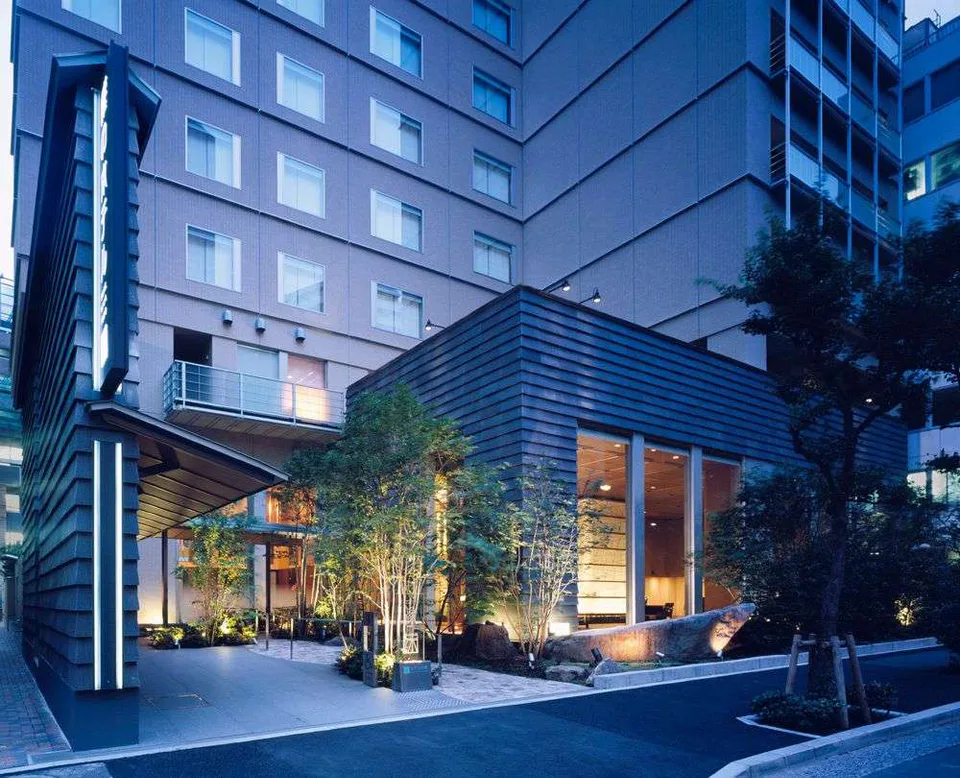
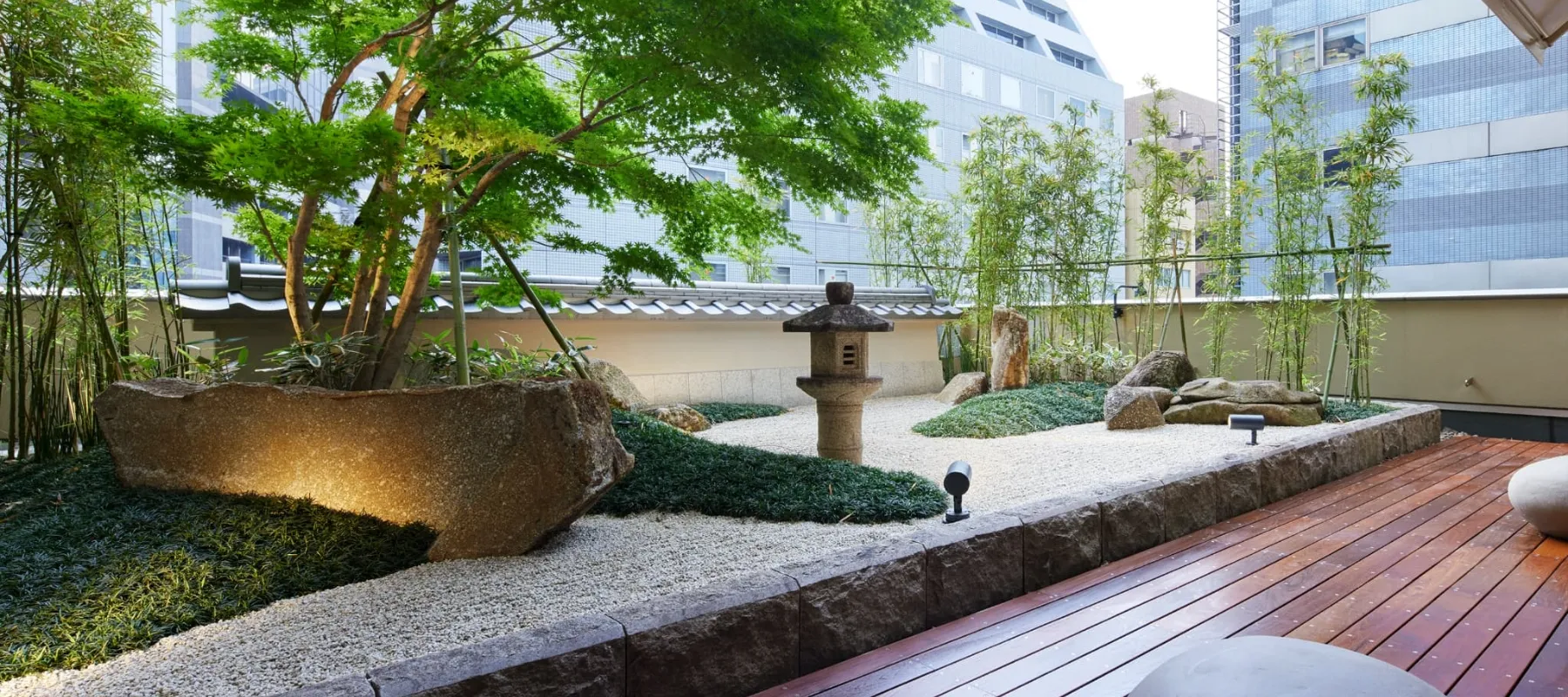
The existing photographs also show the entrance and a small landscaped terrace. They help explain the contrast between a compact room and the areas outside it; the terrace is not proof that every guest room has a garden view. The gallery collects the property images in one place.
Shared spaces ease waiting, while laundry changes what you pack
The third-floor Refresh Lounge is open around the clock for hotel guests and has a small tatami area and library. A separate Relaxation Room offers three massage chairs, also 24 hours. Those rooms can move reading, route planning or a short wait while a companion showers out of an 18 m² bedroom. They cannot hold two open cases for you, guarantee a particular seat or replace a private conversation at the end of the day. If you know you will never leave the room after returning, do not count the lounge as extra private floor area.
Niwa's laundry corner is likewise open 24 hours. The current cashless machines use alkaline ionised water without added detergent; the hotel lists ¥600 for a wash and ¥100 for ten minutes of drying. Those fees matter less than whether washing once lets you pack fewer outfits. One wash midway through a five-night stay can reduce what you carry and keep in the room. A traveller who brings full outfits for every day and never uses the machines gets no space benefit from their presence. Tokyo shopping hotel choices provide a contrasting case where daily purchases may outweigh the effect of one laundry load.
The shared garden terrace, shown below, contributes a place to pause away from the bed but is not the same as a balcony attached to your booking. For a couple who deliberately plans some reading or rest outside the room, these spaces can make a compact category more livable. For two people working privately, video-calling or unpacking together, the 24 m² room's private space remains the more relevant feature. A much larger Okinawa suite demonstrates how differently room area matters when the stay itself, rather than city sightseeing, is the main activity.
Suidobashi as a base, not just a pin in central Tokyo
From Niwa, the hotel gives a four-minute walk to JR Suidobashi's East Exit, about five minutes to the Toei Mita Line's Suidobashi A1 Exit and about eight minutes to Jimbocho A5. That provides useful options for a mixed Tokyo itinerary without putting your room inside a vast terminal. The walks still exist, particularly with luggage or in rain. A Tokyo Dome event also changes the late-night calculation: the Tokyo Dome area comparison weighs Niwa against hotels with different event-return walks.
If your arrival leaves only a few usable hours, choose the first activity around the route into Suidobashi rather than assuming a hotel in central Tokyo is near everything. Tokyo's first-and-last-day timing guide helps separate a short arrival evening from a full sightseeing day. The difference matters more than a six-square-metre room upgrade when you will barely reach the hotel before bed.
A balanced base can be less efficient than a specialised one if the trip repeatedly starts from the same hub. Shinjuku may save transfers for western Tokyo and some long-distance departures; Ueno may fit a Narita-oriented arrival or departure better. Tokyo Station versus Shinjuku and Ueno versus Shinjuku deal with those route patterns. If your final morning uses an early Shinkansen, a Tokyo Station hotel could be worth more than six extra square metres in Suidobashi.
For a single concert night, the optimal hotel can differ from the base for the rest of a Tokyo holiday. Dome, Ariake and Makuhari event bases compares the venue-return routes. Use that calculation before letting Niwa's lounge or garden settle a trip whose last train after the show is the real constraint.
Food nearby is not limited to emergency convenience-store meals. Dining LIEU on the ground floor serves French-influenced food from breakfast through dinner; YUKURI is the Japanese restaurant with kaiseki, seasonal dishes and handmade soba. They are useful when a traveller does not want another journey after returning to the hotel, though their restaurant pricing is not a budget-food default. The hotel also describes convenience shopping within a short walk. Buy what you need for the day instead of storing a multi-day food haul in an 18 m² room. A Tokyo Dome concert guest should compare the concert-night walk separately from this room-size decision.
Our seven Hotel Niwa Tokyo ratings
The assessment assumes a three-to-five-night Tokyo base. The room mark is for the 24 m² Superior King or a twin that actually fits two travellers with luggage.
| Dimension | Our rating | The booking consequence |
|---|---|---|
| Location | Suidobashi helps Dome and central rail days, but it is not a platform-side Tokyo Station hotel. | |
| Room | The 18 m² Queen works lightly packed; 24 m² buys six extra square metres every evening. | |
| Cleanliness | Current stay feedback consistently praises room and shared-space upkeep. | |
| Service | Staff assistance is a reliable strength in recent multi-market assessments. | |
| Facilities | Shared garden space, a small gym and laundry help a five-night stay beyond the bedroom. | |
| Food | The breakfast setting suits a slower morning; nearby alternatives matter on early departures. | |
| Value | The 24 m² upgrade has repeated use for two large cases; a carry-on pair can save in the Queen. |
Our overall five-night read is 8.5/10 when the reserved room matches the luggage. Do not treat every Niwa room as having the same floor-space advantage.
Seven booking checks after the hotel ratings
↔ Scroll table left or right
| Dimension | Useful evidence | What it means for a three-to-five-night stay |
|---|---|---|
| Room circulation | 18 versus 24 m²; actual furniture layout not measured. | Daily case opening and two simultaneous tasks favour Superior. |
| Bed choice | Queen, Twin, Superior King and Superior Twin have different widths. | Choose the required bed arrangement before sorting by rate. |
| Shared space | 24-hour Refresh and Relaxation rooms. | Useful for reading and breaks, not private storage. |
| Laundry | 24-hour cashless wash and dry at published per-use fees. | Can enable lighter packing if you will actually wash. |
| Rail access | Four minutes from JR Suidobashi East Exit; alternative Toei and Jimbocho walks. | Flexible for mixed routes, but not every journey starts here. |
| Food options | LIEU and YUKURI on site; local convenience shopping. | Helps when staying nearby for dinner, but compare meal cost. |
| Value of the upgrade | Six extra square metres reused each night; rates vary by date. | Compare exact room totals and cancellation conditions. |
The earlier article used numerical traveller-fit scores. There is no independently measured basis for claiming that an 18 m² room is “44 out of 50” for one couple and “30 out of 50” for another. The underlying distinctions remain: light packers who use the lounge can reasonably choose the smaller room, while large bags and a shopping-heavy five nights make the Superior more compelling. These seven dimensions make the choice auditable without presenting invented precision.
Price the six square metres across the entire stay
Subtract the Standard or Queen/Twin total from the comparable Superior total, then divide the difference by travellers and nights. Use the same dates, party size, breakfast inclusion, taxes and cancellation deadline. The resulting per-person-per-night premium is the cost of reducing a repeated room constraint, not simply a charge for a bigger number in the listing. No fixed yen threshold works across every date. An approximate foreign-currency conversion may help your budget, but make the booking decision from current yen totals rather than an old exchange-rate example.
↔ Scroll table left or right
| Before paying more | Question to answer |
|---|---|
| Same room label | Are both rates for the live Queen/Twin versus Superior King/Superior Twin categories? |
| Same flexibility | Is one refundable while the other is not? |
| Same meal conditions | Does either total include breakfast? |
| Repeated benefit | Will unpacking, desk use or private evening time improve on several nights? |
| Better district instead | Would a Shinjuku, Ueno or Tokyo Station hotel save more repeated travel? |
If the answer to the repeated-benefit question is no, the smaller room can be disciplined spending. If the room needs constant reshuffling or two people must work and pack at once, the 24 m² category addresses a real cost. A 30 or 36 m² category deserves attention when three-person capacity, a more substantial desk or the separate shower and jetted bath are explicit needs. Otherwise, compare the 24 m² breakpoint first. For a trip centred on Shinjuku evenings, HOTEL GROOVE SHINJUKU may settle the area issue; for large-family space, MIMARU's Tokyo family-base choice is more relevant than another Niwa upgrade.
Once your room and district are settled, compare Hotel Niwa Tokyo stays on identical dates and cancellation terms. For two light packers on three or four sightseeing nights, begin with Queen or Twin. For five shopping-heavy nights with two large cases, price Superior King or Superior Twin before making the reservation.
Related Tokyo stay decisions
Tokyu Stay Shinjuku Eastside · Hotel Niwa Tokyo — guest · Hotel Niwa Tokyo — access · Hotel Niwa Tokyo — shared · Tokyo Honeymoon Hotels: Don’t Pay · Sapporo vs Chitose for the · Tokyo Disney Split Stay: Move · Where to Stay in Hakone · Yokohama or Tokyo: Where to · Hakone Loop Before Check-In or · Kagoshima or Ibusuki: Where to · Sapporo Hotel Comparison: Tokyu Stay · Hakata or Tenjin for an · La Vista Furano Hills: Is · Hiroshima or Miyajima: Where to · Early Shinkansen from Osaka: Should