
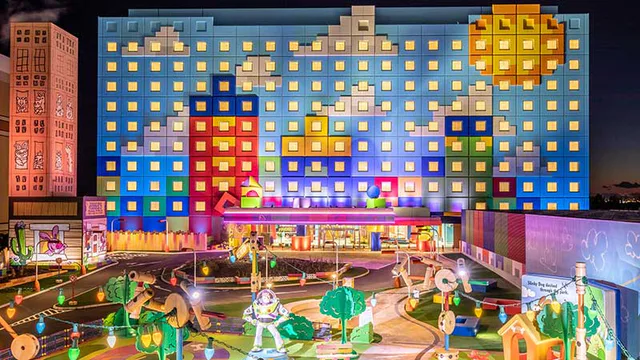
Four guests can fit into every room on a booking screen and still have a very different night's sleep. At Tokyo Disney Resort, the meaningful question is which four people are travelling. Four adults need a more equal set of beds than two parents with younger children; a family carrying large cases needs space that a light-packing group may never use. The park plan then changes the value of the address. A hotel by the monorail matters much more when a child will return for a midday rest than when everyone leaves at opening and comes back after dinner.
Grand Nikko Tokyo Bay Maihama's true Deluxe Family rooms are the strongest starting point for four adult-sized sleepers. Oriental Hotel Tokyo Bay's Marin Deluxe is a four-bed alternative across the resort boundary in Shin-Urayasu. Toy Story Hotel makes sense when children will enjoy the setting and the party accepts a smaller fourth bed. Tokyo Disneyland Hotel earns its high price only when a family will use its Disneyland-side location or its larger room repeatedly. Those are room-and-itinerary decisions; the hotel names alone cannot settle them. Before comparing resort rooms, decide whether a Disney-area stay is worth moving out of Tokyo at all.
↔ Scroll table left or right
| Four-person group | Room to examine first | Physical advantage | Cost in the itinerary |
|---|---|---|---|
| Four adults or older teens | Grand Nikko Nikko Deluxe Family or another true Deluxe Family | Four permanent beds, with 56–64 m² in the Nikko category | Exact Family inventory is scarce; it does not carry Disney Hotel Happy Entry. |
| Four adults watching the total bill | Oriental Marin Deluxe | Four 110 cm beds within a 42 m² room before its two smaller beds are used | The direct park shuttle runs on a schedule and uses public roads. |
| Parents with two younger Toy Story fans | Toy Story four-person Standard or 35 m² Superior | Disney setting, Bayside Station access and a room children may enjoy beyond sleep | The third and fourth positions are a trundle and pull-down, not equal permanent beds. |
| Family making several Disneyland room returns | Tokyo Disneyland Hotel Junior Family | 57 m², separate living area and a Disneyland-front address | Three regular beds plus a trundle; the location premium needs actual use. |
What the fourth bed means in each room
Occupancy is permission for four people to stay, not a promise of four matching mattresses. Disney's Toy Story Hotel lists four-person rooms with two regular beds, a trundle and a pull-down bed. Its published bed measurements make the difference visible: a regular bed is 110 by 203 cm, while the pull-down is 85 by 185 cm. A shorter child might be delighted by it; a tall teenager may feel very differently. Tokyo Disneyland Hotel's Junior Family Room supplies three regular beds and a trundle. The fourth sleeper's comfort is part of the price calculation, even though that room is much larger.
Write the sleeping assignment before opening a rate calendar. Does each adult need a full bed? Will two children share or does each need a distinct surface? Is anyone particularly tall? A four-person room with a trundle can be an excellent match for one family and a poor match for another. The Tokyo family-room guide applies the same test beyond the resort. For this comparison, distinguish four adults from two adults and two younger children instead of letting one generic “family of four” label hide the problem.
Floor area is the next filter. Toy Story's four-person Standard variants are about 29–30 m² depending on view, and its Superior is 35 m². Grand Nikko's Nikko Deluxe Family gives 56–64 m²; Tokyo Disneyland Hotel's Junior Family gives 57 m². A family with carry-ons and a single park day may spend little waking time in a 29 m² room. Four large suitcases, a stroller and several days of unpacking turn circulation into a real constraint. Compare the footprint you will actually occupy, not a photographed room that might be a different category.
Grand Nikko: a four-bed category inside a much wider room list
The Nikko Deluxe Family room is designed for four: Grand Nikko specifies four 140 cm Simmons beds and a 56 m² Type A or 64 m² Type B/C layout. Its listed inventory is nine Type A rooms and one each of Types B and C. That count explains why a search can show the hotel as available while the exact family layout has sold out. The earlier Regular Deluxe Family listing described a 56 m² room with four 120 cm Simmons beds and only two such rooms; the hotel's current room navigation uses floor-specific family categories, so check the exact live room name and four-bed floor plan before paying. Do not substitute an ordinary “sleeps four” Grand Nikko room silently.
Its other large-looking categories require care. The Nikko Deluxe is a 40 m² two-bed room that adds a bed for a third guest. The hotel's 32 m² Superior and 40 m² Deluxe types can also use extra beds at higher occupancy. Those may still suit parents and children, but they do not deliver the four permanent sleeping surfaces that made Deluxe Family attractive to four adults. The two Grand Nikko family categories comparison is useful after availability is known, and the Grand Nikko–Hilton family comparison broadens the Bayside alternatives.
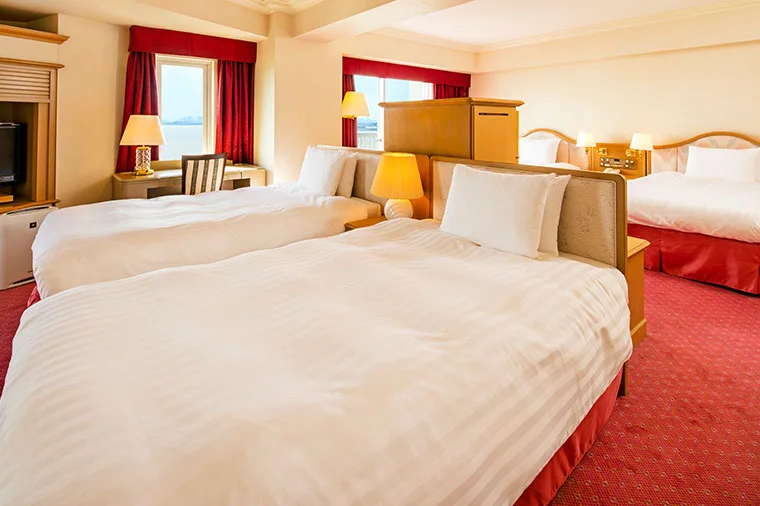
The photographed Grand Nikko room shows four made beds separated across a broad floor. It illustrates the four-surface proposition, but the photograph alone cannot identify which named Deluxe Family variant a live offer includes. Ask the reservation page for the bed count, widths and floor plan. A good headline price for a Superior room should be judged as a different product, not treated as a discount on this layout.
Grand Nikko is a Tokyo Disney Resort Official Hotel, a category distinct from a Disney-owned hotel. Its transport uses the Disney Resort Cruiser connection to a Resort Line station, so reaching a park is a sequence rather than a walk from the bedroom to the gate. That sequence may be perfectly easy for one outbound and one return journey. Repeated midday visits expose each transfer and wait. On arrival, the hotel's luggage service can help: its Maihama Welcome Center counter has described baggage storage and delivery to the hotel during an 08:00–15:00 window. Confirm the service for the booked day, especially if a late train makes the window irrelevant. The Disney, Official and Partner hotel comparison explains why those category labels produce different benefits.
Oriental: more equal beds, with a scheduled ride home
Oriental Hotel Tokyo Bay is connected to Shin-Urayasu Station and sits in the Partner Hotel group. The Marin Superior is 32 m² with two 120 cm beds, one 100 cm bed and one 90 cm bed. That distribution may be suitable for two adults and children but leaves unequal choices for four adults. Marin Deluxe, at 42 m², is the room to price for a four-adult party: its published layout has four 110 cm beds plus two 90 cm beds and a maximum occupancy of six. Four guests can use the four wider beds while leaving the two narrow ones unused. Its entrance permits shoes to be removed, and the room has a bathroom with a washing area; verify the precise room plan if those details matter to a child or older relative.
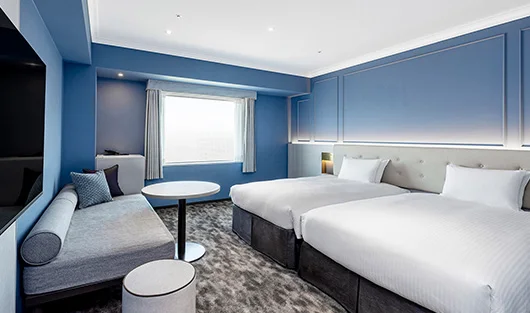
The image of an Oriental room shows blue walls, twin beds and a sofa area. It conveys the hotel's lighter Marin design, but it does not establish that the pictured room is Marin Deluxe or that four 110 cm beds are already set. Compare room names and diagrams on the booking page. If the Deluxe rate is high, examine whether the more compact Superior works for your actual bed allocation rather than assuming every four-person listing is equivalent.
Tokyo Disney Resort describes a complimentary direct Partner Hotel bus to both parks and gives about fifteen minutes for Oriental. The hotel also advises that the road trip and timetable vary; a family should allow for waiting, traffic and the walk from the bus terminal. This is sensible for a morning departure followed by a late return. A pre-planned toddler nap is less simple: the party has to leave the gate, locate the stop, meet a departure, ride to Shin-Urayasu, settle in the room, then reverse the process. The value of Oriental's four-bed room depends on whether that pattern matches the day. One versus two park days changes how often the transport is used.
There is also a city-stay possibility. Shin-Urayasu's rail connection may fit a longer Tokyo or Chiba itinerary better than a Bayside address, while resort transport remains available on park days. That is a route question, not a guarantee of a faster commute everywhere in Tokyo. Check the journey to your next accommodation or airport before deciding a lower room rate is a saving. A family moving hotels only for one park day should compare the entire move with the Tokyo split-stay trade-offs.
Toy Story: decide how much room the theme gets
Toy Story Hotel has rooms built around Andy's room, with toy imagery throughout the property. Its four-person Standard options are roughly 29 or 30 m² depending on the view category; the four-person Superior rooms are 35 m². The extra area in a Superior can matter when four people dress, open luggage or spend an arrival evening inside the hotel. Yet both follow the four-person sleeping pattern of two regular beds, a trundle and a pull-down. The larger category eases movement; it does not turn the fourth bed into a regular one.
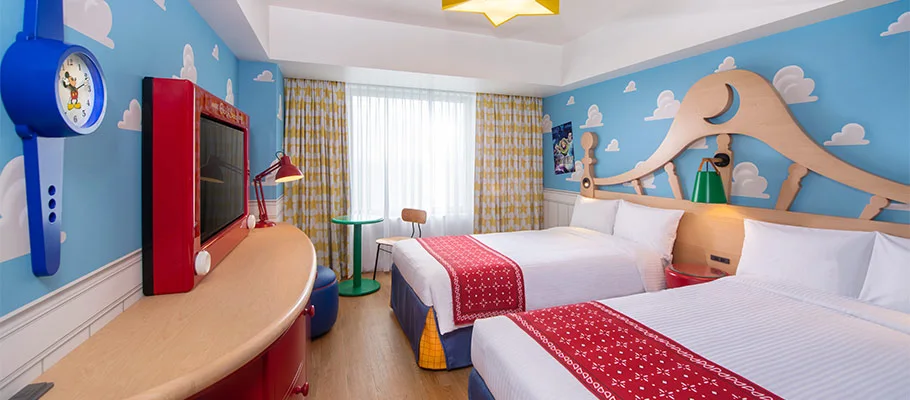
The picture shows two visible beds, blue cloud wallpaper and toy-themed fixtures. The full sleeping arrangement includes beds not established by this single angle, so use Disney's room diagram for the four-person layout. A family with young children may happily give the pull-down to a smaller guest and use the room as part of the Disney trip. Four adults paying extra for the theme need to answer a harder question: is the least comfortable sleeper satisfied for each night? Hilton versus Toy Story and Disneyland Hotel versus Toy Story are useful only after that answer is clear.
Toy Story sits beside Bayside Station on the Disney Resort Line. From JR Maihama, guests reach Resort Gateway Station and take the monorail to Bayside. This is still transport, and the room is not inside either park, but the final station-to-hotel leg is short. A parent repeatedly leaving a park with a tired child may value that simpler last stretch. If the plan never includes a return to the room, the same feature has less opportunity to earn its premium. A two-night stay can also give children more time to enjoy the hotel outside the park; a one-night arrival late and departure early may deliver little themed-hotel time. Disney has announced a hotel closure on 18 January 2027 for energy-supply work, with related changes on 18–19 January; those dates need a different hotel plan.
Disneyland Hotel: the room and address work on different problems
The Tokyo Disneyland Hotel Junior Family Room is 57 m² and has a bedroom plus separate living room. Disney lists three regular beds and a pull-out trundle for a fourth guest. It solves floor-space and zone-sharing problems better than Toy Story's Standard room, but does not solve four equal beds. Families interested in another Disneyland Hotel type should distinguish the Superior Alcove, Deluxe and Junior Family names: a room's four-person capacity cannot tell you which surface the fourth person receives. The direct hotel comparison gives those alternatives context.
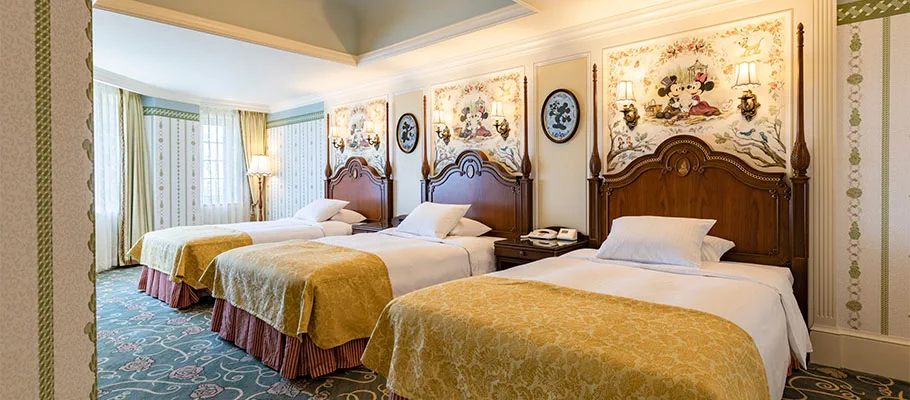
The photographed room has yellow-covered beds and ornate Disney-themed headboards. Its visible space is consistent with the Junior Family proposition, yet a photograph cannot replace a booking-specific diagram, especially when a trundle is tucked away. Assign its fourth sleeper before treating 57 m² as a complete answer to comfort.
Its distinctive advantage is the Disneyland-front position. For a child who will nap, a grandparent who expects to rest early, or a family returning for medication or a change of clothes, a closer room can be used multiple times. A party that leaves in the morning and returns only after its last attraction gets far less from that geography. The premium is not automatically justified by the word “Disneyland” on the facade. For a DisneySea-led stay, trace the actual monorail or other route to that park rather than assuming the Disneyland Hotel is equally placed for both. Compare the park split before buying the room.
Happy Entry is a morning benefit with conditions
Under the current published arrangement, Toy Story Hotel and Tokyo Disneyland Hotel guests can use Happy Entry at Tokyo Disneyland on eligible dates during a stay, including checkout day but not check-in day. Grand Nikko's Official Hotel status and Oriental's Partner Hotel status do not confer that Disney Hotel benefit. DisneySea has a different eligible-hotel list: do not buy Toy Story for DisneySea early entry or assume a Disneyland Hotel stay currently includes it outside a special period. Disney can announce unavailable dates and operational changes, so confirm the exact park and date during booking. The Happy Entry value guide is the next calculation after the room works for everyone.
Happy Entry begins admission earlier than for other guests, but attractions start operating after the general opening. Its usefulness comes from earlier positioning and access to eligible in-park transactions, not a promise of an extra quarter-hour on every ride. A person who cannot sleep well on the fourth bed feels that each night; the early-entry benefit may affect a single morning. A family with a specific Disneyland opening plan may still pay for it. Match that plan to a stay night: checking in after a full park day will not retroactively create morning eligibility. If a bundle is being considered, compare a Vacation Package with hotel only as a separate cost decision.
The park-day pattern determines the winning address
For one Disney day, the family uses its outbound journey and its journey home once. A spacious room farther from the gate can win because the trip does not repeat. With two consecutive full park days, a late first-night return and the next early start sit close together; the hotel location contributes twice. If the family also returns for a midday rest, the number of crossings rises again. Count the whole loop: park exit, stop, wait, ride, hotel walk, room time, then travel back and re-entry. A shuttle advertised as a fifteen-minute ride describes only one segment of that loop.
There is no need to buy a nap-friendly address for a group that will stay in the parks continuously. Conversely, a toddler's reliable sleep or an older companion's limited stamina can make an easy return more valuable than extra floor area. These are plans that should be discussed before rates, because the same hotel changes rank without any change in its room. Tokyo versus Disney-area lodging handles the larger location choice, while the three resort hotel groups sets the transport and benefit differences side by side.
A single park day inside a longer Tokyo holiday may not warrant a hotel move at all. Checking out, carrying four guests' cases, waiting to check in and repacking the following day consume time that a direct return trip to Maihama might not. Use a resort-area room when the family has consecutive park days, a repeatable rest plan or an arrival/departure pattern that gains from staying there. Otherwise, compare the split-stay cost with a Tokyo hotel that already fits four. This question comes before choosing between Toy Story and Grand Nikko.
How to compare rates without losing the room you chose
Enter all four guest ages and compare the exact named category on the same dates. Grand Nikko Superior with extra beds is not its Deluxe Family. Oriental Marin Superior does not offer the Marin Deluxe bed distribution. Toy Story Standard and Superior share a pull-down fourth position but differ in space. Disneyland Hotel Junior Family has a separate living area; a cheaper four-person room might use an alcove or another layout. Save a screenshot or booking confirmation that identifies the category and sleeping arrangement. If the four-bed Grand Nikko inventory is unavailable, move to the next suitable room rather than assuming the hotel's brand guarantees the beds.
Price the whole stay. A hotel rate may change with breakfast, cancellation terms, children sharing beds or a view; a package may include park-related elements a room-only quote lacks. Do not compare two room totals until the date, occupancy, inclusions and ability to cancel match. Add transport where relevant: an Oriental shuttle is complimentary, but its schedule may cost flexibility, while a Bayside room uses the Resort Line. A taxi taken because a plan repeatedly misses a shuttle can erase a headline discount. The comparison should be made with actual live yen quotes rather than a claimed universal price order.
For two nights, the practical effects repeat. A larger room can reduce congestion each morning and make evening repacking easier. Toy Story's setting gives children another chance to enjoy the property, and a second night can line Happy Entry up with a park morning. A one-night stay may favor the feature that works automatically—four decent beds, appropriate room size or the particular park location the next morning. Neither hotel “wins two nights” without the family schedule. Compare Grand Nikko's room premium only after its bed layout is confirmed, and compare the two Disney hotels if room returns and theming remain central.
Seven checks that produce a defensible shortlist
↔ Scroll table left or right
The scores below assume four guests in the exact named rooms from the first table. Bed equality, the trip back from a park, and a usable Disneyland Happy Entry date matter more than a small overall-score gap.
| Hotel dimension | Grand Nikko Tokyo Bay site score and basis | Oriental Hotel Tokyo Bay site score and basis | Toy Story Hotel site score and basis | Tokyo Disneyland Hotel site score and basis |
|---|---|---|---|---|
| Location | 9/10 — The Bayside shuttle feeds the Resort Line; several midday room returns still involve a station leg. | 7/10 — A scheduled road shuttle reaches the parks, with traffic and fixed departures shaping nap or return timing. | 8/10 — The hotel has a short Bayside Station walk, then a Resort Line ride; a child may enjoy the themed return. | 10/10 — The Disneyland-front address shortens repeated Land returns, while DisneySea still needs a resort journey. |
| Room | 9/10 — The named Nikko Deluxe Family offers four permanent 120/140 cm beds in 56–64 m²; confirm scarce inventory. | 9/10 — Marin Deluxe has four 110 cm fixed beds in 42 m² before its two smaller extra positions are used. | 7/10 — Standard and Superior four-person rooms are about 29 and 35 m²; the third/fourth beds are trundle and pull-down. | 9/10 — The 57 m² Junior Family separates living space but uses three regular beds plus a trundle rather than four equals. |
| Cleanliness | 9/10 — Current large-sample guest cleanliness feedback is strong; room subtype remains decisive. | 9/10 — Recent guest cleanliness feedback is strong; request the exact Marin Deluxe layout. | 8/10 — Recent guest accounts are positive, but the category sample is smaller than the large chain hotels. | 9/10 — Recent guest accounts support high presentation standards, with fewer publicly comparable category reviews. |
| Service | 9/10 — Recent staff feedback is strong and luggage handling helps around park hours. | 9/10 — Current service feedback is strong; the timed shuttle needs the family’s real return hour. | 9/10 — Guest service reports are positive; benefit eligibility must be checked on the actual Disney date. | 9/10 — Guest service feedback is strong; the front-of-Land advantage should be used rather than merely photographed. |
| Facilities | 8/10 — The lounge and seasonal pool need awake hotel time; this is not a Disney Hotel Happy Entry stay. | 8/10 — Family amenities support a lower-cost four-bed room, but a road shuttle remains the transport constraint. | 7/10 — The hotel grounds and theme reward younger children; facilities are narrower than a large resort hotel. | 8/10 — Disneyland Happy Entry can matter on an eligible non-check-in day; themed spaces add value when children have time to explore. |
| Food | 8/10 — On-site dining is convenient after parks, with meal-plan value reduced by early entry. | 8/10 — Breakfast and casual meals can fit a shuttle-based base; compare actual inclusion. | 7/10 — Lotso Garden Cafe adds a themed meal, but a sleep-only park day may not justify a dining package. | 8/10 — Hotel dining suits a room-return day, provided the family will be there for the paid meal. |
| Value | 7/10 — Four equal beds and broad floor area can beat a themed premium for older children or adults. | 8/10 — Four fixed beds make a cost-conscious adult group possible if the shuttle schedule fits. | 7/10 — Young Toy Story fans may enjoy the theme and eligible Land entry enough to offset smaller floor area. | 7/10 — The premium earns more with repeated Disneyland returns and usable Happy Entry; a one-ride park day may not repay it. |
| Overall | 8.4/10 — the clearest four-equal-bed resort choice when the named family room is available. | 8.3/10 — a four-fixed-bed alternative with a timetable-dependent park ride. | 7.6/10 — most persuasive to younger fans who will enjoy both the hotel and eligible Land benefit. | 8.6/10 — the strongest Disneyland address when room returns or eligible Happy Entry are used. |
There is no reliable universal numeric score for these seven dimensions. Four adults might rank beds above everything else; a younger child's reliable nap can push access to the top. Apply the checks to the real party, then discard any room that fails the sleep test before comparing extras. If Grand Nikko's family room or Oriental Marin Deluxe has a sensible rate for four adults, start there. For two adults with smaller children, Toy Story is attractive when the hotel itself is part of the holiday. For a Disneyland-centered family that will make several room trips, test Tokyo Disneyland Hotel's premium against the minutes and effort saved, while still assigning its trundle bed honestly.
After choosing the room type, compare Maihama-area stays for your dates or check Shin-Urayasu alternatives. Verify the named room and cancellation policy on the final booking screen. A map pin or a broad “family room” label cannot confirm a fourth bed.
Room and transport details
Toy Story Standard four-person layout · Toy Story Superior four-person layout · Happy Entry park and date conditions
Your next decision
Once the room has passed the bed-and-space test, decide whether the family should stay near Tokyo Disney or keep a Tokyo hotel, then use Disney Hotels vs Official and Partner Hotels to decide how much resort proximity and Disney-specific benefits are actually worth.
Related guides: Tokyo Split Stays: For 5–7 Nights, I’d Only Move Hotels in These Three Cases · Best Place for a First Japan Autumn Trip: Tokyo, Kyoto, Hokkaido or Tohoku? · Grand Nikko Tokyo Bay Maihama vs Hilton Tokyo Bay for Families · Best Dates for USJ Halloween 2026: Crowds, Prices and Hotels · Best Japan eSIM for Tokyo, Osaka and Kyoto: Data and Hotspots · Best Kawaguchiko Hotels for Mt Fuji Views and Private Baths · Tokyo Honeymoon Hotels: Don’t Pay for the View Until You Pick the Night You’ll Stay In · Best Niseko Apartments for Families and Groups: Kitchens, Laundry and 4–8 Guests · Hilton Tokyo Bay vs Toy Story Hotel for Families · Tokyo Family Hotels: “Sleeps Four” Is Not the Same as “Works for Four”