
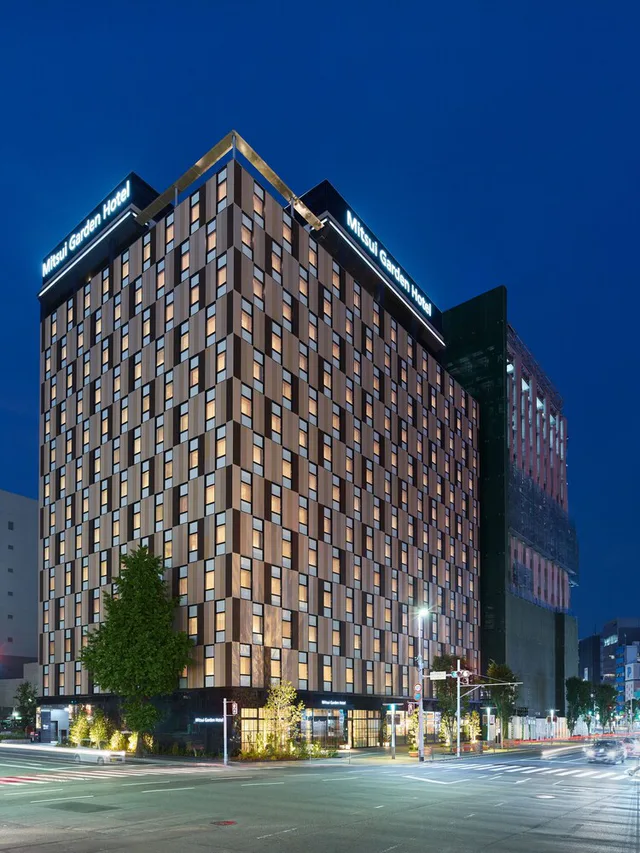
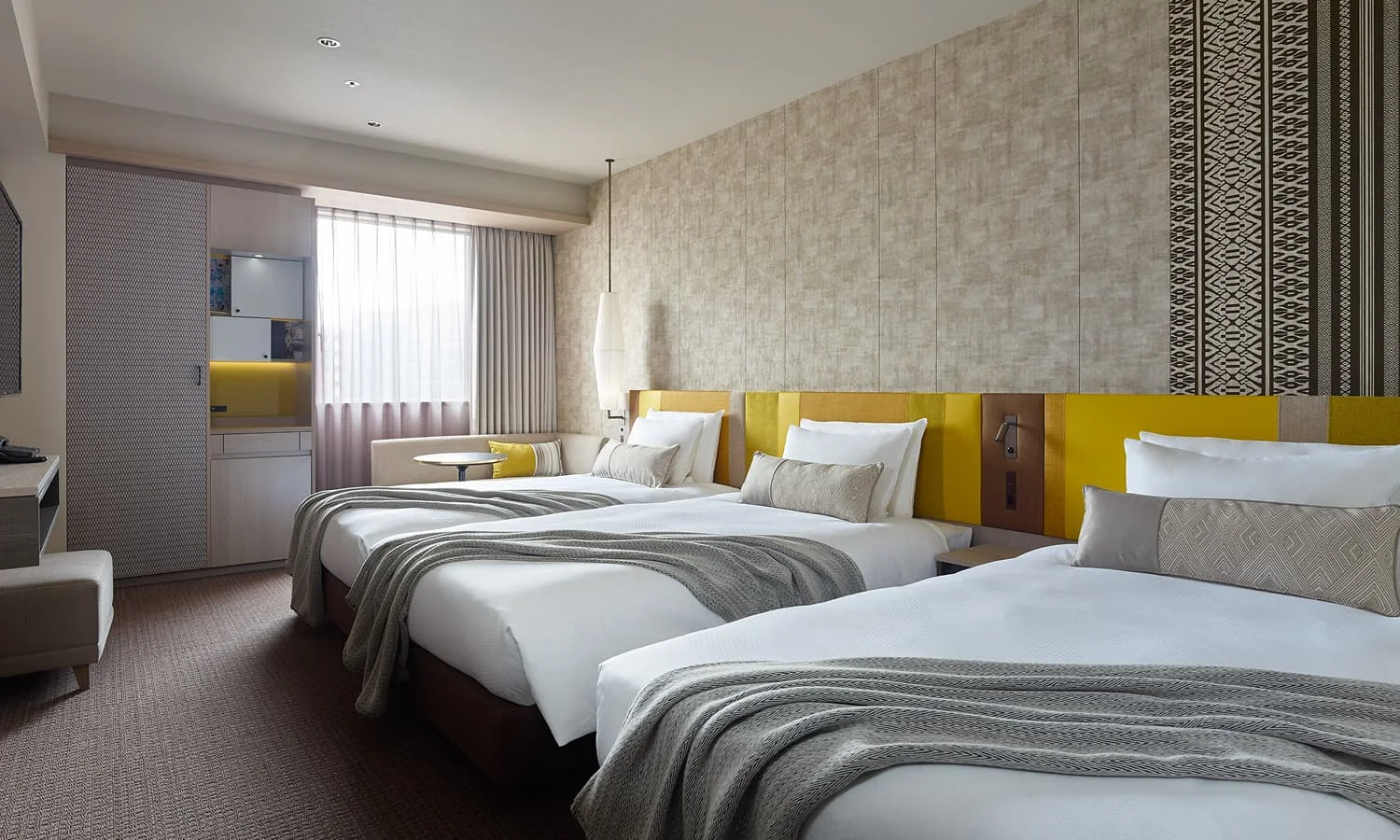
Three adults can sleep in separate beds at Mitsui Garden Hotel Fukuoka Gion without booking a second room. The Standard 3 Beds category is 26.6 m² and has three 1,110 mm beds. That makes the hotel a serious candidate for friends or grown family members who each need a proper mattress. Its limit is just as concrete: three large cases and three people dressing, packing or working inside 26.6 m² can press against the available floor. Decide whether the room will be a place to sleep between outings or somewhere the group expects to spend hours together.
The address also needs a closer look than the label “Hakata hotel.” The property lists an approximately seven-minute walk from the Hakata side of JR Hakata Station and five minutes from Gion Station Exit 5. An airport arrival with luggage may favour Gion; a week of regional rail departures may favour the Hakata walk. Where to stay in Fukuoka makes that wider base choice clearer, but this room decision begins with your three beds and the journeys you repeat.
The room earns its price when all three beds matter
Many rooms marketed for three guests combine two beds with a sofa bed or an extra bed brought in for the third person. The exact Mitsui Standard 3 Beds product has three individual beds of the same published width and a maximum occupancy of three. At reservation, check the room name and the three-adult occupancy together. A search result for the hotel alone could be showing a Double or Twin rate; its cheaper headline is irrelevant if the chosen room cannot hold the party in the agreed sleeping arrangement. Fukuoka rooms for three or four adults explains why room count and adult capacity need separate checks.
Three 1,110 mm mattresses occupy a substantial part of the 26.6 m² footprint. The published area includes the bathroom and the space under fixed furniture, so dividing it by three is a comparison device, not a promise of 8.9 m² of clear floor for every guest. Bed equality is the reason to buy this category. If the party brings three 28-inch hard-shell cases, do not assume they can all lie fully open with a free corridor. One person can unpack while the others leave cases closed, or the group can keep daily items outside the cases. Ask the hotel about storage if that rhythm will be troublesome over a long stay. Luggage forwarding in Japan may solve a multi-city part of the problem.
The Superior Double is a different purchase. Its listed 20.7 m², 1,510 mm bed and two-person maximum suit a solo traveller or a couple who wants one shared bed. The room information describes the category as having no view, so “Superior” should not be read as a view upgrade. It cannot replace the three-bed booking for three adults. A couple weighing this room should compare the total and window expectation with other Hakata or Gion doubles; the distinction is functional rather than a hotel-wide ranking.
↔ Scroll table left or right
Room you select | Beds and area | Capacity | Decision point |
Standard 3 Beds | Three 1,110 mm beds in 26.6 m² | Three guests | Everyone gets an individual bed; plan the luggage floor |
Superior Double | One 1,510 mm bed in 20.7 m² | Two guests | For one or two people; the category is listed without a view |
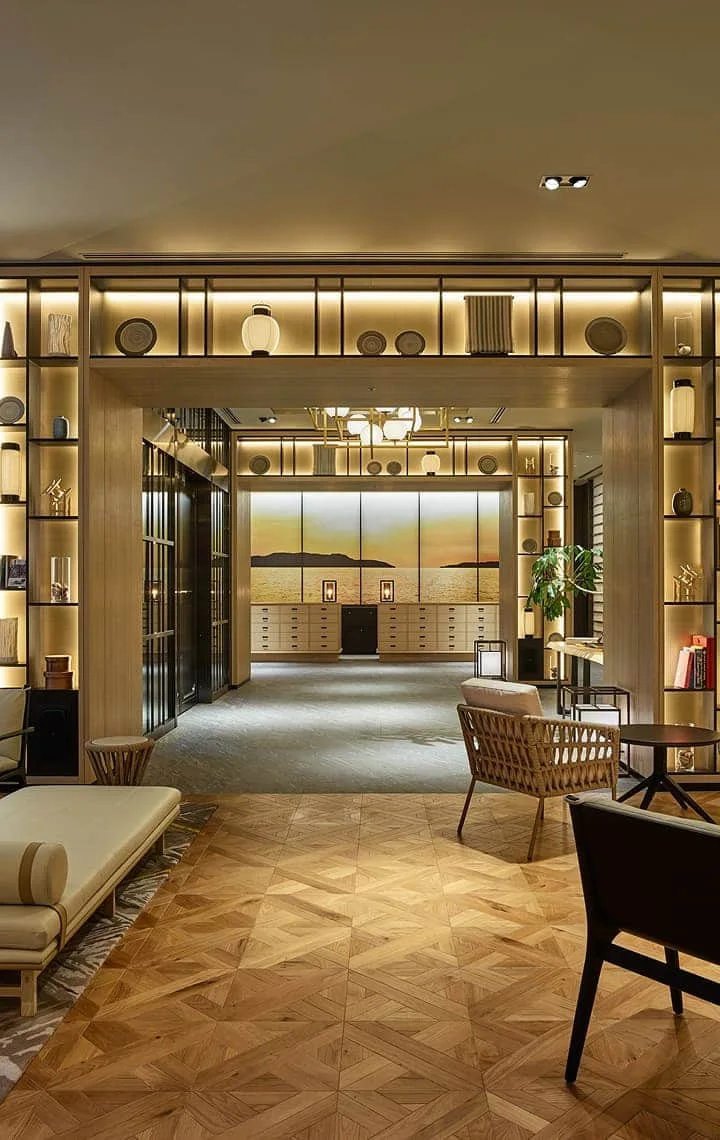
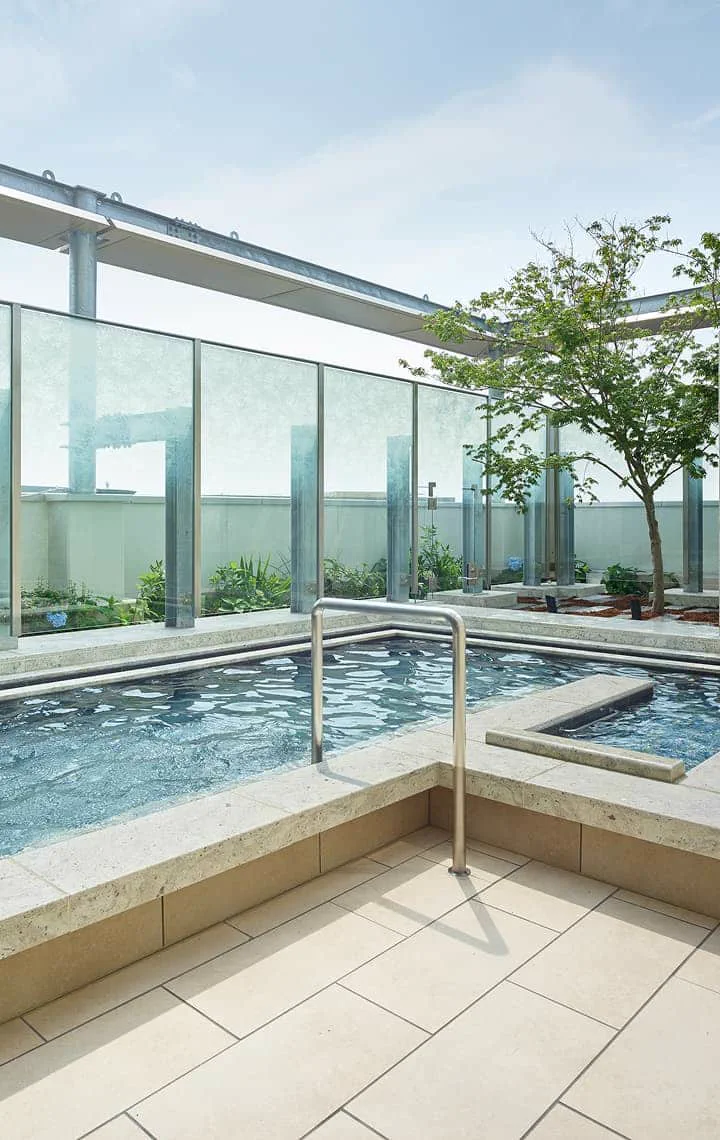
Photographs show the bed layout, lobby and bath, but cannot prove how your own bags will sit on the floor. Use them to judge fixed furniture and the path between beds, then compare your actual case sizes. The room picture below shows three beds; the other hotel photograph later in this guide is a separate Solaria room, included for a specific space comparison. Neither image should be taken as a guarantee that every case opens flat.
The final walk depends on the next train
Fukuoka Airport sits on the Airport Line corridor serving Hakata and Gion. If the first task is checking in, Gion Exit 5 leaves the shorter hotel walk by the property’s published figures. Exit placement, lifts and the group’s baggage can matter more than two nominal minutes, so inspect the station exit before travelling. If the first or next important movement is a Shinkansen or JR departure, walking to the Hakata-side station entrance may be simpler than a short subway hop and another transfer. Build the full airport journey before trying to save a couple of minutes on its final block.
Regional travel magnifies a small recurring difference. A group leaving Hakata on several mornings for Yufuin by train, bus or car, a Shinkansen trip, or another Kyushu city pays the walk repeatedly. Travellers who spend their days around Tenjin or use Nishitetsu towards Dazaifu might accept a different hotel geography even if this Mitsui room is attractive. Count departures and returns, including evenings with tired legs, rather than deciding from an airport transfer alone.
↔ Scroll table left or right
Your repeated movement | Hotel approach to consider | Practical reason |
Airport check-in with several cases | Gion Exit 5 | The hotel quotes the shorter final walk |
Early JR or Shinkansen departures | Hakata-side entrance | The walk ends at the rail hub you actually need |
Yufuin or other Kyushu travel | Map the Hakata departure point | Avoid a transfer before the significant journey |
Most days in Tenjin | Compare a Tenjin base too | A slightly longer transfer every day can outweigh a good first arrival |
For a single evening in central Fukuoka, the two approaches are both manageable. The decision becomes sharper over three to five nights when the same three people return with shopping or board early trains. Hakata or Tenjin for an early flight adds the departure-day angle, while Fukuoka transport passes separates the rail networks. A hotel near Hakata does not make every Nishitetsu movement start in Hakata.
Bath, laundry and breakfast change the daily routine
The guest public bath on the 13th floor has an indoor bath, an open-air bath, a reclining bath and a steam sauna. Hotel hours list 15:00–25:00 and 05:00–09:00, with no separate bath fee for staying guests. For three adults, the useful benefit is not simply “a bath on site.” A guest who is comfortable using it can wash while another person uses the in-room bathroom, reducing a single-bathroom queue after a long day. Someone who prefers private bathing gains no such benefit. A group returning after 01:00 would miss the late session and need to use the morning window or its room bath.
Coin laundry is also on the 13th floor. One wash partway through a four- or five-night trip can shrink the clothes everyone has to carry, particularly if Fukuoka is the first stop of a longer Kyushu route. Machine availability and waiting time are not guaranteed by a facilities listing. Consider who will run the load and whether the party’s evening timing makes that practical. Long-stay Fukuoka hotels compares this kind of repeated convenience with the daily pressure of room size.
The bath and laundry are more persuasive over several nights because their value repeats. On a one-night stay, a convenient train morning may be the only feature used. Over three nights, one guest can use the bath regularly and the group may do laundry once. But neither facility creates extra walking space in the bedroom. If all three travellers need to work at separate surfaces or spread luggage on the floor, buy the floor area rather than treating a bath as a substitute. Fukuoka hotels with parents puts bathroom queues into a different group context.
Breakfast is served at Noukabanzai Mantei, Hakata Gion from 07:00 to 10:30, with last entry at 10:00. The published guest buffet price is ¥2,860 including tax; the non-guest price is ¥3,300. If all three adults add guest breakfast each morning, that is ¥8,580 per day before comparing a room package, so the choice should be intentional. Check whether the selected rate already includes it. A JR departure near the start of service leaves little time for a relaxed meal; on that day a bakery or station option may fit better. Fukuoka breakfast choices gives alternatives beyond the hotel.
A Yufuin morning deserves particular care. The Yufuin no Mori reservation guide and Fukuoka–Hita–Yufuin–Beppu route help establish the first transport leg. Add the walk, boarding margin and packing time for three people before paying for three breakfasts that must be eaten in a rush. On a slower city day, a buffet can simplify the morning; it should be evaluated by day rather than assumed to have equal value on every night of a package.
Arrival and checkout are ordinary times, with one late-arrival trap
Check-in starts at 15:00 and checkout is 11:00. The reservation information warns that arriving more than two hours after the time supplied to the hotel without contacting it can put the booking at risk. If a flight is delayed or a Kyushu connection runs late, call or message the property with the revised arrival time. A room guarantee is too important to leave to an old ETA. Late-arrival Fukuoka hotel choices addresses the first-night route if the group is arriving well after dinner.
For an early arrival, ask about luggage storage and use the time before 15:00 elsewhere; do not plan to occupy the triple immediately. The 11:00 checkout gives a useful but finite window for three adults to pack and clear the room. If the next hotel is elsewhere in Kyushu, forwarding bags from Hakata may remove a case from a complicated day. Confirm delivery timing and hotel acceptance before sending it, especially when changing towns after one night.
A 41.8 m² Solaria triple shows what the space premium buys
Solaria Nishitetsu Hotel Fukuoka’s 41.8 m² Deluxe Triple has three fixed 120 × 205 cm beds. Compare that specific room with Mitsui’s Standard 3 Beds, rather than comparing hotel names or assuming every Solaria triple is configured identically. The difference is 15.2 m² in published gross room area, about 5.1 m² per guest when simply divided by three. These figures include bathrooms and fixed furniture; they are not measured clear floor. They do signal that the Tenjin room has substantially more tolerance for cases, shopping bags and different dressing schedules.
↔ Scroll table left or right
Exact three-bed product | Published area | Gross area divided by three | What the group buys |
Mitsui Standard 3 Beds | 26.6 m² | About 8.9 m² each | Three equal beds close to the Hakata/Gion corridor |
Solaria Deluxe Triple | 41.8 m² | About 13.9 m² each | Extra space in a Tenjin-based room |
Difference | 15.2 m² | About 5.1 m² each | More room for baggage and time spent indoors |
↔ Scroll table left or right
Check before choosing | Mitsui Garden Fukuoka Gion | Solaria Deluxe Triple |
Bed arrangement | Three equal 1,110 mm beds | Three 120 × 205 cm beds |
Luggage and circulation | Compact 26.6 m²; test large-case routine | 41.8 m² gives more room to spread |
Transport geography | Hakata and Gion for JR and Airport Line | Tenjin for Nishitetsu and city evenings |
Bathroom routine | 13F guest bath may relieve room-bath queue | Compare the selected room and group preferences |
Laundry | 13F coin laundry listed | Check current facilities for the chosen stay |
Breakfast | 07:00 start; price separately or in package | Compare the matching package and departure time |
Final cost | Quote the exact three-adult room in yen | Divide the total premium by people and nights |
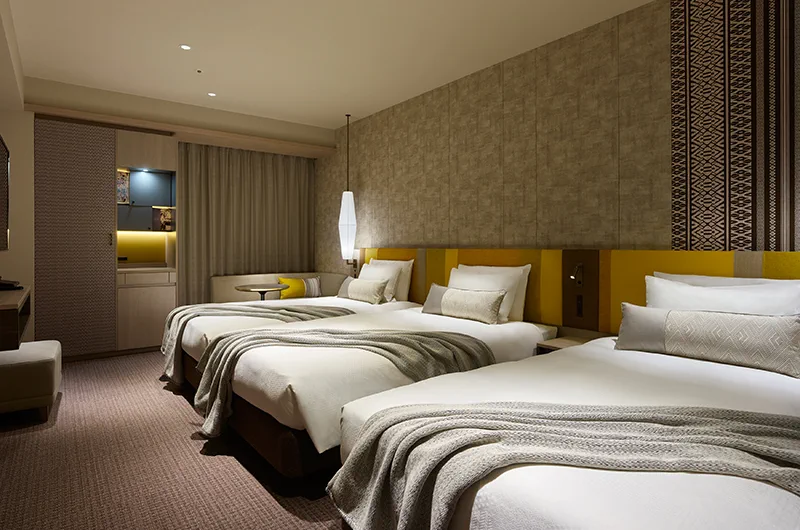
The Mitsui room photograph makes the bed arrangement easy to understand: all three sleepers have an individual bed. The photograph cannot settle the luggage question for a party with three different cases. If everyone travels with cabin bags and spends days outside, the compact layout may be an efficient use of the budget. For heavy shoppers or a group spending afternoons back in the room, the alternative below gives the excess floor a practical role.
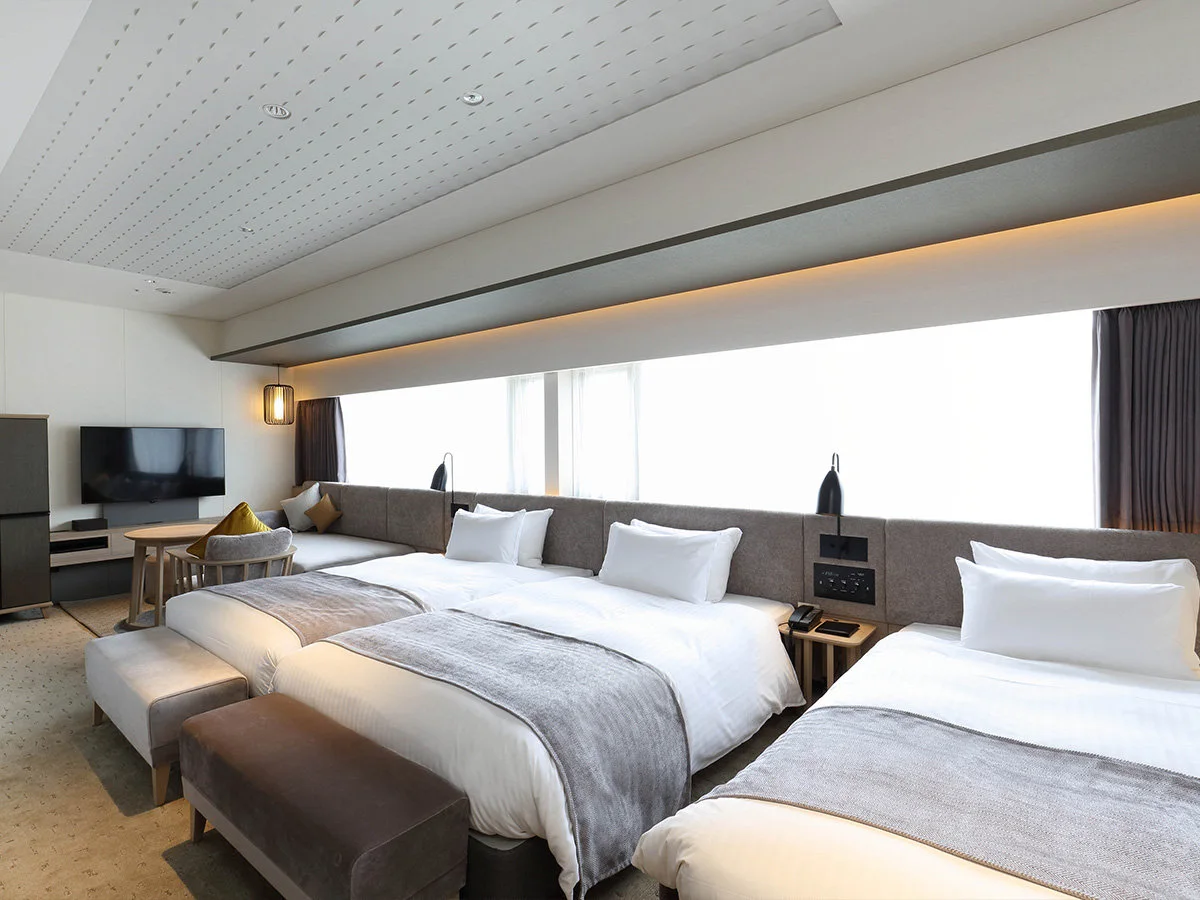
The Solaria image shows a different hotel’s three-bed room. Its location changes the route as well as the room: it is in Tenjin by the Nishitetsu Fukuoka station and Tenjin bus-centre area. For repeated Nishitetsu journeys, particularly Dazaifu, that geography can matter as much as the extra 15.2 m². For repeated Shinkansen or JR starts at Hakata, the Mitsui address may save daily backtracking. Fukuoka hotel bases for groups has a wider group-room discussion.
Suitcase capacity remains an inference rather than a published guarantee at both properties. Three 28-inch cases can be awkward in the smaller room, but no square-metre figure proves that any exact case opens at a specific position. Think about the actual trip: how many nights, how much shopping, and whether people will return to the hotel between outings. A party with different sleep times may value two rooms more than either large triple. The Hakata station hotel comparison is useful if the group decides to look for more privacy near rail departures.
Compare the complete three-adult price in yen
Set the search to three adults and the same dates at both hotels. Select Mitsui Standard 3 Beds and Solaria Deluxe Triple, then align breakfast, taxes, payment timing and cancellation deadline. A Double card at Mitsui and a triple card at Solaria are not comparable products. The useful premium is the difference between final totals, divided by three guests and the number of nights. A current exchange rate may help your own budgeting, but a conversion from August 2026 cannot be a permanent benchmark for future bookings.
For example, if the Solaria total exceeds the Mitsui total, ask what that difference purchases each day: a larger room, less luggage choreography, Tenjin evenings and Nishitetsu access. If the trip includes three early Hakata departures, those benefits may not offset the new travel pattern. If three people spend five nights with large cases and frequent shopping, the spatial premium may be easier to justify. Avoid declaring one property cheaper in general; rates change by date, inventory and cancellation conditions.
The Mitsui bath can be a genuine tie-breaker if the party will use it to relieve bathroom traffic; it is not a cash-equivalent perk for guests who avoid shared bathing. Laundry similarly matters most when it removes packing or an outside wash trip. Count only benefits your group will actually use. Fukuoka budget hotels explains why the lowest visible room rate can hide a poor fit, while hotel breakfasts around Fukuoka helps frame meal-led location choices.
Neither triple is ideal for every group. If travellers keep different bedtime hours or need private calls, two rooms can be more comfortable than a single 41.8 m² room. If the trip requires both a large shared room and several early Hakata departures, inspect larger Hakata categories rather than accepting either compromise. THE BLOSSOM HAKATA Premier for three adults is a relevant comparison, and Fukuoka family hotels covers groups with children whose sleeping rules differ.
Seven site scores for three adults sharing one room
Dimension | Site score | Mitsui Gion in a three-adult booking |
|---|---|---|
Location | The hotel quotes about seven minutes from JR Hakata and five from Gion Exit 5; repeated Tenjin days weaken the base. | |
Room | Three equal 1,110 mm beds fit the 26.6 m² category, but three large cases consume the remaining floor. | |
Cleanliness | Current aggregated guest cleanliness categories sit around 8.6–9.2/10. | |
Service | The aggregated staff category is around 9.0/10. | |
Facilities | A thirteenth-floor guest bath and coin laundry help three travellers share one bedroom. | |
Food | The hotel breakfast starts at 07:00; price its package only for mornings the group will use. | |
Value | Three individual beds near the Hakata/Gion corridor can beat paying for a larger Tenjin triple when rail days dominate. | |
Overall | Best for a rail-led group that values equal beds and can keep luggage compact. |
These site scores are out of ten for the Standard 3 Beds category used by three adults. Room and value would change with a different party or rate; cleanliness and service draw on anonymous guest category aggregates.
The booking decision
Book the Mitsui three-bed category when all three adults want individual beds, the trip repeatedly uses Hakata or Gion, and the group can keep large cases mostly closed. A three-night rail-led stay with an evening bath or a wash load makes several of its facilities useful. Reconsider it for four or five nights if everyone brings a large case and expects to spend time in the room; price the 41.8 m² Solaria product and two-room alternatives. If the itinerary is mostly Tenjin and Dazaifu, the location premium of a Hakata/Gion base weakens even before room area enters the calculation.
Before paying, confirm the exact room label, three-adult occupancy, final tax-inclusive total, breakfast treatment and cancellation deadline. Check the arrival time you report to the property, particularly after a flight or regional connection. Compare three-adult stays around Hakata and Gion with those conditions aligned. When comparing another rate for the same hotel, inspect the room category rather than assuming the first displayed card is the Standard 3 Beds.