
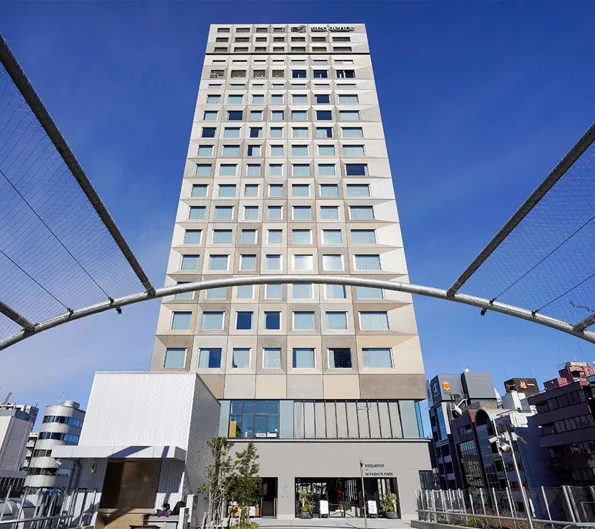
The hotel rises above MIYASHITA PARK North at the edge of Shibuya.
A 17:00 check-in changes the value of sequence MIYASHITA PARK more than its Shibuya address suggests. Arrive after a long flight at lunchtime and need to lie down: the room is unavailable for hours. Arrive from Kyoto in mid-afternoon, happily spend the time in Shibuya, then leave Tokyo after lunch two days later: the 14:00 checkout can be useful. The hotel’s location, rooms and late breakfast matter, but the first booking question is whether your real arrival and departure clocks fit this unusual exchange.
For an international trip, count usable private-room hours rather than praising “late checkout” in the abstract. The desk can hold bags before check-in, yet storage does not provide a shower, nap or quiet work space. Equally, a departure for a 09:00 train leaves most of the 14:00 checkout unused. Work out where you will be on both days, then compare the same room and price with other Shibuya versus Shinjuku bases. Sequence can be a sensible evening-focused Shibuya hotel without being the best first night after a red-eye.
The value of the shifted hotel day
↔ Scroll table left or right
Arrival and departure pattern | Fit | Reason |
Midday arrival after overnight flying, need private rest | Poor | Bags can be held but the bedroom opens at 17:00 |
Mid-afternoon arrival with outdoor Shibuya plans | Good | The waiting hours were already city time |
Several Shibuya evenings and a late final departure | Strong | Frequent short returns and a usable 14:00 checkout |
Morning airport or rail departure | Weak for the clock feature | The later checkout cannot be used |
Four to six friends who want one shared base | Conditional | Bunk capacity must be tested against cases and privacy |
Late flight after a flexible final morning | Good | Breakfast and room use can continue into early afternoon |
The clock cannot be judged on the departure side alone. A guest who reaches Shibuya at 14:00 but cannot settle into a room until 17:00 gives up three hours that may be valuable after a flight. A guest who leaves at 08:00 receives none of the later checkout. The best fit is an afternoon spent comfortably outside the room followed by a final morning with no early transport commitment. A Tokyo first-visit length comparison helps when a short trip makes every hour count.
A morning arrival exposes the cost of 17:00 check-in
The hotel confirms that check-in begins at 17:00. Reception will keep luggage before then and after checkout on the day of use, excluding certain items, but this only removes the need to drag bags around Shibuya. It does not grant early access to the bedroom. If a shower or sleep is central to an arrival plan, compare properties with an earlier confirmed check-in, a paid early-access option actually available for your date, or a previous-night booking. Do not infer early room access from luggage acceptance.
A flight landing at Haneda or Narita in the morning can put travellers in Shibuya around midday, with the most tiring part of the journey still ahead if the group has not slept. In that case, the wait until 17:00 may outweigh the convenience of the address. Plan the airport transfer and immigration margin honestly; the Haneda arrival transport guide can help compare the first leg. If anyone needs a private recovery window, make that need decisive before looking at rooftop views or a later checkout.
The same rule produces a different result after an afternoon train from Kyoto or Osaka. If you expect to reach the property around 15:00 and already want to shop, walk through Harajuku or eat near Shibuya, leaving luggage at reception may be sufficient. Check in after 17:00 when the outdoor part of the afternoon is naturally finished. The shifted clock costs little in that itinerary. A Tokyo base guide for first-time visitors is useful if the trip does not specifically require Shibuya.
Recovery requirements should decide the first-night hotel before neighbourhood preference. Sequence is coherent for someone comfortable being outside until late afternoon; it is harder to recommend to a family with a tired child, a traveller recovering from overnight travel, or anyone needing a private work call shortly after arrival. Store the cases if you choose the hotel, but make a real plan for those hours rather than treating the bag service as an early check-in substitute.
A 14:00 checkout needs a late onward departure
The hotel’s standard checkout is 14:00. That can keep the room available through a slow breakfast, packing and a midday rest. It also avoids the common sequence of leaving at 11:00, handing over cases and coming back for them. The value disappears if the party leaves early for an airport or train. For a late flight, calculate the actual time you need to reach the terminal; the Tokyo luggage-storage choice may still be relevant if you want to continue sightseeing after 14:00.
The late checkout can fit the final Tokyo night of a multi-city or open-jaw trip. A traveller returning from Osaka, using Shibuya in the evening and flying home late the next day can keep the room until after lunch. By contrast, an early Shinkansen or a morning departure from Haneda leaves that feature largely unused. A Tokyo to Osaka travel comparison can clarify the onward clock; the hotel cannot alter a booked departure.
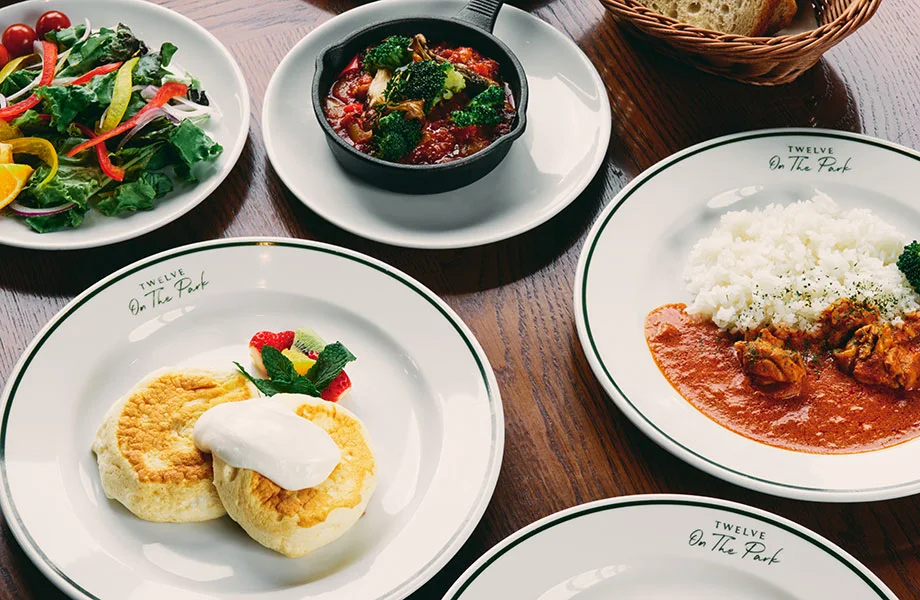
TWELVE ON THE PARK BAR & GRILL serves breakfast from 07:00 to 12:00, with last order at 11:00. That unusually long window supports the same late rhythm. You could eat closer to mid-morning, pack and still check out by 14:00. A guest leaving at 07:30 gains little from it. Breakfast inclusion and pricing differ by rate, so compare the package actually offered. The menu and service hours can change; decide on a room using the relevant booked rate rather than a generic “breakfast included” filter.
Breakfast plates at TWELVE ON THE PARK BAR & GRILL.
The Shibuya address pays off through repeat use
The hotel lists about a three-minute walk from Tokyo Metro Shibuya Station Exit B1, seven minutes from the Hachiko exit and eight minutes from Meiji-jingumae Exit 7. The distinction between exits matters with luggage or rain; “next to Shibuya Station” hides how large the interchange is. The address is MIYASHITA PARK North, 6-20-10 Jingumae. Save the precise entrance rather than searching for the broader park after dark. The Shinjuku versus Shibuya comparison can clarify whether this side of Tokyo matches your evenings.
A group that finishes several evenings in Shibuya, Harajuku or Omotesando can return to the room, leave purchases and go back out without crossing Tokyo. That repeated short walk is the real location benefit. Someone who leaves each morning for Disney, Nikko or Kyoto and returns only to sleep may get less value from the premium address. The Tokyo Disney stay-location decision is particularly relevant if park days dominate the itinerary.
lyf Shibuya Tokyo addresses a similar area with a different space trade: it can suit travellers comfortable with a smaller private room and social common areas. Sequence offers larger Twin or Bunk categories, the late hotel day and a direct connection to the park complex. Compare how the room will be used, not only two walking times on a map. For a trip built around late Shibuya nights, the ability to return repeatedly may justify both options more than it would on an early-start sightseeing route.
The park-side entrance closes at 23:00
One access instruction deserves attention before the first night out: the MIYASHITA PARK-side entrance closes from 23:00 to 08:00. The hotel directs guests to elevators at the Jingumae 6 intersection on the northern edge of RAYARD MIYASHITA PARK during those hours. Save that point in your map, especially if you expect to return after dinner or drinks. The building remains accessible by the stated route; a closed mall-side door should not be mistaken for a closed hotel.
A traveller who checks in during daylight may remember only the convenient route through the park. After 23:00 that mental map fails. Walk the alternate way once or save the hotel’s access diagram before going out. This is a small operational detail, but it matters more to an evening-focused guest than another minute of estimated station walking time. For a Shibuya night itinerary, include the final hotel approach, not just the last train.
Twin and Large Twin solve different space problems
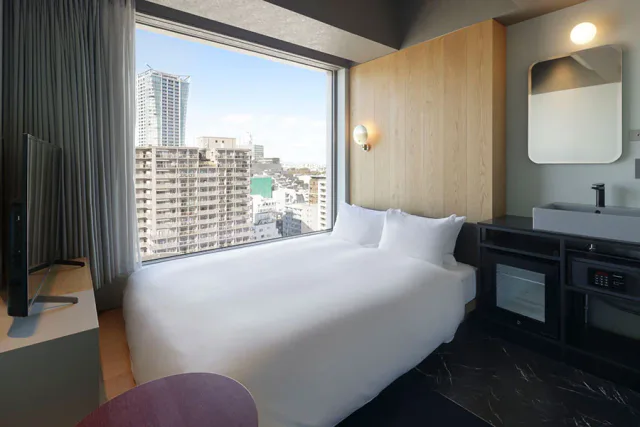
The Twin is listed at 23.7m² for two guests, with two 1,220mm beds. The Large Twin has 30.2m², the same two bed widths and a capacity of three; a third person uses a studio couch. The upgrade therefore buys floor area and a possible third sleeping place rather than wider primary beds. Two travellers carrying modest luggage for a short stay may have little reason to pay a high premium. A longer stay with full-size cases and shopping is a more credible use of the extra 6.5m².
↔ Scroll table left or right
Room type | Area and capacity | When its space helps |
Twin | 23.7m²; two guests | Shorter stay for two with moderate luggage |
Large Twin | 30.2m²; up to three guests | Longer stays, large cases or a third guest on a studio couch |
Compare both categories for the same dates and cancellation conditions. A two-night stay with day bags may be well served by the standard Twin; a four- or five-night stay with large cases can feel different when both travellers need floor space daily. Three guests should check the couch configuration and total rate, then compare a second room if privacy matters. The Tokyo hotel space guide may help establish how much area your party actually needs rather than paying for the word “Large.”
Bunk capacity is a group decision, not a comfort guarantee
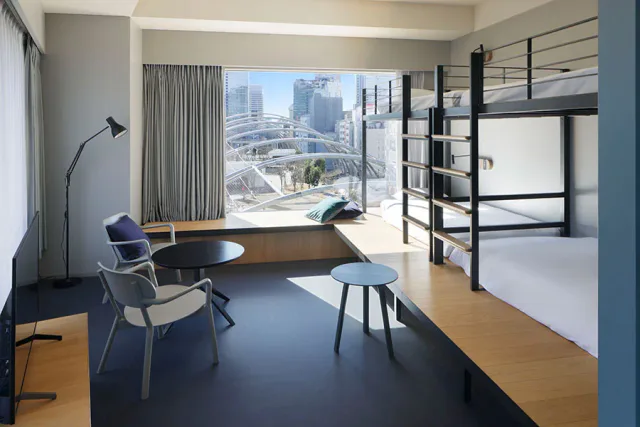
The hotel lists Bunk Bed 2 at 16.9m², Bunk Bed 3 at 18.3m², Bunk Bed 4 at 30.5m² and Bunk Bed 6 at 40.6m². Their capacities match their bed counts, with 970mm beds. A six-person room is therefore a real option, but occupancy does not reveal how six suitcases, shower turns and sleep schedules will work. Check the room diagram and bathroom arrangement as carefully as the headline capacity. The Osaka hotel choice for four to six friends explores the same group trade in another city.
Friends who actively enjoy a shared room can make the Bunk format work, especially for a short Shibuya-centred visit. If half the group wants early sleep and the rest returns after midnight, privacy may be worth two or three rooms. Large luggage can also absorb the floor area that looked generous in a room photograph. Compare the total group price of the exact Bunk with separate rooms, then ask which arrangement gives the group a tolerable morning routine. The friends’ Osaka itinerary has a broader approach to splitting group days.
Do not choose Bunk Bed 6 solely because a six-person capacity makes the per-person rate look attractive. If everyone needs desk time, has full-size cases or expects privacy, a single shared room may be a false economy. If the group treats the room mainly as a place to sleep after shared Shibuya evenings, it can be an efficient option. Compare the same breakfast, taxes and cancellation rules across alternatives; a cheap headline room can lose the advantage once all six travellers’ practical needs are counted.
The hotel says rooms are cleaned every two days from the date of check-in. A one-night stay will hardly notice, but a longer group stay should plan for how towels, bins and personal belongings are handled between cleans. Do not assume a conventional full daily service from a general hotel search result. The paid self-service laundry in the building can help on a long trip, though it is not a substitute for extra room space or privacy.
Amenities that matter only to the right traveller
The property has no large public bath, gym or pool; its FAQ does confirm a paid self-service laundromat. Guests can store baggage at reception within the stated limits, and the property is cashless for hotel payments. These facts make the comparison clearer. A traveller planning an evening soak should choose a hotel designed around that routine, such as ONSEN RYOKAN YUEN SHINJUKU; a traveller washing clothes mid-trip gains a real convenience here.
Likewise, a morning train or airport departure can favour a base chosen for that route. Hotel Century Southern Tower centres a different station routine; the Haneda-area last-night decision asks whether moving closer to the airport actually saves stress. Sequence is strongest where its late hours and Shibuya return trips are used. It need not win every Tokyo hotel comparison.
Three mistakes created by reading the headline too quickly
First: early bag storage is treated as room access. Reception can accept a case, but a traveller needing privacy at 15:00 still has a two-hour gap until standard check-in. Plan an actual place and activity for that wait, or choose a different first-night booking.
Second: 14:00 checkout is counted as value even when the booked train or flight forces departure early. Put the actual leave-the-hotel time beside the hotel policy. An 08:00 exit makes the late checkout irrelevant, regardless of how generous it sounds.
Third: the Bunk room is selected by bed count without a group discussion about luggage, bathroom turns or bedtime. Six legal occupants do not automatically make one comfortable room. Compare a Bunk price with two or three private rooms for the identical dates.
Five practical checks before selecting a rate
Write the expected arrival time in Shibuya and whether anyone needs a room before 17:00. Note the actual departure time on checkout day, including travel to the airport or train. Count how many evenings will end near the park, and choose the room category using luggage and privacy needs. Finally, trace the after-23:00 elevator approach once. That short exercise will reveal whether the hotel’s distinctive schedule and address work for this specific trip.
Only then compare exact room type, guest count, breakfast, taxes and cancellation terms on the dates you will travel. An extra-large room and a standard Twin are not equivalent quotes. A non-refundable rate should not be compared casually with a flexible booking. If the group is still choosing its neighbourhood, the Tokyo first-time hotel areas guide is the prior decision.
Compare the room that fits your actual schedule
See sequence MIYASHITA PARK rooms for your dates. Check the exact category and booking terms before choosing.
A standard Twin may be sufficient for a short two-person stay. Compare its whole-stay price with the Large Twin only after deciding whether 6.5m² changes daily use. For a third traveller, confirm the studio-couch setup in the quoted Large Twin rather than assuming a third full bed.
For four to six friends, price the matching Bunk room against multiple rooms in the same property or nearby. The correct answer depends on luggage, sleep routines and privacy, not simply the lowest per-person headline. A group that splits its days may prefer separate keys and independent returns.
Who should shortlist sequence MIYASHITA PARK?
Shortlist it when Shibuya is a repeated evening destination, the first afternoon is already planned outside the bedroom, and the last morning has room for breakfast and a slower checkout. Under those conditions the address and clock reinforce each other. A couple in a Twin, a group deliberately sharing a Bunk room or a traveller taking a late onward service can all use it well, for different reasons. The hotel’s photos are attractive, but the booking case comes from the actual schedule.
Compare other properties after a red-eye or long-haul arrival if a room is needed before 17:00. Also look elsewhere when the visit revolves around early departures to western Tokyo, an airport or a Shinkansen. Sequence’s Shibuya location may still be pleasant, but a feature you cannot use should not be part of the value calculation. For an early flight, compare the KIX last-night move decision only if your itinerary also includes Osaka; in Tokyo use the actual airport route.
The most reliable test takes two lines in your itinerary: the time you need privacy on arrival and the time you must physically leave on departure. If 17:00 and 14:00 fit those answers, compare the room size and total price. If either time conflicts with a real need, location alone should not rescue the booking. A Shibuya Sky evening plan can help fill the first afternoon, but it cannot replace a rest that a tired traveller requires.
Seven scores for sequence's shifted Shibuya day
| Dimension | JapanLayer score | What matters for this booking |
|---|---|---|
| Location | MIYASHITA PARK puts Shibuya Station, shops and evening streets within a short walk. | |
| Room | The 23.7 m² Twin is compact; the 30.2 m² Large Twin works better for cases or a third guest. | |
| Cleanliness | Room upkeep is generally strong, with scheduled cleaning every two days. | |
| Service | Guest assistance is steady, though the fixed late check-in shapes what staff can offer. | |
| Facilities | Paid laundry helps a longer stay, but there is no guest bath, gym or pool. | |
| Food | The park restaurant serves a 07:00–12:00 breakfast with a main plate and half buffet. | |
| Value | The 17:00–14:00 room clock is favourable only when departure time makes the late checkout useful. |
JapanLayer score: 8.0/10 for a Shibuya stay that starts in the city before the 17:00 room opening and uses the 14:00 checkout. A tired midday arrival cuts directly into room value despite the exceptional address.
More Tokyo hotel context
lyf Shibuya hotel trade · Choosing Shinjuku or Shibuya · Tokyo hotels for a first visit
Hotel details for your booking date
Hotel location, park access and guest hours
Station walks and after-hours elevator route
Twin and Large Twin size and capacity
Luggage, laundry, bath and payment details
The hotel home page lists the current guest hours. Breakfast runs 07:00–12:00 with last order at 11:00; check the rate you select for inclusion. The hotel’s room and service conditions may vary by date, so the exact quote and cancellation policy govern the booking.
Related guides: Chiikawa Park time slot · Hakone ryokan timing · Sapporo summer events · A slower Tokyo stay · Shibuya hotel comparison · Japan airport logistics · Room-size decisions · Tokyo evening route · Group hotel space