
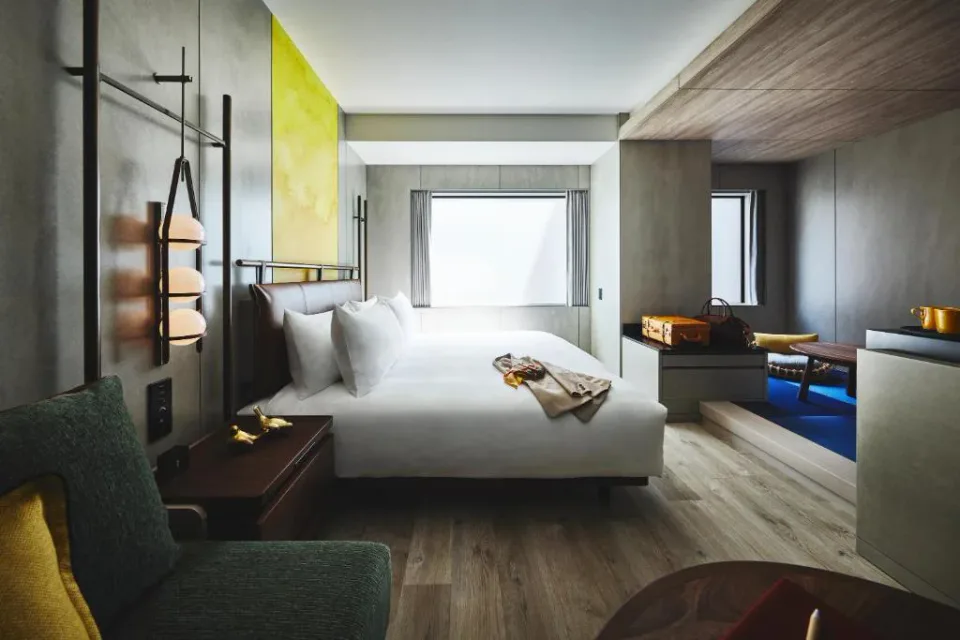
At Zentis Osaka, the laundry and work space in Room 001 can change how lightly you pack for a longer stay.
At voco Osaka Central, a Premium room gives two people 30–31 square metres of private space every night.
The decisive question for four or five Osaka nights is what would make the room harder to live in by day three. Zentis Osaka has a 25 m² Studio and a shared area, Room 001, with guest washers and dryers. voco Osaka Central's 30–31 m² Premium rooms provide more space inside the bedroom, while its listed laundry is a service rather than a guest machine. If you can make good use of one mid-stay wash, start with Zentis. If two open cases, shopping and separate bed choices will shape every evening, price a voco Premium room against it. Neither answer survives an inconvenient route to the places you visit most often.
The features pay off on different schedules. Extra floor area is useful whenever both travellers are getting ready, sorting purchases or resting. A laundry machine may matter only once, yet it can remove clothing from the luggage you carry through the whole trip. Before comparing hotel photos, decide whether you will actually wash clothes, which room category is available for your dates, and whether the final walk to the hotel fits your daily route. A low headline rate for the wrong room type is an unhelpful comparison.
The separate Zentis and voco hotel guides go deeper into each property; this comparison stays focused on the choice between them for a longer Osaka base.
The choice in one table
↔ Scroll table left or right
What the stay requires | Start by pricing | Where it helps | What could change the answer |
A planned mid-stay self-service wash | Zentis Studio | Room 001 can support a smaller packing list | Machine availability or little time to do the load |
Two large cases open each evening | voco Premium | 30–31 m² remains private throughout the stay | A Zentis Corner Studio rate with the right beds |
Several JR Osaka departures | A station-side hotel as well | Repeated rail approaches may dominate the decision | Only one regional outing and many local days |
Late dinners mainly around Namba | A Namba base as well | Shorter returns after the evening's last stop | Most other days point north or use Higobashi |
What you gain on each of four nights
List the tasks that repeat during the stay. Two travellers opening cases and sharing one bathroom will encounter the room layout every day. One laundry load could change the packing plan for the entire journey. Route friction also accumulates: three JR outings produce six outward and return movements. Treat these as different kinds of value, then decide which inconvenience is real for your itinerary rather than assigning an abstract score to an amenity.
↔ Scroll table left or right
Feature | Zentis | voco | When you use it | Decision to make |
Bedroom area | Studio 25 m²; Corner Studio 32 m² | Premium 30–31 m² | Every night | Is extra private floor needed for luggage or time in the room? |
Washing clothes | Self-service machines in Room 001 | Laundry valet and dry cleaning listed | When clothes actually need cleaning | Will you operate a machine or hand items to a service? |
Bed and bath | Studio king/shower; Corner twin or king/bath | Premium king or twin options | Every night and morning | Which exact category meets both travellers' needs? |
Base for the day | Walk to JR Osaka; shorter to Kitashinchi | Higobashi Metro and nearby alternatives | Each outward and return journey | Which station will your itinerary use repeatedly? |
The comparison changes if you never plan to use the machines. Zentis still offers a pleasant 25 m² room and shared lounge, but Room 001 no longer offsets a cramped packing routine. Conversely, if a wash lets you travel with a smaller case, voco's additional bedroom space might solve a problem you have already removed. Set your luggage on the floor at home and test whether the clothing needed for four or five nights can realistically fit the packing strategy you are considering.
Two guest patterns, different weak points
These are practical scenarios, not hotel quality ratings. Both properties can work for four nights. The difference appears when a specific room or routine begins to obstruct the stay: luggage left open, a required mid-trip wash, a bath preference, an early rail departure or repeated returns from Namba. Use the following tables to identify which constraint you would actually meet.
Light luggage and one planned wash
↔ Scroll table left or right
Question | Zentis Studio | voco Premium |
Luggage | A smaller bag may be possible after a wash | More private floor for bags |
Laundry task | Operate the machine in Room 001 | Use service or carry more clothes |
Bed choice | One king listed | King or twin category may be bookable |
Bathroom | Shower room | Check the selected room's bathroom |
Daily route | Test JR Osaka and Kitashinchi approaches | Test Higobashi and JR transfers |
Likely constraint | Time and availability for the wash | Price premium for space you may not need |
Two large cases and evenings spent in the room
↔ Scroll table left or right
Question | Zentis Studio | voco Premium |
Open cases | Confirm the room layout before expecting space for both | 30–31 m² gives more room on paper |
Private evenings | Guest lounge adds shared seating | Extra area stays inside the room |
Beds | King; Corner Studio needed for twin option | King or twin options within Premium |
Clothes | Room 001 remains available if plans change | Service available; no guest machine listed |
Route | Dojimahama, Kitashinchi and JR approaches | Higobashi, Yodoyabashi and Hommachi approaches |
Likely constraint | 25 m² with two large cases | Higher total rate or unsuitable daily rail route |
A guest with a carry-on who expects to wash clothes gets a concrete use from Zentis Room 001. A pair with large cases and no interest in doing laundry will feel the room-area difference more often. The tables deliberately do not declare an overall winner: exact dates can also change the price gap, while a JR-heavy or Namba-heavy itinerary can outweigh either room feature. Decide the daily route before paying a premium for space or a facility you will scarcely use.
Zentis gives laundry a place outside the Studio
Zentis lists its Studio at 25 m² for one or two people, with a king bed and shower room. The 32 m² Corner Studio can sleep up to three, offers king or twin configurations and adds a bathtub with shower. Room 001 is separate from those rooms. It contains self-service washing and drying machines, irons, a microwave, coffee and places to sit. The Japanese hotel page describes the multipurpose space as open around the clock. Check the machine's current price and availability for your stay; its presence does not mean a free or immediate wash.
Think through the whole washing task rather than the photograph of a machine. You will need time to sort clothes, move a load to a dryer and collect it before sleeping or leaving the hotel. The machines are shared, so another guest may be using them when you return. A planned wash can still be valuable if it lets each person bring fewer changes of clothes on a longer Japan trip. If your schedule is packed from breakfast to midnight, paying for a laundry service may be more realistic than depending on a self-service load.
Start with the Studio price for two people; do not jump to Corner Studio solely because it is seven square metres larger. The upgrade makes sense when twin beds, a bathtub or space for a third guest are requirements. It may also be worth pricing when two large cases need to stay open, though the published room area alone cannot promise an unobstructed patch of floor. Compare the actual bed configuration and bath listing on the selected rate before paying. A Corner Studio and a voco Premium room are closer in area, but they differ in location and laundry arrangements.
voco's Premium category makes the extra space private
IHG shows three current area bands at voco Osaka Central: Standard 21–26 m², Premium 30–31 m² and Grand 36–40 m². A Standard is not a like-for-like substitute for Zentis Studio if your reason for considering voco is more room. Premium is the useful comparison. It offers king or twin bed options, subject to the room booked, and keeps the extra space available at any hour without going to a shared facility. For a four-night stay, confirm the exact room category rather than relying on a generic hotel photograph.
A bigger room does not guarantee that every square metre is clear floor. Still, Premium's published minimum exceeds Standard's published maximum, so the category represents an area change rather than merely a new label. It may let one traveller unpack while the other uses a desk or relaxes, and it gives cases and shopping bags a better chance of staying out of the walking line. Look at the floor plan and the particular bed layout if those details matter; the room dimensions are a starting point, not proof of how a suitcase will fit.
The laundry distinction is narrower and more useful than a blanket statement that voco has none. IHG currently lists dry-cleaning pickup, laundry valet and same-day dry cleaning. Its amenities page does not list a guest-operated coin laundry. A service can clean the clothes, but it may involve a different price, timing and handover from running a load yourself. If self-service washing is essential, ask voco about the current options before reserving or choose a hotel whose machines are explicitly listed. Do not assume an unlisted facility exists.
An awkward arrival matters less than an awkward daily route
From JR Osaka Station's Sakurabashi Exit, Zentis gives a walk of about twelve minutes; JR Kitashinchi is about four minutes away. With large cases in summer heat or heavy rain, the Osaka Station walk deserves attention. But a single difficult arrival can be dealt with by a taxi for the final stretch or careful exit choice. More important is whether you will repeat the same approach morning and night. If several days start with JR Osaka, count those walks. If the days stay around Dojimahama, Nakanoshima and southern Umeda, the address may be more convenient than the Osaka Station distance suggests.
voco is near Higobashi on the Yotsubashi Line, with Yodoyabashi and Hommachi also within walking reach. That gives several ways into Osaka's Metro network and makes Nakanoshima or the surrounding office and dining streets easy to combine with a hotel return. It does not place the room at JR Osaka Station. For Kyoto, Kobe or Himeji outings that use JR, include the transfer or final walk to the JR hub in the comparison. A map pin midway between districts is useful only when the actual lines serve your plans.
Write down the journeys rather than choosing from a general claim that a hotel is central. An airport arrival happens once; four dinner returns happen four times. A planned departure for Hakone or Kyoto may happen only once, but with luggage and a fixed train it can carry more weight than an ordinary evening. Use the route and the effort involved, not an invented number of minutes saved for every traveller.
Compare the price of the exact room you need
Rates change by date, taxes, cancellation policy and bed type, so there is no permanent yen threshold at which one property wins. Select Zentis Studio or Corner Studio and the specific voco category that solves your needs. Compare the same dates and the total payable amount, then decide what the additional room area or laundry access is worth in this particular trip.
For two people, divide the total price difference by two and by the number of nights. That produces a per-person nightly cost for the change you are considering; keep the full booking total visible as well, including taxes and any charges due at the hotel. A small nightly difference can accumulate over five nights, while a one-off laundry fee may be modest by comparison. The calculation helps you notice the trade; it cannot tell you whether you will actually use the feature.
Now test the behaviour each room requires. In a Zentis Studio, can both travellers live comfortably with a king bed, a shower and 25 m² while using Room 001 for one wash? In voco Premium, will the larger bedroom prevent a daily nuisance, and what is the plan if clothes need cleaning? If the party needs twin beds and a bathtub, compare Zentis Corner Studio with the specific voco Premium configuration instead. Room names are less important than what is included in the rate you can book.
Keep the prices in yen when comparing offers. A conversion into your home currency is useful for budgeting on the day you book, but an exchange-rate snapshot from an old article could mislead you. Cancellation windows also matter when plans may change. A flexible rate that preserves the option to switch hotels is not equivalent to a prepaid non-refundable offer, even when the displayed room category is identical.
Four-night scores for Zentis and voco
| Dimension | Zentis Osaka | voco Osaka Central |
|---|---|---|
| Location | 8/10 — Dojima puts several Osaka routes in reach, but repeated JR departures still need a station approach. | 8/10 — Higobashi connects well to Metro routes but adds time to JR-based days. |
| Room | 7/10 — The 25 m² Studio works efficiently for two; a Corner Studio is a different size and price. | 9/10 — A named Premium room supplies 30–31 m² of private space across every night. |
| Cleanliness | 9/10 — Rooms and shared areas have a particularly strong upkeep record. | 9/10 — Recent room-upkeep scores are strong at this newer hotel. |
| Service | 9/10 — Staff scores are high and Room 001 gives the hotel a useful second workspace. | 9/10 — Staff and hotel service perform well, including paid laundry arrangements. |
| Facilities | 9/10 — Guest washers, dryers and work seating in Room 001 matter on a four-night trip. | 8/10 — The gym and modern public rooms help, but there is no guest washer-dryer equivalent. |
| Food | 8/10 — UPSTAIRZ is a genuine on-site meal option, with breakfast inclusion varying by plan. | 9/10 — LOKAL HOUSE restaurant and a well-regarded breakfast support an easy hotel morning. |
| Value | 9/10 — Shared laundry and a competitive Studio rate are useful if private space is not the bottleneck. | 8/10 — The extra room area pays over four nights when laundry can be outsourced or skipped. |
JapanLayer overall scores for four or more Osaka nights: Zentis Osaka 8.4/10 and voco Osaka Central 8.6/10. Zentis gives a smaller private Studio and Room 001 washers for a light-packing routine; voco's 30–31 m² Premium room offers space every night while laundry remains a service decision. Quote the exact room and laundry need before reading the narrow overall gap as a winner.
When neither hotel solves the real problem
If JR Osaka Station is the repeated starting point, compare a hotel nearer the rail platforms. If you need both a self-service washer and more private area, look at Tokyu Stay Osaka Hommachi or Mercure Tokyu Stay Osaka Namba as separate possibilities, checking their current room and laundry details before booking. If the trip mainly lives around Namba, choose a Minami base. The relevant alternative is the one that removes the constraint neither of these two rooms resolves.
For a single overnight, the calculation is different. A wash is unlikely, and you may spend little time in the room between arrival and departure. Select the address that handles the flight, train or event you actually have. The longer-stay advantages in this comparison become meaningful only when you use them; a good one-night base could be neither of these properties.
The area gap between voco Standard and Premium is real
IHG's published ranges do not overlap: Standard is 21–26 m² and Premium is 30–31 m². Premium begins four square metres above the largest Standard, about a 15% increase from 26 m²; measured against the smallest 21 m² Standard, 30 m² is roughly 43% more published area. Those are category comparisons, not promises of clear luggage space. Grand rises to 36–40 m² as another budget decision. Put the price of the exact Premium category beside Zentis rather than using a Standard headline rate to argue that larger voco rooms are inexpensive.
Room shape and furniture still matter. A bed placed differently can leave more usable floor than a larger but awkwardly arranged room, and the bathroom takes part of the published area. IHG lists king and twin options for Premium, so verify which one the offer actually reserves. If the two travellers have different sleep schedules or need separate beds, that may be more important than the numerical area difference. Photographs help identify layout but cannot prove the exact room assigned on arrival.
The space question is easiest to underestimate on check-in day, when cases are still closed. By the third evening, laundry, purchases and tomorrow's clothes may all be out at once. A Premium room can keep that routine inside the bedroom, which is particularly useful if you work in the room or return early. If you unpack into storage and spend little waking time there, the extra floor may be less valuable. The decision rests on how you use the room after the first night.
Higobashi connects well to Metro routes, less directly to JR days
The hotel describes Higobashi Exit 7, Yodoyabashi Exit 13 and Hommachi Exit 28 as nearby approaches. Those options make it possible to choose a line that fits different city trips, but the exits are not interchangeable when carrying luggage. Identify the station you will use most, then inspect the walk to that entrance and any lift route. A hotel close to three stations can still require a tiring final ten minutes if you choose the wrong approach after a long day.
On the Yotsubashi Line, Higobashi (Y12) is next to Nishi-Umeda (Y11); Hommachi (Y13), Yotsubashi (Y14) and Namba (Y15) lie to the south. That makes a Metro trip toward either Umeda or Namba straightforward. JR services for Kyoto and Kobe introduce another step: reach Osaka Station's platforms after the Metro ride or walk from the hotel to the JR hub. The distance is manageable for many guests, but it repeats each time those regional journeys recur.
Three JR day trips create six hotel-to-JR movements: three departures and three returns, often with luggage or shopping in hand. That is a stronger location test than one sightseeing ride. If every regional day begins at Osaka Station, a station-adjacent hotel such as Hotel Granvia Osaka may remove the same transfer repeatedly. If JR is only one day and most visits follow Metro lines, voco's Higobashi location can still be a sensible base.
The Hotel Granvia Osaka guide gives a useful station-side comparison for a rail-led trip. Measure the mornings and tired returns it would shorten against the room and laundry features you would give up. A brand comparison alone cannot answer whether an address suits three consecutive regional day trips.
Namba is a direct Metro ride, though not the same neighbourhood
voco can work for an occasional Namba dinner because Higobashi and Namba share the Yotsubashi Line. The return is still a train journey plus a walk to the hotel. If Dotonbori or Shinsaibashi will supply almost every late evening, staying in Namba may fit better than repeatedly crossing the city after dinner. Consider where the group expects to finish, not just where it starts at breakfast.
That distinction is easier to see in the Namba vs Umeda guide and the Namba hotel comparison. A single Namba evening is simple enough by Metro from Higobashi; a series of late nights changes the balance. Use your actual dinner and attraction plans rather than treating a direct train as if it placed the hotel next to Dotonbori.
At voco, laundry is a service decision
The need for clean clothes depends on the rest of the journey as much as the number of Osaka nights. Four nights at the start of a long Japan trip may allow packing for the full week. Four nights after hot days, sports, a theme park or another city may make washing urgent. Decide before booking whether you will hand items to a hotel service, find a laundrette nearby or operate a machine yourself.
IHG lists laundry valet, dry-cleaning pickup and same-day dry cleaning at voco. These services may be useful for an urgent garment or a traveller who does not want to spend the evening watching a machine. They are not the same as a guest coin laundry, which does not appear in the current amenities list. Ask for the current price, deadline and return time if your plan depends on getting specific clothes back before departure.
If you intend to wash clothes yourself, do not book voco on the assumption that an unlisted coin machine is available. Ask the hotel what is possible for your dates, or compare a property that publishes its self-service setup. The Tokyu Stay Osaka Hommachi five-night guide is one relevant long-stay alternative. A paid service can still be the better choice if you would rather spend the evening elsewhere.
A spacious bedroom and a washing machine address different problems. Premium solves the first. Room 001 gives Zentis a way to address the second. Neither feature automatically compensates for an inconvenient route, an unsuitable bed arrangement or a price you do not want to pay over several nights.
Beds and accessible routes come before room area
IHG lists accessible guest-room features at voco and says connecting rooms and cribs may be available on request. Those listings do not guarantee that the particular room or dates in your search will meet a family's needs. Confirm the bed arrangement, any crib request and the accessible route with the hotel before paying for a non-refundable booking. The 30–31 m² Premium figure cannot tell you where a crib will stand or whether a sofa bed is included.
At Zentis, the standard Studio lists one king bed and a shower, while Corner Studio can be arranged with twin or king beds and a bathtub. Those details may settle the decision before the general hotel comparison does. For a traveller with limited mobility, ask about the entrance, lifts, bathroom and route from the nearest useful station. A room can be large enough yet still fail because a shower, doorway or final street crossing is unsuitable. Compare the exact booked room rather than relying on a broad accessibility label.
If four people need their own beds, neither a conventional two-person room nor an unspecified connecting-room request is an adequate plan. Price a confirmed connecting arrangement or an apartment hotel with the occupancy and sleeping setup shown in the reservation. Paying for a larger premium room does not create an extra bed unless that exact configuration is offered and booked.
Put a four-night itinerary against the room choice
Consider two adults with large suitcases. Their hotel decision can change without changing the travellers, simply because the sequence of days changes. The following examples show which journeys would expose a location weakness and when a private room advantage can justify it.
A city-focused stay makes voco Premium plausible
Arrival day: settle in and eat near the hotel rather than crossing Osaka again.
Use one evening for Namba and Shinsaibashi, returning by Metro.
Make one Kyoto excursion, with no repeated run to JR Osaka on the following day.
Spend the final full day around Nakanoshima, Utsubo and central Osaka.
Here the Premium room's extra area is useful on each return. Namba appears once, so its Metro ride is a manageable outing rather than a nightly obligation. A single Kyoto day does not make JR Osaka the trip's permanent hub. If both travellers prefer space to doing their own laundry and the exact rate is acceptable, voco Premium has a clear role. Compare the room category and bed choice before booking; a Standard room does not deliver the same argument.
Several JR departures expose the route cost
Arrive by JR with luggage and depart early on the last morning.
Travel to Kyoto on one day, then Kobe or Himeji on another.
Add one further regional outing that begins at Osaka Station.
Count the return to the hotel after each rail day as well as the morning departure.
In this pattern the hotel sends the group toward JR Osaka Station on multiple mornings and brings them back after full days. The Premium room remains comfortable, but it cannot remove those transfers or walks. Compare a hotel closer to Osaka Station against both Zentis and voco, then see whether its room meets the luggage and bed requirements. The repeated rail journey may be worth more than either laundry access or extra area.
Namba evenings point to a different base
Dotonbori or Shinsaibashi supplies most of the evening plans.
Kansai Airport is used in both directions, without a JR-heavy series of day trips.
A walkable Namba return matters more than either hotel's particular room feature.
When almost every useful evening ends around Dotonbori and the airport route also favours Minami, a Namba hotel deserves first consideration. A comparison confined to Zentis and voco would overlook the most direct way to remove late returns. Keep both on the shortlist only if their price, room layout or facilities compensate for the repeated journey you have identified.
Reaching Zentis after a flight or late train
Zentis lists two practical Kansai Airport approaches. Its access page gives about 50 minutes by Haruka to JR Osaka Station followed by around twelve minutes on foot from the Sakurabashi Exit. The airport bus takes about 60 minutes to Herbis Osaka, with a roughly ten-minute walk from the bus stop. These are planning estimates, not door-to-door guarantees; the useful route depends on the arrival terminal, waiting time and luggage.
The station exit matters. Sakurabashi is on the western side of Osaka Station, closer to the hotel's Dojimahama direction than some other exits. With two large cases, inspect the exit and street route before choosing a taxi merely because the citywide map looks complicated. In heavy rain or after a delayed flight, paying for a short final ride may still be sensible. Do not turn a manageable one-time approach into the sole reason for a four-night hotel choice.
Zentis says vehicles cannot enter the area immediately around the property between 22:00 and 01:00. If a late flight leads to a taxi arrival during that window, check the appropriate drop-off point with the hotel and expect a final walk. The restriction concerns vehicle access near the hotel, not whether guests may check in. Once settled, JR Kitashinchi's four-minute walk can be more useful than the Osaka Station distance for evenings around Dojima and southern Umeda.
For a trip combining several regional outings, the Osaka, Kobe and Koyasan four-day itinerary can help test whether one fixed Osaka base is sensible. If the party needs a larger multi-bed arrangement, the MIMARU Osaka Shinsaibashi Central comparison addresses a different room problem. The hotel that is easiest on arrival is not necessarily the one that serves the rest of the itinerary.
At Zentis, Studio and Corner Studio are different products
Studio is 25 m², listed for one or two guests, with a 1,810 × 2,030 mm king bed and shower room. Corner Studio expands to 32 m², takes up to three, offers twin or king beds and includes a bathtub plus shower. An accessible Studio with a queen bed is also described on the hotel's room page. Those distinctions affect sleep and bathroom use, not merely floor area. Verify the exact bed type on the booking screen; a hotel-level photograph can show a different room.
For a couple staying four nights, the Studio can be the sensible starting quote if a king bed and shower suit both people. The extra Corner Studio area becomes relevant when luggage must remain open, but its more decisive benefits may be twin beds or a bath. If those are requirements, compare it directly with voco Premium, where the published 30–31 m² area is similar. The difference then shifts toward laundry, hotel location, room layout and total rate.
Neither hotel's square-metre figure reveals exactly how much clear floor remains beside the bed. Desks, chairs and a particular corner shape change the usable space. Look for a floor plan or ask about the specific room category if two full-size suitcases must stay open. If you plan to unpack into storage and close the cases, 25 m² may be ample for your routine. If the cases become everyday furniture, paying for more room is easier to justify.
↔ Scroll table left or right
Room | Area and guests | Bed | Bath | When to select it |
Studio | 25 m²; one or two | King | Shower | Two guests who prefer a compact room and can use Room 001 |
Corner Studio | 32 m²; up to three | Twin or king | Bathtub and shower | Twin beds, a bath, a third guest or more room are required |
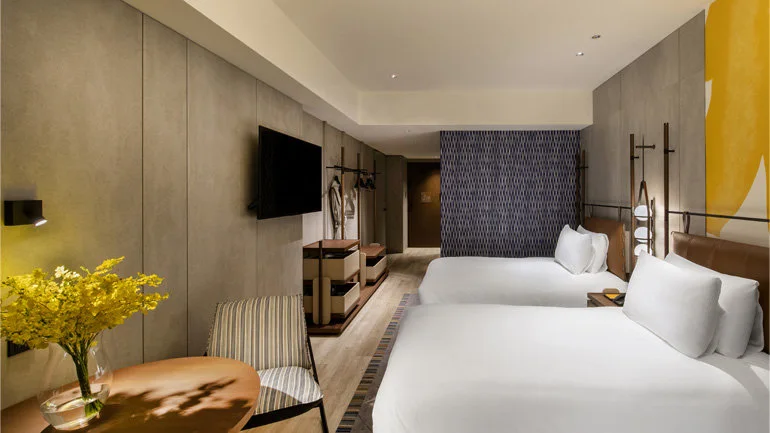
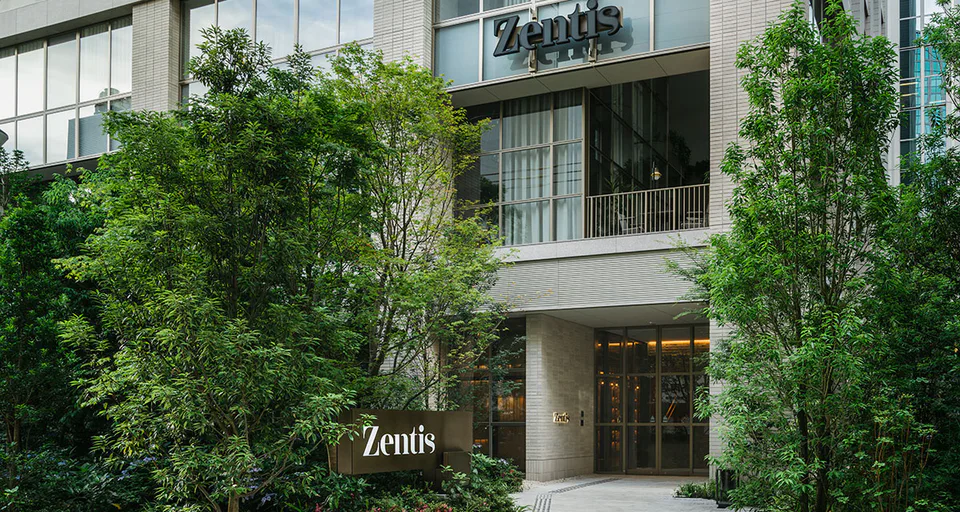
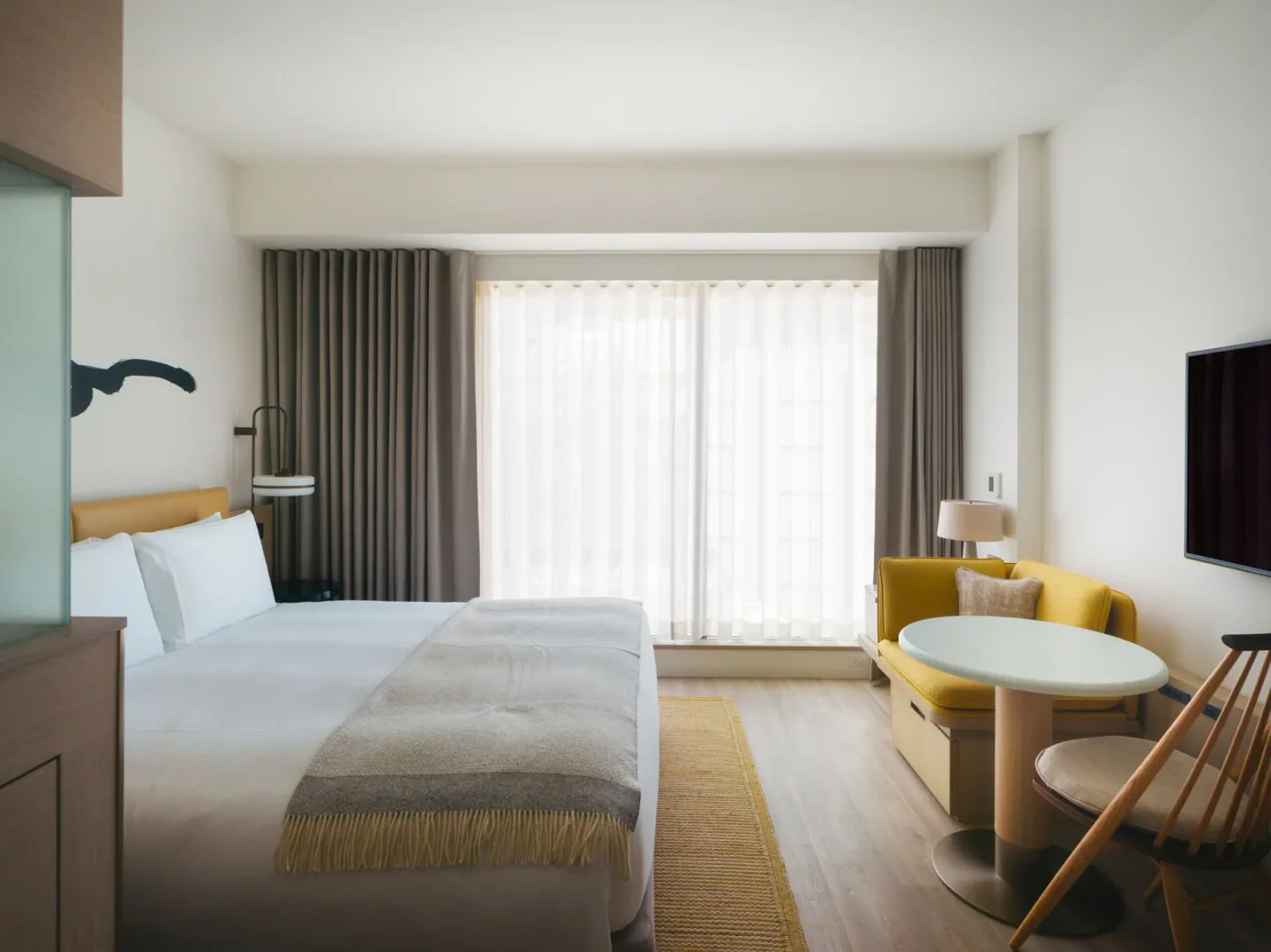
The room and facility images illustrate different areas of Zentis. Use the accompanying room specifications to decide what the rate includes, especially where a photograph shows a bathtub or twin beds that are absent from the basic Studio description.
Room 001 helps only if its facilities enter your routine
Room 001 has three guest washers and three dryers, with Zentis-specific Kimura Soap detergent, irons, a microwave and Nespresso coffee. The multipurpose space is open 24 hours. It also lists a fragrance bar, book collection and shoe-care service; those extras may interest some guests, but the laundry is what can materially change a four-night packing plan. The hotel separately offers full laundry and dry-cleaning service. Check machine fees and availability before relying on a wash at a particular hour.
A realistic evening might mean starting laundry after dinner, spending the cycle reading or planning the next day, then collecting and putting away the clothes before bed. It is less attractive if you come back exhausted, need to sleep immediately or find the machines occupied. Build a buffer rather than assuming a wash will finish exactly when you want it to. Some travellers will gladly pay a service to avoid that task; others will value being able to wash ordinary clothes themselves at a convenient hour.
Zentis also has a guest lounge with seating and a communal table. It can give one person somewhere to read or work while the other rests in the Studio. That shared space can make a compact bedroom easier to live in, though it does not add private square metres. The Tokyu Stay Osaka Hommachi guide covers a different hotel where in-room facilities may suit a longer stay. If you expect confidential calls or long periods relaxing together, voco Premium's private area may matter more.
Test whether you would use the facilities over four nights
Test a four-night stay against the facilities rather than assuming you will use them. Night one might begin with a 20:30 arrival and a meal, with no time for laundry. Night two could hold a wash after shopping; night three might end late after USJ or Osaka Castle, when 24-hour Room 001 becomes useful. On night four, sort purchases and decide whether a second load is needed. This is a planning example, not a report of a stay. If all four nights end too late for the task, the machines should not be credited in the hotel comparison.
For one night, almost all of that strategy disappears. You may never reach Room 001 and have little reason to reduce the packing list for a single hotel. For four or five nights, the ability to refresh clothing can change the suitcase you brought to Japan. Stay length matters because a feature can affect more than the days spent in this one room; its value depends on the onward trip as well.
What a Zentis Studio asks you to accept
The basic Studio has no bathtub and lists a king bed rather than twins. JR Osaka Station is a walk away, not attached to the hotel. Room 001 is shared, so a washer may be occupied. Drivers should note that the hotel points to a separate nearby partner car park rather than an on-site garage, and vehicle access near the entrance is restricted from 22:00 to 01:00; confirm the current parking arrangement before relying on it. If bathing, separate beds, immediate JR access or a guaranteed laundry hour is essential, the Studio is the wrong baseline regardless of the photographs.
The trade-offs extend beyond the room. Breakfast and a noon checkout have value only when your schedule leaves time to use them; confirm the checkout term on your rate. If the next leg is the Osaka to Beppu overnight ferry guide, freshly washed clothes may be more useful than extra Osaka floor space. If the trip ends after these four nights, the packing benefit shrinks. Take the rest of the journey into account rather than valuing Room 001 as an isolated hotel amenity.
Compare booking sites using the same room and terms
Select the room category first. A Zentis Studio quote, a Corner Studio quote and a voco Premium quote buy different bed, bath and space arrangements. On each booking site, check occupancy, bed type, breakfast, taxes, payment timing and cancellation cutoff. The headline nightly price can conceal a different set of conditions. Save a dated screenshot or note of the comparable totals if you are deciding between several offers.
No booking platform is always cheapest for this hotel. Check the same room, dates and conditions across offers, then see whether a flexible rate is worth the difference. If you need mobile data to compare or manage reservations while travelling, the Japan eSIM guide for Tokyo, Osaka and Kyoto covers that separate practical issue; it should not be folded into a hotel-room price comparison.
Check Zentis Osaka rooms for the full stay.
Make the room decision before selecting the platform
Zentis Studio is most persuasive when two travellers are comfortable with a king bed and shower, want to pack lightly and can reserve time for a self-service wash. Corner Studio changes the bed, bath and floor-area comparison. voco Premium is stronger when private space and a king-or-twin choice will be used every evening, and a laundry service or extra clothes can cover washing needs. Check the daily route before committing to either: repeated JR Osaka trips can favour a station hotel, while repeated Namba evenings can favour Minami. Then compare like-for-like rates for the exact room and cancellation terms you need.
For a four-night comparison, check Osaka room availability using the exact party size and room category for Zentis and voco.