
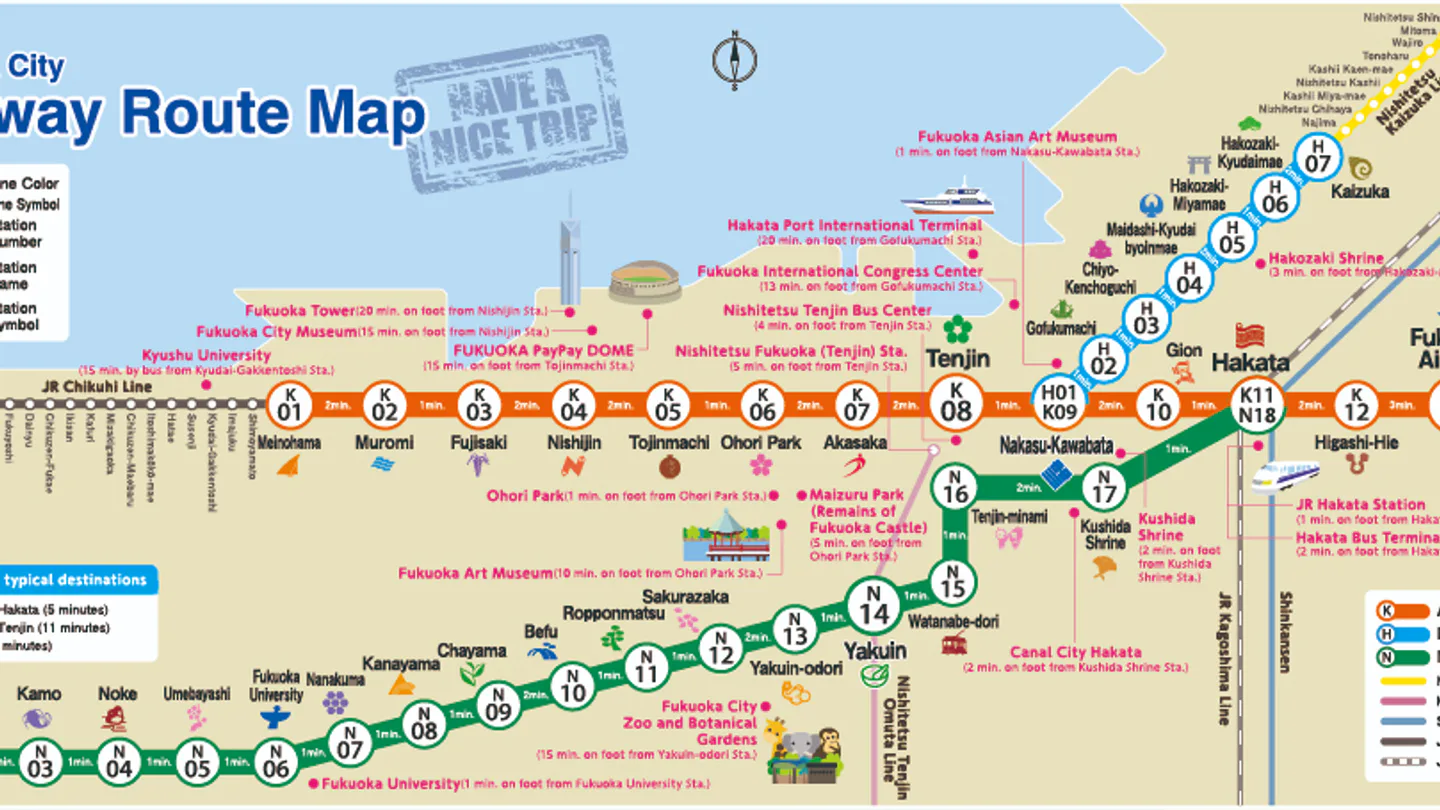
A pass is useful only after you know whose tracks and buses your day uses. A visitor spending the day between Hakata, Tenjin and Ohori Park can usually ride the Fukuoka City Subway with one eligible contactless bank card and let its ¥640 daily ceiling do the arithmetic. A family, a Dazaifu rail trip or a journey onto JR's Chikuhi Line changes that answer. The ticket with the broadest name is rarely the first one to buy.
Fukuoka has several fare owners: the city runs the subway, JR Kyushu runs regional rail, and Nishitetsu runs its own trains and buses. A card may work across them without making their day passes interchangeable. Build your day around actual station pairs before pricing a pass. If you are still deciding where to sleep, compare Hakata and Tenjin as bases; the choice changes which operator you use most.
The city-subway fare ceiling
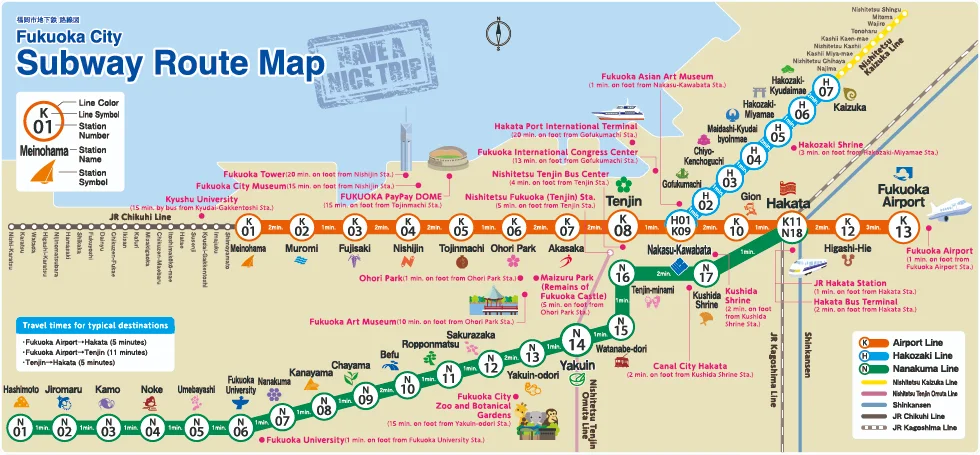
The adult Subway 1-Day Pass is ¥640 and the child version ¥320. On eligible contactless bank-card or device rides, the subway also limits the adult fare charged over a 03:00-to-03:00 travel day to ¥640. That is a ceiling, not a flat charge: two ¥210 trips still cost ¥420, three cost ¥630, and a fourth trip of the same length takes the uncapped total to ¥840 but leaves the contactless bill at ¥640. Three ¥260 trips similarly total ¥780 before the cap. Distances change individual fares; the principle is that you pay less when your actual rides do not reach the ceiling.
Tap in and out with the same physical card or the same phone or watch. The operator treats media separately even when a phone holds the same account as a plastic card; swapping them midjourney can prevent the exit gate from recognizing the entry, and switching during the day can spoil the ceiling you expected. An ordinary Japanese transport IC card is convenient for mixed operators, but it is not the bank-card contactless product that receives this subway cap. Before leaving for an Itoshima coast trip, that distinction matters more than the number of subway rides.
Why buy the ¥640 subway ticket anyway? It gives a fixed subway fare without relying on an eligible contactless card, and showing it can unlock listed discounts at participating facilities. If one of those places already fits your Fukuoka city itinerary, compare the discount with your expected rides. The ticket remains a subway ticket: neither a museum benefit nor the word “day” adds JR or Nishitetsu coverage.
↔ Scroll table left or right
| Day you have planned | Fare product to price first | Boundary to remember |
|---|---|---|
| Adult moving only around subway stations | Eligible contactless card or device | ¥640 daily ceiling applies only to city-subway rides on the same medium. |
| Adult visiting a pass-discount attraction | ¥640 Subway 1-Day Pass | Check that the facility benefit is useful to your actual day. |
| Family making repeated subway trips | ¥1,000 Fami Chika Ticket | Family eligibility and travelling together are required. |
| Tenjin to Dazaifu and back | Ordinary Nishitetsu fare or Dazaifu ticket | The city subway pass does not cover the Nishitetsu rail trip. |
| Dazaifu, Yanagawa and additional local buses | ¥2,980 Nishitetsu FUKUOKA 1DAY PASS | JR and city subway remain outside it. |
| Hakata or airport side to Itoshima | Transport IC card or suitable through ticket | Contactless subway bank-card travel does not continue onto JR Chikuhi Line. |
| Expensive same-day mix of rail, bus, subway and ferry | ¥2,500–¥2,800 Tourist City Pass, if eligible | Count the covered journeys and check visitor/purchase rules. |
A family ticket changes the calculation
Fukuoka's ¥1,000 Fami Chika Ticket covers an eligible family with at least one child or infant, as many as two adults, and no numerical limit on eligible children or infants. Everyone travels the same itinerary; the operator's family relationship definition still applies. It is a one-day ticket for the Airport, Hakozaki and Nanakuma subway lines, not a general group pass for unrelated adults. The current purchase route includes the my route digital ticket, so arrange it before reaching the gate if this is the choice for your party.
For two adults and two elementary-school children, four separate one-day tickets would cost ¥640 + ¥640 + ¥320 + ¥320 = ¥1,920. An eligible Fami Chika family pays ¥1,000, a ¥920 difference on a subway-heavy day. With one adult and one elementary-school child, compare the ¥800 Family Pair Ticket instead. On eligible weekends, holidays and school-holiday periods, a child's ¥100 subway pass can make an adult ¥640 day ticket plus that child ticket cheaper than the ¥800 pair fare. These calculations stop at the subway gates: a Dazaifu or Itoshima outing needs its own operator fares.
Arriving at the international terminal
The Domestic Terminal has the Fukuoka Airport subway station. The International Terminal does not. Reaching the station after an international arrival means baggage collection, a walk to the free inter-terminal shuttle, a wait and about ten minutes on the bus before the subway leg. That extra transfer may be the relevant cost when luggage is heavy or the flight is late. There are also direct buses from the international side to Hakata, Tenjin, Dazaifu and other Kyushu points, so compare the actual hotel route rather than assuming a subway ride begins at arrivals.
An arrival evening with Airport to Hakata and perhaps one later Tenjin journey will probably stay below ¥640 on ordinary subway fares. The number of useful rides left is small even though the city pass lasts a day. If your next destination is Yufuin or Beppu, the Fukuoka–Yufuin rail, bus and car comparison is the relevant transport decision. If it is a preflight overnight, see which base suits an early airport departure.
One Dazaifu visit: use the Nishitetsu fare world
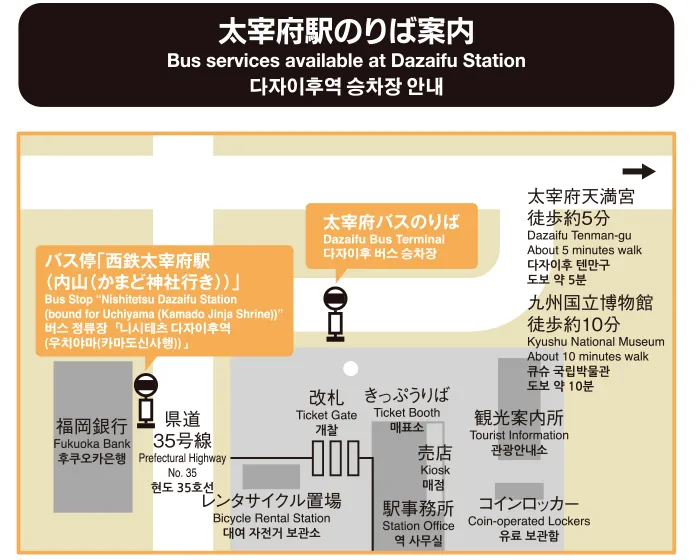
For a straightforward Dazaifu visit, reach Nishitetsu Fukuoka (Tenjin) or Yakuin and use the Nishitetsu rail connection onto its Dazaifu Line. JR Hakata is a different station and operator; the subway merely links the city bases. Price the ordinary return train fare against Nishitetsu's Dazaifu sightseeing ticket. The current ¥1,000 digital or ¥1,040 paper adult ticket from Tenjin pairs return rail travel with a voucher for one Umegae Mochi and selected local benefits. The digital version uses my route and lists registration countries; the paper version is sold at Tenjin. Whether the bundle helps depends on whether you would use its extras. A Dazaifu food stop may make the voucher relevant; it is not a reason to alter an otherwise short shrine visit.
The Fukuoka City + Dazaifu Tourist City Pass costs ¥2,800, but its broader coverage cannot repay itself through one simple rail out-and-back. It also excludes the Dazaifu Liner Bus “Tabito.” A day that returns to Tenjin for dinner is better costed as its real rail and local journeys. For a trip that extends into autumn viewpoints, the Dazaifu and nearby foliage routes helps establish which additional bus or car movement you actually need.
When the Nishitetsu network pass earns its ¥2,980 price
The current FUKUOKA 1DAY PASS is ¥2,980 for adults and ¥1,490 for children. Its train area runs from Nishitetsu Fukuoka (Tenjin) to Yanagawa and includes the Dazaifu and Amagi branches; it also covers a wide area of Nishitetsu local buses. The pass makes sense to investigate when a day repeatedly uses that same operator, such as Dazaifu plus Yanagawa plus useful bus sections. It is not an unlimited ticket for city subway or JR. An older brochure may still quote ¥2,800, but that was the earlier fare; Nishitetsu revised rail fares on 1 April 2026, and its current pass listing is ¥2,980.
One attraction in Dazaifu is not enough evidence. List the exact long train sectors and local-bus legs, then add their regular fares. That prevents a “network pass” from quietly paying for journeys you never take. Tenjin is the logical rail base for this kind of day; Hakata can work too, but the city transfer is separate. If the trip is really a choice between destinations, decide Dazaifu or Itoshima on the outing itself before buying its ticket.
The through train to Itoshima has a payment boundary
A train can stay physically continuous beyond Meinohama, leaving the city subway for JR Kyushu's Chikuhi Line towards Chikuzen-Maebaru and other Itoshima stations. Fukuoka's contactless bank-card subway system cannot be used through onto that JR section. The ¥640 city-subway ceiling cannot cap JR's fare merely because you keep your seat. A compatible transport IC card or the appropriate through ticket handles the journey without making a false pass assumption.
If the morning or evening includes several separate subway trips, a city day ticket might still have a job; cost those legs apart from the JR section. For the beach and village portions of the day, the harder question may be how long to remain on the peninsula. Day trip versus overnight in Itoshima addresses the timetable and stay trade-off, while a car-days-first hotel plan is relevant only if you are actually hiring a vehicle.
The Tourist City Pass is for a deliberately mixed day
The foreign-visitor FUKUOKA TOURIST CITY PASS costs ¥2,500 for Fukuoka City or ¥2,800 with Dazaifu. Within defined areas it combines eligible buses, trains, subways and ferries, and selected facility benefits. This breadth can matter on a day using several otherwise separate operators. It adds little to a central Hakata–Tenjin–Ohori Park route that an ordinary subway payment already covers. The Nakasu and Hakata Bay boat comparison can also clarify whether a water journey is actually in the plan before counting ferry coverage.
The pass is restricted to eligible short-stay overseas visitors. A paper purchase involves a passport at a listed counter. The tourism guide currently limits its digital app to visitors from South Korea, Taiwan and Thailand under its stated privacy rules; a visitor from another country should plan on an available paper channel rather than assume app purchase. Dazaifu's Tabito bus remains excluded even from the extended version. A genuinely multi-operator day can justify the price, but name the JR, subway, bus and ferry trips that get close to it first.
Six days, six starting points
International arrival, Hakata hotel, Tenjin dinner
Buy no pass on arrival. Pay the actual bus or subway fares; the short evening gives a day product little room to save. Late-arrival hotel access matters more than an unlimited ticket.
Hakata, Ohori Park, Tenjin, Kushida Shrine and back
Use one eligible contactless medium throughout the subway portion; the ¥640 cap catches an expensive riding day. If a participating museum discount is already planned, calculate the 1-Day Pass instead. The two-, three- or four-day Fukuoka plan can help place this city day.
Two adults and two children on the subway
Check family eligibility, then compare ¥1,000 Fami Chika with separate adult and child products. At the cited prices, four individual day tickets cost ¥1,920.
Dazaifu and a Tenjin dinner
Use ordinary Nishitetsu rail fare or its destination ticket, with a separate city ride if needed. Do not purchase the ¥2,800–¥2,980 network products for an itinerary without repeated covered legs. The Kyushu National Museum ticket choice may affect whether a pass attraction benefit has real value.
Dazaifu, Yanagawa and local buses
Add regular Nishitetsu fares and compare with its ¥2,980 1DAY PASS. A mixed JR or subway segment still needs a separate payment.
Hakata to Itoshima and back
Take a compatible IC card or valid through ticket for the subway-to-JR ride. Do not rely on the subway bank-card tap across Meinohama. If the itinerary instead expands into multiple northern Kyushu rail days, compare a regional JR pass against the real train list.
Where the hotel base changes the fare
Hakata naturally puts the JR station and city subway into the day: regional departures, the domestic-airport rail link and a correctly ticketed Itoshima through train fit that base. Tenjin places Nishitetsu's main station beside the Dazaifu and Yanagawa decision while keeping subway access to Hakata and the airport. A hotel near dinner may prevent a late return fare or an awkward transfer; compare where the food day ends and the yatai areas rather than buying a pass and then changing the stay to suit it.
Price flexibility too. If an unlimited ticket pushes you onto a detour, a rushed museum or an extra bus solely to make it “pay,” ordinary fares may buy a calmer day for only a small difference. With central subway travel, the contactless ceiling already takes away much of the risk of underestimating rides. A family ticket, a repeated Nishitetsu day and a genuinely costly multi-operator day are the clear reasons to calculate more closely.
A separate Kyushu route needs its own transport budget. The Chinese-language regional-lodging comparison below illustrates three sleeping bases outside the city; it is not a Fukuoka transit map and none of the city passes described above buys that regional travel. Plan those legs with the Hita–Yufuin–Beppu overnight route or five- or seven-day Kyushu itinerary instead.
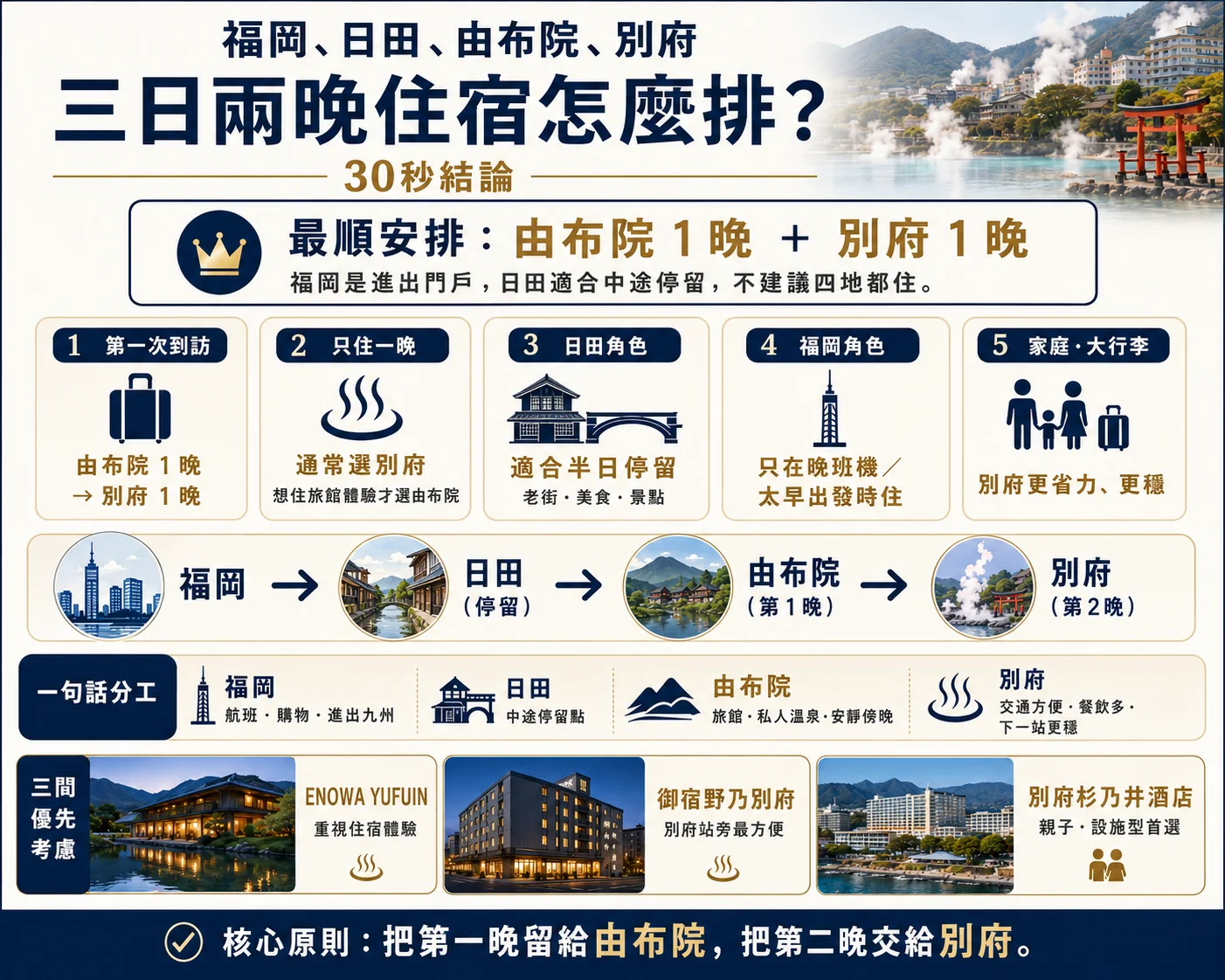
For a city-subway adult day, one eligible contactless card is the least fussy starting point. A family should calculate the family ticket before separate fares. Dazaifu and Yanagawa belong to Nishitetsu's pricing, while Itoshima crosses into JR even if the train does not stop for a change. Only the journeys on the calendar, not a pass name, can tell you whether the wider products are worth their price.
After identifying the lines you will actually ride, see Fukuoka rooms along that transport pattern before assuming a pass can rescue an awkward base.
Related routes and fare pages
Fukuoka–Yufuin transport comparison · Hakata vs Tenjin · Fukuoka City Subway — 1-Day Pass · Fukuoka City Subway — contactless payment and daily cap · Fukuoka City Subway — Fami Chika Ticket · Nishitetsu — FUKUOKA 1DAY PASS · Nishitetsu — Dazaifu and other discount tickets · Fukuoka City Tourist Guide — FUKUOKA TOURIST CITY PASS · Fukuoka Airport — International/Domestic terminal shuttle · JR TOKYO Wide Pass 2026: Don’t Bundle Skyliner or Subway Tickets Until You Map These 3 Days · Do You Need a Car in Okinawa? Rental Car vs Public Transport · Tokyo Subway Ticket vs Suica: Don’t Choose a Pass Until You Count These 24–72 Hours · Kinosaki Private Bath vs Public Baths: Do You Need a Private Onsen? · Solaria Nishitetsu Hotel Fukuoka vs ONE FUKUOKA HOTEL: Which Tenjin Stay Fits? · Fukuoka Long-Stay Hotels: What Starts Annoying You by Night 5—Laundry, Luggage or the Trip Back? · A Mount Fuji Day Trip from Tokyo Can Buy You Transport — Not the View · Fukuoka Hotel Selector: Answer 8 Questions Before You Compare Hotels · Oshima Island Fukuoka Day Trip: I’d Pay for the Island Transport, Not a Guaranteed ‘Path of Light’ Sunset · Sanrio Puroland Tickets 2026: Save on the 2 PM Pass Only If You Know What You’ll Skip · Kochi Yosakoi Festival 2026: Which Day, Which Venue and Do You Need Paid Seats? · Solaria Nishitetsu Hotel Fukuoka vs CROOM Hakata Gion: Better for 4 Adults? · Mitsui Garden Hotel Fukuoka Gion vs Solaria Nishitetsu Hotel Fukuoka: Best for 3 Adults?