
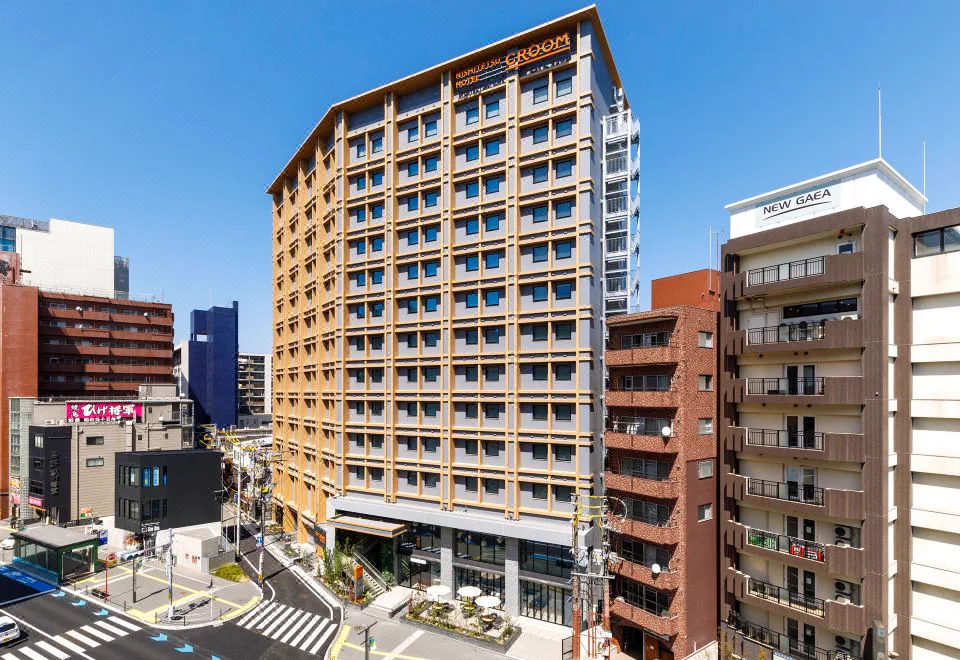
Nishitetsu Hotel Croom Hakata Gion has a room whose published capacity can reach six, yet a six-person booking asks much more of that room than a four-person stay. Comfort Fourth remains 30.4 m² at either occupancy. Four guests divide that gross area into 7.6 m² each; six divide it into about 5.1 m² each. Neither number is clear floor space, because beds, furniture and bathroom occupy part of the total. They make the key trade visible: two additional people add luggage and morning routines while the room does not grow. Fukuoka rooms for three or four adults gives a useful smaller-party starting point.
Four adults with modest bags can sensibly price one Comfort Fourth first. At five, compare one room with a pair of rooms on the same dates. At six adults, make two rooms the baseline quote and keep the single room only if its saving and togetherness justify one private bathroom, shared sleep hours and six sets of belongings. A published maximum occupancy confirms what can be booked; it cannot certify a comfortable routine for every adult group.
↔ Scroll table left or right
Party | Initial comparison | What may tip the decision |
Four with light luggage | One Comfort Fourth against two rooms | Bed arrangement and upper-bunk comfort |
Five | Quote both configurations | Fifth suitcase and bathroom demand without more room area |
Six adults | Two rooms as the benchmark | One room only if everyone accepts the daily bottlenecks |
Six with different sleep times or many large cases | Two rooms strongly favoured | Second door, bathroom and luggage floor area |
Thirty-point-four square metres is a room total, not spare floor
The hotel lists Comfort Fourth at 30.4 m², with capacity up to six and a separate toilet, wash area and bathing room. That layout is a real advantage over a single compact all-in-one bathroom. It still contains just one private toilet for the party. The listed room area covers circulation and fixtures, so the division by guest count is a comparison tool, not a personal-space allowance. The same room gives approximately 7.6 m² per guest at four, 6.1 m² at five and 5.1 m² at six.
↔ Scroll table left or right
Registered occupants | Gross room area per guest | Practical reading |
Four | 7.6 m² | One-room short stay can be plausible if the beds and bags fit |
Five | about 6.1 m² | Price a second room before committing to the fifth person |
Six | about 5.1 m² | Published capacity exists, but one shared routine becomes demanding |
Moving from four to six reduces gross area per person by roughly one third. A fifth and sixth traveller also bring phones, shoes, toiletries and drying towels. By the fourth night, shopping, used laundry and wet-weather gear can make an initially workable room feel much tighter. A one-night stop is different: keep bags mostly shut, shower in turns and leave in the morning. Do not assume the fourth-night version of the room behaves like check-in night. Six travellers in Okinawa examines the same group decision in another region.
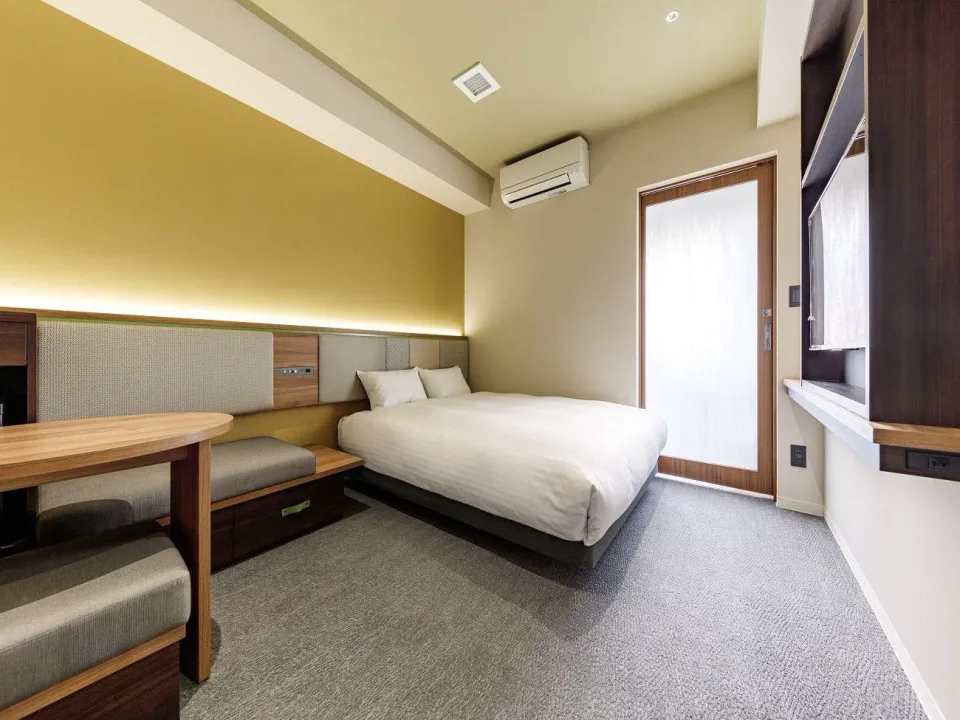
The bed map also matters more than the occupancy limit. The standard Fourth and Comfort Fourth share the 30.4 m² figure but are different products. The standard Fourth is sold for up to four; room information describes separate single sleeping surfaces in a bunk arrangement. Comfort Fourth raises capacity by using wider lower sleeping surfaces plus upper bunks. Four friends who expect four separate beds should price the standard Fourth as well as the Comfort Fourth, rather than treating the six-person label as an automatic upgrade. Solaria Tenjin room and location focuses on exactly that bed and area comparison.
A six-person morning has one private toilet
At six occupants, the bathroom is often a more severe constraint than the room area. Suppose the group reaches the hotel late and must leave for a train early. Bags must be opened, devices charged and showers sequenced; the next morning the same jobs happen under a departure deadline. The hotel’s public bath may let some guests wash in parallel when they are comfortable using it and its operating window fits. It cannot supply a second private toilet, a private changing area for each person or an accessible substitute for every traveller.
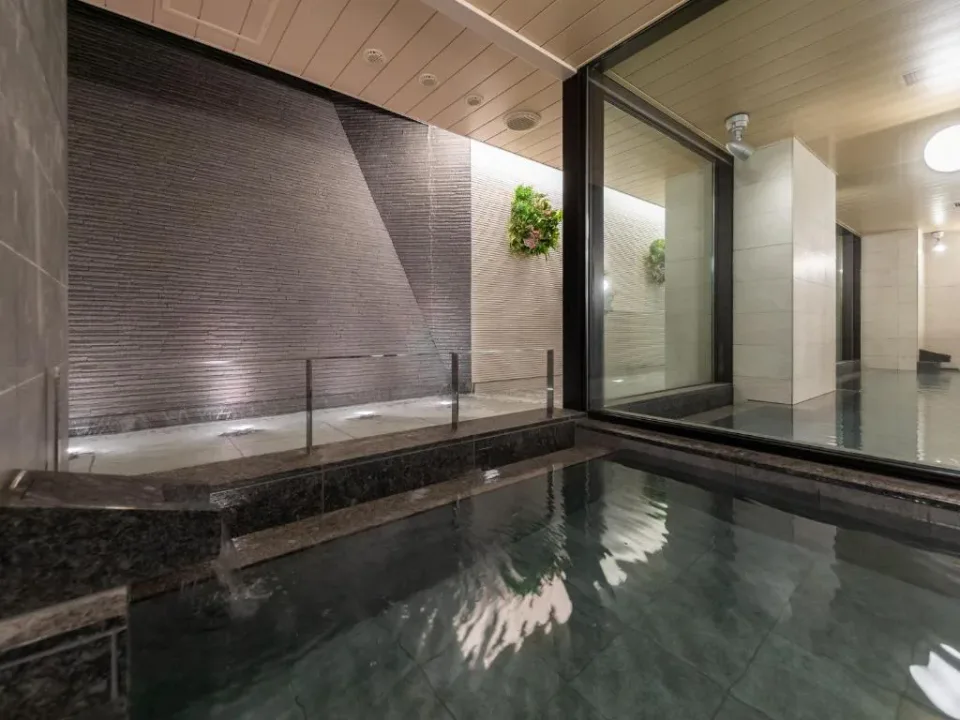
A group of friends with staggered schedules may manage the one-room plan well. Six people who all need to be dressed and outside within a 60–90 minute window are much more exposed to one slow shower or a missing charger. Two rooms create two private bathroom routines and two places to pack. That operational gain can outweigh a modest nightly saving. The public bath itself is a genuine hotel feature, shown in the approved property photo below; judge whether your actual group would use it rather than adding it as an abstract perk. Croom’s washer-dryer and bath choices explores the longer-stay side of that question.
Put a price on the second bathroom
Compare a real one-room Comfort Fourth offer with a real two-room combination for the same dates, guest count, breakfast, tax and cancellation conditions. Subtract the one-room total from the two-room total, then divide by guests and nights. The result is the added privacy cost per person per night. No invented room quote is needed: the calculation uses the prices on the offers actually available to your party. If there are six people staying three nights, the full difference should be shared over eighteen person-nights, not judged as a single intimidating total.
That premium buys more than square metres. One pair can sleep while another comes back late; luggage can be divided; morning departures can happen in parallel. One room, conversely, can be a deliberate choice for a close group on a short, social visit. The decision changes when a mobility-limited guest cannot use a bunk, when several people have large hard-shell cases or when the group must leave for an early Shinkansen. Osaka rooms for four to six friends offers another city’s version of the same price-versus-routine trade.
Do not compare a six-person Comfort Fourth against two randomly selected double rooms whose total permitted occupancy is only four. Confirm the registered guest limit, sleep surfaces and exact room category on both sides. If two-room inventory is limited, a headline price may be less relevant than whether the plan can actually register all travellers. Room adjacency or connecting arrangements should not be assumed from a request field.
Kushida Shrine-mae helps sightseeing; repeated Hakata trains change the map
The hotel stands at 6-30 Gionmachi near Canal City. Its current access information puts Kushida Shrine-mae Station on the Nanakuma Line around one minute away via stair exit 4 or about two minutes via escalator exit 5. Hakata Station is one rail stop away, which is useful for many trips. It is not the same as sleeping beside the JR or Shinkansen platforms. Moving six people and their cases through an extra transfer can be a larger penalty than moving one lightly packed traveller.
A stay centred on Canal City, Kushida Shrine and Gion can make this position attractive. One early train from Hakata is manageable; several early departures should trigger a comparison with a true station-side hotel. Miyako versus Blossom Chuo and Hakata Station hotel comparison show how the transfer repeats across a visit.
The address should also match what the group actually does at night. Tenjin shopping and Daimyo dinners may favour a different station and hotel arrangement, while Gion/Canal City plans make Croom easier to justify. Hakata versus Tenjin, the First Fukuoka stay length and the Fukuoka yatai areas help expose the repeated movement before the booking. If the group will shop heavily, Fukuoka hotel areas for bag drops adds a different test.
For four adults, Solaria changes the room area and bed trade
A four-person group should compare more than one Nishitetsu room. Solaria Nishitetsu Hotel Fukuoka’s Deluxe Quad is listed at 41.8 m² for four, 11.4 m² more than Croom’s 30.4 m² Fourth categories. Its fourth sleeping surface is a daybed, rather than a fourth identical conventional bed. The listed regular bed width is 120 cm and the daybed measures about 100 × 195 cm. Solaria therefore buys luggage and shared living space; it does not promise four perfectly equal sleeping positions.
Croom’s standard Fourth takes up to four and uses separate single beds, with upper-bunk positions. That can be preferable to a three-bed-plus-daybed arrangement for friends who care about individual beds, yet the vertical layout is a poor choice if nobody can or wants to climb. Its separate toilet and wash area also differ from some ordinary hotel rooms. Check the room photo and plan that correspond to the actual category offered, not a generic picture of the hotel. Fukuoka rooms for three or four adults puts those choices beside other candidates.
Comfort Fourth’s up-to-six capacity should not automatically replace the standard Fourth in a four-adult search. Its wider lower beds can support the higher occupancy, while the standard Fourth’s four individual sleeping surfaces may align better with four friends. A couple with children may make a different decision. If bed equality matters, resolve it before splitting the price equally. The published maximum says little about who gets which bed.
A second hotel comparison starts with the district
Solaria sits at Nishitetsu Fukuoka (Tenjin) Station and is roughly five minutes from the Airport Line’s Tenjin Station. That location is strong for Tenjin shopping, Daimyo evenings or Nishitetsu trips such as Dazaifu. Croom belongs to the Kushida Shrine-mae / Gion side. For travellers repeatedly returning to JR Hakata, neither the Solaria area nor the Croom address should be mistaken for a station-connected Hakata room. Solaria against ONE FUKUOKA HOTEL is more relevant when hotel time in Tenjin is the main purchase.
Luggage can reverse a room-space conclusion. Four carry-ons make Croom’s 30.4 m² easier to operate. Two large cases and two small bags leave either room in contention. Four large hard-shell cases make Solaria’s additional 11.4 m² more consequential. Shopping adds bags over time, so ask how the room will work on the last night rather than only at arrival. For a wider Kyushu route, luggage forwarding in Japan may remove a main case before the hotel decision is made. The Hakata-to-Yufuin luggage plan deals with one common onward journey.
Check the plan, not the request box
Nishitetsu’s January 2026 notice says special requests entered on overseas booking sites are treated as preferences and may not be fulfilled on the day. If your six-person plan depends on a particular bed arrangement, two rooms nearby, or an accessibility requirement, a comment box is not a guaranteed feature. Confirm the registered occupancy, exact room name, bedding and any essential arrangement before the free-cancellation deadline. The hotel’s request notice explains the policy; the room category and booking conditions still control what is reserved.
The same discipline applies to arrival time, bath use, breakfast and total price. Compare one Comfort Fourth to two actually available rooms for the same party and nights. Keep any group calculation in yen, since exchange rates move. The hotel lists check-in from 15:00 and checkout by 11:00 for ordinary plans, subject to the rate selected. A public bath can help a group, but its current hours and each traveller’s comfort with communal bathing should be checked for the booked date.
↔ Scroll table left or right
Decision dimension | What the evidence says | What the group must settle |
Occupancy | Comfort Fourth 30.4 m², up to six | Who sleeps where, not only the permitted count |
Floor and luggage | 7.6 m² gross each at four, about 5.1 m² at six | How many full cases remain in the room |
Bathroom routine | Separate toilet/wash/bath zones but one private toilet | Whether departures can be staggered |
Shared bath | Can add bathing capacity for willing guests | Hours and individual accessibility needs |
Location | Kushida Shrine-mae beside hotel, Hakata one rail stop | Frequency of JR departures versus Gion plans |
Alternative room | Standard Fourth four guests; Solaria quad 41.8 m² | Bed fairness, upper bunks and district |
Total booking | One room versus a valid two-room quote | Privacy cost per person-night and cancellation |
For one or two nights, especially with light bags and flexible mornings, a six-person Comfort Fourth can be a conscious compromise. By four or five nights, the same group should expect the laundry, shopping and sleep-schedule issues to recur. At four occupants, the standard Fourth and Solaria comparison may matter more than the six-person maximum. At five or six adults, calculate the two-room premium and ask every traveller about beds and bathroom timing before paying. A family with children should also consider Fukuoka family hotels, since the bed-sharing decision differs from six adults.
Seven site scores when six share the Comfort Fourth
Dimension | Site score | Why the six-person setup changes it |
|---|---|---|
Location | Kushida Shrine-mae is beside the hotel; repeated JR departures still require the Hakata connection. | |
Room | Six people share 30.4 m², about 5.1 m² gross each, with bags and one private toilet. | |
Cleanliness | The current aggregated guest cleanliness category is around 9.4/10. | |
Service | The aggregated guest service category is around 9.1/10; critical bedding requests still need direct confirmation. | |
Facilities | Separate wash zones and the public bath help a group, but they do not create a second private bathroom. | |
Food | Breakfast can start at 06:30; six different morning schedules may make a room-only rate easier. | |
Value | One room can reduce the booking total, yet the rate must beat two valid rooms by enough to justify less privacy. | |
Overall | Most persuasive for four light-packing guests; at six adults, compare two rooms before paying. |
These are site scores out of ten for six adults using one Comfort Fourth, rather than a score for every Croom room category. Cleanliness and service use anonymous guest category aggregates; room and value reflect the unusually dense sleeping plan.
To compare current availability, open rooms around Kushida Shrine-mae and Gion with the actual number of guests. Price a valid two-room arrangement against Comfort Fourth on identical dates. If the whole itinerary starts at JR Hakata, compare rooms near Hakata Station too. The answer should reflect the group’s space and morning routine as well as the displayed room total.
Other Fukuoka group decisions
Fukuoka hotels for three · Miyako Hotel Hakata · Hakata Station hotel comparison · first-visit three-day Fukuoka route · Fukuoka yatai guide · Solaria Nishitetsu Hotel Fukuoka · Fukuoka to Yufuin · Miyako Hotel Hakata vs · Fukuoka hotels for three · Nishitetsu Hotel Croom Hakata · Nishitetsu Hotel Croom Hakata · Nishitetsu Hotel Croom Hakata · THE LUIGANS Spa & · Mitsui Garden Hotel Fukuoka · Six People in Okinawa? · Nishitetsu Hotel Croom Hakata: · La Vista Furano Hills: · Mitsui Garden Hotel Fukuoka · Save Sunday for Omotesando: · Mitsui Garden Hotel Fukuoka · Sapporo Autumn Fest 2026: · WeBase Hakata vs UNPLAN · Centara Grand Hotel Osaka: · MIMARU Osaka Shinsaibashi Central:.