
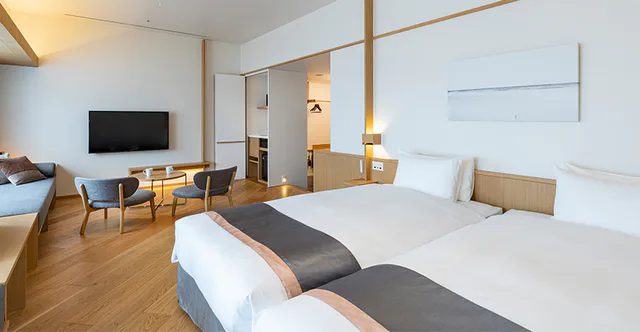
A week in Fukuoka is long enough for small room and location decisions to become daily routines. The traveller who washes clothes on Tuesday may need less luggage for the remaining five nights; the person who never cooks or does laundry may get no return from paying for a kitchenette. A private 12 m² studio can work when a shared kitchen and lounge really become part of the day. Two large suitcases and two people who want to spend evenings privately can make that same setup tiring. Decide which task the room must perform before ranking hotels by a nightly headline rate.
Four properties illustrate distinct answers. Tokyu Stay Fukuoka Tenjin puts washer-dryers in rooms but its basic 18–19 m² categories remain compact. HOTEL IL PALAZZO offers 27–35 m² room choices and EL DORADO as an additional place to sit. lyf Tenjin shifts some cooking, work and laundry into shared facilities while many studios are only 12 m². Hotel JAL City Fukuoka Tenjin is a conventional 21–28 m² room choice around Akasaka Station. None wins a five-to-seven-night stay independently of the daily route.
The map comes first when several mornings begin at Hakata JR. The Hakata-or-Tenjin area decision separates rail departures from evening dining and shopping. A very well-equipped Tenjin room can still cost the traveller time if the trip starts at Hakata every day. For a short stay, that friction is minor; after eight or ten repeated rides, it belongs beside laundry and room size.
The property features solve different repeat problems
| Repeated need | Likely starting point | Limitation to price in |
|---|---|---|
| Wash and dry clothes privately during a five-to-seven-night stay | Tokyu Stay Fukuoka Tenjin | The 18–19 m² entry rooms do not become roomy because a machine is installed. |
| Spend two or three quiet hours in the room or lounge each evening | HOTEL IL PALAZZO | Its 27–35 m² choices and EL DORADO are less useful when every day ends near midnight. |
| Use shared cooking and working space to keep the room bill down | lyf Tenjin Fukuoka | A 12 m² private studio does not offer much suitcase or two-person living room. |
| Keep a straightforward private room without apartment features | Hotel JAL City Fukuoka Tenjin | No in-room washer-dryer proposition; Akasaka may be a poor base for repeated Hakata JR starts. |
The table ranks functions, not a hotel's overall quality. A washer used twice may genuinely replace several packed outfits. A lounge visited nightly may replace the need for a larger private room. Conversely, a facility ignored for six of seven days has almost no value to that traveller. The broader Fukuoka hotel-area comparison helps set the route before choosing among the facilities.
Tokyu Stay makes the laundry decision concrete
Tokyu Stay Fukuoka Tenjin lists a washer-dryer and microwave in its Moderate Single and Moderate Double, both 18 m². The 19 m² Residential Double adds a kitchenette to the washer-dryer, while the 30 m² Residential Twin and 40 m² Deluxe offer more room and cooking equipment. A traveller who intends to wash clothes halfway through a week can pack for fewer days. That benefit is especially tangible when luggage would otherwise stay open on the floor of an entry room.
The trade is that appliances occupy a real, finite room. Two travellers carrying large 28-inch suitcases should not infer spare floor space from the word Residential. For a longer stay, compare the 18–19 m² lower categories with the 30 m² twin by exact bed arrangement and rate rather than assuming the cheapest in-room washer solves both laundry and luggage. The Tokyu Stay room decision tests whether the appliance justifies a Tenjin address when trains leave Hakata.
Housekeeping also changes the daily experience. The property says simple cleaning on a multi-night stay is provided on request: towels, bathmat and nightwear can be changed and trash removed. Once a stay reaches seven nights, fuller room cleaning is performed once a week in addition to that simple service. Guests who expect a fully made bed and a complete room clean every day should not silently assume that an extended-stay brand supplies it. For a seven-night booking, read the actual plan and decide whether the posted schedule fits the way the room will be used.
Breakfast at Tokyu Stay's Osteria Valentina is currently a ¥2,200 Japanese-Western buffet, 06:30–10:00 with last order at 09:30. Seven paid adult breakfasts amount to ¥15,400; four cost ¥8,800. Those are simple yen totals, not a stable foreign-currency price. If two mornings start early at Hakata and others are spent eating elsewhere in Fukuoka, buy or include only what the schedule is likely to use. The complete Tokyu Stay versus IL PALAZZO comparison shows why a shorter stay can lead to a different answer.
| Tokyu Stay choice | Published area and equipment | Practical long-stay test |
|---|---|---|
| Moderate Single / Double | 18 m²; washer-dryer and microwave | Laundry autonomy matters more than spreading out. |
| Residential Double | 19 m²; washer-dryer, microwave and kitchenette | Will the small kitchen be used often enough in a compact room? |
| Residential Twin | 30 m²; washer-dryer and kitchenette | Two beds and luggage may justify a larger category. |
| Deluxe | 40 m²; washer-dryer and kitchenette | Check the actual guest number and bed setup before treating it as an automatic bargain. |
Tokyu Stay's Tenjin location can make evening food and shopping easy, but the station pairing depends on the full itinerary. A washer-dryer is a poor reason to add a cross-city transfer every morning if the machine will run only once. It is a strong reason when a light-bag traveller keeps several Tenjin-based days and can wash without leaving the room. A late-arrival first-night plan may also keep a tired flight arrival from forcing an unnecessarily long final transfer on day one.
IL PALAZZO answers the room-time question
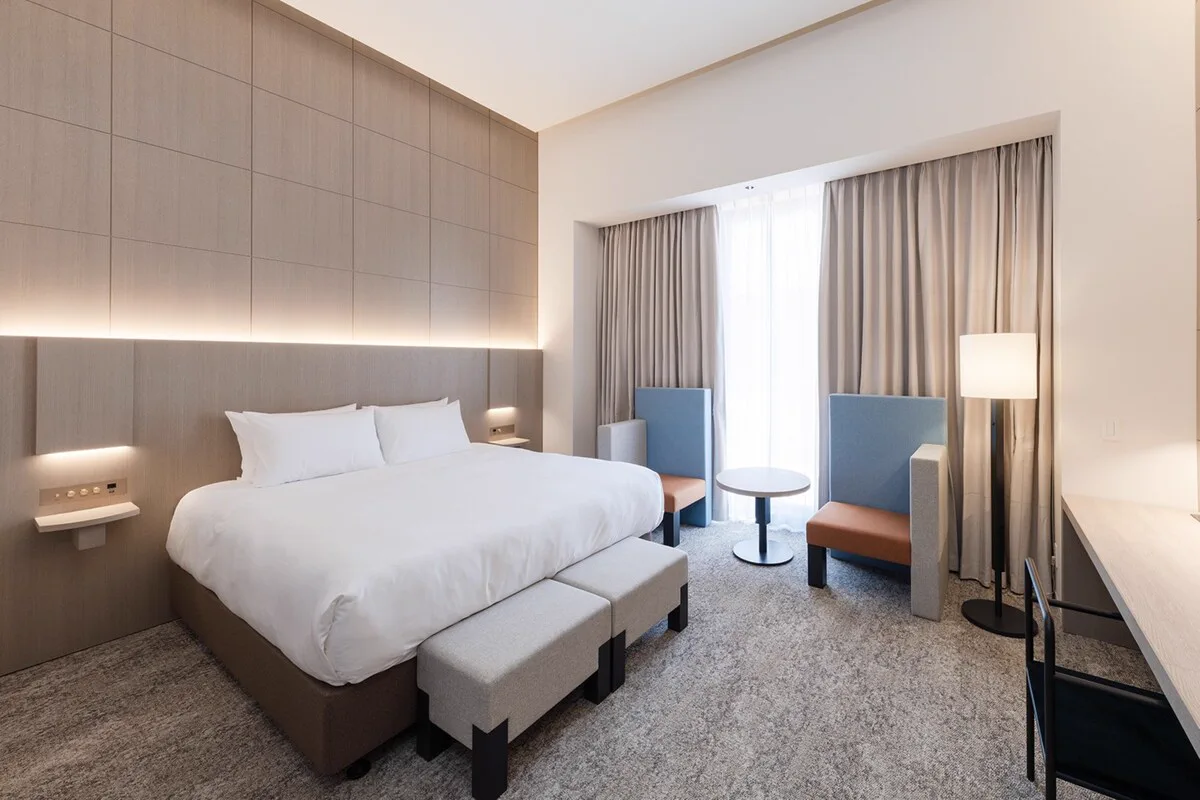
HOTEL IL PALAZZO's published Superior Queen is 27 m² and Deluxe King is 35 m². The latter's large desk and king bed support a different evening from a compact wash-and-sleep room. EL DORADO is a shared extension of that space, with guest breakfast listed from 07:00 to 11:00 and an exclusive guest lounge service currently from 17:00 to 19:00. Midday buffet and afternoon tea are separately priced offerings; do not read a lounge photograph as unlimited all-day food included in every rate.
This combination is worthwhile when someone returns after sightseeing to work, read, regroup or have a slow dinner period. The 27–35 m² room also makes luggage and shopping easier to live with across a week. It does not perform Tokyu Stay's in-room laundry task. If the travellers intend to leave at 07:00 and return at 23:00 each day, the larger room and lounge may receive too few waking hours to justify a premium. The IL PALAZZO location review adds the Nakasu-side route question.
A booking should distinguish included guest breakfast and the 17:00–19:00 lounge service from the paid lunch and afternoon tea services. The hotel currently lists a visitor breakfast price of ¥4,500; that is not the charge shown for an overnight guest on the lounge page. For a seven-night stay, repeatedly assuming a complimentary full lunch would materially distort the budget. Exact service conditions can change, so compare the chosen room and package with the hotel's current lounge page before paying.
lyf works when shared space is used on purpose
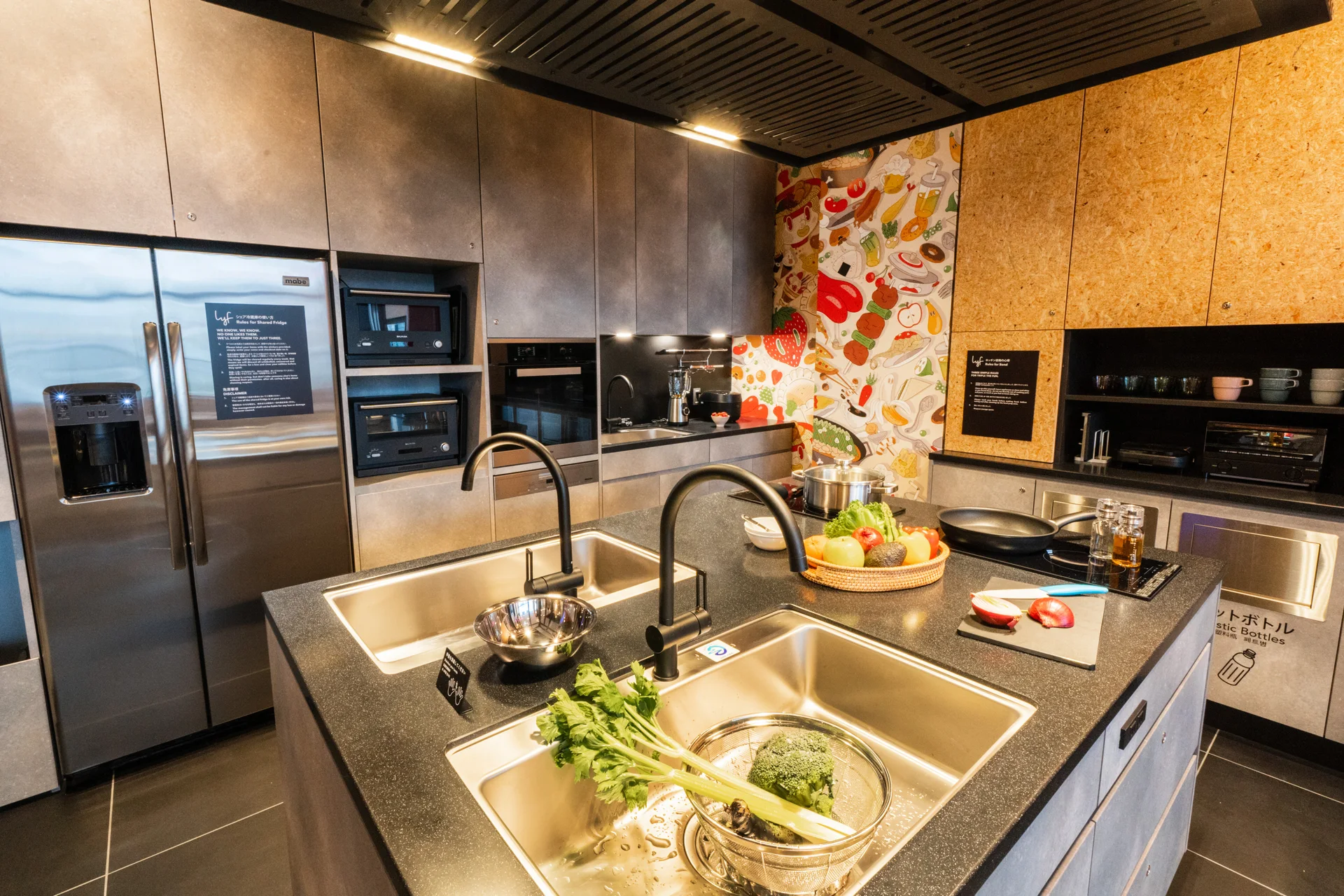
lyf Tenjin Fukuoka lists One of a Kind double and Side by Side twin studios at 12 m²; Side by Side Plus offers 16 m². The private room is deliberately compact. BOND is the shared kitchen, WASH & HANG the launderette, and CONNECT a social working area. A solo traveller who is comfortable preparing a simple meal in a communal kitchen and sitting outside the bedroom may get more functional space than the 12 m² number alone suggests.
The same plan is less convincing for two people who each bring a large suitcase and want private evening time. Laundry means leaving the room and using a common facility, whereas Tokyu Stay makes the machine part of the room. The kitchen also sits outside the studio. These are substantive differences, not merely aesthetic preferences. The lyf Tenjin room-and-shared-space guide works through the trade in more detail.
Ask whether the group would actually use the communal areas daily. If one person works while the other rests, a shared table may help; if both need privacy and silence, leaving a small bedroom can feel like a compromise. The 16 m² corner twin buys only four more square metres than a 12 m² studio, so it should be compared by actual dates rather than assumed to solve every luggage issue. If the stay is mostly evenings in Tenjin and only sleep happens in the room, the small footprint is easier to accept.
JAL City is the conventional-room counterexample
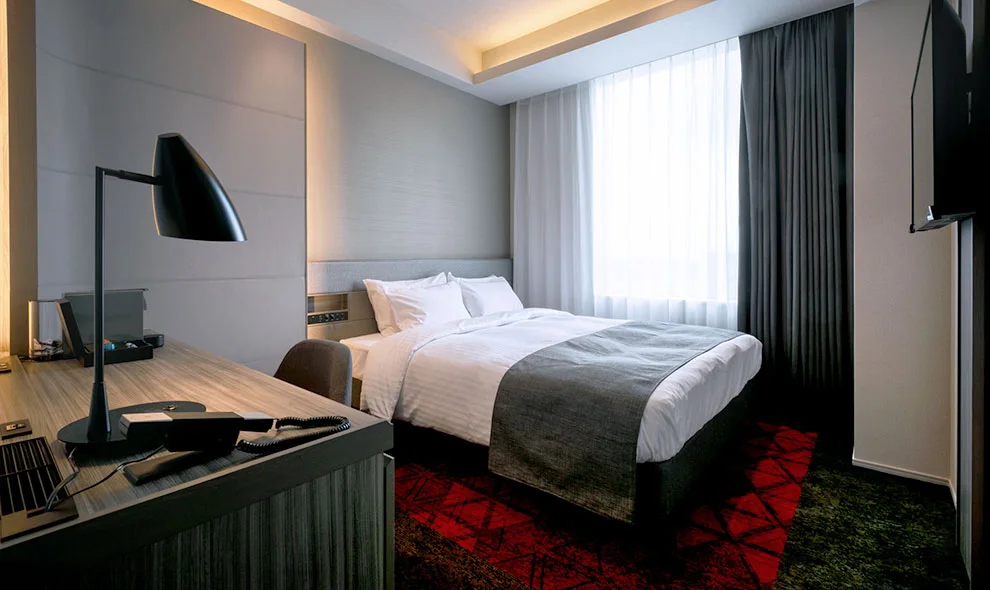
Hotel JAL City Fukuoka Tenjin has a 21 m² Moderate Queen and a 28 m² Superior Twin. The latter lists two 120 cm beds and a separated bath and toilet. For guests who will eat out, do laundry only occasionally and spend private evening hours sorting purchases or working, this conventional layout can do more than a kitchenette that never gets used. Its Akasaka Station position makes a different daily map from a hotel near Hakata station or deep in Tenjin's evening district.
That map matters on a long stay. Akasaka is useful for some Tenjin-side days, while repeated Hakata JR departures add another ride and station transition. JAL City's room does not replace the in-room washer-dryer proposition at Tokyu Stay. The choice is an explicit trade between floor area, bed and bath layout, laundry method and base. The JAL City Akasaka walk and room guide checks whether that station position serves the route.
Breakfast inclusion, cleaning and cancellation should be compared on the actual room plan, not inferred from a hotel category. Seven nights make even a small daily add-on noticeable. For a larger party, the three-or-four-adult room decision may point to two rooms. For two guests, the distance between a 21 m² queen and a 28 m² twin can also matter more than it would on an overnight stay. Evaluate how many hours they will spend together inside, not simply whether the listing displays the word spacious.
Seven days turn the Hakata–Tenjin ride into a schedule item
Fukuoka City Subway's published fare table gives ¥210 one way for an adult between Tenjin and Hakata. A return costs ¥420. Four extra round trips in a week amount to ¥1,680; seven amount to ¥2,940. The yen is rarely the decisive cost. Each unnecessary trip also means walking to the station, reaching the platform, waiting and repeating that process after a tiring day. This is why a Tenjin room that wins on laundry or lounge space can still lose for a JR-heavy route.
| Unnecessary Tenjin–Hakata return journeys | Adult subway fare at ¥210 each way | What the fare excludes |
|---|---|---|
| One | ¥420 | Station approach, platform wait and luggage handling |
| Four | ¥1,680 | Eight separate rides within the week |
| Seven | ¥2,940 | Fourteen rides generated by a base mismatch |
If a car is planned on only some days, the Fukuoka car-day base guide is more useful than forcing a car into every day. If three or four day trips use JR from Hakata, look again at a Hakata-side hotel before paying for Tenjin long-stay equipment. If most dinners, shops and appointments are in Tenjin, the same room placement may save time instead. An extra night in Fukuoka versus Yufuin can alter the count of station starts, as can the Fukuoka dinner-base decision. Do not convert the subway fare into a dated dollar figure; exchange rates and card charges are unrelated to the stay-location calculation.
Seven qualitative checks before choosing a week-long room
The old article's numeric friction scores implied measured precision that the hotel facts do not provide. The useful comparison is seven separate questions with visible evidence; the result changes with the traveller's route and habits.
| Dimension | Evidence to compare | When it becomes costly |
|---|---|---|
| Location | Hakata JR starts versus Tenjin, Nakasu and Akasaka evenings | Repeated station transfers to reach the first train |
| Room utility | 12, 18–19, 21, 27–28 and 35 m² examples | Two guests and permanently open cases in a small room |
| Laundry | In-room Tokyu washer versus lyf shared launderette | Many wash cycles or an inconvenient shared-laundry queue |
| Cooking and food | Selected Tokyu kitchenettes, lyf BOND, hotel breakfasts | Paying for facilities or seven breakfasts that go unused |
| Common areas | IL PALAZZO EL DORADO and lyf CONNECT/BOND | Wanting privacy, or returning after the useful service period |
| Housekeeping | Tokyu simple cleaning on request and weekly fuller cleaning after seven nights | Assuming a complete daily room clean |
| Whole-stay value | Room, breakfast, transit and usable facility time together | A cheap nightly rate with repeated add-ons or lost hours |
Different weeks change the answer. A laundry-heavy solo trip based around Tenjin can favor Tokyu Stay. Two people planning relaxed hotel evenings may gain more from IL PALAZZO's private area and lounge. A social traveller who rarely sits in the bedroom can make lyf's shared facilities do real work. Travellers who want a plain private room and only occasional laundry may prefer JAL City. A week with frequent Hakata JR departures may instead point back to a Hakata hotel, and a two-, three- or four-day Fukuoka route can clarify the number of rail-heavy days, even if its in-room feature list is shorter.
The final comparison should use the same seven dates, number of guests, exact room and bed setup, breakfast, cancellation deadline and taxes. The Fukuoka budget-hotel cost guide illustrates how unused perks and transfers move the total. The Osaka long-stay comparison is useful only if the itinerary also includes a base change there; it should not replace a decision about Fukuoka's actual daily route.
A five-to-seven-night Fukuoka base should solve the task you will repeat, not the one that sounds appealing in a listing. Count intended wash cycles, evenings in the room and morning Hakata departures; then compare rooms around Tenjin and Akasaka with those same dates and conditions.