
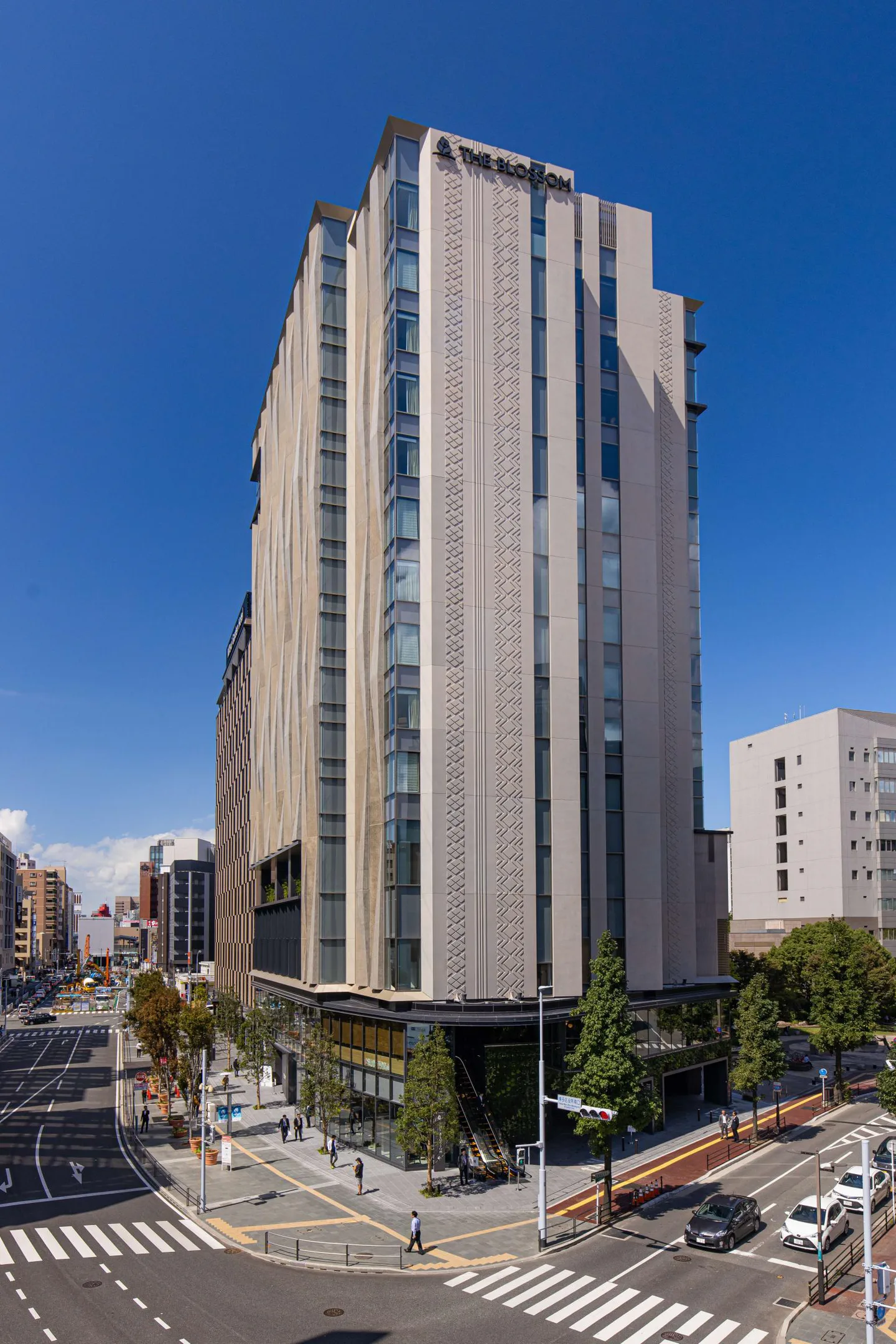
The address sits between two useful parts of Fukuoka. THE BLOSSOM HAKATA Premier is about seven minutes from JR Hakata Station, where many Kyushu trains begin, and roughly two minutes from Kushida Shrine-mae on the Nanakuma subway line. A booking here makes sense when the time saved on old-town evenings and the space of a larger twin offset the walks back to the rail hub. For a late arrival followed by an early train, those advantages may have almost no time to matter.
This review treats the hotel as an itinerary choice. The Deluxe Twin offers 30–37 m², two regular beds and an optional extra bed for a third guest; the fourth-floor bath is another draw, subject to its admission rules. None of those features cancels a repeated journey to Hakata Station. Count your rail departures, consider who will use the bath, then compare a station-side room on the same dates. The three-hotel Hakata station comparison is a useful starting point if walking distance is your main constraint.
Where this Hakata address earns its place
↔ Scroll table left or right
Trip shape | Likely fit | What changes the answer |
Late arrival and early train next day | Weaker | The seven-minute Hakata leg repeats before the room and bath get much use. |
Two adults with large cases for three or four nights | Strong | The 30–37 m² Deluxe Twin can be used across the stay. |
Evenings around Canal City, Kushida and Nakasu | Strong | Kushida Shrine-mae is close, reducing returns through Hakata. |
Three JR or Shinkansen days | Compare station hotels | Repeated Hakata walks may outweigh the room advantage. |
Public bath is unusable for the party | Reprice without it | The room and address must carry the decision alone. |
Three adults in one room | Check exact bedding | Deluxe Twin extra bed and NAGOMI futon are different. |
Two stations serve different days
The hotel's route information gives approximately seven minutes on foot from JR Hakata, two minutes from Kushida Shrine-mae Exit 5 on the Nanakuma Line and six minutes from Gion Exit 5 on the Airport Line. Ekimae Sanchome bus stop is about a minute away. These are distinct access options, not interchangeable directions from one station. If you arrive by Shinkansen you still have the Hakata walk; a Nanakuma-line trip may put you much closer to the door.
Hakata's rail hub is useful for a Yufuin train or bus journey, a Kyushu rail-pass itinerary or a move onward through the island. On city evenings, the hotel's position pulls the other way, toward Canal City, Kushida Shrine and Nakasu. Staying beside Hakata's platforms saves minutes on rail mornings; this address can save a return to the hub when dinner is east of Tenjin. Map the places you will actually revisit instead of letting the word 'Hakata' settle the choice.
A first visit with one intercity train day and several Fukuoka nights can favour the old-town side. A stay built around departures every morning will expose the seven-minute leg repeatedly. Guests whose plans lean heavily toward Tenjin should widen the search: Hakata versus Tenjin as a base may matter more than the difference between two Hakata hotels. The property has a useful middle position, but a middle position cannot shorten every journey.
Canal City shopping and a Nakasu yatai evening are plausible reasons to use this side of the district. Travellers intending to return to the room with shopping bags can also compare the Fukuoka shopping-hotel decision. If those are only one-off stops, a station-side room may make the rest of the stay easier.
The cost of a seven-minute walk depends on repetition
Write the Hakata trips into the day plan before deciding whether the distance is trivial. A published walk estimate describes one direction in ordinary conditions; it says little about how often you repeat it, where the train platform is, or how quickly your group moves with cases. The same address can be low-friction for one traveller and a daily inconvenience for another.
Consider four hotel nights with three days that begin and end at JR Hakata. Those three round trips create six station-to-hotel legs. Arrival and final departure add two more: eight legs in total. At seven minutes per published leg, the arithmetic reaches 56 minutes of walking across the stay. This is a planning illustration, not an observed door-to-platform journey; rain, lifts, crossings and walking pace will change the real total.
A closer hotel can reasonably cost more when it removes much of that repeated movement, especially with an older parent or a tight first train. JR Kyushu Hotel Blossom Hakata Chuo and Hotel Forza by the Chikushi exit show how much room size and exit location vary among station choices. Check which side of Hakata your train and hotel use; a headline station walk does not describe the entire transfer.
Now consider a stay where the only JR luggage legs are arrival and departure. If the other days remain in Fukuoka and several dinners finish around Canal City or Nakasu, this hotel's eastern position may be used more often than Hakata's rail edge. A three-day Fukuoka route can expose that pattern before booking. The question is not whether seven minutes is intrinsically long; it is whether the itinerary asks you to pay it repeatedly.
What the Deluxe Twin adds beyond a station room
The larger twin is the most concrete room reason to stay here. A Moderate Double can suit one person or a short light-luggage visit, and the 27 m² Moderate King works for travellers who want one broad bed. Neither automatically solves the needs of two people carrying large cases or three people sharing. Ask for the actual room category rather than relying on a photograph of a different category within the same property.
The hotel lists Deluxe Twin rooms at 30–37 m² for two or three guests. The two standard beds measure 120 × 200 cm, and a third occupant uses an added bed. The bathroom has a separate washing area. Because this category spans seven square metres, the 37 m² end should not be assumed for every reservation; room layouts and orientation can also differ. For a group, compare the booked bedding and floor plan with the luggage that must remain accessible during the stay.
Published Moderate Double size runs from 21 to 24 m², while Moderate King is 27 m². Comparing the lower endpoints, 30 m² is roughly 43% more area than 21 m². That arithmetic shows why a twin might feel materially different on a longer stay, but it is not a promise of 43% more usable luggage space in any particular pair of assigned rooms. Furniture, bed arrangement and bathroom footprint determine how that area works. Fukuoka family hotel choices put similar weight on the sleeping layout and repeated room use.
↔ Scroll table left or right
Room category | Size and capacity | Booking detail that matters |
Moderate Double | 21–24 m²; two guests | 160 × 200 cm bed; shower booth, without an in-room bathtub. |
Moderate King | 27 m²; two guests | 180 × 200 cm bed; corner category and shower-only layout. |
Deluxe Twin | 30–37 m²; two or three | Two 120 × 200 cm beds, washing-area bath and optional third extra bed. |
Comfort Deluxe Twin NAGOMI | 31–32 m²; two or three | Two 120 × 200 cm beds, washing-area bath and tatami-area futon. |
Three guests need a bedding decision, not a capacity label
Both Deluxe Twin and Comfort Deluxe Twin NAGOMI permit up to three people, yet they reach that number differently. Deluxe Twin has two 120 cm beds and takes a third extra bed. NAGOMI spans 31–32 m² and uses a futon in its tatami area for the third sleeper. Someone comfortable on a floor futon may prefer NAGOMI's arrangement; someone expecting three elevated beds should not infer that from either room name. The three-or-four-adult Fukuoka room guide helps test whether one room is the right purchase at all.
Ask how the third sleeping surface is prepared and where the luggage goes after it is in place. A room's stated capacity describes permission to occupy it, not the amount of open floor left at night. Two adults with one child may judge the futon differently from three adults sharing equally. If a member of the group cannot sleep on a futon, rule NAGOMI out before comparing the price. The one- or two-square-metre category difference matters less than that physical setup.
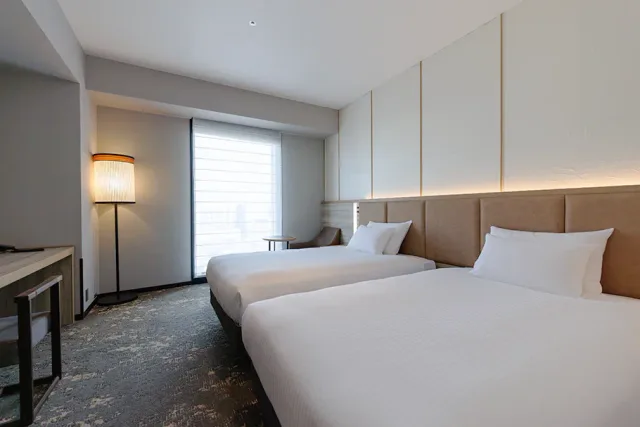
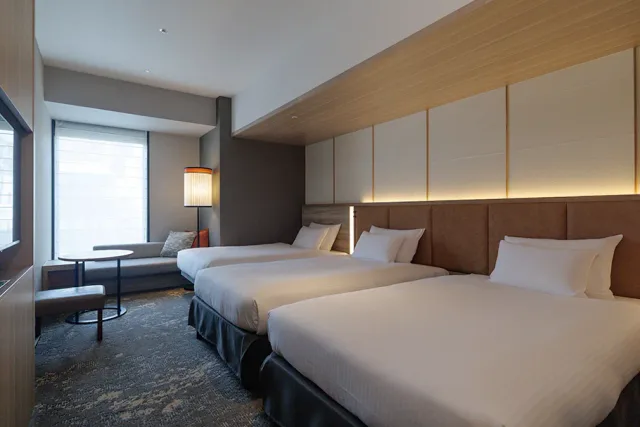
Search with all three guests entered, then compare the same cancellation and breakfast conditions. The cheapest two-guest result may be for a Moderate Double and says nothing about the final three-person cost. For a group that wants a conventional third bed, confirm the Deluxe Twin extra-bed arrangement in the selected rate rather than assuming every room photograph shows it deployed.
The fourth-floor bath has useful hours and specific entry rules
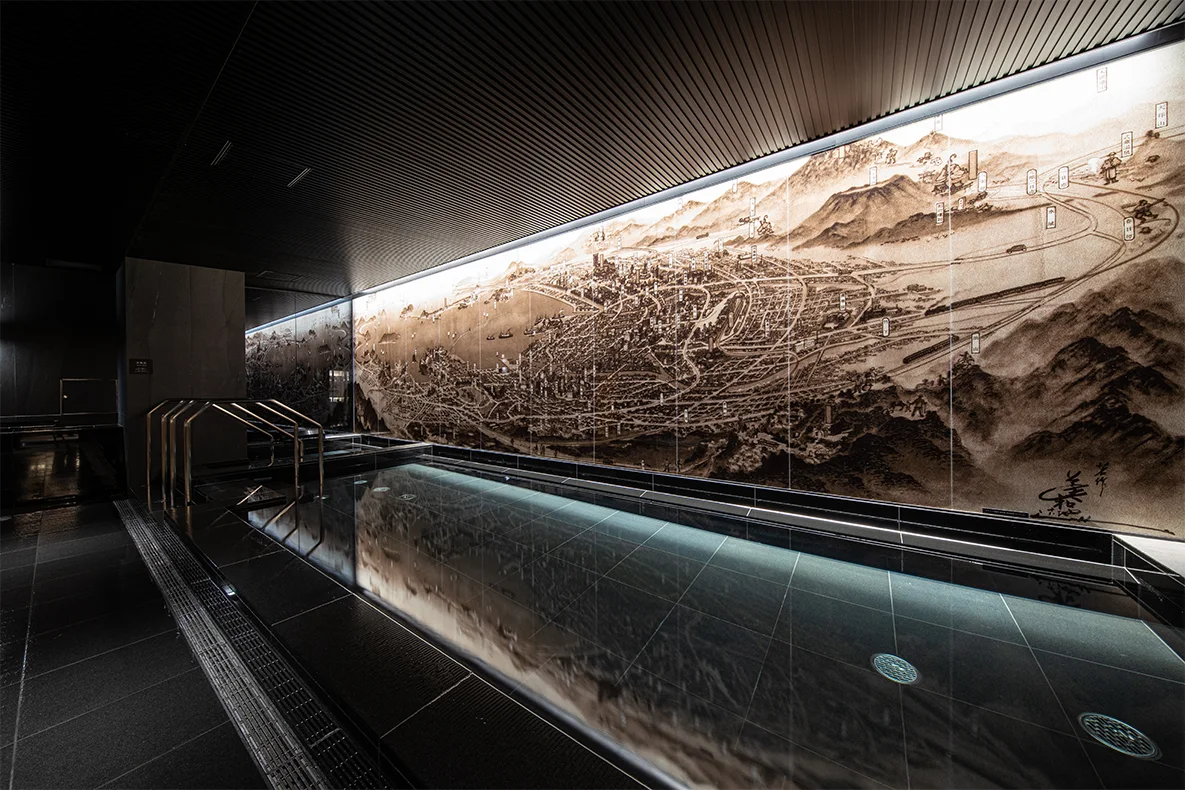
Staying guests can use the large public bath and sauna without an additional admission charge. The current hours are 15:00–25:00 and 06:00–09:00, leaving an evening window after dinner and a short early-morning window. These hours are also listed for the fourth-floor fitness room. A guest who returns early enough can use the bath several nights; a traveller entering after midnight and leaving at dawn may only have a narrow opportunity, even though the facility appears in the hotel description.
For a longer stay, count likely bath sessions rather than treating the amenity as an abstract bonus. Two evenings back before closing may make the room more appealing than a smaller station hotel. On an early departure day, breakfast, packing and reaching the platform may crowd out the 06:00–09:00 bath slot. The Miyako versus Blossom comparison separates the direct-station benefit from the kind of bath experience each hotel offers.
The hotel excludes guests who are still in diapers from the public bath and may deny entry to intoxicated or disruptive guests. Its facilities page states a general tattoo restriction, but a separate hotel notice explains an exception: a tattoo may be admitted if it can be completely covered by no more than two approved 10 × 10 cm stickers, supplied free at the front desk. Larger designs that cannot be fully covered are not admitted under that notice. This correction matters if bath access is decisive for your booking; do not treat the older blanket wording as the whole policy.
If somebody in the party cannot enter the bath, price the room and location on their own merits. The separate washing area in the Deluxe Twin remains relevant, but it is a different feature from a shared bath session. A Torifito Hakata Gion comparison shows another room-plus-bath trade-off nearby. Choosing for the facilities your group can use is more reliable than giving every amenity the same value in a checklist.
A transfer night uses the hotel differently
An arrival at 22:30 with two large cases leaves little evening. The bath remains open until 25:00, but unpacking, dinner and sleep may consume that time; a morning train can make the 06:00 bath slot unattractive as well. The Deluxe Twin provides generous space for the cases, yet they might never be fully opened. In this pattern, two seven-minute station walks can be more noticeable than the larger room. Late-arrival Fukuoka hotels focus on the first-night journey rather than facilities used later.
A station-adjacent room has a simpler purpose on that night: leave the train, get to bed, then reach the next platform. Forza's one-minute Chikushi-side location illustrates how much room area some travellers are willing to surrender for that short chain. If the transfer also involves a large family, however, the room capacity may be the harder constraint. Compare the actual sleep arrangement before buying a smaller room solely for its walk time.
The transfer case does not condemn the property for every stay. It simply changes which parts of the booking are usable. A late first night followed by three city nights is a different purchase from one late night followed by an early train. Split stays can even make sense when the wider Kyushu route changes hotels; one hotel need not optimize both the arrival and every later day.
A multi-night city stay uses the room between outings
Three or four nights give the larger twin a chance to matter. Cases can stay open without being repacked each morning, and guests can return before an evening out. The hotel then connects a comfortable room with the Canal City–Kushida side of the city; after dinner, the bath may still be open. This is a stronger case for the extra station walk than a listing that simply says 'spacious room'. A Fukuoka long-stay hotel comparison gives more weight to daily annoyances than to a first impression at check-in.
That plan changes if all dinners and shopping end near Tenjin. You could still use the hotel's space, but the two-node Hakata/Kushida geography would not be doing as much work. Fukuoka food-trip hotels frame the return journey around where a meal finishes. For a group with several Hakata departures, the room must compensate for those repeated station legs as well.
The three-day first-visit route and Nakasu, Tenjin and Nagahama yatai areas make the evening geography more concrete. If sightseeing takes you on a Dazaifu or Itoshima day trip, check the transport leg separately; not every excursion begins at the same station. A room that shortens the way back after dinner should still be tested against the morning departure point.
Breakfast competes with the morning departure buffer
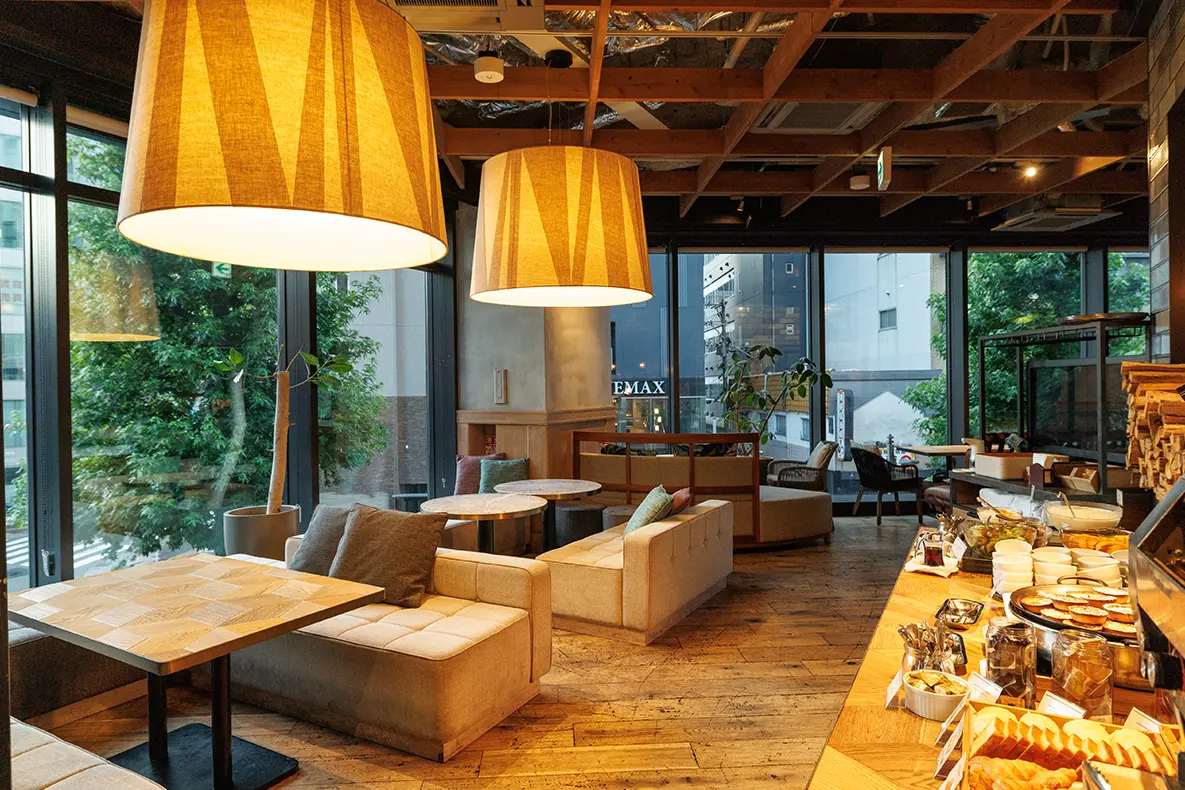
Nine Doors serves a Japanese-Western breakfast buffet from 06:30 to 10:00, with final entry at 09:30. The hotel currently lists ¥3,080 for adults and ¥1,870 for children, while children under seven eat free. Those are meal terms, not an estimate of how much breakfast adds to a particular room rate. If two adults would both eat there, compare the breakfast-included rate against the room-only price using the same occupancy and cancellation terms.
An unhurried city morning can use the full service window. A train morning needs a different calculation: allow for eating, retrieving bags, the seven-minute outdoor walk, finding the correct Hakata platform and a boarding margin. A 06:30 opening does not guarantee enough time for every early Yufuin, Aso or Shinkansen departure. Fukuoka breakfast options can help if a simpler meal works better, while Fukuoka to Aso tests whether the trip itself belongs in one day.
Prepaying for breakfast does not create more departure time. On a rail-heavy itinerary, compare the included-meal premium with the mornings when you can actually sit down. If only one of three mornings is relaxed, a room-only booking may be easier to manage, provided that is the rate available on your dates. Check the current dining hours again for the actual stay because the timetable is an operational detail.
Rain and suitcases alter the walk
Seven minutes is the hotel's ordinary walking estimate. It is less predictive when two large suitcases, umbrellas or a slower walking companion turn each crossing into a pause. The route is most consequential at arrival and departure, when the bags are necessarily with you. A light day bag on a dry evening is a different load. Fukuoka rainy-day hotel routes is useful for examining the uncovered final stretch rather than relying on a station distance alone.
Count how many Hakata legs actually carry the heavy bags. If there are only arrival and checkout legs, several old-town evenings may still justify this address. If a multi-city itinerary makes you drag the same cases to JR on successive days, station proximity can deserve a higher room price. The Hakata-to-Yufuin luggage options show when a baggage plan can change that balance.
Forwarding the largest case on an appropriate multi-stop route can remove part of the walk's burden, but confirm the receiving property, delivery date and anything you need overnight first. Japan luggage forwarding choices covers that decision in more detail. Do not use an assumed same-day delivery to justify a booking; choose the hotel on a route your group can manage even if the baggage arrangement requires an extra day.
Compare room plans with the same inputs
Enter the correct adult and child count, then hold the room category, meals, tax treatment and cancellation rules constant between offers. A Deluxe Twin with a third extra bed and a NAGOMI futon are distinct three-person products. A low Moderate Double rate is not a like-for-like price comparison. When choosing between this property and Mitsui Garden Hotel Fukuoka Gion for three adults, ask what each sleeper gets and how much floor remains, then decide whether Hakata's seven-minute walk is acceptable.
Compare THE BLOSSOM HAKATA Premier room plans for your dates.
For a station-first alternative, compare the Miyako versus Blossom decision on the same dates. The stronger rate is the one whose facilities, bedding and cancellation conditions your group will use; a lower teaser price for another room type does not settle it.
For three adults or a family, check whether breakfast and the extra sleeping surface are included before making payment. The room category matters as much as the hotel's name, and a listing image may show a two-person setup even when the category permits three.
The answer changes with the number of Hakata mornings
This hotel is a convincing choice when at least two of its concrete advantages will recur: a 30 m²-class Deluxe Twin, evening use of the fourth-floor bath, and a route that finishes near Kushida, Canal City or Nakasu. A three- or four-night city stay with luggage and unhurried returns gives those features time to earn their price. The booking is less compelling if the room is only a bed between trains.
For three rail days in a four-night stay, the illustrative eight Hakata crossings total 56 minutes at the hotel's seven-minute estimate. That number is a signal to compare a closer hotel, not a prediction of your actual walking time. With a parent, children or heavy cases, the experience may weigh more than the minutes; with light bags and city evenings, less. Fukuoka hotels with parents offers another lens on repeated movement.
For a single transfer night, start with station access. For three guests, decide whether the third person gets the Deluxe Twin extra bed or NAGOMI futon. For anyone relying on the public bath, apply the diaper and tattoo-sticker rules to the actual party. If those checks still favour THE BLOSSOM HAKATA Premier, the walk is a known trade rather than a surprise at arrival.
The Hakata Premier stay in seven scores
| Dimension | JapanLayer score | What matters for this booking |
|---|---|---|
| Location | Hakata Station is roughly seven minutes away, with Kushida Shrine-mae closer for subway journeys. | |
| Room | The 30–37 m² Deluxe Twin accommodates a third person only through its named extra-bed arrangement. | |
| Cleanliness | Room and bath upkeep are a clear strength in recent stay records. | |
| Service | Staff scores are strong and the hotel's luggage and front-desk setup suits rail-based arrivals. | |
| Facilities | The fourth-floor public bath, sauna and guest laundry make a multi-night stay more useful. | |
| Food | Breakfast has good variety but adds cost, and its start time may miss the earliest departures. | |
| Value | The room size and bath justify the premium better over several nights than on a sleep-only stop. |
JapanLayer score: 8.7/10 for several Hakata nights in the Deluxe Twin with time for the fourth-floor bath. A one-night rail transfer has less reason to pay for the larger room and the walk between Hakata Station and Canal City.
Other Fukuoka decisions that affect this booking
Where to Stay in Fukuoka: Hakata or Tenjin? · HOTEL FORZA Hakata Station Chikushi-Guchi I · Miyako Hotel Hakata · Fukuoka 3-Day Itinerary
Hotel access, rooms, bath and dining
Hotel access · Deluxe Twin and NAGOMI rooms · Moderate Double and King rooms · Public bath hours · Bath and sauna facilities · Tattoo cover-up notice · Nine Doors breakfast.
Related guides: Vessel Hotel Campana Susukino: Is the 25:00 Public Bath Worth a 4-Minute Walk? · Miyako Hotel Hakata vs THE BLOSSOM HAKATA Premier: Direct Station Access or Public Bath? · Hotel Torifito Hakata Gion Review: Is a 23 m² Twin and Public Bath Worth Leaving Hakata Station? · The Naha Terrace: Are 35m² Rooms and 12:00 Check-Out Worth a 15–20 Minute Station Walk? · Hotel Sonia Otaru: Is a Canal-View Room and Rooftop Onsen Worth the 8-Minute Station Walk? · JR KYUSHU HOTEL Blossom Hakata Chuo: 2-Minute Hakata Access and 25m² Twin · Hakodate Kokusai Hotel: Is an 8-Minute Station Walk Worth the 2026 Pickup, Hot Spring and 5:30 Breakfast? · HOTEL COLLECTIVE Naha Review: Kokusai Street, 30m² Rooms and a 7-Minute Monorail Walk · Sapporo Grand Hotel: Is the 10-Minute Underground Walk Worth It in Winter? · ONSEN RYOKAN YUEN SAPPORO: Is the Karurusu Hot Spring Worth a 13-Minute Walk?
Further room-and-station comparisons
JR East Hotel Mets Premier Akihabara Review: Is a 17 m² Room Worth the 1-Minute Location?
The Park Front Hotel at Universal Studios Japan: Is the 1-Minute Walk Worth It?
OMO5 Otaru: Is a 9-Minute Station Walk Worth Staying by the Canal?
JR Kyushu Hotel Blossom Shinjuku Review: Is the 25m² Superior Twin Worth It?
Hotel Sosei Sapporo Review: Is a 39 m² Twin-Queen Room Worth a 15-Minute Walk from Sapporo Station?