
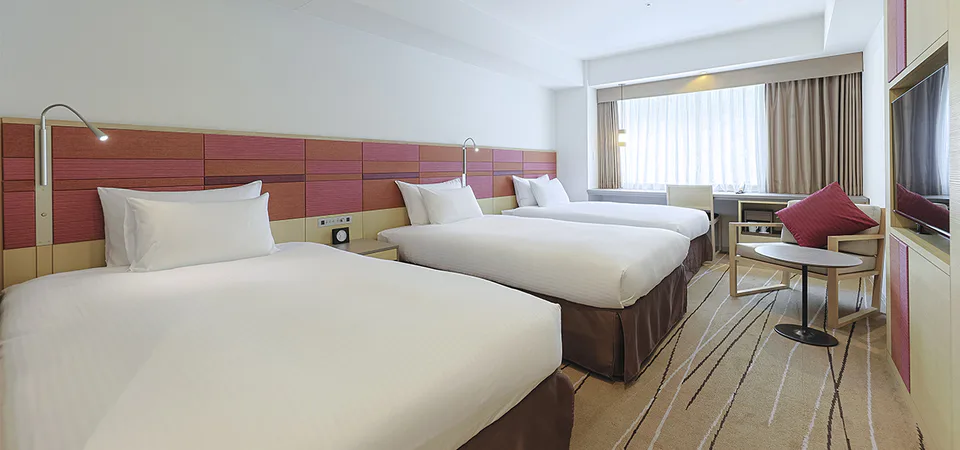
Three adults can often share well in Fukuoka because a real triple gives each person a defined bed. Four adults face a more difficult question: one quad may cut the rate and keep the group together, but a second room buys another bathroom, a second place to open luggage and the freedom to sleep at different times. The number of nights makes that bargain change. A one-night stop rarely exposes much friction; four mornings before Kyushu departures will.
Price a real triple first for three friends. For four unrelated adults, put a named quad beside two comparable twin or double rooms on the same booking dates. Then compare the bed positions, bathroom arrangement and the extra total per traveller per night. “Sleeps four” is only an occupancy permission, not a promise of four equal sleeping surfaces. The Fukuoka friends-trip hotel guide applies the same test to late nights and shared facilities.
The difference between one and two rooms repeats each morning
| Party and stay | Opening comparison | Reason to switch |
|---|---|---|
| Three adults, one to three nights | One genuine triple with three approved beds | Privacy or different sleep schedules outweigh the extra room cost |
| Four friends, one night | One workable quad against two rooms | Inferior fourth bed, four cases or a fixed early departure |
| Four friends, three or more nights | Two rooms as the benchmark | An unusually practical quad saves enough to justify one bathroom |
| Two couples | Two rooms | Everyone explicitly wants shared sleeping and the saving matters |
| Adults with younger children | One suitable family room | Guaranteed connecting arrangement and child rules make two rooms viable |
| Four large cases and shopping | Two luggage zones or a genuinely spacious quad | The one-room floor plan leaves clear access after beds and bags |
Imagine four adults who each use a bathroom for fifteen exclusive minutes before a 07:30 train. A single room can impose roughly an hour of sequential preparation. With two bathrooms and an even split, that illustrative queue could fall to half an hour. The assumed fifteen minutes is not a measured hotel statistic; it simply exposes why room size alone misses the morning bottleneck. A room with separate toilet, basin and bathing area can relieve part of the conflict, but it is still not automatically two complete bathrooms.
Sleep matters in parallel. Friends returning from different evenings can enter two rooms without waking the whole party. Two couples gain separate doors, changing space and alarm times. On a single night, these may be small benefits; by night four they repeat. The five-night Fukuoka hotel test examines the repeated inconveniences that one-night reviews tend to miss. For a family with children, separation can have the opposite effect if the rooms are not actually connected.
Turn the second room into a per-person decision
Use the same refundable or non-refundable terms, guest count, breakfast basis and tax treatment, then divide the total difference between two rooms and one quad by the number of adults and nights. For example, a hypothetical ¥36,000 quad against two comparable rooms totalling ¥44,000 adds ¥8,000 for the group in one night. Among four adults that is ¥2,000 each for another bathroom, door and luggage area. Across a four-night booking, calculate from the actual complete totals rather than assume a fixed daily rate. The example is arithmetic, not a current Fukuoka room quote.
This number does not become a universal “right price for privacy.” A group with one early train and one shared bedtime may decline it. Friends taking different Kyushu excursions might gladly pay it repeatedly. If a quad has a day bed rather than a fourth conventional bed, the person allocated that surface should be part of the price decision. The Osaka group-room comparison uses similar bed and bathroom constraints in a different hotel market.
Fukuoka City's accommodation tax does not simply double when one booking becomes two rooms. It is charged per person per night: the combined city/prefecture tax is ¥200 below a ¥20,000 accommodation fee per person per night and ¥500 at ¥20,000 or more. Two rooms can move a guest across that per-person threshold, but room count itself is not the tax base. Check the final displayed price and how the booking applies tax. Breakfast often follows people, too, so a room-only quad should be compared with two room-only rates unless the packages genuinely include different meals. The city explains the per-person lodging tax.
Three adults have several distinct bed compromises
Solaria Nishitetsu Hotel Fukuoka's Deluxe Triple is the generous Tenjin-side example. Its published 41.8 m² layout has three 120 × 205 cm regular beds. Dividing headline floor area by three gives about 13.9 m² per guest, although that gross number includes bathroom, furniture and circulation, not empty floor. The more useful feature is that no friend needs a sofa or pull-out bed. If Tenjin evenings, shopping or Nishitetsu lines dominate, the location can support the room choice. The Tenjin Solaria comparison tests whether its wider room suits the wider stay.
Mitsui Garden Hotel Fukuoka Gion's Standard 3 Beds is a different compromise. It publishes 26.6 m² and three equal 1,110 mm beds, making it a bed-fairness option near the Hakata/Gion side at roughly 8.9 m² gross per person. The room offers less shared floor area than Solaria's Triple, but nobody is assigned an auxiliary mattress. The current room list confirms that the three-bed configuration is a named product. The detailed Gion triple analysis examines whether three cases leave enough usable floor.
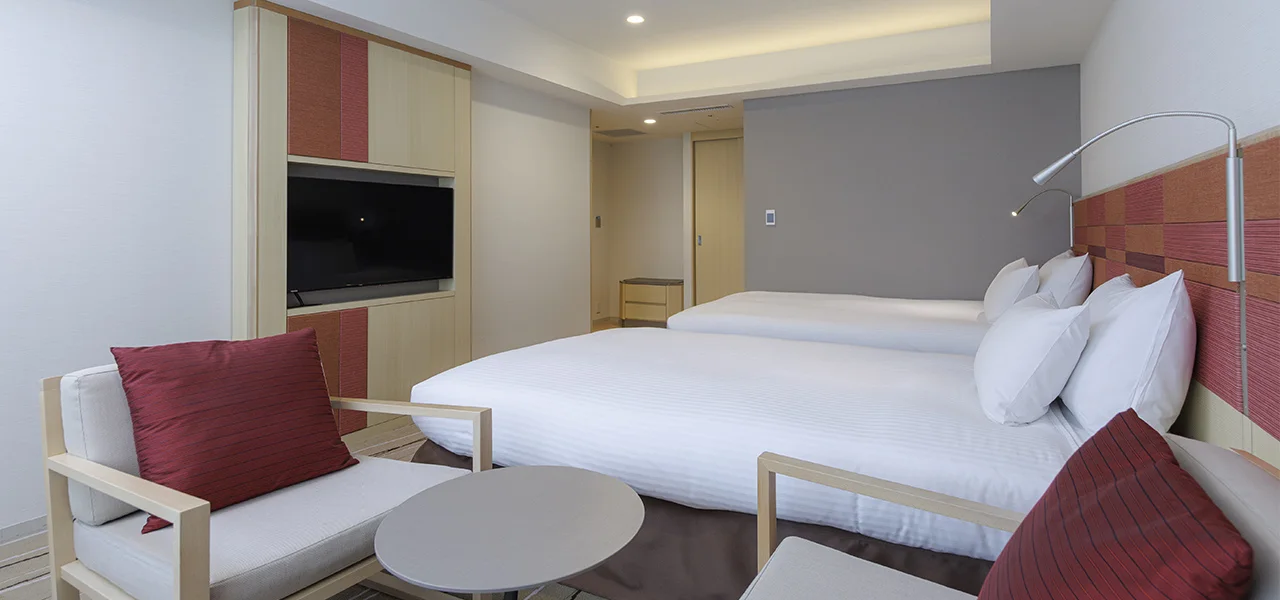
JR Kyushu Hotel Blossom Hakata Chuo's 29 m² Deluxe Twin takes the opposite approach: two principal beds and a pull-out trundle for the third guest. Its station-side convenience can beat perfect bed parity for a rail-heavy trip, but the third traveller should approve the surface. The hotel publishes the main beds at 120 × 200 cm and the added third at 120 × 188 cm. The room's own specification distinguishes these lengths. A three-adult party should not read the listing simply as “three equal beds.” The Gion-versus-Blossom comparison expands the Hakata-side alternatives.
Nishitetsu Hotel Croom Hakata Gion has another kind of advantage: published group rooms with separated toilet, washing-area bath and basin, alongside a guest public bath. The three-person format is more compact than Solaria's, but the wet-area separation can let different preparation tasks happen without everyone waiting for the same room. That matters only if the group accepts the exact beds and uses the shared facility. The Croom group-room review looks at the upper capacity and bunk arrangement; that should not be confused with equal beds for three adults.
For three friends, one genuine triple normally has a strong cost and coordination case when all beds are acceptable and the luggage fits. Two rooms become worthwhile when one traveller needs solitude, the third bed is a poor match, or the complete premium is small. Do not book two rooms merely because three adults sound like an awkward number; Fukuoka has multiple purpose-built triples. The citywide hotel-choice guide helps fit these rooms to a specific itinerary.
Four adults need a fourth-bed diagram and a bathroom plan
Solaria's Deluxe Quad publishes the same 41.8 m² overall area as its triple, but its fourth sleeping position is a 100 × 195 cm day bed beside three 120 × 205 cm beds. It is a credible one-room choice when the fourth person accepts the smaller surface and the group uses the Tenjin location. It is not four identical beds simply because the category is called Quad. For four friends with early alarms, the one-bathroom morning still needs to be acceptable. Hakata versus Tenjin should be decided before a rare group room pulls the whole trip to the wrong district.
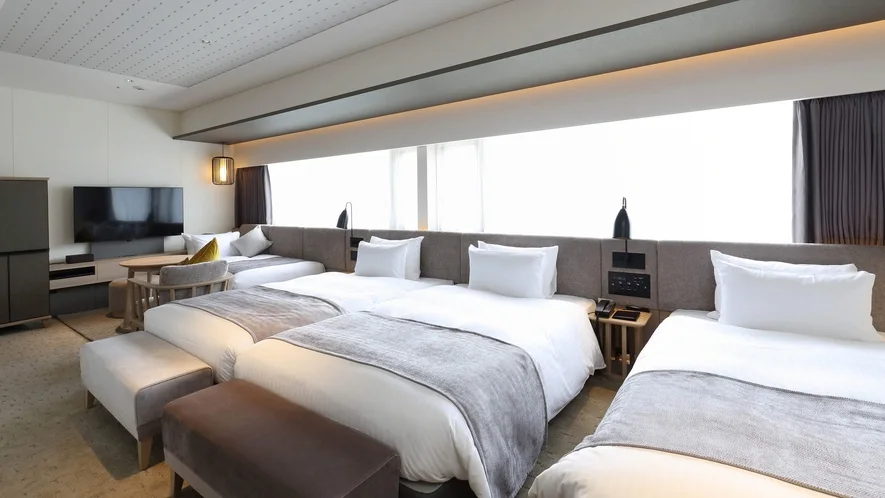
Croom Hakata Gion's Comfort Fourth covers 30.4 m² and can accept a larger group under the hotel's maximum occupancy rules. Its separate toilet, washing-area bathroom and independent basin make one shared room more workable for four. The public bath can reduce a shower queue for adults willing and permitted to use it, but tattoo rules, opening times and personal preference matter. A pair that avoids communal bathing still relies on the single in-room bath. Croom also uses bunk-style sleeping in the group layout; assign those positions to actual guests. The hotel's current room list gives the area and wet-area configuration.
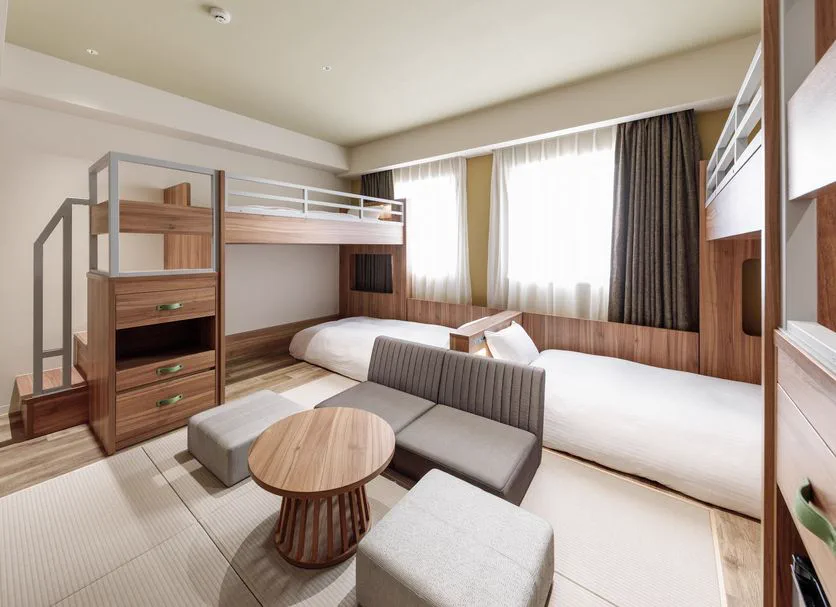
A room's published square metres include beds, built-ins, bathroom and furniture. They do not promise four large cases can remain spread out. A one-night party can open and close bags in turns without much cost. Across four nights, repeating that choreography after shopping or laundry becomes a real constraint. Two rooms create two separate circulation zones even if their combined nominal area is not dramatically larger. The shopping-hotel location guide adds the question of when cases and purchases are actually brought back.
| Bookable pattern | Strong point | What must be accepted |
|---|---|---|
| Solaria Deluxe Triple, 41.8 m² | Three regular 120 cm beds with Tenjin access | Tenjin must fit the rail and evening pattern |
| Mitsui Garden Gion Standard 3 Beds, 26.6 m² | Three equal 111 cm beds on Hakata/Gion side | Less gross floor area for cases |
| Blossom Hakata Chuo Deluxe Twin, 29 m² | Hakata Station approach | Third position pulls out and is shorter |
| Solaria Deluxe Quad, 41.8 m² | Large one-room option for four | 100 cm day bed and one bathroom |
| Croom Hakata Gion Comfort Fourth, 30.4 m² | Wet-area separation and guest bath | Bunk preference and public-bath use vary |
| Two twin or double rooms | Two bathrooms, luggage zones and doors | Higher total rate; adjacency may not be guaranteed |
Two room numbers do not guarantee adjacent doors
For unrelated adults, separately located rooms may be fine. For parents supervising children, adjacency or an internal connecting doorway can decide whether two rooms are acceptable at all. A request for “nearby” rooms may be noted without becoming a guarantee. Ask whether a connecting product is sold and book that specific category if it is essential. Do not assume that two standard twins on the same booking will be assigned together. The Keihan Namba room comparison illustrates the difference between an internally linked pair and a polite room-location request.
A family may rationally pay more for one practical room because supervising children behind two separate doors is not acceptable. Two couples may rationally pay more for separate rooms even when a quad has ample area. These are different constraints; neither should be hidden beneath a generic “best value” ranking. If the group changes size, rerun the whole comparison rather than stretching a three-person room by one mattress without checking occupancy. The couples' Fukuoka base guide handles a separate pair-of-couples itinerary question.
Location can outweigh the rare quad
Solaria's Tenjin setting works for shopping, food evenings, the Nishitetsu network and Dazaifu access. Mitsui Garden Gion, Croom Hakata Gion and JR Kyushu Blossom become more convenient when early JR departures from Hakata drive the days. A group making repeated rail trips to Yufuin, Nagasaki or Kumamoto may spend enough mornings crossing the city to undo the appeal of a wider Tenjin room. A group whose evenings consistently end in Tenjin can have the opposite result. The two-, three- or four-day Fukuoka plan helps identify how many early departures truly repeat.
The district choice should precede the exact room search. Otherwise the group may find a good four-bed photograph, then design a bad trip around it. Miyako Hakata versus Solaria Tenjin compares the two bases, while the Tenjin hotel comparison is useful after Tenjin itself has won.
Stay length changes the room's job
On one night, a valid quad may be the easiest booking and checkout. Over two nights, use the per-person premium and luggage test without a predetermined winner. After three or four nights, two rooms become a stronger opening choice for four unrelated adults because the queues and sleep conflicts recur. At five nights, one room should offer either an exceptional layout, meaningful whole-stay saving or a supervision reason. A larger published area by itself does not prove it will feel generous once four cases and four adults are in place. The three-day Fukuoka route makes a related point: moving properties during a short visit can cost more time than it saves.
Check three errors before payment. First, map each adult to an actual sleeping surface, distinguishing regular, trundle, day bed, upper bunk and futon. Second, compare like-for-like flexibility and meals. Third, price both real configurations; a scarce quad may be more expensive than expected on a busy weekend, while two common rooms may sit close in total. There is no permanent Fukuoka break-even yen figure because date, event demand and available inventory change. The full-cost hotel guide adds transfers and unused benefits to the quote.
For three adults, a true triple with three accepted beds is usually the sensible first price. For four adult friends, start with the exact quad against two similar rooms and calculate the privacy premium per person per night. One night can favour the shared room; repeated early starts, unequal beds or large cases can shift the answer quickly toward two bathrooms. Two couples usually benefit from two doors. A parent-child group may favour one room unless connecting arrangements are secured. Compare Fukuoka group rooms by actual district and guest count, then save the bed diagram and cancellation terms with the reservation.
Other group-room examples
Hakata vs Tenjin · Hakata vs Tenjin · Mitsui Garden Fukuoka Gion vs Solaria · MIMARU Osaka Namba Station: Is One 35 m² Apartment Better Than Two Rooms for Four? · USJ Hotels for One Day vs Two Days: When Is Universal City Worth Moving To? · THE LUIGANS Spa & Resort Fukuoka: Is a 33m² Sea-View Room Worth Leaving Hakata for One Night? · La Vista Furano Hills: Is a Small Room Worth It for a One-Night Furano Stay? · Nikko vs Kinugawa Onsen: Where Should You Stay for One or Two Nights? · Tokyu Stay Hida-Takayama Musubi no Yu: Which Room Works for Two Suitcases and Three Nights? · Sapporo Autumn Fest 2026: The One-Kilometre Food Route That Leaves Room for Dessert · Osaka Solo Travel Hotels: Pay for Less Friction, Not a Bigger Room