
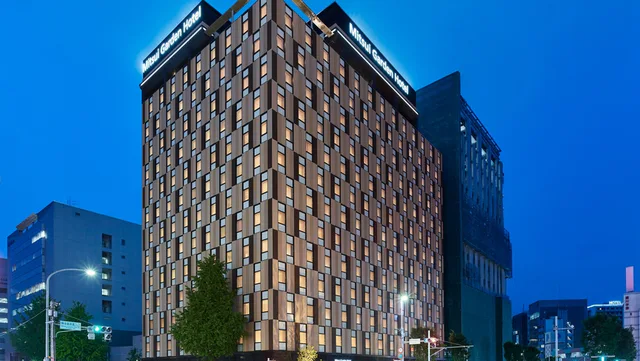
Three adults comparing Mitsui Garden Hotel Fukuoka Gion with THE BLOSSOM HAKATA Premier should decide who sleeps where before comparing the bath or breakfast. Mitsui Garden sells a 26.6 m² Standard 3 Beds room with three fixed beds of the same stated width, 1,110 mm. THE BLOSSOM offers a larger Deluxe Twin, 30–37 m², by adding an extra bed beside two 1,200 × 2,000 mm beds. Its 31–32 m² Comfort Deluxe Twin with TATAMI space instead places the third guest on a futon. Those are three different sleeping contracts, even when a booking screen calls all of them rooms for three.
Neither hotel is a dramatic shortcut to Hakata Station: both describe the walk from JR Hakata as about seven minutes. If the party is still choosing between districts, settle Hakata versus Tenjin first. If the larger question is whether to share one keycard at all, the one-room-versus-two-room guide is the better starting point. This comparison assumes one room and three adults are already the preferred arrangement.
Our seven-part decision for three adults
| Decision factor | Mitsui Garden Fukuoka Gion | THE BLOSSOM HAKATA Premier | Our call |
|---|---|---|---|
| Equal sleeping setup | Three fixed 1,110 mm beds in Standard 3 Beds | Two 1,200 mm main beds plus an extra bed, or a third futon in the tatami category | Mitsui Garden when three people split the bill and expect the same bed type |
| Published room area | 26.6 m² for the named triple | 30–37 m² Deluxe Twin; 31–32 m² tatami twin | THE BLOSSOM for a longer stay, provided the third sleeper accepts the trade |
| Three-suitcase tolerance | More packing in turns is likely | Extra gross area gives more room to negotiate circulation | THE BLOSSOM, without promising three permanently open large cases |
| Hakata access | About seven minutes from JR Hakata; also about five from Gion Exit 5 | About seven minutes from JR Hakata, nearer the Kushida Shrine and Canal City side | Itinerary dependent; neither is station-connected |
| Public bath for guests with tattoos | Published restrictions on body art have been removed | A later notice allows tattoos covered by up to two approved stickers, while an older facilities page still conflicts | Mitsui Garden is the clearer choice when bath access is essential |
| Breakfast before departure | 07:00 start; last entry 10:00 | 06:30 start; last entry 09:30 | THE BLOSSOM only when the extra half-hour is usable |
| Value at the actual occupancy | Paying for three equal beds in less space | Paying for more room area with a different third bed | Compare three-adult totals on the same dates, meal basis and cancellation terms |
The table is a decision aid, not a promise of a particular room assignment. THE BLOSSOM publishes ranges, and the upper end of its Deluxe Twin range is not guaranteed merely by selecting the category. Mitsui Garden is easier to assess for bed fairness; it is harder to make three large suitcases disappear inside 26.6 m². The relevant question is which inconvenience the group would notice every day.
At Mitsui Garden, the third bed is part of the room
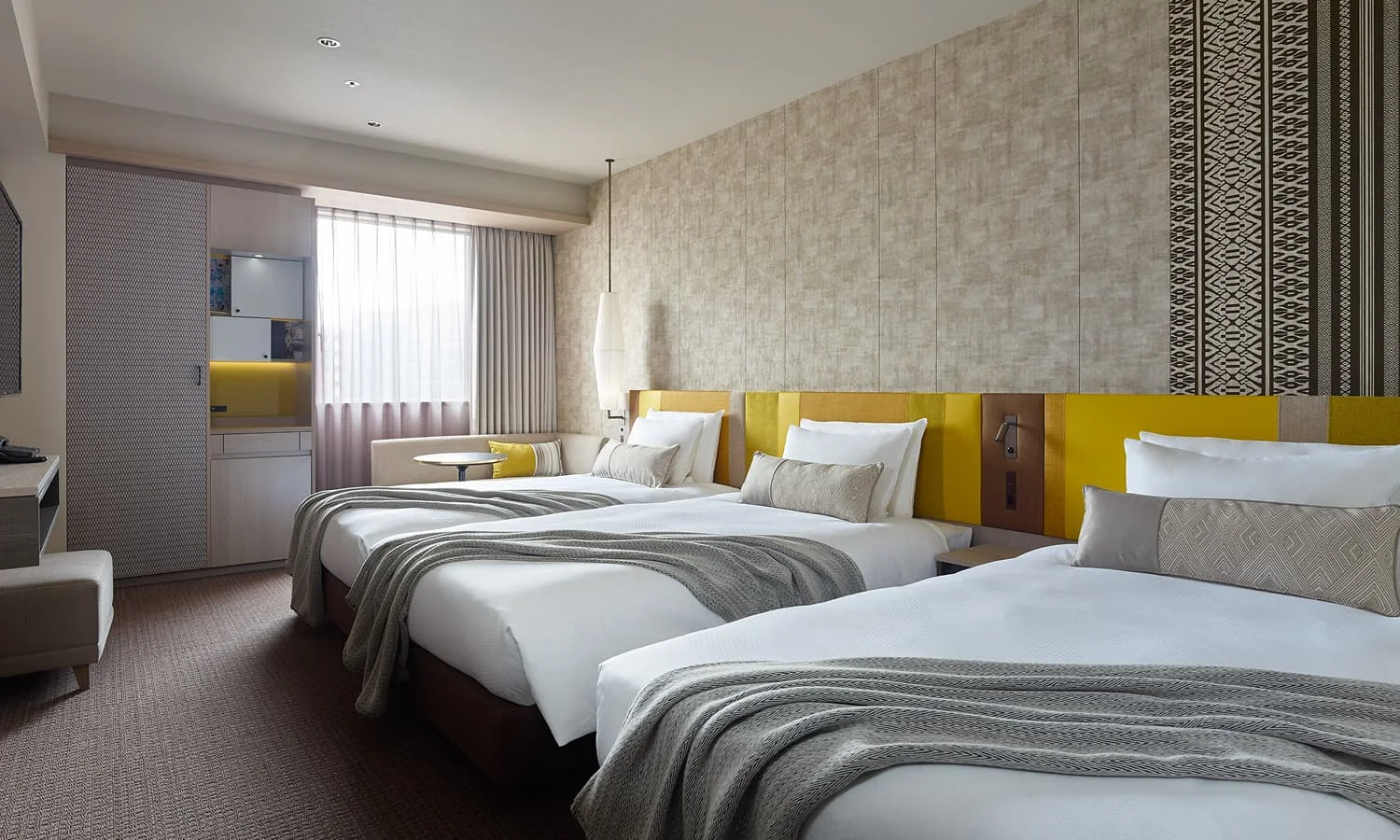
The Standard 3 Beds category is unusually clear for three unrelated adults. Its three 1,110 mm beds are fixed room inventory, so there is no sofa conversion or unstated extra-bed width to negotiate after arrival. That makes the room particularly practical for friends who are dividing the rate equally, siblings who do not want to assign a poorer bed, or a short stay in which everyone returns late and wants an uncomplicated sleeping arrangement. The separate Mitsui Garden triple-room review goes further into that exact category.
The cost of equality is space. Dividing the published 26.6 m² by three produces about 8.9 m² per person, but that figure includes the bathroom, furniture and the beds themselves. It is useful for comparing room categories, not for estimating an empty patch of floor beside each mattress. One large case may be easy to open; three 28- or 29-inch cases kept open with a clear path to the bathroom is a very different proposition, and neither hotel guarantees that arrangement.
For a one-night arrival or departure stop, I would usually let the three matching beds outweigh the smaller footprint. The group can unpack in sequence and leave the cases shut. During a four- or five-night visit, repeated clothes changes, shopping and early mornings make the restricted circulation more consequential. The Fukuoka long-stay hotel guide tests those recurring irritations. Before treating the fixed-bed room as a bargain, work out whether the group actually needs a common room for all those nights or could split into two rooms on the busiest dates.
Mitsui Garden's stated guest-room area also uses its published measurement convention and a floor plan may differ from the assigned room. That limitation does not undermine the bed count, but it is another reason to avoid describing 26.6 m² as an exact measure of usable floor. The photo below shows the three-bed arrangement; it does not show three fully open large suitcases.
At THE BLOSSOM, choose the third sleeping surface deliberately
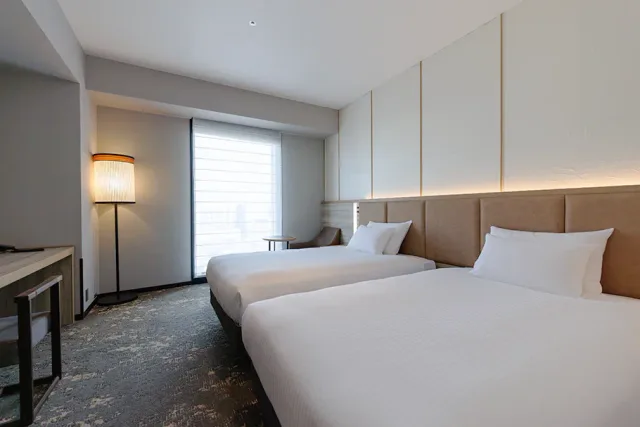
The Deluxe Twin offers two 1,200 × 2,000 mm beds and can accommodate three people with an additional bed. Its listed area spans 30–37 m², a total gain of roughly 3.4–10.4 m² against Mitsui Garden's named triple. At three guests, the corresponding gross area is about 10.0–12.3 m² per person. These calculations explain why THE BLOSSOM can feel like the more workable multi-night base, although they say nothing about the exact shape of the remaining space once an extra bed is installed.
The extra bed's dimensions are not published with the two main-bed measurements. A tall traveler, someone with a bad back or the person who will sleep there for five nights should not accept a vague “three-person capacity” label as proof of equal comfort. Confirm the extra-bed specifications for the booked plan before payment. If the third sleeper says no, the room's greater area cannot rescue the choice. For another look at the property's regular rooms and bath, see the THE BLOSSOM room guide.
There is a more explicit alternative within the same hotel: the Comfort Deluxe Twin with TATAMI space. It has two 1,200 × 2,000 mm beds and a futon for a third guest, across a published 31–32 m². That is approximately 10.3–10.7 m² of gross area per person. The trade is known in advance, which can be preferable to an unspecified rollaway. It is a poor swap for someone who finds getting down to or rising from floor level difficult. Once the futon is laid out, the tatami area is a sleeping zone rather than free sitting space, so the room size alone should not be used to promise a separate lounge.
Don't pay for the 37 m² end of a room range by assuming it will be assigned. The hotel says dimensions and specifications can vary by room. Ask whether the offered three-adult rate names the Deluxe Twin with an extra bed or the tatami/futon room, then judge that specific product. A two-guest search result with a lower headline price is not the same booking. The Hakata station hotel comparison helps if the room still looks too compromised.
When the bags arrive, the location difference shrinks
Mitsui Garden puts JR Hakata's Hakata Exit roughly seven minutes away on foot, and Gion Station Exit 5 roughly five minutes away. THE BLOSSOM describes a similar seven-minute walk from JR Hakata. Those are useful walking estimates, but neither property gives three adults a station-connected handoff for a Shinkansen arrival with three heavy cases. On a wet day or after a late train, the final streets can matter more than a small difference in a map pin. The rainy-day hotel access guide examines that last stretch.
Mitsui Garden's Gion alignment is a slight advantage when the trip will repeatedly use that side of the district. THE BLOSSOM is more naturally placed for evenings toward Kushida Shrine and Canal City. Choose the micro-location against the actual itinerary rather than adding an invented ten-minute station gap to justify a preferred hotel. If the last night has one job—protecting an unusually early departure—compare the early-flight Hakata base and the Miyako versus THE BLOSSOM access trade-off before paying a premium for either room here.
The three-adult room is only one part of a Fukuoka stay. A group dividing its days between nearby food streets and rail trips can use the three-day Fukuoka route to test whether a Hakata base is efficient. A slower visit may look different after deciding whether two, three or four days in the city are actually needed. Those plans change how often the larger room would be used, which is more relevant than its area in isolation.
The bath rules matter only if everyone can use the bath
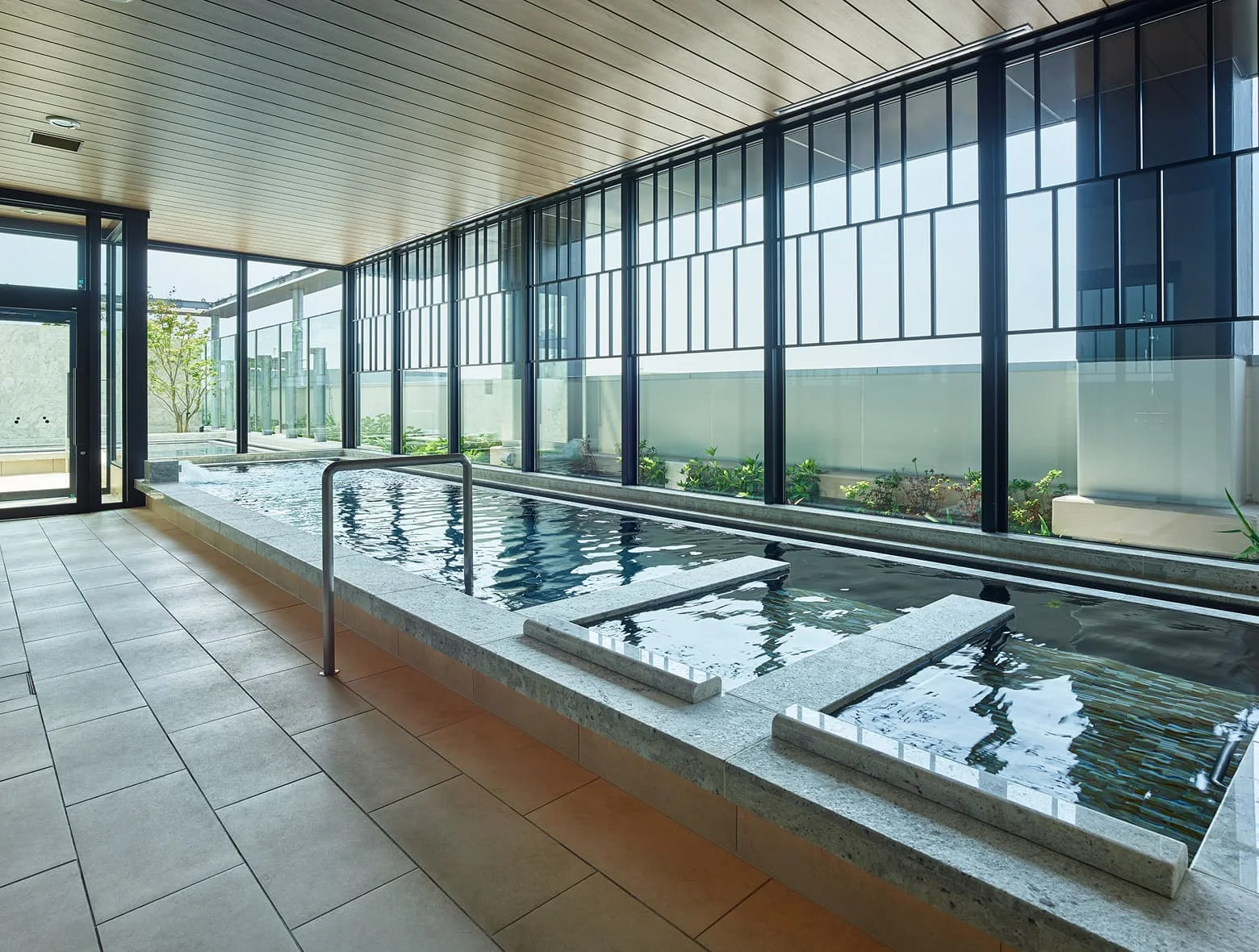
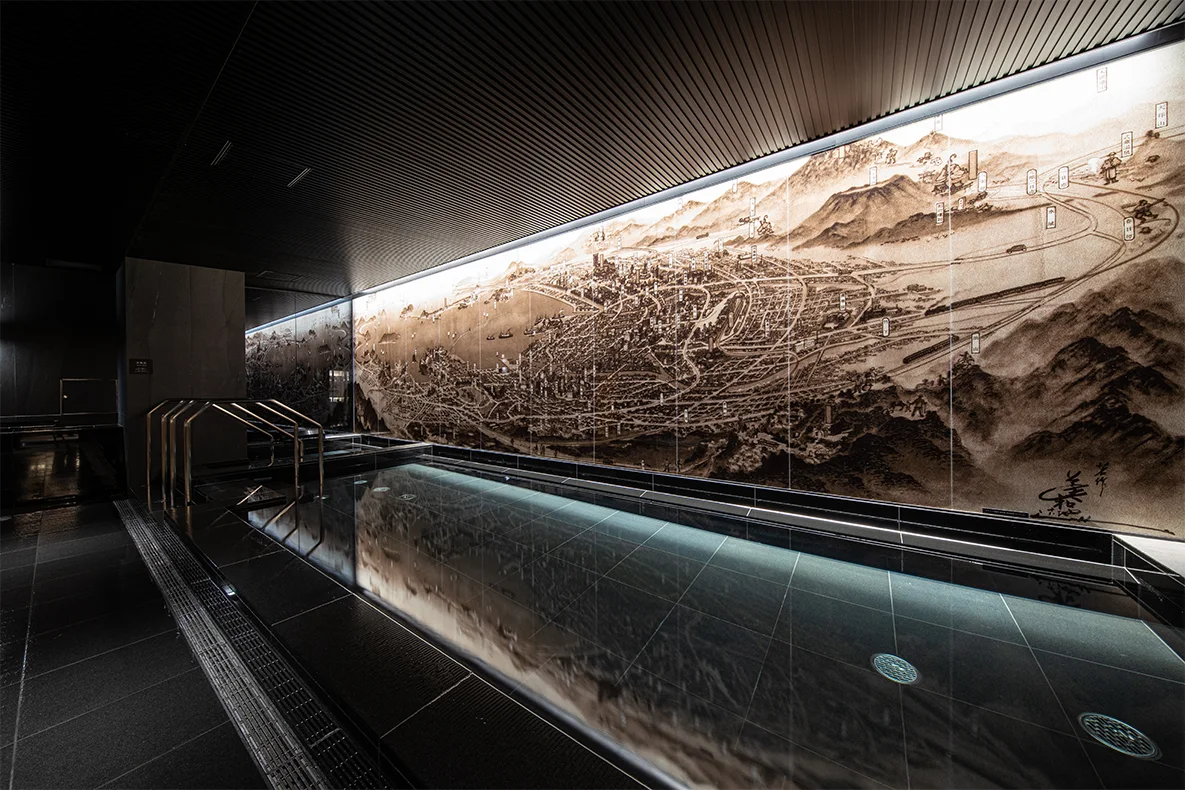
Mitsui Garden's rooftop public bath is on the 13th floor. The currently published hours are 15:00–25:00 and 05:00–09:00, and the stated restrictions concerning tattoos and body art have been removed. For a three-person party that includes a tattooed traveler and wants to bathe together or at the same time, that policy clarity is a real advantage. It is still a shared bath, so opening hours and possible crowding should be weighed against how late the group returns.
THE BLOSSOM has a public bath, but its published conditions do not all say the same thing. A later, specific notice permits entry when each tattoo can be fully covered with no more than two approved 10 × 10 cm stickers; the front desk supplies those stickers without charge. An older general facilities description still says tattooed guests are declined. A group relying on the bath should confirm the rule for its particular tattoos before booking. Treating the newer notice as a universal admission guarantee would overstate it, while ignoring that notice would wrongly exclude guests who meet its conditions.
If nobody expects to use a shared bath, remove this criterion from the hotel premium. A private in-room shower is already part of the nightly routine, and paying extra for a facility the party will skip does not improve the sleeping arrangements. Readers who put baths first can compare Mitsui Garden's triple with the BLOSSOM bath and twin rooms directly rather than treating every Hakata hotel as equivalent.
Breakfast can be a tie-breaker, but only on a usable morning
THE BLOSSOM starts breakfast at 06:30 and lists 09:30 as last entry, with service ending at 10:00. Mitsui Garden starts at 07:00 and takes its last entry at 10:00 before a 10:30 finish. The half-hour head start can help three adults eat before an early Yufuin, Beppu or Shinkansen day. It has no value if the party must leave before 06:30, and it should not outweigh a third bed that one person dislikes every night.
Compare the actual meal-inclusive and room-only totals for three adults. The current separately listed breakfast prices and package prices can differ, so do not infer the rate from a headline for two guests. A group that prefers to buy food outside can use the Fukuoka breakfast guide; for another hotel breakfast trade-off, see Hotel Nikko versus THE BLOSSOM. Compare nearby opening times on the mornings that matter. This is especially relevant for a four- or five-night visit: buying a buffet for every day because one departure is early can make the apparent room value misleading.
Match room choice to the number of nights
| Trip pattern | Room I would shortlist first | What could change the answer |
|---|---|---|
| One-night transfer with three friends | Mitsui Garden Standard 3 Beds | A much lower three-adult rate elsewhere or a need for genuinely station-connected access |
| Three to five nights with several large cases | THE BLOSSOM Deluxe Twin if the extra bed is accepted | Unacceptable extra-bed dimensions or a high rate that makes two rooms competitive |
| Third traveler enjoys a futon | THE BLOSSOM tatami twin | Difficulty using a floor bed or a need to keep the tatami area free at night |
| Bath access for a tattooed traveler is decisive | Mitsui Garden | THE BLOSSOM confirms that the tattoos meet its sticker conditions |
| Very early train and minimal time in the hotel | Reopen the shortlist | A closer Hakata property may protect the departure better than either seven-minute walk |
Room area becomes more valuable when all three people repeatedly dress, repack and bring shopping back to the same space. It does not make a poor sleeping assignment fair. In particular, a five-night Deluxe Twin is attractive only if the guest on the extra bed actively accepts that arrangement. A shorter Mitsui stay works because the group can organize luggage in turns; a longer one requires more tolerance for the narrow floor around fixed beds.
If the room cost for three begins to approach two separate rooms, pause the head-to-head comparison. Privacy, bathroom access and floor space may be worth more than either hotel's shared triple configuration. The larger-party lodging guide covers that reset, while the Fukuoka hotels with parents guide is more relevant when one traveler has a mobility constraint. For three friends, the group room and bathroom comparison adds a different test. A futon should never be offered as a surprise to the person least able to use it.
Price the same three adults before making the call
One date can settle this comparison immediately: Mitsui Garden Fukuoka Gion has announced a full accommodation closure from 10 through 15 January 2027 for electrical inspection and renovation. Overnight stays resume at 15:00 on 16 January. On 10 January there is no late checkout, post-checkout luggage storage or stay extension. If your three-person trip overlaps that interval, use THE BLOSSOM or another Hakata hotel rather than assuming an empty search result means the triple room has merely sold out.
Set the search to one room and exactly three adults for the same dates. Record which named room is offered, whether breakfast is included, the cancellation deadline and whether payment is due now or at the hotel. At THE BLOSSOM, check whether the third bed is an added bed or futon; at Mitsui Garden, confirm that the result is Standard 3 Beds rather than a twin whose capacity label invites assumptions. The same nightly number has different meaning if one offer is refundable and another is not.
Convert an upgrade into a per-person amount only after comparing the full room totals: additional room cost per night divided by three is the extra cost per adult per night. For example, a ¥6,000 nightly difference is ¥2,000 each. That arithmetic does not establish whether the larger room is worth it; it gives the third sleeper a fair way to discuss the change. If THE BLOSSOM costs more and that person still dislikes the extra bed, there is no hidden group benefit to balance the bill.
For the same stay dates, compare three-adult rooms around Hakata on the accommodation map. Keep the dates, guest count and cancellation rules aligned when you compare these hotels with a two-room alternative. If the preferred room tier is sold out, the Forza, Blossom Chuo and THE BLOSSOM comparison gives a nearby shortlist; the CROOM Hakata Gion room guide is useful when the party size changes.
My decision is Mitsui Garden for three equal-bed adults staying briefly, and THE BLOSSOM for a longer stay when the third guest knowingly accepts an extra bed or futon. Both require a genuine walk from JR Hakata. A tattoo-sensitive bath plan strengthens Mitsui Garden; a breakfast departure between 06:30 and 07:00 strengthens THE BLOSSOM. The group should settle those specific points together before paying, because neither hotel's brand name resolves the third-person problem.