
The right Fukuoka breakfast can be a dish you came to taste or the meal that gets everyone onto a reserved train without drama. Those are different mornings. A slow city day leaves space for mentaiko and rice, a queue and a later lunch. A Yufuin departure, early flight or highway-bus boarding gives that same queue a cost. Hakata udon offers a local hot meal, but the shop's opening time matters more than the category. Onigiri is a sensible choice when breakfast needs to be quick, portable and predictable.
Begin with the first time you cannot move: a train, check-in target, tour departure or lunch reservation. Work backwards to the moment the group must leave the table, allowing for checkout, luggage and the correct station platform. Only then choose where to eat. Fukuoka has plenty of distinctive food, but there is no reason to spend the morning's entire buffer proving that breakfast was local.
↔ Scroll table left or right
| What happens after breakfast | First option to examine | When to change it |
|---|---|---|
| Reserved JR or Shinkansen departure from Hakata | Hotel meal, station-area food or onigiri | A special restaurant is the day's main priority and there is a generous transfer buffer |
| No fixed start in central Fukuoka | Seated mentaiko rice or another fuller meal | Lunch is early and important, or a queue would displace sightseeing |
| Local hot food before a modest city plan | An exact udon shop whose hours fit | The shop opens later than the day permits |
| Early airport, bus or excursion departure | Onigiri, night-before takeaway or useful hotel breakfast | The hotel buffet genuinely opens early enough for an unhurried exit |
| Breakfast is itself a food stop | Mentaiko, market food or a chosen café | The trip crosses town only to return to its departure hub immediately |
The 09:17 Hakata train is a useful reality test
JR Kyushu's current timetable lists Yufuin no Mori 1 leaving Hakata at 09:17 and reaching Yufuin at 11:31. That sounds late enough for a restaurant breakfast, but it leaves less room once a group adds checkout, a subway ride and a possible queue. The scenic train is reserved, and an avoidable delay in Fukuoka can also reduce the useful afternoon at a Yufuin ryokan. A breakfast near Hakata Station, a hotel buffet that finishes in time, or food bought the previous evening keeps the morning pointed toward the platform.
From a Tenjin or Nakasu hotel, travelling to a famous breakfast and then back to Hakata may create two transfers before the day's first real trip begins. If that restaurant is one of the reasons for visiting Fukuoka, give it a separate unhurried morning. If Yufuin is the priority, the station side wins. The Fukuoka–Yufuin transport comparison helps settle the larger journey, and the overnight choice shows why arriving in time for a ryokan afternoon can matter more than one cross-city breakfast.
That 09:17 train is an example, not a universal daily promise: the operating calendar and railway schedule must match the actual travel date. The principle extends to an Aso morning, Nagasaki from Fukuoka or a fixed highway bus. The failure cost of missing the departure is larger than the failure cost of a less famous first meal.
Mentaiko works when the morning can belong to food
Spicy cod roe on rice is a recognisable Fukuoka breakfast and can be worth a seated stop. Give that stop actual time. Ganso Hakata Mentaiju in Nishinakasu posts a 07:00 opening and a 22:30 close, with last order at 22:00. Its railway-station outlet is a different product: the Hakata branch opens at 09:00, sells bento and gifts, and has no dining area. A visitor cannot move the Nishinakasu restaurant's sit-down experience to the Hakata platform merely because the brand is shared.
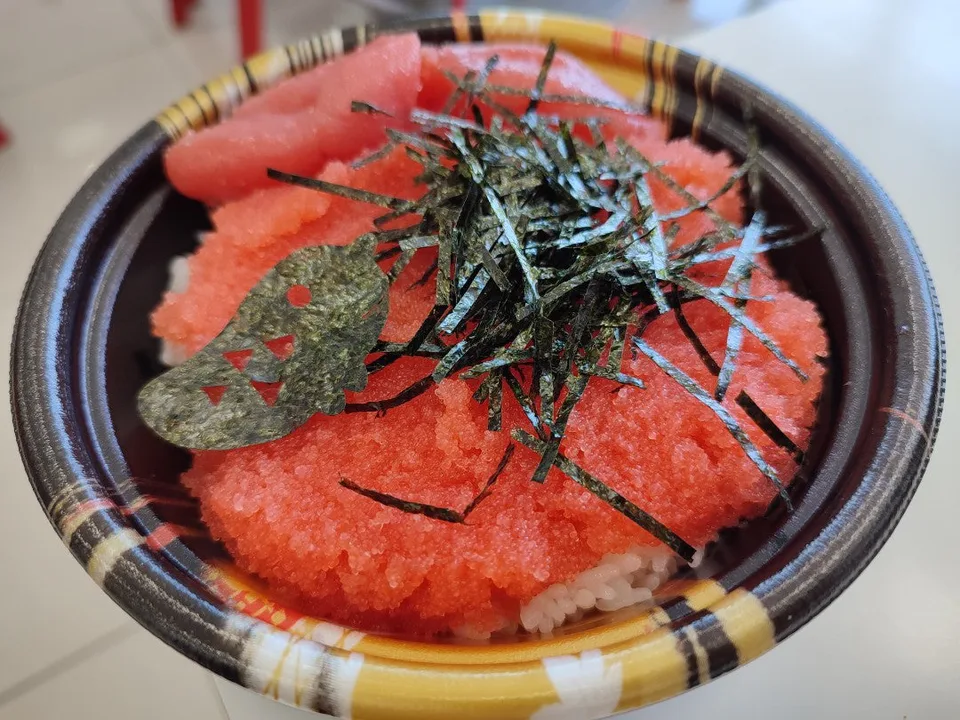
The retained image shows a rice bowl with cod roe and seaweed. It illustrates the style of meal; it is not evidence that a named restaurant will serve an identical bowl or have an empty seat on your travel date. The Fukuoka mentaiko comparison is the better place to decide which preparation or shop interests you once the morning's time is available.
The Nishinakasu site's reservation wording is currently inconsistent: one line says web reservation slots are accepted from 17:00, while another mentions 07:30–08:30 and evenings; a later line again says no bookings from 07:00 to 17:00. Do not treat a breakfast booking as secured based on any single text snippet. Use the live booking form or ask the venue, and assume a walk-in queue unless you hold a confirmed slot. This uncertainty makes the restaurant a poor default immediately before a 09:17 reserved train, even though it opens early.
A relaxed Tenjin or Nakasu morning can absorb the wait and a fuller rice meal. It also works when lunch will be late. If the next fixed activity starts around noon or there is a destination lunch you care about, a large breakfast can spend appetite and time twice. An evening yatai plan might leave breakfast as the day's main seated Fukuoka speciality; a food-focused hotel base can place that stop within a less rushed route.
Udon needs an address and an opening hour
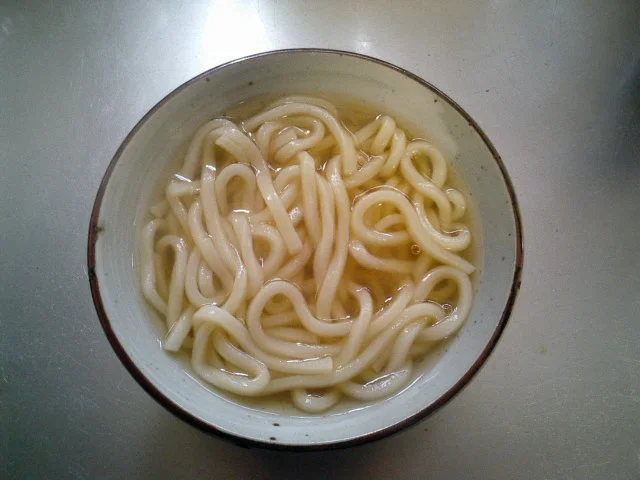
Hakata udon is a local noodle tradition, associated with a softer texture than some other Japanese regional styles. It can make a satisfying hot breakfast without a large rice set. But “udon” does not specify a business hour. Fukuoka City's listing for Nagahama Udon, for example, shows 08:00–15:00 on weekends and holidays and 10:00–15:00 on weekdays. That restaurant can serve one kind of breakfast morning and be unavailable on another. An early JR trip cannot be planned around the word on a menu.
The retained photograph shows a simple bowl of thick noodles in pale broth without toppings. It is a visual example of the food category, not a claim about any named shop's exact serving or opening time. If a chosen udon counter is by the departure station and opens before the group's leave-the-meal deadline, it can solve both the local-food and transport needs. If it requires a detour or opens at 10:00 on a weekday, choose another breakfast and have udon later.
Hakata's strength as a hotel area is proximity to JR and intercity travel, not a guarantee that every local specialty opens at 07:00. Tenjin offers more central-city food and shopping, yet its location may add the wrong first movement when the day begins on a Hakata platform. Hakata versus Tenjin is therefore a daily route question. The Tenjin and Nakasu hotel comparison can help if a slower food-focused morning is a recurring feature of the stay.
Onigiri protects a day that starts elsewhere
Rice balls are often treated as the fallback after a more ambitious breakfast fails. On a transport morning, they can be the plan. They can be purchased quickly near the station or the previous evening if the departure is too early for comfortable shopping. The portion is easy to match to an anticipated lunch, and the group can decide exactly when to eat rather than waiting for a table. This is useful before an early flight, a reserved limited express, a fixed bus or a family checkout with several bags.
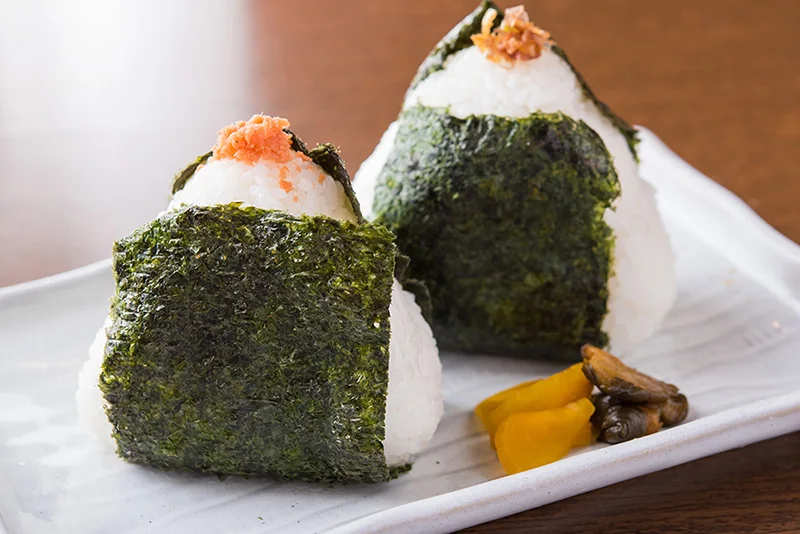
The retained photograph shows two triangular onigiri and pickles. It is not a promise that the same fillings are available at every station or convenience store. Buy what suits the group and storage conditions. The trade-off is that a quick rice ball gives up the experience of a seated Fukuoka breakfast. Make that decision deliberately, then let the destination's meal have room. A Yufuin morning-mist trip or multi-stop Kyushu route often benefits more from arriving on time than from an extra city restaurant.
The same logic applies to an airport day. Breakfast is useful if it helps the group leave on time, not if it creates a second reservation to protect. The Hakata-or-Tenjin early-flight choice addresses the first night's and last morning's geography; late-arrival lodging is another case where easy food can be more valuable than a famous meal.
Hotel breakfast is valuable when it removes work
A buffet with many dishes can still be poor value if it opens too late for the group to sit down before departure. The relevant calculation is the interval between the hotel's breakfast opening and the moment you must leave the property, after allowing for eating, checkout and luggage. If that interval is only a rush, a room-only rate plus station-area food may work better. If everyone can eat calmly and the buffet removes an outside queue, route search and luggage detour, the convenience has a real value even without a particularly local menu.
This is especially true for a family or older travellers coordinating several mornings. A hotel meal can simplify who eats when and reduce separate movements. It may also be unnecessary for a group that wants Fukuoka food as part of sightseeing on a slow day. Family hotel logistics and stays with parents explain why deleting a morning task can matter more than a buffet's size. A lower room rate is not a saving if daily breakfast trips consume the time it bought.
The neighbourhood changes the default
In Hakata, a morning train, Shinkansen or intercity bus can keep breakfast, checkout, luggage and boarding within one district. Choose an option that fits the hub's actual opening hours and your platform buffer. A food stop elsewhere is justified only if it is explicitly one of the morning's priorities. On a Tenjin or Nishinakasu city day, a café or mentaiko restaurant can be part of the outing itself; the morning is free to run more slowly. Nakasu's busy evening identity does not prove that an exact breakfast counter opens early, so check the business rather than inferring its hours from the district.
Lunch is another boundary. If the group has reserved seafood or another substantial meal near noon, a huge breakfast may make the expensive booking less enjoyable even if it fits the clock. If lunch is not until mid-afternoon, a rice set or hotel buffet has more space. A café and dessert walk can fill a flexible morning in smaller pieces, while the mentaiko guide helps when the dish itself is the goal. These are route and appetite choices, not nutritional rules.
A visible queue should have a limit set before joining it. For a food-focused morning, waiting may be part of the plan. Before a reserved departure, the queue can use only the buffer that leaves the platform comfortable. Once that margin is gone, switch to a backup in the same neighbourhood rather than treating minutes already waited as a reason to risk the train. The backup need not be equally famous; it has a different job. Fukuoka's transport choices can reduce confusion, but no pass rescues a missed fixed train.
Three mornings, three reasonable breakfasts
A city morning without a hard start is the natural place for mentaiko rice. Choose the restaurant, allow for possible waiting and let the meal affect lunch timing. If a particular café is the reason to leave the hotel, treat it as a sightseeing stop rather than trying to squeeze it between checkout and an unrelated reservation.
For Hakata to Yufuin, Nagasaki or another reserved journey, eat near the station or in the hotel if breakfast opens early enough. Udon works when a specific shop is open and lies on the departure route; onigiri works when the group needs the highest time certainty. If the ticket is Yufuin no Mori 1, a posted 09:17 departure is a reason to protect the platform window, not a challenge to complete an elaborate breakfast across town first.
Before a flight or early bus, buy simple food the night before or choose a hotel breakfast that really fits the exit time. Do not cross central Fukuoka merely to check a dish from the trip list. A slower later day can carry the special meal. The choice among mentaiko, udon and onigiri changes with the next fixed commitment, the neighbourhood and the group's appetite; that is why all three can be the right local breakfast on different dates.
For the live details behind those examples, use JR Kyushu's Yufuin no Mori timetable, the Nishinakasu and Hakata shop information, and Nagahama Udon's listed hours. Confirm the operating day and any accepted restaurant reservation in the purchase or booking screen, especially where a web page shows inconsistent time ranges.
If an early food stop starts the day, check Fukuoka rooms near that morning route before paying for a hotel breakfast you may skip.