
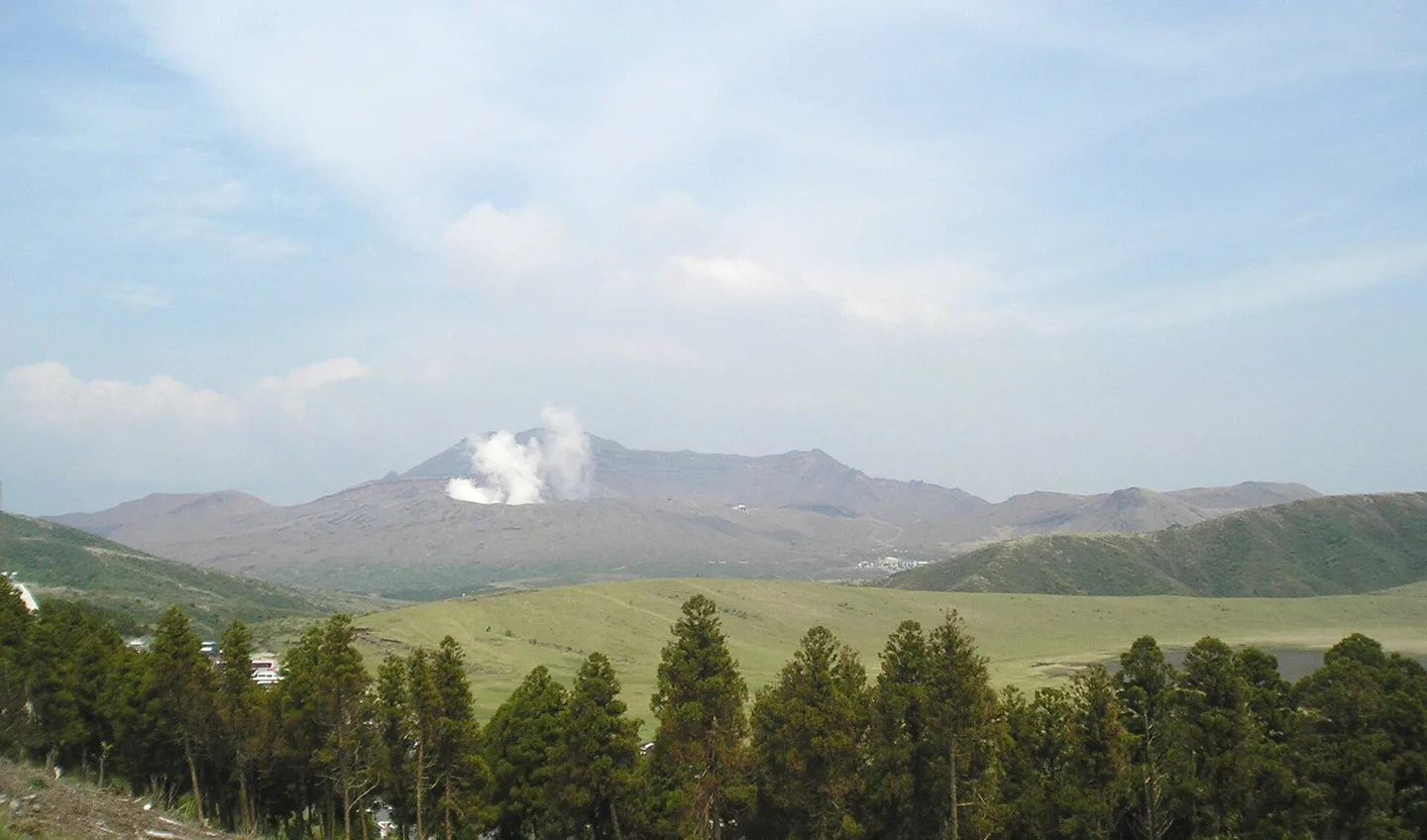
Aso fits a long self-drive day from Fukuoka if you leave early and let the mountain be the only major destination. By train and bus, the same return trip gives far less time at the actual landscape than the map suggests. Staying in Aso removes the afternoon train deadline; staying in Kumamoto moves part of the rail journey off the sightseeing day. The right answer depends on whether your priority is Kusasenri and the caldera, a particular hotel evening, or the currently restricted Nakadake crater itself.
There is a consequential update to older Aso itineraries. Japan's Meteorological Agency lowered Mount Aso from eruption alert Level 3 to Level 2 on 1 September 2026. Its 23 October report keeps roughly one kilometre around Nakadake First Crater under restriction. The road to the crater is still closed and Sanko Bus says its crater shuttle is suspended, but the regular Aso Station–Kusasenri–Aso Sanjo Terminal bus reaches the mountain terminal. A Level 2 warning is not permission to enter the restricted crater zone. It does allow a different landscape day from the Level 3 conditions that shaped many August 2026 reports. The Kyushu Odan bus update distinguishes wider regional service from crater access.
Choose the scale of the trip before choosing a ticket
| Travel plan | Practical base | What makes it work | What it costs |
|---|---|---|---|
| Rental car, one focused landscape day | Fukuoka return is possible | Early departure and two or three Aso anchors, with no second region added | Long road day and limited recovery if weather deteriorates |
| No car, Kusasenri and mountain time are central | Aso overnight | Mountain visit escapes the same-day return-train limit | Rural hotel last mile and another check-in |
| No car, city lodging and a modest Aso visit | Kumamoto overnight | Hakata–Kumamoto transfer is completed the previous day | Aso Station still requires a bus or taxi uphill |
| Crater viewing is essential | Reconsider the date or purpose | Only a future lifting of the local restriction makes the crater possible | Current accessible scenery is not the same experience |
| Aso plus Kurokawa or Takachiho | Overnight onward route | The second place receives its own travel block | More hotel and transport planning |
These are itinerary choices, not fixed tour products. An Aso landscape day can still be worthwhile while the crater stays shut. If seeing the active crater is the non-negotiable reason for spending a Japan day, leaving Fukuoka earlier does nothing to remove a safety boundary. If open caldera views, Kusasenri, Daikanbo and Aso Shrine appeal on their own, the current restriction changes the route rather than erasing the trip. Aso within a four-day Kumamoto visit starts from a closer base and gives the landscape more room.
The train window ends at Aso Station, not Kusasenri
JR Kyushu's 2026 ASO BOY! schedule illustrates the car-free constraint. On a day the relevant trains operate, No. 1 leaves Kumamoto at 09:57 and reaches Aso at 11:27. No. 4 leaves Aso at 15:56 and arrives in Kumamoto at 17:08. Between those two Aso Station times are 4 hours 29 minutes. You must reach Kumamoto from Fukuoka before the outbound departure and return to Fukuoka after the inbound one; neither leg has been counted in that station window. The named train runs by operating calendar, so use the date-specific schedule rather than assuming every train is ASO BOY! Hakata or Tenjin as a Fukuoka base affects the first and last city-side transfers.
Aso Station is below the main mountain viewpoints. The Aso onsen and tourism association quotes roughly 35 minutes and ¥3,500 one way by taxi to the Kusasenri volcano-museum stop. If the same approximate taxi duration is used in both directions, subtracting 70 minutes from the 4-hour-29-minute station window leaves about 3 hours 19 minutes before taxi waiting, a meal, walking or a safe train-return margin. That is a planning illustration, not a promised sightseeing duration or a guaranteed taxi fare. The association's separate road estimate to Kusasenri is roughly 40 minutes by car, showing why the mode and starting point matter.
The bus costs less than a private taxi but runs to its own clock. Sanko's Aso mountain line now advertises Aso Station–Kusasenri–Aso Sanjo Terminal service, with a published pattern of nine uphill and ten downhill buses per day. Buses can fill, and the operator does not promise a connection with the JR train you hoped to catch. A visitor arriving at 11:27 cannot simply convert the whole four-hour window into mountain time. Choose the actual outbound and return bus for the travel date, count the wait at both ends, and keep a return that reaches the station before the rail departure. A Northern Kyushu rail pass may change the intercity fare, but it does not improve the mountain-bus timing. The regional transport plan helps decide whether a car is worth using for more than this one excursion.
The current mountain boundary
The August 2026 Level 3 warning covered roughly two kilometres from Nakadake First Crater and temporarily cut the regular mountain-bus operation back to Kusasenri. On 1 September, JMA reduced the alert to Level 2. Its 23 October commentary still says to avoid the area within roughly one kilometre of the crater and follow local entry restrictions; volcanic gas and downwind ash are also concerns. Sanko now lists the normal road route through Kusasenri to Aso Sanjo Terminal. The separate shuttle from that terminal to the crater remains suspended because the crater road is closed. Do not describe a ticket to the mountain terminal as a ticket to the crater.
Restrictions can change on a day when the rail timetable does not. Sanko notes that gas, fog and local decisions can change crater-road operation shortly before opening or during the day. A plan built around an unrestricted crater should not be sold against the present Level 2 situation. Kusasenri, broad caldera viewpoints and Aso Shrine remain different objectives, subject to weather and any local road instructions. For a family, having those alternatives can preserve the day; for someone whose main wish is the crater rim, an alternative grassland viewpoint may not be an honest substitute.
The geography also matters. Daikanbo lies away from the mountain terminal on the caldera's north side, and Aso Shrine is a separate town-side stop. A public-transport traveller should not assume that arrival at Aso Sanjo Terminal connects conveniently to both before a 15:56 train. A driver can combine them more flexibly, but the road segments still take time. Other Aso outdoor activities are alternatives when a crater visit is barred, though they have their own operating conditions. Takachiho Gorge's transport plan belongs to a separate day.
Driving from Fukuoka: useful flexibility after a long approach
Aso-area access material puts Fukuoka IC to Kumamoto IC at about one hour twenty minutes. Local tourism information describes Kumamoto IC to Aso at about fifty minutes, and the Aso association adds about forty minutes from Aso Station to Kusasenri. Added as planning sectors, that is roughly two hours fifty minutes from Fukuoka IC to Kusasenri, before reaching the interchange from your hotel, collecting the rental, taking a break, meeting traffic or parking. Repeating those sectors in reverse gives about five hours forty minutes of road time before city-side pieces. This is not live navigation data; it explains the scale of a same-day out-and-back.
The car earns its cost by controlling the last mile. You can move between Daikanbo, Kusasenri and Aso Shrine without matching a sparse set of mountain buses. It does not create an unlimited day. Choose two or three coherent anchors: Daikanbo with Kusasenri for a landscape day; Kusasenri with one nearby mountain stop and Aso Shrine for scenery and culture; or Daikanbo with Aso town and Uchinomaki when clouds make the high mountain less rewarding. Reaching the closed crater is not one of the available combinations. If you are deciding whether to take a vehicle through the whole region, the Kyushu rail, bus and car itinerary gives that rental a broader test.
Compare Fukuoka and Kumamoto rental options for the date by the pickup branch's hours, insurance or protection, drop-off point and the time left after returning the car. A low base price is not enough if collection delays the start and the final return imposes another drive after dark. The Fukuoka car-day hotel plan matters when the first hour of an early drive begins in city traffic or with a rental pickup. If only this day needs road flexibility, a driver-versus-JR comparison may be more relevant than a multi-day car booking. A driver who dislikes the long return can still rent for a one-way regional leg and sleep in Aso or Kumamoto. A family with young children may prefer that reset rather than adding one more scenic stop as everyone tires.
Which overnight actually helps?
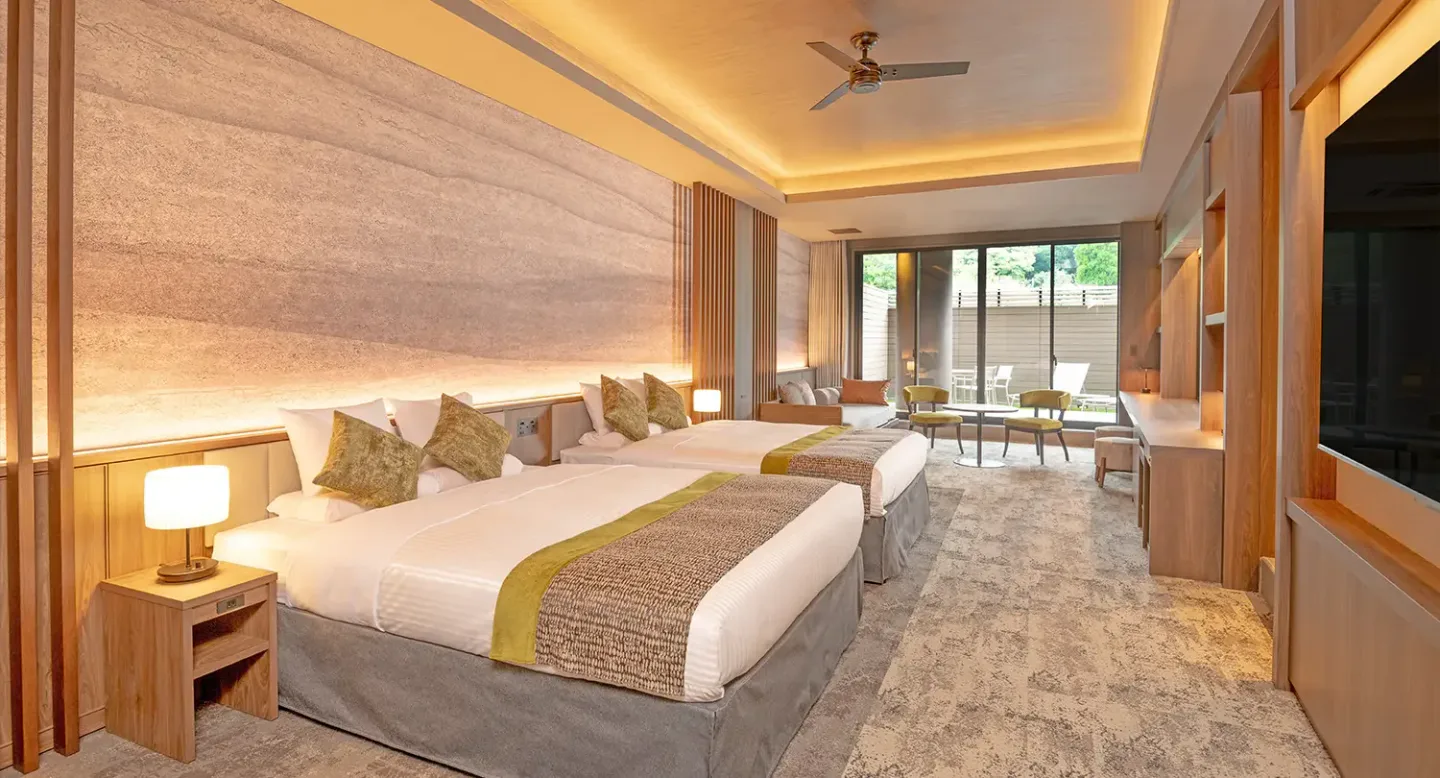
Aso: This is the most direct purchase of mountain time. Reach the area on Day 1, sleep near the portion of Aso you intend to use, and start Day 2 with a weather choice rather than a 15:56 train deadline. It suits a visitor for whom Kusasenri, caldera scenery and a rural onsen evening matter more than an urban hotel base. An early Aso balloon booking is another specific reason to sleep locally, subject to its meeting and cancellation rules. But “Aso” is not a single walkable hotel district. Aso Station, Uchinomaki, individual ryokan and the mountain bus stops are separated. Confirm pickup, taxi, bus or car access to the booked property. The Aso overnight from Kumamoto compares that extra local move with a one-day visit.
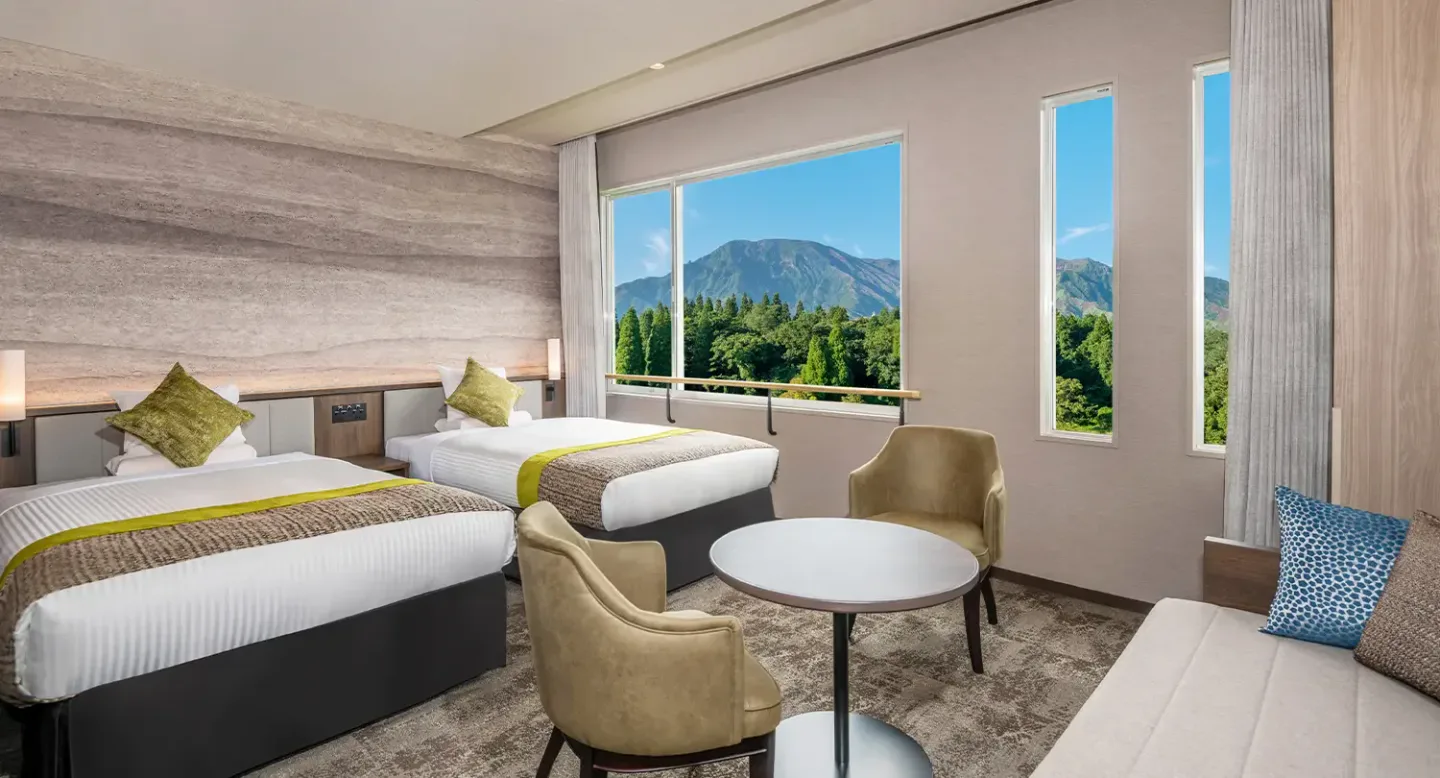
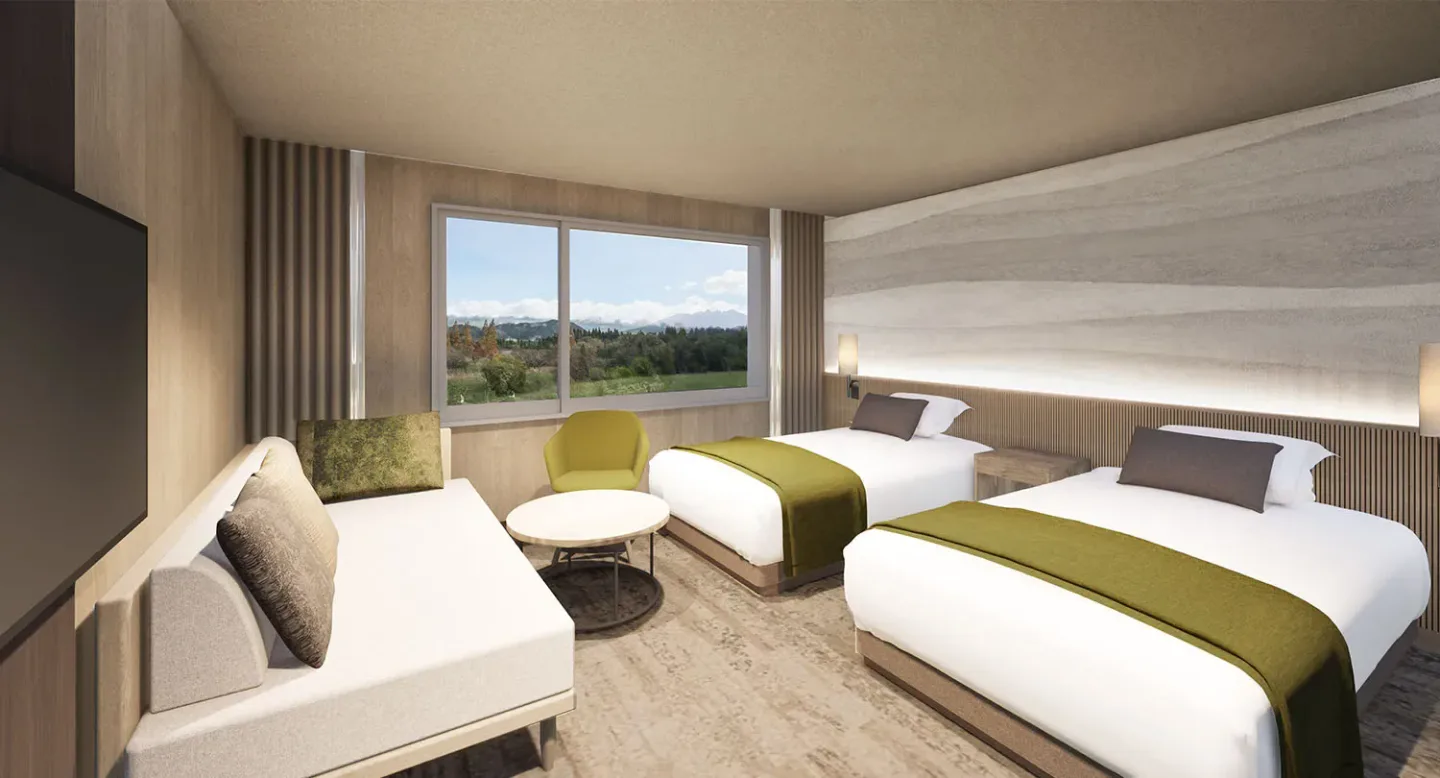
The article's three room photographs illustrate why a hotel should be chosen by actual booked features. One shows a broad twin room with an outdoor seating area, another a pair of beds beside a mountain-facing window, and a third a different twin layout with seating. The pictures do not establish that any given rate includes a private open-air bath or that the same room is available on your dates. If a bath or view is the reason for the overnight, match the photograph to the sold category and its stated inclusions. See Aso stays for your travel dates and check that last mile before paying.
Kumamoto: The city is a compromise for a rail-first traveller. Taking the Hakata–Kumamoto leg the day before gives a simpler start, Shinkansen access and a wider urban hotel and dining choice. You still have to travel from Kumamoto to Aso, then from Aso Station up to the chosen mountain area. The 09:57–11:27 ASO BOY! example remains a relevant departure even after a Kumamoto night. Stay there when Aso is one part of a city-centred route; sleep near Aso when the landscape is the main reason for adding a night. Beppu versus Yufuin overnights poses a similar question elsewhere in Kyushu: whether the room buys a distinct evening or only changes the transfer.
Kurokawa: This is its own onsen stay, not a generic overflow bed for Aso. A ryokan dinner and bath can make the journey worthwhile when the next day continues across central Kyushu. The Kyushu Odan bus connects the area with Aso, but services are sparse enough that the timetable shapes the whole day. A visitor returning directly to Fukuoka after one mountain afternoon usually has a simpler choice in Aso or Kumamoto. The Kyushu Odan service update is relevant if Kurokawa or Yufuin is the onward destination. For an alternative route that actually finishes in Yufuin, compare the direct Fukuoka–Yufuin transport before committing to the Aso detour.
Takachiho is a second travel block
The Aso–Takachiho Asochiho bus is listed at about two hours ten minutes end to end, with three normal round trips. It was rerouted in 2026, including an October timetable and stop revision; current operator information names Aso Sanjo Terminal on the route. That is an onward intercity bus, not a frequent loop between the caldera stops. Combining Fukuoka, Aso, Takachiho and a Fukuoka return in one day would spend far too much of the day on connections even if every bus were on time.
Give Takachiho its own day or let an overnight join the two places. The gorge boats, walking route and possible evening performance have separate booking and timing constraints. Plan Takachiho independently if it is truly important. A night-kagura stay provides an actual reason to continue there instead of returning immediately. The same discipline applies to Kurokawa: adding a ryokan can make a two-day journey richer, whereas squeezing it into the Fukuoka return turns a landscape trip into a race through departure times.
Families need time that survives a missed bus
The 4-hour-29-minute station gap is most misleading for a group that walks slowly or needs a fixed lunch, child breaks or assistance boarding. A mountain bus might be full; a taxi may not be waiting; a rain shower can send everyone back indoors. Sanko explicitly warns that its bus schedule does not guarantee the JR connection. If the single Aso day is important, a family can use a car with a low stop count or buy an Aso overnight and separate the long-distance travel from the mountain hours. Older travellers can make the same calculation without treating a fast map estimate as the pace they must maintain.
There is a useful distinction between recovery margin and needless extra time. An Aso night buys a second weather opportunity and removes the deadline to race back to Fukuoka. A Kumamoto night mainly removes the Hakata–Kumamoto leg from the morning; it does less for the local bus. One extra hotel only helps if the group can reach it comfortably and use the recovered time. The Nagasaki day-trip versus overnight choice offers another Fukuoka-based example, but Aso's mountain last mile creates a different constraint.
A two-day route with a job for each day
On Day 1, travel from Fukuoka toward Aso and choose a lower or more flexible stop such as Daikanbo, Aso Shrine or the town area if cloud blocks the mountain. A driver can adapt on the way; a rail visitor should arrange the hotel transfer before arrival. Spend the night in Aso if the morning landscape is central, or Kumamoto if the city base matters more. Do not force the restricted crater into either version. The exact safe-access boundary must be respected even on a clear day.
On Day 2, use the morning for Kusasenri and the legally accessible mountain zone, then return via Kumamoto or continue into central Kyushu. If Kurokawa or Takachiho follows, that onward bus or drive is already the day's major transfer. If the view is poor, an Aso overnight lets you swap the mountain and lower-level stops without losing the whole visit. An autumn Kyushu mountain-road plan needs its own daylight and weather allowance; do not reuse a summer drive estimate in late foliage season. The difference from a Fukuoka rail day trip is concrete: you are no longer trying to complete the mountain between an 11:27 arrival and a 15:56 departure.
A day return by car remains reasonable for a traveller comfortable with roughly the cited road sectors twice, who wants a small number of Aso landscape anchors and accepts that weather may narrow the result. Public transport from Fukuoka is better treated as an overnight when the mountain is the point. As of 24 October 2026, Level 2 restrictions still keep the crater itself off the itinerary, while the regular mountain bus again reaches Aso Sanjo Terminal. Take the day for Kusasenri and the caldera if those places meet your aim; postpone a crater-centred plan until local restrictions truly change. A Fukuoka hotel near the right departure matters if you choose the long day return.
Transport and volcanic-status details
Japan Meteorological Agency — current Mount Aso volcanic activity and alert · Sanko Bus — Aso crater shuttle status · JR Kyushu — ASO BOY! timetable · Aso tourism association — access, local travel and taxi estimates · Sanko Bus — Aso–Takachiho service
Other day-trip and overnight decisions
Mt Fuji Day Trip or Overnight: When an Extra Night Is Worth It · Oshima Island Fukuoka Day Trip: I’d Pay for the Island Transport, Not a Guaranteed ‘Path of Light’ Sunset · Takayama Day Trip or Overnight from Nagoya: 4-Day Trip Guide · Biei Day Trip or Overnight? When Staying One Night Is Worth It · Jozankei Autumn Leaves 2026: Day Trip or Overnight? The Foliage Buses Change the Answer · Nara Day Trip or Overnight? When Is One Night Worth It? · Dazaifu vs Itoshima: Which Fukuoka Day Trip Should You Choose? · Nikko vs Okunikko in Autumn: Day Trip, Overnight and Where to Stay · Nikko Day Trip or Overnight: Which Fits a 4-Day Tokyo Trip? · Itoshima Day Trip or Overnight? Is One Coastal Night Worth It? · Otaru Day Trip or Overnight? When Is One Night Worth It? · Izu Oshima Day Trip or Overnight? Jetfoil vs Night Ferry From Tokyo