
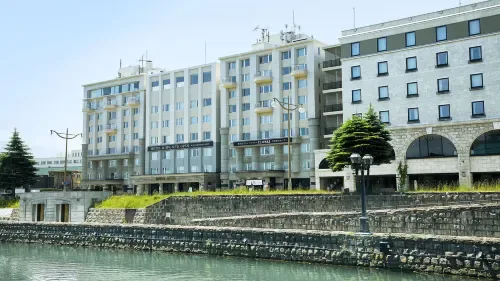
Hotel Sonia Otaru sits directly along the canal, around eight minutes on foot from JR Otaru Station. That distance is a real luggage walk in winter, yet sleeping beside the water can turn one rushed canal stop into several different visits: late afternoon, the lit warehouses after dinner and a quiet morning before day visitors arrive. The top-floor natural hot spring adds another reason to return to the hotel between those walks. A room here makes most sense when the arrival and departure hours leave time to use both the location and the bath.
The hotel name does not guarantee an in-room canal view. Its own room page warns that some canal-side rooms on lower floors cannot see the canal clearly. That makes two separate purchases: an address beside the canal, and a room whose exact category and floor deliver the view. A city-side room can still be a good Sonia booking if the location and bath are the reasons for staying. Deciding whether Otaru deserves an overnight comes before paying extra for a particular window.
↔ Scroll table left or right
| Your night in Otaru | Sonia's useful advantage | What can defeat it |
|---|---|---|
| Arrival around 15:00–17:00, dinner by the canal and a relaxed morning | Several canal visits and two possible bath windows | The room's view category costs more than you will use |
| Arrival after 21:00 followed by an early JR train | Perhaps one short bath or canal glance | The winter luggage walk remains while most hotel benefits disappear |
| Rail arrival with two large cases in snow | Canal and hot spring after the difficult transfer | Snowbanks make the first and last eight minutes too costly |
| Self-drive visit | Arrival at the building removes the station carry | Paid, first-come parking and vehicle size limits replace it |
| Two nights based in Otaru | Canal and bath visits can repeat after one arrival transfer | A second Otaru night may be less useful than keeping one Hokkaido base |
The luggage walk is paid twice; the canal can be used several times
The hotel's eight-minute station estimate is modest with a light case on dry pavement. A January or February arrival can feel different when snow has narrowed the footway and both travellers have full-size bags. A station-side room reduces that first transfer. Sonia offers a different kind of convenience once cases are in the room: the Otaru Canal is at its doorstep, so a guest can step out for a short view without planning another ride or long walk.
One overnight has four possible canal windows. Arrival before dinner provides daylight on the warehouses. After dark, lamps and reflections change the same route. Early morning can be quieter than the day-trip period. A final short walk after breakfast is possible before checkout. If three or four of these fit the itinerary, a canal address contributes repeatedly while the station transfer happens on arrival and departure. If only one canal visit survives, the room premium needs a stronger reason. The Dormy Inn, OMO5 and Sonia winter comparison gives the station-versus-canal trade in one place.
A late train arrival followed by an early JR departure reverses the balance. The guest still walks with bags but may miss the evening bath and have no time to enjoy the water. Dormy Inn PREMIUM Otaru is the direct station-side counterexample. Hotel Torifito Otaru Canal presents another canal-area room and walk to price on the same dates.
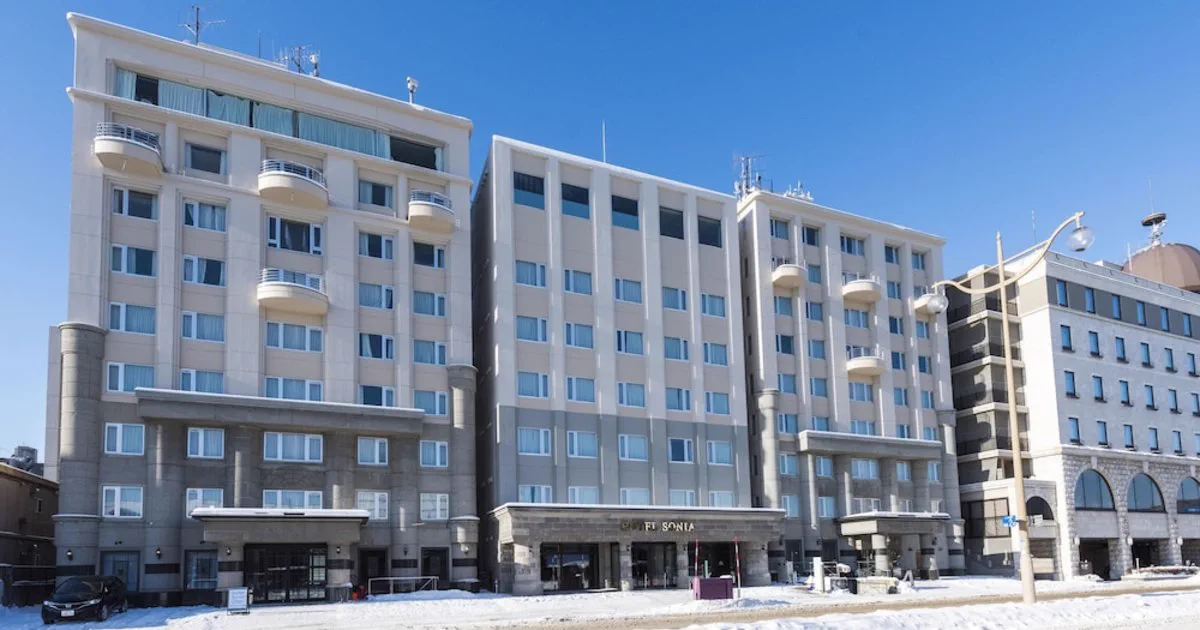
The winter exterior image shows the Sonia entrance with snow at street level; it is a useful reminder that “eight minutes” describes a route, not the effort of dragging cases through conditions on a particular day. A winter Hokkaido trip without a car has to account for every such luggage transfer. For a summer plan that also includes Sapporo, the five-day Hokkaido route may make Otaru a day trip rather than a hotel move.
Parking replaces the JR walk for drivers
Driving in from another Hokkaido stop eliminates the station-to-hotel suitcase carry. The hotel's route page places it about five minutes from the Otaru interchange. Its current dedicated site lists 37 hotel parking spaces, ¥1,200 per night, available from check-in at 15:00. Spaces cannot be reserved; an early arrival costs extra, and a full lot sends the driver to a non-affiliated paid car park. Snowfall may reduce the number of usable spaces. A group page still displays a different total of 58 spaces, so rely on the current property parking instructions and ask before treating any capacity as guaranteed.
The group access information gives multilevel-park limits of 5.0 m length, 2.0 m width and 1.55 m height. A compact car arriving before a busy evening has a stronger parking case than a tall SUV or minivan, though it still has no reserved bay. The lot is reached down a narrow alley between Uroko Banya and Hotel Nord Otaru. A driver who will leave the vehicle parked for the entire stay should count the nightly fee and rental day against how walkable central Otaru is after check-in. A full-week versus partial Hokkaido car rental can expose a vehicle kept idle through Otaru.
For a winter road trip, first-come parking is a risk of its own; a late arrival does not ensure an easy bay even when the station walk is irrelevant. Winter rental timing should be decided for the whole route, not for one hotel. A family road-trip base plan may also make a second Otaru hotel night unnecessary if the car is already serving several destinations.
A canal-side category may still have a poor canal view
About seventy percent of Sonia's 149 rooms are on the canal side. That is not the same as seventy percent having an unobstructed water view; the room page warns that view depends on floor and some canal-side rooms cannot see the canal. The Standard Twin is 20.9 m² with two 120 cm beds and faces the city. Canal Standard Twin A is 21.5 m² with two 120 cm beds, but its category warning still says a clear canal view is not assured. Canal Standard Twin B is also 21.5 m² and can accommodate a third person with an extra bed, yet its view likewise depends on the particular room.
↔ Scroll table left or right
| Room choice | Published space and use | View or bed question |
|---|---|---|
| Standard Twin | 20.9 m²; two 120 cm beds | City-side room, no canal view |
| Canal Standard Twin A | 21.5 m²; two 120 cm beds | Canal side, but view varies by floor |
| Canal Standard Twin B | 21.5 m²; two beds plus optional third | Confirm extra bed and actual outlook |
| Canal Superior Twin | 24 m²; optional third bed | More room, still check the view note |
| Deluxe Family Triple | 45 m²; three 120 cm beds plus optional extra | More space for four, no canal view |
These categories make a real choice for a family. A 45 m² Deluxe Family Triple has three full beds, room for an extra and a separate bathing area, yet it faces away from the canal. Four people with cases may gain more from that layout than from paying for a tighter canal-side category. A couple spending a long evening in the room may value a verified upper-floor view more. Confirm the exact room name, sleeping surfaces and view wording on the payment screen, then ask the property if the view is the deciding factor. OMO5 Otaru provides another canal-area stay to compare when room character matters.
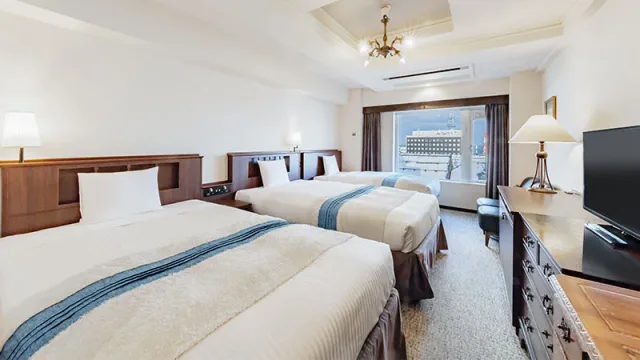
The room photograph shows three beds and a window; it establishes what that pictured arrangement looks like, not the dimensions or guaranteed view of a different named category. Sonia's address beside the water comes with any room; an in-room panorama must be bought separately. A larger Sapporo room with a longer station walk is a useful reminder that area and location are separate costs.
The top-floor hot spring has two useful daily windows
The natural hot spring is on the main building's top floor and is for overnight guests. Current hours are 15:00–24:00 and 06:00–10:00. Guests aged fifteen or above pay a separate ¥150 bathing tax. The men's bath looks toward the canal and the women's section has an outdoor bath. The spring uses water from Otaru's Ironai area; it is a circulated bath with added heat or water, rather than an untouched source flowing through every tub.
One night can permit a soak after dinner and another before breakfast or checkout. A 23:30 return from a long meal makes the first of those thin; a 07:00 train can remove the second. Count sessions that the timetable genuinely allows. If there is only time for one, compare the final room price with a station hotel whose bath might be easier to reach. A Sapporo onsen hotel with a longer walk shows the same trade in another city; Hakodate Kokusai combines a similar station distance with very different breakfast hours.
A bath is not a reason to ignore the room's bed and floor needs. Children, mixed bathing rules, tattoos and available time should be checked for the actual party before counting the amenity as used. The hotel sells an overnight Otaru experience, but a traveller who dislikes communal bathing should compare it largely on location and room value. The Hokkaido region itinerary helps decide whether the stop deserves a night at all.
The breakfast decision spends the only Otaru morning
Sonia's breakfast is served at SUSHI & GRILL IL ONAI in the North Building. Its buffet includes a seafood rice-bowl option and Otaru dishes. That is useful in poor weather, with children, or before an onward train. Yet some visitors deliberately want a market, sushi or another seafood breakfast in town. Paying for the hotel buffet and an outside breakfast can crowd the same short morning.
Choose the meal that fits the rest of the day. A late start with a planned canal walk can support a leisurely buffet. An early train may require a faster option, while a traveller who wants a particular Otaru breakfast should buy room-only if the price difference makes sense. Two nights make it possible to try both a hotel morning and an outside one, but the second hotel night has to earn its own place in the Hokkaido plan. The Otaru day-trip or overnight guide is the starting point for that decision.
Our seven Hotel Sonia Otaru ratings
One canal-side night is the basis for these marks. A room labelled canal-side is not automatically a clear canal view, and the winter station walk still has to be paid with luggage.
| Dimension | Our rating | The booking consequence |
|---|---|---|
| Location | The canal is at the door, while JR Otaru is an outdoor eight-minute walk. | |
| Room | A lower-floor canal-side category may have an obstructed view; buy the specified outlook. | |
| Cleanliness | Current upkeep results are sound but less even than the location signal. | |
| Service | Recent staff scores are positive, with winter luggage still a self-managed approach. | |
| Facilities | The top-floor hot spring adds a night and morning use window. | |
| Food | Breakfast is well received, but spending the only Otaru morning indoors has a cost. | |
| Value | A true canal outlook and multiple waterside visits repay the extra station transfer. |
Our overall one-night canal read is 8.2/10. A quick rail stop with no evening walk is usually better served near the station.
Which stay actually earns the extra transfer?
One Sonia night is strongest when arrival is early enough to see the canal before and after dinner, use at least one bath window, and still have morning time by the water. Two nights increase the return from the location and bath because the initial transfer happens once while those activities repeat. The second night should also support a real Otaru itinerary; it is not automatically better than keeping Sapporo as one base. A long Sapporo base can be simpler for repeated city days.
Look elsewhere if the stay is station–sleep–station, if winter luggage is the decisive constraint, if the car cannot fit or parking must be guaranteed, if the bath will be skipped, or if the booked room does not promise the view that justified its price. Dormy Inn's near-station case is strongest for an early train; the three-hotel winter comparison puts the differing room and route costs together.
For rail visitors, Sonia's eight-minute walk is easiest to justify when the canal and bath produce several actual sessions. For drivers, count ¥1,200 and the uncertainty of a first-come bay instead of pretending the station distance matters. The right booking identifies a room whose sleeping space and outlook match the group. Compare Sonia and nearby Otaru rooms with that category and arrival mode in mind.
Hotel details
Related guides: OMO5 Otaru: Is a 9-Minute Station Walk Worth Staying by the Canal? · Hotel Torifito Otaru Canal: Is a 7-Minute Walk from Otaru Station Worth It? · The Naha Terrace: Are 35m² Rooms and 12:00 Check-Out Worth a 15–20 Minute Station Walk? · Hakodate Kokusai Hotel: Is an 8-Minute Station Walk Worth the 2026 Pickup, Hot Spring and 5:30 Breakfast? · Lake Biwa Otsu Prince Hotel: Is the 36.2m² Lake View Worth the Shuttle? · Lotte Hotel Busan vs Arban Hotel: Is the Five-Star Premium Worth It in Seomyeon? · Hotel Gracery Sapporo: Is a 1-Minute Station Walk Worth a 15 m² Room? · Hotel Sosei Sapporo Review: Is a 39 m² Twin-Queen Room Worth a 15-Minute Walk from Sapporo Station? · ONSEN RYOKAN YUEN SAPPORO: Is the Karurusu Hot Spring Worth a 13-Minute Walk? · Zentis Osaka: Is Room 001 Worth the Walk from Osaka Station?