
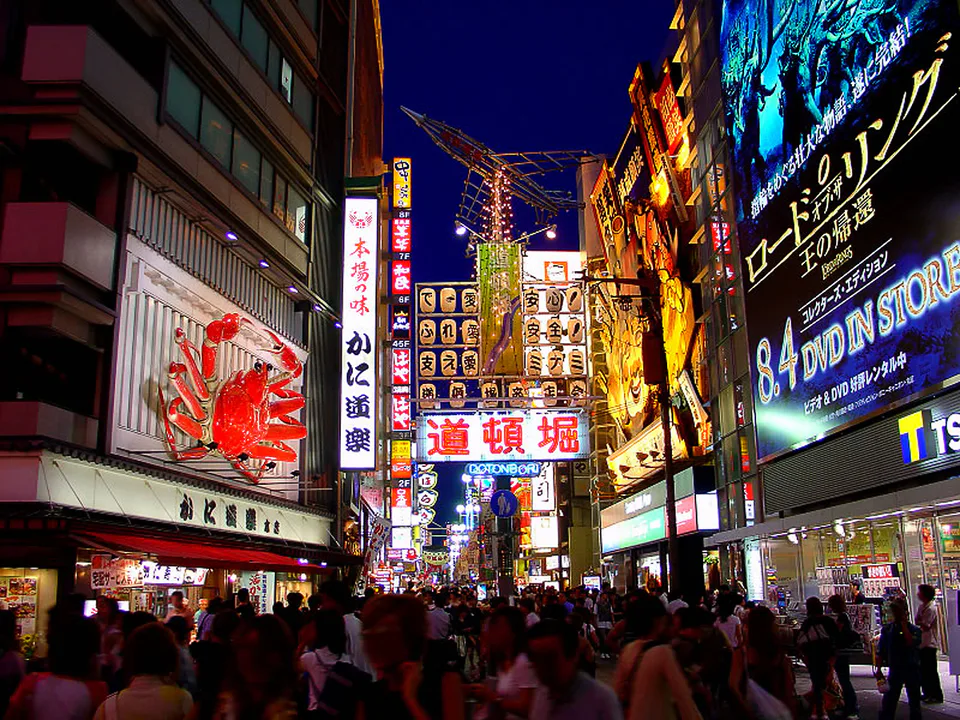
Osaka changes character at street level after dark: Dotonbori's canal signs and the illuminated riverside in Nakanoshima give two quite different evenings without an admission ticket. Pay for elevation when you want the city laid out beneath you, or when a Ferris wheel is already beside the day's main stop. A short visit seldom needs both Umeda Sky Building and HARUKAS 300. The useful choice is where you will be at sunset, whether the sky is clear, and whether the view justifies moving across the city.
Umeda Sky offers the more exposed rooftop experience near Osaka Station. HARUKAS 300 has a high enclosed panorama over Tennoji and Abeno. Tempozan Ferris Wheel is a shorter and cheaper bay-area lift after Kaiyukan. Each answers a different evening plan. The current regular adult admission at the two large decks is close—¥2,000 at Umeda Sky and ¥2,200 for a HARUKAS same-day ticket—so a ¥200 difference should not send you to the wrong end of town.
The fare examples below use yen because currency conversions age quickly. Published opening hours, discount eligibility and weather operations should be matched to the date you choose. The Tempozan operator and Osaka Metro currently show a ¥1,000 regular ride; some older tourism pages still display ¥900. That ¥900 figure now appears as an Osaka Metro card discount, which is a different condition.
Give each evening a purpose
A night-view plan becomes simpler if you name what you want to see. Dotonbori provides the dense signs and crowds many visitors mean by an Osaka night. Nakanoshima is a riverside stroll. A bay wheel adds a brief look over the port, while the two major decks turn the skyline into the event. On a three-, four- or five-day Osaka itinerary, it is often easier to use free views on ordinary dinner nights and reserve one clear evening for a tower.
↔ Scroll table left or right
What you want after dark | Natural choice | Why it fits |
Osaka signs and canal reflections after dinner | Dotonbori | Free and often already on a Namba route. |
A calmer illuminated river walk | Nakanoshima / Crystal Bridge | Free, with architecture and several viewpoints as you walk. |
A brief lift after Kaiyukan | Tempozan Ferris Wheel | About fifteen minutes; current regular adult fare ¥1,000. |
An included Umeda wheel ride with the Amazing Pass | HEP FIVE | The pass lists it for evening use; Umeda Sky is only discounted after 15:00. |
An exposed rooftop at dusk | Umeda Sky Building | The outdoor 173-metre roof is the distinctive part. |
A sheltered high panorama | HARUKAS 300 | A 300-metre building over Tennoji with an enclosed 360-degree view. |
Booking an elevated attraction every night takes time away from food, neighbourhoods and the route back to your hotel. The panorama from Umeda and the one from Tennoji are not identical, but most first-time short stays gain more variety by pairing one high view with a street or river scene. An Osaka solo itinerary is another reminder that the best evening is not always the fullest one.
The two flagship ticket prices are now close
Umeda Sky lists ¥2,000 for an adult. HARUKAS 300 lists ¥2,200 for an adult same-day WEB ticket and ¥1,980 for a WEB ticket bought by the previous day, a ten percent saving. Those are the current published categories, not a forecast for future dates or special events. If you can commit early, HARUKAS is nominally ¥20 cheaper per adult than the regular Umeda admission. Whether an exposed roof or an enclosed 300-metre panorama appeals more should carry far more weight than that difference.
↔ Scroll table left or right
Ticket | One adult | Two adults | Most relevant difference |
Umeda Sky regular | ¥2,000 | ¥4,000 | Open-air roof and Umeda routing. |
HARUKAS 300 same-day | ¥2,200 | ¥4,400 | High indoor panorama near Tennoji. |
HARUKAS 300 WEB advance | ¥1,980 | ¥3,960 | Previous-day purchase required for ten percent saving. |
Two adults would spend ¥4,000 at Umeda Sky, ¥4,400 on HARUKAS same-day tickets or ¥3,960 for the HARUKAS advance offer. The advance pair saves ¥40 relative to Umeda's regular pair. A subway detour, a missed dinner booking or a cloud-obscured view can matter more than ¥40. If both routes fit equally well, compare the actual viewpoint experience rather than trying to extract a decisive price winner from almost identical totals.
HARUKAS revised its admission structure in July 2026. Its current ticket listing is the safest place to distinguish WEB advance and day-of-arrival products, including age brackets and the no-re-entry condition. Special event tickets may carry different terms. The older public operating-information page and the newer ticket page have not always presented prices in the same way, so this article uses the active ticket listing for the fare comparison. This detail belongs in booking decisions, not as a reason to buy before knowing whether the forecast suits a view.
Dotonbori: a free night scene already on many routes
If dinner, Hozenji or Shinsaibashi shopping already takes you through Namba, the Dotonbori canal costs no extra journey. Ebisu Bridge and the surrounding signs create a distinctive street-level view; the crowds are part of that scene, though they also make it less quiet. You can walk the canal, leave when ready and adjust for rain without losing a ticket. For someone wanting Osaka's neon and reflections rather than a map of the skyline, this is usually the most efficient first night.
Do it on the same outing as dinner or shopping rather than reserving a separate night-view appointment. A Namba shopping hotel lets the walk end near your room, and the Cross Hotel Dotonbori decision illustrates the convenience of that location. If the only reason to cross town is a familiar photograph, ask whether another Osaka neighbourhood you have not yet seen deserves the time instead.
Dotonbori does not show Osaka's full urban spread from above. Its scale is intimate: canal, bridges, signs and people. A traveller who specifically wants a panoramic horizon will not get a substitute by standing on Ebisu Bridge. That distinction keeps a free experience from becoming a false economy. Choose the scene that answers your actual curiosity, then choose the nearest sensible location for it.
Nakanoshima: an evening walk without a skyline ticket
Crystal Bridge and the Nakanoshima riverfront offer another free night with a different pace. Osaka's tourism information places the pedestrian bridge roughly five minutes from Yodoyabashi Station and notes its lighting and benches. Nearby riverside architecture, including the Central Public Hall, gives the route several views rather than one fixed platform. Because the attraction is the walk, a couple can combine it with dinner without having to time a paid admission slot.
The river is quieter than Dotonbori but does not deliver the aerial drama of a deck. That makes it appealing when a relaxed route matters more than photographic height. Guests deciding between hotels for evenings in different parts of Osaka can use the Osaka couples' hotel guide or Namba versus Umeda base comparison to see which return journey follows the walk naturally.
Maishima: zero admission, substantial travel
Maishima Seaside Promenade gives an open view toward passing ships, Nanko and Tempozan; Osaka tourism describes the site as free and available through the day. The access is less casual than a central walk. From Nishikujo there is a bus, and from Sakurajima on the JR Yumesaki Line a transfer to the Active Bus may be required. Check the return service as well as the outward trip, especially if you want to remain through sunset.
Maishima works well if a hotel, event or other plan already puts you on the island. It can be a poor bargain from central Osaka when the sole objective is saving an admission fee. A free sea view may use the best hour of the evening plus the travel on both sides. Compare that cost in time with a paid deck that sits near your dinner or accommodation, or simply use a central free view.
A western Osaka day at Universal Studios Japan does not automatically make Maishima a convenient second stop; the bus leg still has to fit. If your trip is short, the Osaka, USJ and Kyoto time trade-off may be more useful than another sunset detour. The most attractive free photo can be the wrong use of a tightly scheduled day.
Tempozan: a short lift above an existing bay-area day
Beside Kaiyukan, Tempozan Ferris Wheel makes sense as a compact add-on. Osaka tourism gives the rotation at about 15 minutes and the approach from Osakako Station at around five minutes. The current regular fare shown by Osaka Metro is ¥1,000, while its listed card discount is ¥900; an older Osaka tourism page still says ¥900 without that distinction. Hours vary with season and weather, so use the operating calendar for your date. It is a bay view, not a substitute for the city's highest panorama.
Two full-fare adult rides would be ¥2,000. That is roughly half the pair's same-day cost at Umeda Sky and less than half at HARUKAS. The saving matters most when you are already at Kaiyukan: the wheel adds elevation without an extra cross-city journey. If you would travel to Tempozan only for the ride, transport and time may erase that advantage. Kaiyukan and bay-area planning can help decide whether the aquarium day itself warrants the trip.
The Osaka Amazing Pass lists the wheel among participating attractions. If you hold the pass, look at the exact pass date and facility status before buying a separate ticket; a pass inclusion is useful only when the ride operates and you can reach it in the planned window. The wheel may close for weather or on aquarium closing days. A discount or inclusion should not be the sole reason to detour to the bay.
The Osaka Amazing Pass changes the Umeda evening math
Pass holders receive Umeda Sky observatory admission only for entry up to 15:00. From 15:00, showing the pass gives a ten percent discount instead. Applied to the regular ¥2,000 adult fare, that is about ¥1,800 for an evening visit, not free entry. Sunset seekers should put that amount in the pass calculation before choosing Umeda Sky; buying a pass for an evening view that is only discounted can make the break-even look better than it is.
HEP FIVE Ferris Wheel is a different pass option in Umeda. The current pass list gives an ordinary ¥1,000 fare, 11:00–23:00 operating hours and final boarding at 22:45, subject to the attraction's own schedule. It reopened after a renovation period ending in April 2026. A pass holder already near Umeda after dinner may get the elevated view they want without paying the extra Umeda Sky admission. The two attractions are different experiences, so use the pass benefit only if the wheel itself appeals.
↔ Scroll table left or right
With an Osaka Amazing Pass | Admission consequence |
Umeda Sky entry by 15:00 | Pass-listed observatory entry is included. |
Umeda Sky after 15:00 | Presenting the pass gives ten percent off, about ¥1,800 for an adult. |
HEP FIVE after dinner | The wheel remains a listed pass attraction during its operating window. |
Umeda Sky remains the better purchase for someone who wants the rooftop and the sunset transition. HEP FIVE is the cleaner pass-inclusive choice for a casual evening lift. The distinction is about the desired experience and the pass time boundary, not a universal ranking. The Osaka Amazing Pass assessment is relevant if the entire day's attractions and transport are still undecided.
Umeda Sky's value is the open air
Kuchu Teien Observatory lists 09:30–22:30 operation with the last entry at 22:00. Adult admission is ¥2,000; the published ¥500 child bracket runs from age four through elementary school. The roughly 173-metre outdoor roof is what differentiates it from a conventional windowed platform. Because the outing depends partly on being outside, rain, strong wind and poor visibility deserve more weight here than they would for a sheltered indoor night scene.
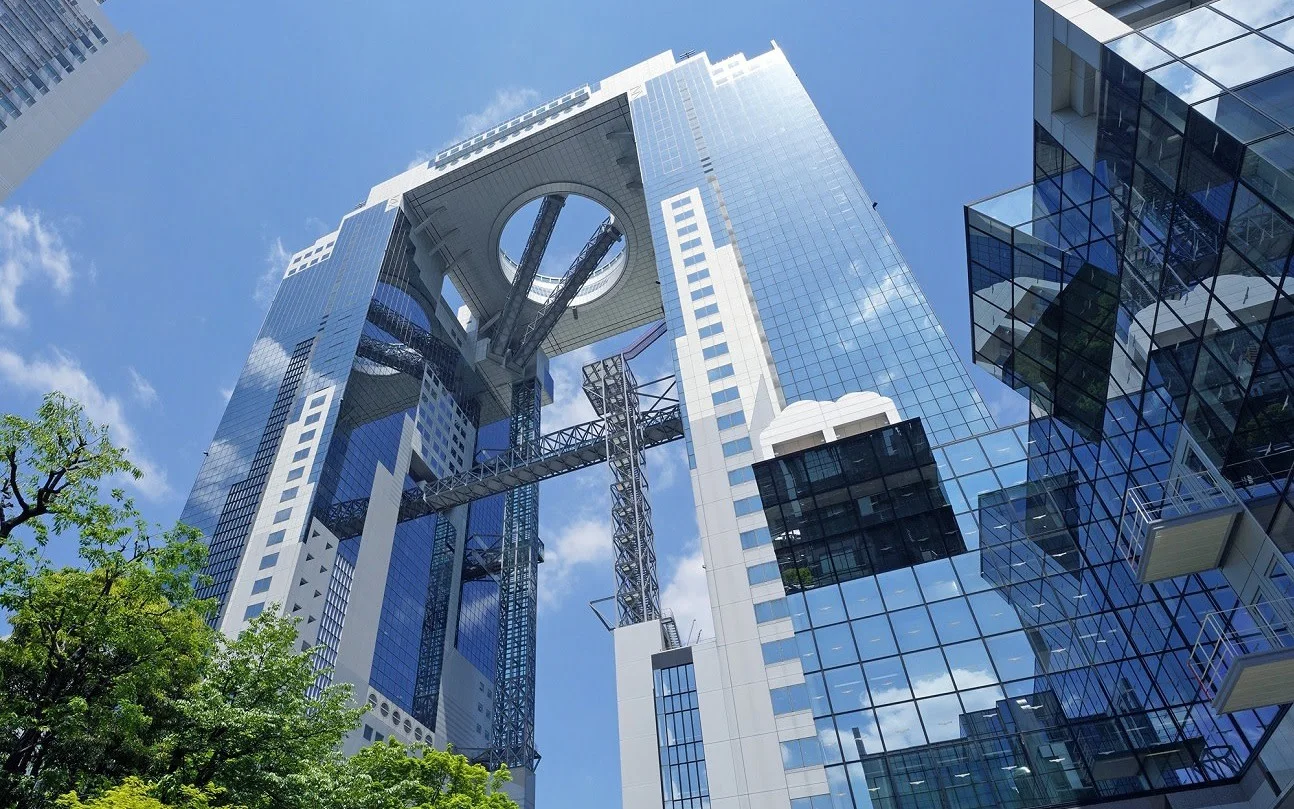
The circular roof can be memorable during the change from dusk to darkness, with a view over Umeda and the wider city. A photograph of the building's exterior does not show what the roof feels like, so do not judge the purchase solely from the structure's distinctive shape. If you are already near Osaka Station, reaching this deck may make an easy evening. If your hotel is near Tennoji, the same rooftop has to justify a longer return journey.
Leave enough time for the phase of light you care about. A ticket used only for a hurried photo after full darkness loses the transition that gives the open-air route much of its character. Conversely, holding the evening open for a clear-weather visit can be wiser than fixing the ticket to a cloudy night merely to follow a rigid itinerary. Osaka hotel bases for Kyoto and Kobe days can also affect how much of Umeda you already pass through.
HARUKAS 300: a high panorama above Tennoji
HARUKAS 300 currently lists ¥2,200 for a same-day adult ticket from age 15, ¥900 for ages six to fourteen, and free entry for preschool children aged five or younger, with school-status exceptions stated on the ticket page. WEB advance tickets bought by the previous day are ¥1,980 and ¥810 for the two paid brackets. Standard opening hours are 09:00–22:00, with admission ending thirty minutes before close. The observatory occupies the upper part of the 300-metre Abeno Harukas building.
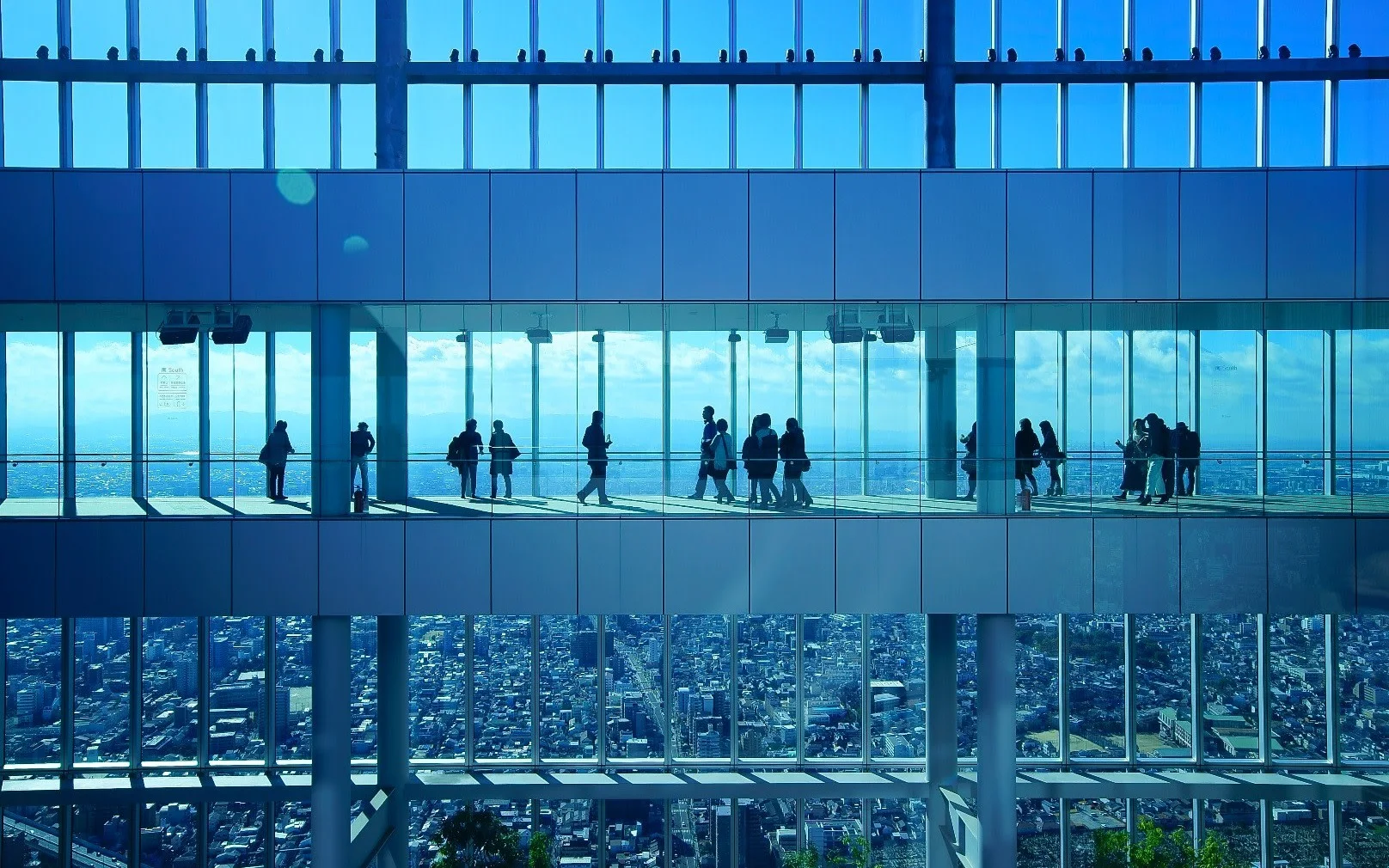
The normal ticket is single-entry: once you leave, you cannot come back on that admission. WEB advance purchase cuts the fare and avoids a ticket-counter transaction, but it makes the visit less flexible if weather changes. Day-of-arrival availability or queue handling may vary on busy dates. The choice is therefore not only ¥220 in savings per adult; it is whether you can identify a suitable evening early enough to commit.
For a first-time visitor who wants one high, enclosed 360-degree view, and who is already around Tennoji or Abeno, HARUKAS is a coherent paid outing. It is less compelling when the group is tired after an all-day attraction, visibility is poor, or no one particularly wants a skyline. Height cannot manufacture a good view through cloud. A Tennoji versus Namba evening route may be more consequential than the deck's modest fare difference.
Two observation decks compete for the same hour
At regular same-day adult prices, a pair visiting both Umeda Sky and HARUKAS spends ¥8,400: ¥4,000 at Umeda plus ¥4,400 at HARUKAS. Using two advance HARUKAS tickets brings that total to ¥7,960. Neither calculation includes travel, food or event admission. More important, both decks are often wanted around sunset. On a short trip they can consume two prime dinner windows to repeat broadly similar city-from-above viewing.
One high view and one free lower view generally make two more varied evenings: Umeda Sky with Dotonbori on another night, or HARUKAS with a Nakanoshima walk. This is not a rule against enthusiasts seeing both. It is a way to protect the scarce hours after sightseeing when a first Osaka visit also needs food and neighbourhood time. The Osaka food and hotel area guide connects that evening choice to where the trip ends each night.
Visit both if skyline photography is a central purpose, if the forecast gives two clear evenings, or if separate plans already place you in Umeda and Tennoji. A different viewpoint can then be worth the second ticket without a dedicated cross-city detour. A traveller with only one free evening should normally choose the location that fits dinner and the way home, then let the view type break the tie.
The hotel's side of Osaka decides the easy view
↔ Scroll table left or right
Where the day ends | Easiest night view | Detour to question |
Namba or Shinsaibashi | Dotonbori canal | A separate Maishima journey solely for free entry. |
Umeda or Osaka Station | Umeda Sky, or HEP FIVE with the pass | Crossing to Tennoji over a ¥20 advance-fare difference. |
Tennoji or Abeno | HARUKAS 300 | Visiting Umeda only because a ranking favours its roof. |
Kaiyukan and Tempozan | Tempozan Ferris Wheel | Leaving the bay at sunset for another deck. |
Maishima event or nearby stay | Seaside Promenade | Adding a different viewpoint when the sunset is already here. |
If you have not booked accommodation, resolve Namba versus Umeda before purchasing a fixed sunset ticket. A Namba room makes Dotonbori effortless; an Osaka Station base brings Umeda Sky closer; a Tennoji plan naturally favours HARUKAS. The bay and Maishima are outliers that work best when another attraction or event already puts you there. The most acclaimed panorama can still create a weaker evening if the return is awkward.
When visibility is poor, change the kind of view
High decks sell distance. Low cloud, haze or persistent rain remove some of the long horizon they promise, and wind can further reduce the appeal or availability of Umeda's exposed roof. Dotonbori's signs and Nakanoshima's lit architecture depend far less on a clear horizon. If a poor-visibility night is forecast, use a street or river scene then; move the paid deck to the clearest available evening if ticket terms permit.
Weather flexibility has value. A same-day choice can cost more than a HARUKAS advance ticket, yet it avoids fixing a view to a night when the upper floors look into cloud. If your schedule has only one evening, choose the option whose experience survives the forecast. Paying for a different high building after the first becomes obscured will not necessarily solve a citywide visibility problem.
One paid view is enough for many first visits
Choose Umeda Sky when the rooftop and the Umeda return route are the attraction. Choose HARUKAS 300 when a sheltered, high panorama suits a Tennoji day. Use Tempozan's short wheel ride if the aquarium has already taken you to the bay. Otherwise, let Dotonbori or Nakanoshima supply a free evening that feels distinct from the deck. None of these choices needs a dollar conversion to make sense; admission, transit and the clear-weather window are the inputs.
Pass holders face one extra rule: Umeda Sky admission is included only before 15:00, while evening entry is discounted ten percent. HEP FIVE remains listed among pass attractions for a later Umeda wheel ride. Maishima remains the free choice with the most demanding access, so reserve it for a western itinerary rather than treating zero admission as a reason to cross the city. Osaka rainy-day alternatives help when even a street walk is unappealing.
The recommendation changes for photographers who genuinely want two skylines, or for a long stay that naturally places separate sunsets in Umeda and Tennoji. For an ordinary short visit, a second high ticket should have a new visual purpose; otherwise it displaces another Osaka evening. This is especially true if a Kyoto or Kobe day trip has already shortened the time available in the city.
Related decision: choose the hotel base before reserving a sunset slot.
Viewpoints, opening times and fares
{Ebisu Bridge and Dotonbori|osaka-itinerary-3-4-or-5-days-when-to-add-usj-kyoto-or-kobe}
Nakanoshima Crystal Bridge and its riverside route.
Maishima Seaside Promenade and access.
Tempozan Ferris Wheel and the Osaka Bay setting.
Umeda Sky Building visitor information.
Umeda Sky Building admission notice.
Osaka Amazing Pass participating attractions and the Umeda cutoff.
HARUKAS 300 ticket categories and advance prices.
HARUKAS 300 admission revision notice.
HARUKAS 300 operating information.
Admission and opening details can vary on special event days and during severe weather. The most useful final check is the schedule for the exact evening, especially if a pass discount or an advance ticket determines the choice. A cloudy high view can usually be replaced with a lower street scene without losing the whole night.
Related guides: Fukuoka Tower: Is the ¥1,000 Ticket Worth the Detour? Timing Changes the Answer · Kanmon Strait Museum: When the ¥500 Ticket Is Worth It—and When the Free Areas Are Enough · Osaka Hotels for Kyoto and Kobe Day Trips: When 3–5 Minutes to the Station Matter Twice a Day · Okinawa Hotel Cancellation Policies: When Is Free Cancellation Worth Paying For? · THE BLOSSOM HIBIYA: Are the High-Floor Views Worth Paying More For? · Osaka Hotels for 4–6 Friends: When One Big Room Stops Being the Better Deal · Osaka and Kyoto in 7 Days: 3 Nights Each — When One Hotel Move Is Actually Worth It · Swissotel Nankai Osaka: Is Nankai Namba Access Worth Paying More For? · Fukuoka Hotels for Couples: Decide Where Your Night Goes Before Paying for Views or a Luxury Room · Nezu Museum 2026: The Garden Isn’t Free — and That Changes Whether ¥1,400 Is Worth It
Further Osaka planning
Edogawa Fireworks 2026: The Best Free Side to Watch, When to Arrive and How to Get Out
Centara Grand Hotel Osaka: Is the 40m² Family Room Worth It for Four?
THE LUIGANS Spa & Resort Fukuoka: Is a 33m² Sea-View Room Worth Leaving Hakata for One Night?
Osaka Kuromon Market Food Tour 2026: You’re Paying for a Guide, Not the Food