
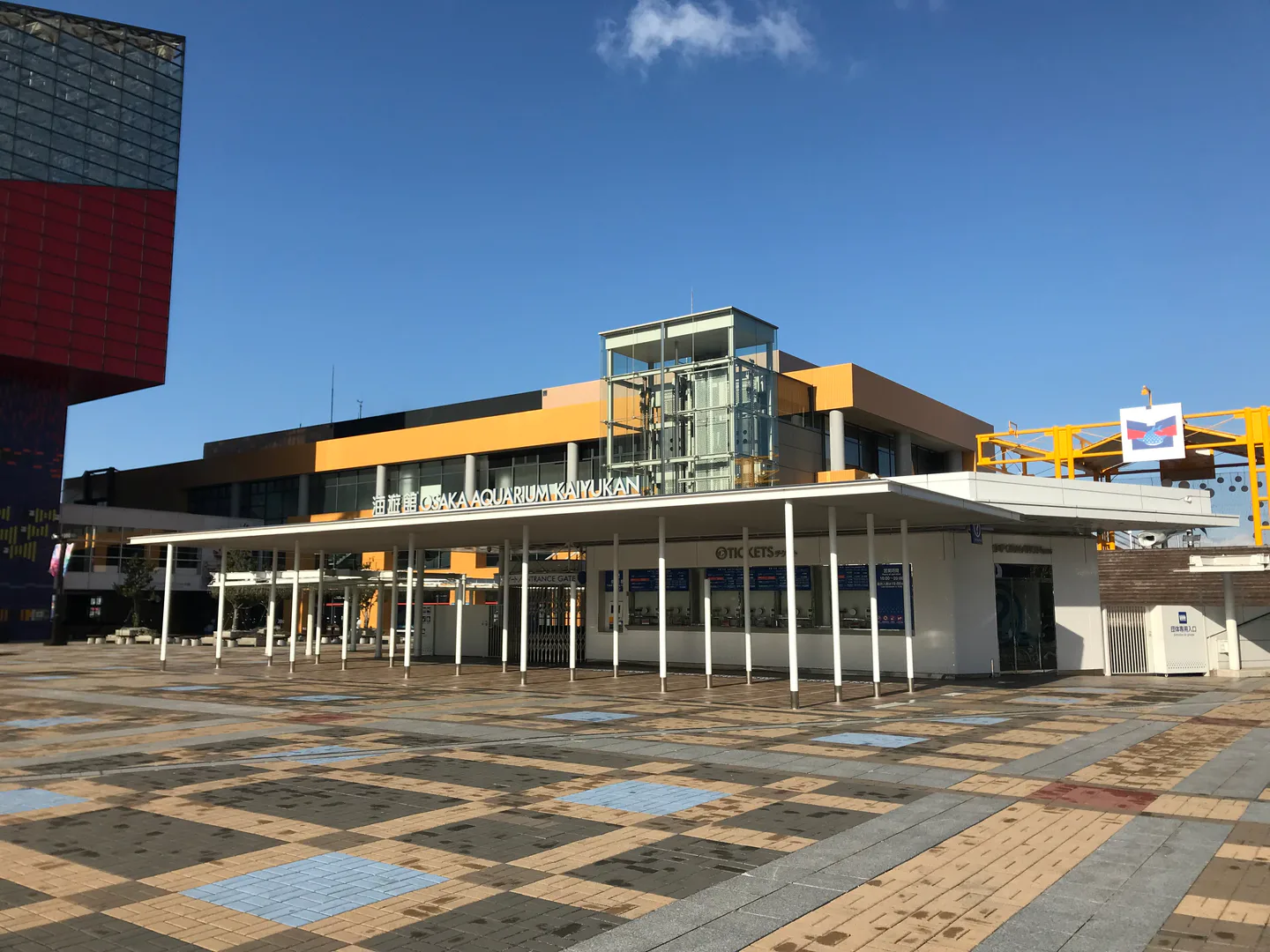
A Kaiyukan visit now has one uninterrupted admission. Osaka Aquarium ended same-day re-entry on 15 June 2026, so a plan that sends you out for lunch and back inside at 5 p.m. no longer works. Reserve a 15-minute entry window that leaves enough time to enjoy the aquarium in one stretch. Store a suitcase before you travel to Osakako: large cases and carts have also been barred from the building since April 2026.
Most first-time visitors can allow two to two and a half hours inside. Add time if children set the pace, you like watching animals from several levels, or you plan to see the change to the Night Aquarium after 5 p.m. Those allowances sit on top of the metro journey, the five-minute final walk and any Tempozan stop. Book the slot around the whole half day, not around a single photograph of the whale shark. Read: where to stay in Osaka for first-time visitors
The single-entry rule sets the day’s shape
↔ Scroll table left or right
Trip shape | Time or preparation | Suitable entry | Main risk |
First Kaiyukan visit | Two to two and a half hours inside | Any daytime slot that fits the route | Compressing the exhibits into one photo stop |
Day and Night Aquarium together | Around two and a half to three hours | Around 3:30–4 p.m. when sold and hours permit | Assuming a 5 p.m. walk-up slot will remain |
Children, older visitors or slow photography | Allow close to three hours | A time that fits meals and energy | Stacking another distant attraction afterward |
Hotel change with cases | Store prohibited large luggage first | Only after the bag hand-off | Arriving with a suitcase or cart |
USJ on the same trip | Normally separate the major visits | Kaiyukan on a dedicated bay half day | Treating a short ferry as a short USJ visit |
Kaiyukan’s group guidance estimates about 90–120 minutes for circulation. An independent visit may take longer because you can pause at multiple views of the Pacific Ocean tank, look for movement in smaller habitats and rest between floors. A hurried hour will show you some highlights but misses the reason the descending route is built around repeated observation. Decide whether you have the time before comparing ticket vendors.
Osaka Bay is also a location choice. On a trip with only two or three Osaka days, an aquarium afternoon may compete with neighborhoods nearer your hotel. The accommodation and Namba–Umeda guides below help calculate the round trip. A conveniently priced ticket does not erase a cross-city journey that breaks up another day. Read: Osaka accommodation decision hub
Two rules that changed in 2026
Once you leave, the visit is over
Before 15 June 2026, some itineraries used re-entry to split an aquarium visit around a meal. That option ended on that date. Eat before you scan the ticket, or plan to eat after finishing the exhibits. If you want the evening lighting, remain inside continuously from the afternoon slot; leaving at 4 p.m. and returning at 5 p.m. requires a separate admission rather than the old re-entry procedure.
The rule favours a well-chosen afternoon entry for someone interested in both day and night versions. It is less forgiving when young children need a proper meal or a long break outside. Work out what the group can comfortably do without leaving the building, then choose the entry time.
Large bags need a place before Osakako
Since 24 April 2026, Kaiyukan has prohibited suitcases and cart-type luggage, including pet carts, and large items whose three sides total at least 120 cm or whose one side exceeds 70 cm. The aquarium asks visitors to leave them at a hotel or locker first. A station locker may be full, so arrange storage before you make the bay trip on a check-out day.
This rule makes the aquarium a poor casual filler between hotel rooms. Travellers with children should settle the luggage hand-off, hotel location and entry slot together. The linked Osaka family-hotel guide can help with the broader base choice; it cannot make an oversized case acceptable at the gate. Read: our Osaka-with-kids hotel guide
The route moves from water’s edge to open ocean
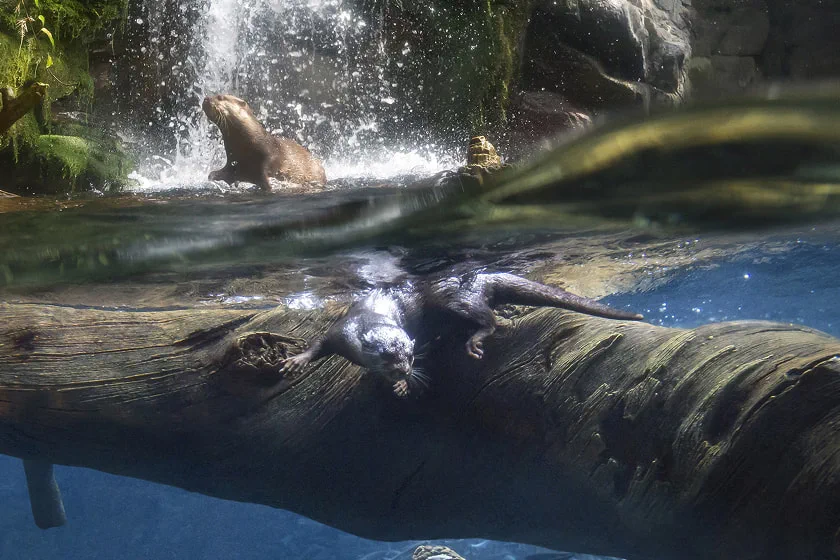
The Aqua Gate tunnel introduces the underwater view. After that, Kaiyukan takes visitors upward to Japan Forest, then leads them down around habitats inspired by the Pacific Rim. Treat the tunnel as the start rather than the single photo opportunity. The sequence is designed to give different perspectives as the route descends.
Japan Forest can surprise someone expecting to see a whale shark immediately. Its forest, stream and waterside setting places land and water in the same story before the larger marine tanks. Giving this first area a few minutes helps the later movement toward the open sea make sense. It is also a good place to let children settle into the visit before the busier central tank.
The Pacific Ocean tank changes at every level
Whale sharks, rays and schools of fish share Kaiyukan’s central Pacific Ocean tank. Older aquarium material describes it as roughly 34 metres long, 9 metres deep and holding about 5,400 cubic metres; those dimensions help explain why the descending walkway keeps returning to the same habitat. The animals will not hold still for a preferred camera angle. Their movement is the reason to look again from below.
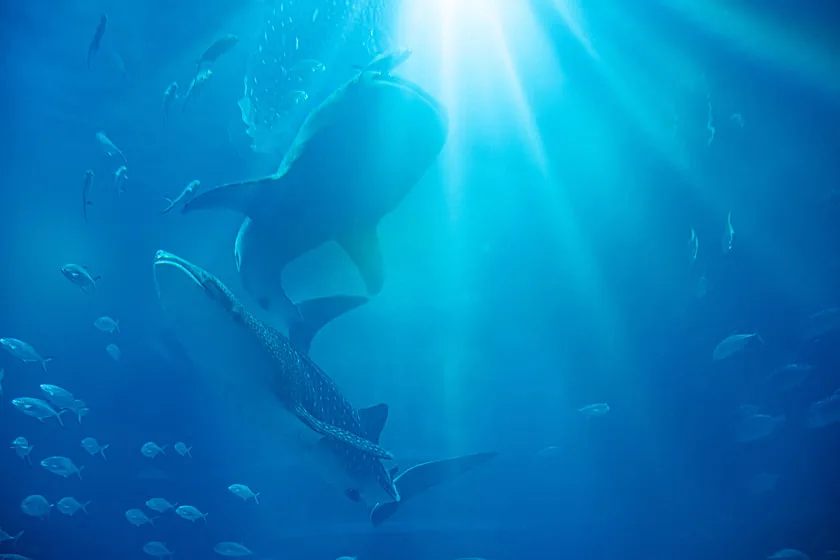
Take the first whale-shark picture if it matters to you, then continue. A ray or school that appeared distant at one window may cross much closer lower down. The tank’s depth lets different animals occupy different parts of the water at the same time. Watching a few passes from more than one level gives a fuller visit than waiting at the first crowded pane for an empty frame.
The first clear window is rarely the last
At busy times, visitors can gather around the initial whale-shark view. The route offers later Pacific Ocean windows, so there is no need to spend the whole first encounter competing for a photograph. Give each group member room to look, move down when the crowd compresses, and spend a longer pause where you can actually follow the animals.
Arctic viewing works on two levels
Kaiyukan’s Arctic Region separates views of the ice-surface world and underwater space. Ringed seals may look almost still from one position, then become much more active in the water below. The change of perspective is the point: it lets a visitor see how an animal uses the habitat rather than just identify it at a window.
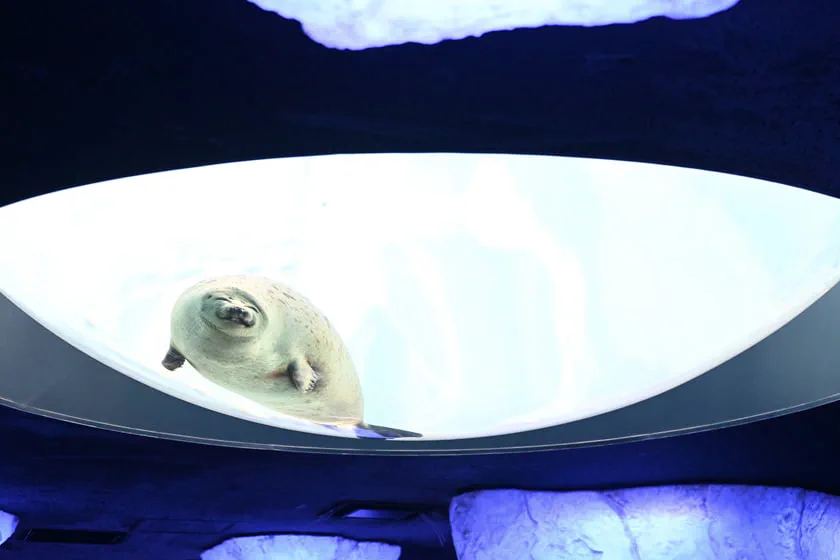
Children may notice that behavioural change more readily than another few minutes at the large ocean tank. A group moving quickly can still prioritise the whale sharks, but it should recognise what is being skipped. The Arctic section is another example of Kaiyukan rewarding visitors who watch across more than one viewpoint.
Jellyfish Galaxy slows the route down
After the size and movement of the central tank, Jellyfish Galaxy offers a darker, quieter setting. Floating jellyfish and lighting make small changes in shape and motion the focus. The room is less about counting species than allowing your eyes to adjust and following a few animals for more than a moment.
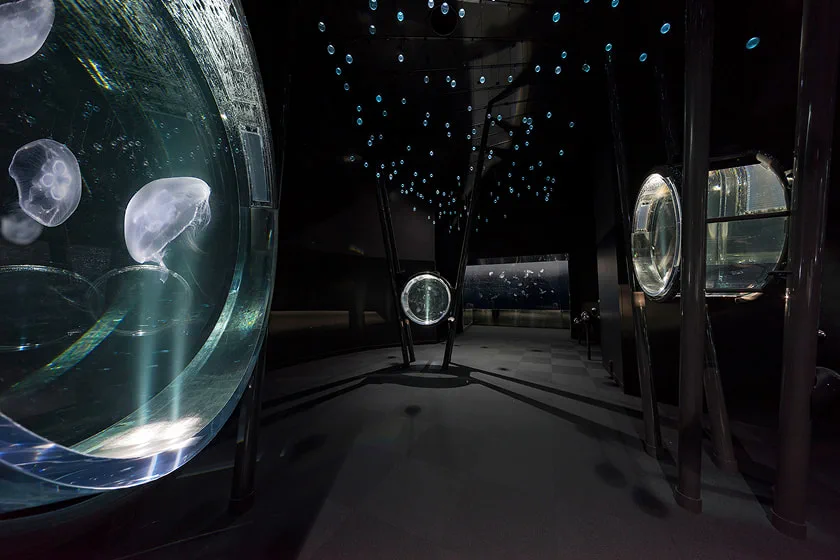
A traveller who dislikes dim, slow exhibits can continue without a forced ten-minute stop. Someone interested in low-light images or a pause between active habitats may find it one of the longest parts of the route. Let the time spent there follow your actual interest, especially if the selected slot brings you close to closing.
The 5 p.m. shift is worth planning only when the hours allow it
Kaiyukan’s Night Aquarium changes the lighting and music at 5 p.m. into a deeper blue evening presentation. Its current feature page gives 5–8 p.m. with last entry at 7 p.m., while warning that seasonal hours can differ. Check the daily calendar before buying a late slot. The night version is a lighting change within the same aquarium, not a second circuit that justifies ignoring the usual visit time.
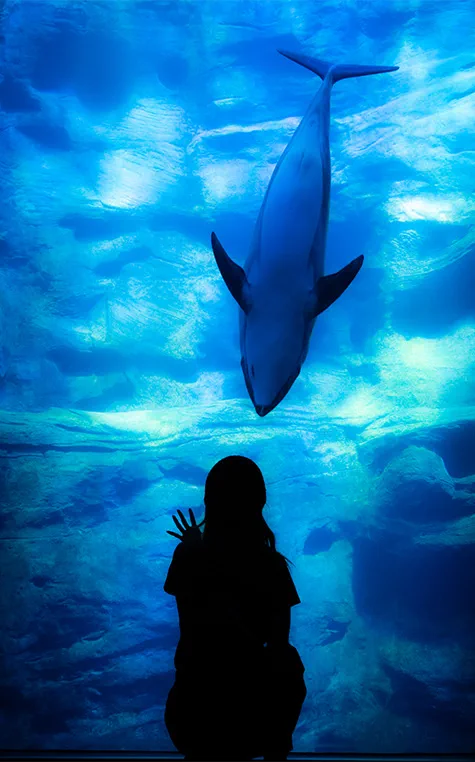
On a date that stays open late enough, a 3:30 or 4 p.m. entry can let adults see some habitats in daylight and continue past the 5 p.m. transition. This works with the single-entry rule because they stay inside. It is an itinerary suggestion, not a promise that every date sells those exact slots or that every visitor moves through the route at the same speed.
A family should choose a comfortable hour over a dramatic one if 5 p.m. collides with dinner, naps or bedtime. Finish the aquarium and then eat nearby, or select an earlier ticket. For adults considering food later in Osaka, the Shinsekai and Kuromon guides below address different evening choices; neither is a reason to keep a tired child inside the aquarium. Read: Shinsekai food evening · Kuromon Market visit
One tank may be absent from an older floor map
The exhibition page currently marks the Aleutian Islands area closed for renovation. That section reopened after earlier work in late 2025 and later changed status again, so a saved map or old photo can be misleading. Do not make a specific Aleutian Islands animal the sole reason to buy a ticket without checking the live exhibition list for your date.
The first-visit core remains the Pacific Ocean habitat, Japan Forest, the Arctic Region and Jellyfish Galaxy. Exhibits, animals and renovation areas can still change for welfare or building work. Use the current exhibit page to set expectations, then let what is actually active guide the time you spend inside.
Choose the slot before looking for a discount
Kaiyukan varies both admission price and operating hours by date. Its e-ticket system sells entry in fifteen-minute windows, with a limited allocation per period. On a popular day, the useful late-afternoon window can disappear even while some admission remains. Pick the date, check its hours and decide whether you want ordinary daytime viewing or the 5 p.m. transition before you compare sellers.
If you expect to miss a reserved entry, try changing the time through the Webket account. A desired replacement may already be full, in which case arrival can involve waiting or another condition on the ticket. Do not assume a train delay automatically turns a timed admission into an anytime ticket; read the change rule for the product you bought.
The aquarium named Klook, KKday and Trip.com among authorised sellers in its June 2026 ticket warning. Even with a recognised seller, compare the exact date, entry time, change conditions and total charge. A small currency saving is not useful if the slot forces you to rush or does not allow the change your itinerary may need.
Klook | Compare Kaiyukan entry times for your date
If the preferred Klook slot is unavailable, compare the same-date KKday listing and the aquarium’s own ticket. Check the entry window and cancellation conditions rather than treating two similar product names as equivalent. The selling platform is a final booking choice after the day’s route is sound. Read: check the same-date Kaiyukan ticket conditions on KKday
Tempozan works best as one chosen half day
For evening lighting, stay inside through 5 p.m.
One workable sequence is a late lunch around Osakako, then entry around 3:30–4 p.m. if offered on that date. Move through the exhibits without a break outside and see part of the route after the lighting changes. On exit, decide whether there is energy for the Giant Ferris Wheel or an Osaka dinner elsewhere. This is more coherent than buying an early ticket and hoping to return after a Tempozan meal.
For families, make nearby additions optional
Give Kaiyukan roughly two and a half to three hours with children, then eat after the visit. Tempozan Marketplace, the Ferris Wheel and other harbor attractions can be useful if the group still wants them. They need not all be on the ticket plan. In bad weather or after a tiring morning, one substantial indoor venue may be enough.
A ten-minute boat does not turn USJ into a short stop
Captain Line links the Kaiyukan west pier with Universal City Port in about ten minutes. The ferry solves a geographical crossing, but it does not shrink either attraction. USJ can consume a full day, while Kaiyukan deserves a proper half day once travel, ticket entry and food are included. Combining them solely because the boat ride is brief often makes both visits rushed.
The pairing is more reasonable if one attraction is deliberately a half-day or the ferry serves an existing hotel-transfer plan. The linked USJ hotel guide examines when Universal City accommodation earns a move; the four-day Osaka–Kyoto itinerary shows how much space a full USJ day needs. Consider those decisions before adding the aquarium to the same date. Read: one USJ day versus two days and when a Universal City hotel actually pays off · our four-day Osaka-and-Kyoto itinerary
The final walk is short; the cross-city route may not be
Osakako Station on the Osaka Metro Chuo Line is about five minutes from Kaiyukan via Exit 1. That makes the last approach simple. The larger cost appears when you attach the bay visit to a distant Osaka district, return to the hotel for bags, or add another timed attraction. Count all legs, not just the five minutes after the metro.
On a first Kansai trip, decide which city hosts your nights before scattering Osaka Bay, Kyoto and USJ across the same day. The Kyoto-versus-Osaka and Namba-versus-Umeda guides below are useful when the journey to Tempozan, rather than the aquarium itself, is what makes the plan awkward. Read: Kyoto vs Osaka as a first-time base · Namba vs Umeda
Who should give Kaiyukan a half day?
The clearest fit is a visitor willing to watch the large tank from several levels, a family that wants a substantial indoor activity, or a couple who would enjoy the quieter evening lighting. Photography, slow animal observation and rain resilience all reward enough time in the building. The ticket is less compelling as a rushed detour for a single whale-shark picture.
If only 60–90 minutes remain, USJ already fills the day, or your Osaka route keeps crossing distant districts, you can remove Kaiyukan without losing the day’s coherence. It is a major aquarium, but it works best when the route and time allowance match its format. Save it for another visit if the current trip cannot offer that.
A complete visit starts before the ticket gate
Allow two to two and a half hours for a steady first visit, or nearer three with children, deliberate photography and the 5 p.m. change. Select one entry window that supports that duration and the day’s actual closing time. Eat and store luggage first. Once inside, continue through the descending habitats without planning to leave and return.
In practice, choose the date and inspect the aquarium’s varying price and hours. Decide whether the night change matters, then select a fifteen-minute entry slot. Only after that should you compare the same slot and cancellation terms across the aquarium’s ticket page, Klook and KKday. The order prevents a cheap ticket from dictating a poor half day.
Next decision | Namba or Umeda for the Kaiyukan day?
More Osaka planning
Where to Stay in Osaka for First-Time Visitors
Namba vs Umeda: Which Osaka Area Should You Stay In?
Where to Stay in Osaka With Kids
Osaka and Kyoto 4-Day Itinerary With USJ
Kyoto vs Osaka: Where Should First-Time Visitors Stay?
Trip.com may list attraction tickets and combinations for Osaka. Compare the exact date, admission type and cancellation rule with the aquarium’s own entry conditions before paying.
Kaiyukan visit details
Tickets and dated price calendar
Daily hours, admission bands, timed-slot stock, ticket changes, the evening program and individual exhibits may shift. Use the calendar and the chosen ticket conditions for the date you travel.
Related guides: Big Tamagotchi Exhibition Osaka Guide: Sold-Out Tickets, Timed Entry and Umeda Access · Port of Nagoya Public Aquarium 2026: How Long to Spend and When Night Entry Is Worth It · Early Shinkansen from Osaka: Should You Stay in Shin-Osaka or Move Only for the Last Night? · Osaka Itinerary: 4 Days with Kobe and a Koyasan Temple Stay · Art Aquarium Nagoya 2026: 4,000 Goldfish Are the Hook — Your Sakae Time Is the Real Cost · 35 Best Things to Do in Osaka 2026: What’s Worth Your Time by Area, Budget and Trip Style · Hotel Intergate Osaka Umeda: Do the Lounge Hours Fit Your Osaka Itinerary? · Osaka Amazing Pass 2026: Easy to Break Even — Harder to Use Well · Toba Aquarium 2026: Is the Sea Otter and Dugong Detour Worth It? · Where to Stay for the Saga Balloon Fiesta 2026: Saga, Tosu or Hakata
More routes around Kansai
Kyoto Aquarium: Is the ¥2,600 Ticket Worth 2–3 Hours in Kyoto?
National Museum of Nature and Science 2026: The ¥630 Ticket Is Cheap — Your 3–5 Hours Aren’t
Kenrokuen Autumn Leaves 2026: Early Entry, Illumination, Transport and Hotels
Osaka 5-Day Itinerary: Give USJ a Full Day — Namba, Umeda, Kaiyukan and Tennoji Without Backtracking
A late aquarium slot is easier if you are not racing back across Osaka afterward. Compare rooms near Osakako with the Chuo Line journey to your next morning stop.