
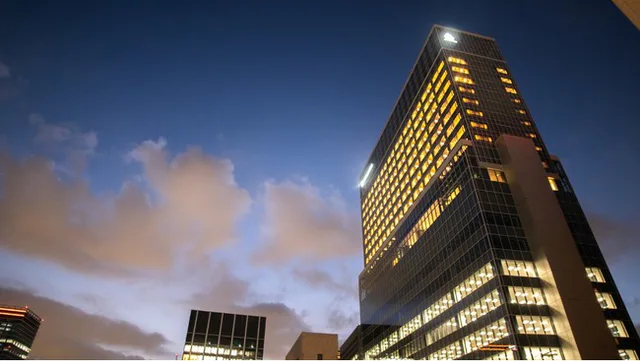
THE BLOSSOM HIBIYA sits above the streets around Shinbashi rather than beside a station concourse. JR Shinbashi's Hibiya Exit is about five minutes away, while Uchisaiwaicho on the Toei Mita Line is roughly two minutes from the door. Guest rooms occupy floors 19–27, and the hotel places its lobby and restaurant on 18 and a lounge on 19. That arrangement makes the height part of everyday use, but the room direction still decides what you see. The booking question is whether that upper-floor setting and two-station access will matter often enough to justify the rate on your Tokyo dates.
A three- to five-night stay with dinners around Ginza or Hibiya can use the location repeatedly. A single late arrival before an early train may use little beyond the bed and the final street walk. Room sizes start at 22 m² and reach 34 m² in the corner twin considered here; the difference in bedding and outlook is as important as the difference in area. Compare the precise category, the line you will use each day and your likely time back at the hotel before paying for a general promise of a view.
Where the rate earns its keep
This is a good candidate for a traveller who wants eastern-central Tokyo as a base: Ginza, Hibiya, Yurakucho, Tokyo Station and Shinagawa all give the Shinbashi area a practical role. The elevated lobby and guest lounge also give the property a more distinct return than a simple station hotel. If two people will unpack for several nights and use the room between outings, the 25 m² twin or king provides a better starting comparison than the cheapest 22 m² listing. Tokyo hotel areas for first-time visitors helps settle the broader district first.
The case weakens when most sightseeing days run west to Shinjuku, Shibuya or Kichijoji. Shinbashi still has useful JR links, but the hotel stops shortening your evenings and starts adding a return across Tokyo. If the room is used only to sleep, a high-floor view and 24-hour lounge may not repay that repeated travel. A Tokyo shopping base comparison can make the location mismatch clearer than comparing hotel amenities alone.
A one-night transfer stay is another weak fit when the group arrives late with heavy cases and leaves early. The hotel is not physically connected to Shinbashi Station, and the published five-minute walk does not include getting out of the platform or finding the correct exit. For that itinerary, Tokyo Station hotels before an early Shinkansen may solve the actual job better. The Blossom remains an option if its specific room is priced competitively, but do not buy the lounge and view in theory when the schedule leaves no time for either.
The property at a glance
↔ Scroll table left or right
Feature | Published setup | When it matters |
JR Shinbashi | About five minutes from Hibiya Exit | Useful JR links, with an uncovered final walk. |
Uchisaiwaicho | About two minutes from A2/A5 | The shorter approach applies to a suitable Mita Line trip. |
Guest rooms | Floors 19–27; 255 rooms | Height is broadly available, but room outlook varies. |
Core rooms | 22 m² Double; 25 m² Twin or King | Beds and direction distinguish them beyond area. |
Free Lounge | 19F, around the clock with coffee and charging | More likely to be used on a multi-night stay. |
Coin laundry | 20F and 24F | Can reduce packing or mid-trip laundry errands. |
Sotoroku breakfast | 06:30–10:00, last entry 09:30 | Only worth including on mornings with enough time. |
The short Uchisaiwaicho walk matters on Mita Line days
The hotel's access list gives four different walking legs: about five minutes from JR Shinbashi Hibiya Exit, four from Tokyo Metro Ginza Line Shinbashi Exit 7, eight from Toei Asakusa Line Shinbashi Exit A2 and two from Uchisaiwaicho Exit A2 or A5. A guest using JR each morning experiences a different doorstep journey from one using the Mita Line. This is why the property should not be called simply 'five minutes from Shinbashi' without considering which train the day actually requires.
The hotel describes Haneda as roughly thirty minutes by rail under suitable connections, including a monorail change at Hamamatsucho or Keikyu/Toei Asakusa service. Narita is given a broader roughly seventy-minute rail reference through suitable routes. Those are transport summaries, not airport-platform-to-hotel guarantees: luggage, train choice and Shinbashi's final exit still add time. A very late arrival might call for a Haneda airport versus city first-night decision before booking several premium city nights.
Over a longer stay, being able to choose between Shinbashi and Uchisaiwaicho can save repeated backtracking. Use the Mita Line when it truly follows the day's route; use JR or Ginza Line when those are direct. The advantage is flexibility among nearby networks rather than a magic two-minute access claim for every Tokyo trip. Check the last leg at night as well: a route ending on the Asakusa Line leaves a longer published walk than one ending at Uchisaiwaicho.
↔ Scroll table left or right
Transport arrival | Published final walk | Best reason to use it |
JR Shinbashi Hibiya Exit | About five minutes | JR/Yamanote days and major-station connections. |
Ginza Line Shinbashi Exit 7 | About four minutes | Direct Ginza Line journeys. |
Toei Asakusa Line Shinbashi A2 | About eight minutes | Some through airport trains despite a longer street leg. |
Uchisaiwaicho A2 or A5 | About two minutes | Mita Line journeys that suit the daily route. |
If the Tokyo stay continues to Hakone by Romancecar or JR or to Kawaguchiko by train or bus, the luggage arrangement may matter more than two minutes around the hotel. Forwarding bags between Kawaguchiko and Hakone is worth settling before deciding which Shinbashi exit feels easiest. The final hotel walk remains real even when the airport rail time sounds simple.
Other Tokyo hotel and onward-route comparisons
OMO5 Tokyo Gotanda offers another south-Tokyo room and view proposition; its best daily routes differ from Shinbashi's.
Tokyo to Kawaguchiko transport determines whether an early Fuji morning starts from a station this hotel actually serves conveniently.
Room direction is the real view decision
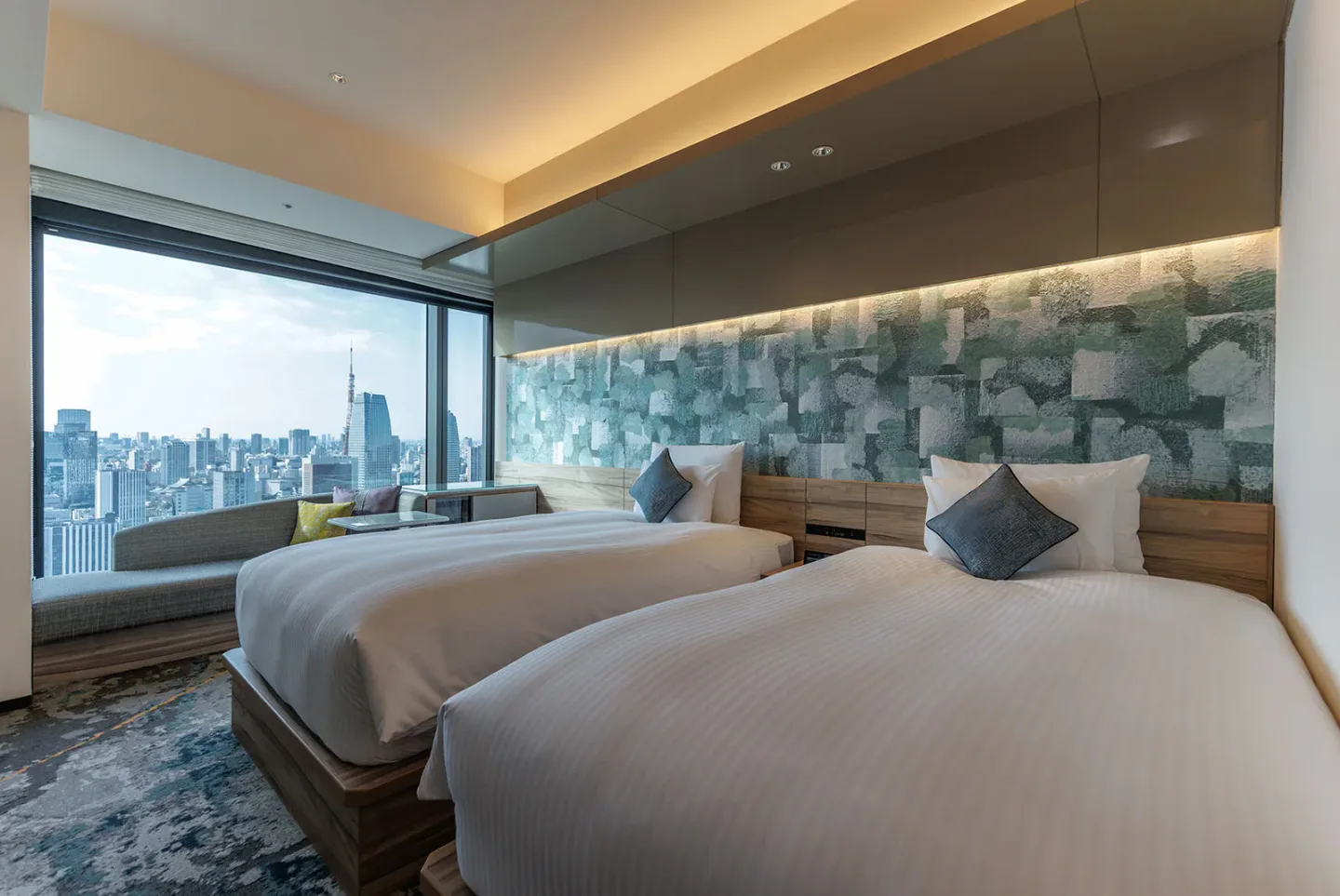
All regular guest rooms sit high in the building, yet their windows face different sides. The 22 m² Superior Double looks toward Hibiya on the northeast side. Superior Twin and Superior King are 25 m² Shinbashi City View categories. Deluxe Corner King is 31 m² on the Hibiya side, while Deluxe Corner Twin reaches 34 m² and looks toward Shinbashi. A generic 'high-floor room' search can hide these meaningful distinctions. Choose direction and bed arrangement from the named category.
Superior Double supplies a 160 cm bed for at most two guests in 22 m². It can be sensible for a solo visitor or a couple carrying light bags, particularly when the room premium over a simpler hotel is small. Two large cases will take more of its floor than in the corner categories. The hotel does not promise a particular luggage layout from the area figure alone, so do not infer that every 22 m² room has the same usable walking space around open cases.
Superior Twin provides two 120 cm beds within 25 m² and is a practical two-person benchmark. The hotel calls its Shinbashi-facing outlook City View, with a broad window. Superior King is also 25 m² on that side, but replaces separate beds with a 180 cm king and offers a different desk arrangement. These are not interchangeable rates for companions who need separate sleeping surfaces. Compare their exact names before concluding that a '25 m² room' includes the view and bed you want.
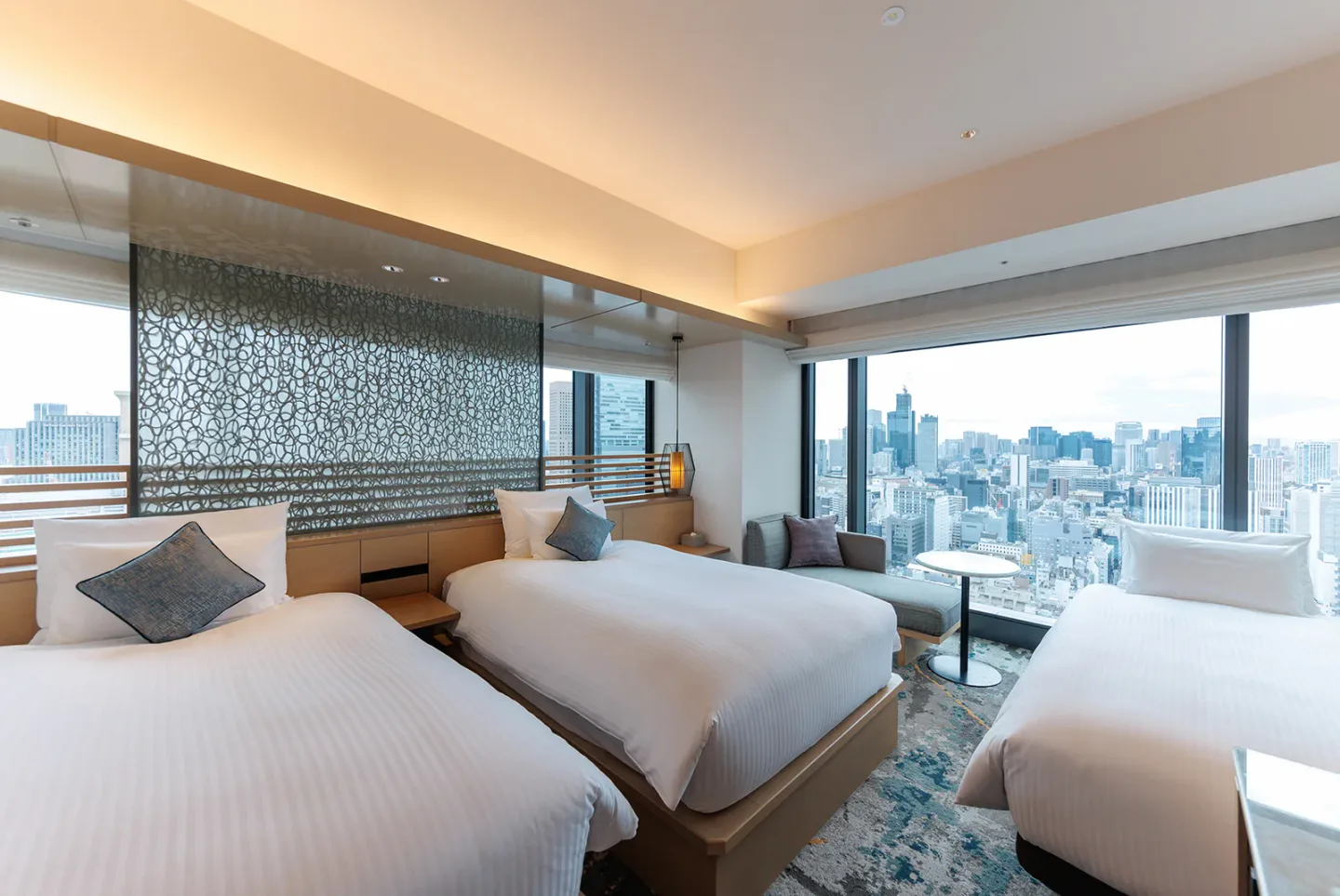
The 31 m² Deluxe Corner King looks toward Hibiya and has windows on two sides, giving a couple more space and a different light pattern. The 34 m² Deluxe Corner Twin looks toward Shinbashi and can take a third guest with an extra bed; that is a three-person capacity, not three identical beds by default. Its larger luggage rack also becomes relevant over several nights. Travellers choosing it mainly for the corner view should confirm the named direction rather than assuming every corner faces the same skyline. Tokyo hotels with parents gives a further check on bedding and walk tolerance.
↔ Scroll table left or right
Room category | Area and outlook | Booking consequence |
Superior Double | 22 m²; northeast/Hibiya side | One 160 cm bed for a solo stay or light-packing couple. |
Superior Twin | 25 m²; Shinbashi City View | Two 120 cm beds and separate sleeping surfaces. |
Superior King | 25 m²; Shinbashi City View | One 180 cm bed and a different desk arrangement. |
Deluxe Corner King | 31 m²; Hibiya side | Two-sided windows and more luggage margin for two. |
Deluxe Corner Twin | 34 m²; Shinbashi City View | Two twins with an optional third extra bed. |
The view belongs to a direction, not only a floor number
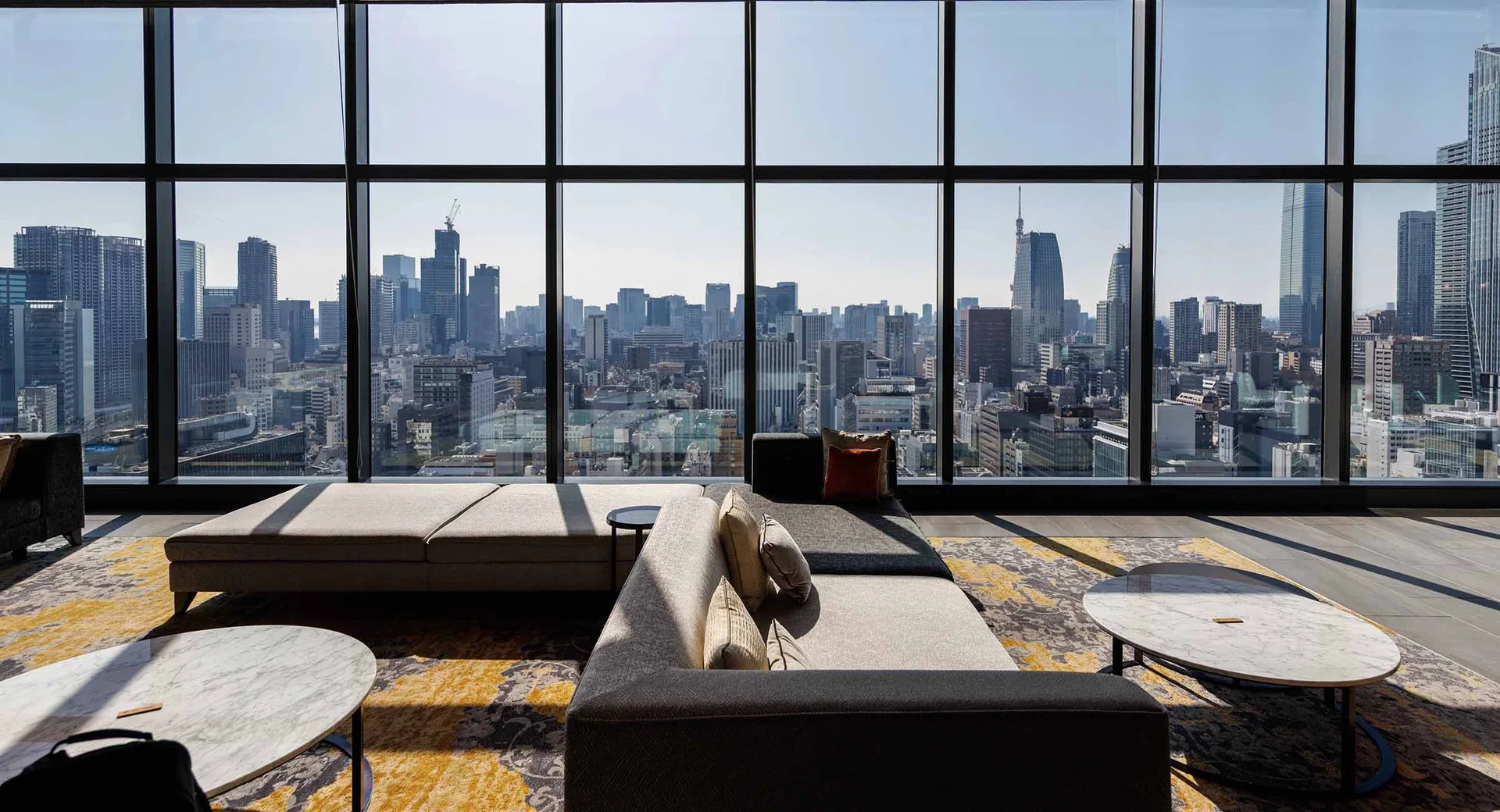
The lobby and Sotoroku restaurant occupy the eighteenth floor; a guest lounge and fitness room sit one floor above, with rooms rising through the twenty-seventh. That means a guest encounters the elevated city setting during check-in, breakfast and returns to the room. It is a real distinction from a street-level lobby. Whether it is worth paying for depends on how much of the stay happens at the hotel; a visitor out from dawn until midnight may notice it far less than somebody returning between meetings or city walks.
No single photo can stand for all 255 room outlooks. The hotel's category descriptions distinguish Hibiya-facing and Shinbashi-facing products, and only certain names include City View. The view through the lounge's broad glazing is shared, but it is not a guarantee that the cheapest room has that same angle. If a panorama is the decisive purchase, select the exact room and direction rather than upgrading based on 'high floor' alone.
The lounge and laundry become useful across several nights
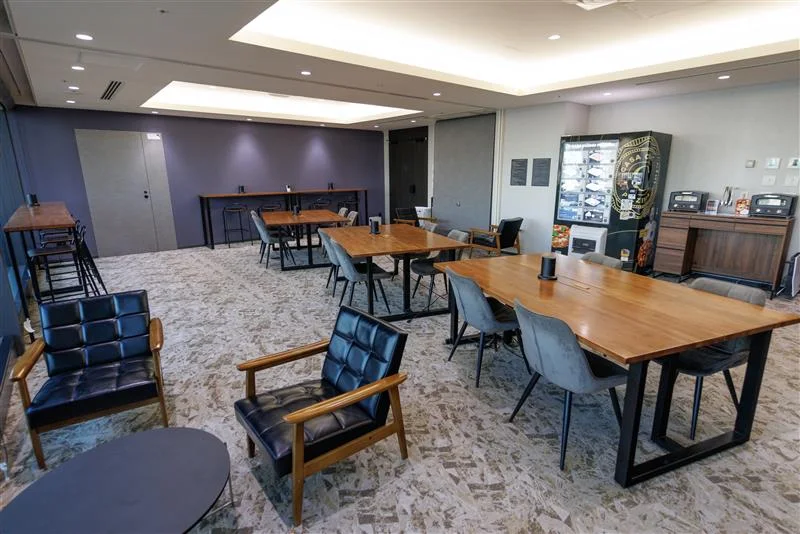
The nineteenth-floor Free Lounge is reserved for hotel guests, with complimentary coffee, Wi-Fi and places to plug in a laptop or phone. The hotel lists it as available around the clock, though cleaning and events can temporarily interrupt access. It is a shared working and waiting space, not an executive lounge with included meals. Two companions keeping different routines may use it more than a couple always leaving and returning together.
Picture an ordinary evening rather than a marketing image: one guest returns from Ginza to answer messages in the lounge while the other rearranges luggage or gets ready for dinner. The hotel then earns value as a temporary base, not only through the room window. On a one-night transfer, that interval might never occur. Tokyo's first and last day time blocks can show whether a late check-in leaves time to use any shared space.
Coin laundry is listed on floors twenty and twenty-four. That is practical when a four- or five-night stay feeds into another Japanese destination, particularly in warm weather or with limited luggage. The hotel does not promise a machine will be vacant when you arrive, so avoid pricing the amenity as an instant service. The nineteenth-floor fitness room is also listed for hotel guests around the clock; bring your own exercise clothes and shoes, since the hotel does not offer rental gear.
↔ Scroll table left or right
Facility | Hotel listing | Use to count |
Free Lounge | 19F; 24 hours subject to closures; coffee, Wi-Fi, sockets | Actual work or pause sessions during the stay. |
Coin laundry | 20F and 24F | Loads that would otherwise need another stop. |
Fitness room | 19F; guest access around the clock | Exercise sessions planned with your own gear. |
Sotoroku breakfast | 18F; 06:30–10:00 | Mornings without an early station deadline. |
Breakfast costs enough to plan it by morning
Sotoroku on the eighteenth floor serves breakfast from 06:30 to 10:00, with last entry at 09:30. The current hotel price for staying guests is ¥3,850 per adult and ¥2,750 per child. Food and drinks are served until 09:45. The buffet includes Japanese dishes and Western choices, but the relevant booking question is how many mornings you can actually eat there. Check whether the rate already includes it before adding the posted walk-in price to every day.
A later city morning around Hibiya or Ginza allows a relaxed breakfast. An early Shinkansen, airport or Fuji departure may not. Work backward from packing, checkout, the walk to the chosen station and the platform or bus boarding margin. The 06:30 opening does not mean breakfast is usable before every first train. A room-only plan can be the better match if most mornings have hard departures.
For a morning to Hakone, use the Romancecar, JR and Hakone Freepass comparison to find the actual departure point. For a Tokyo–Kawaguchiko–Hakone itinerary, the transfer and bag plan may make a leisurely hotel breakfast unrealistic. Breakfast should support the journey chosen, not force a later start simply because it was prepaid.
Which Tokyo days suit this Shinbashi base?
Ginza, Hibiya and Yurakucho keep the day's end in the hotel's part of Tokyo. A dinner, shopping outing or event there may allow a simpler return than one from the west side of the city. Tokyo Station is close enough by rail to be a regular onward node, while the room gives the stay an elevated centre away from the platform. A Ginza versus other Tokyo shopping districts choice can clarify whether this eastern-central geography will recur.
A Haneda arrival followed by several city nights is another coherent pattern. Suitable rail services reach Shinbashi through Hamamatsucho or along the Asakusa Line, and subsequent days can use JR toward Tokyo Station or Shinagawa. The hotel still has an uncovered final walk, especially from the Asakusa Line. For an aircraft landing very late, compare the Haneda late-arrival hotel decision before assuming the city base is best on night one.
Hakone and Kawaguchiko can be reached from Tokyo, but this hotel does not eliminate every change. An early Hakone train may require travel to Shinjuku or Tokyo; a Fuji bus or train may start elsewhere again. That is why a hotel that works beautifully for Ginza evenings can still be imperfect for one ambitious day trip. Luggage forwarding for a Fuji/Hakone sequence may remove more effort than another small change in the hotel walk.
If most days are Shinjuku, Shibuya or Kichijoji, the nightly cross-city return deserves scrutiny. JR connectivity makes the trip possible, not automatically preferable. An alternative such as OMO5 Tokyo Gotanda or a west-side hotel may align better with those plans. The Blossom's room height may still be personally valuable, but then pay for it knowingly rather than describing the location as universally central.
↔ Scroll table left or right
Trip pattern | Reason the hotel can work | Friction to price |
Ginza/Hibiya/Yurakucho evenings | Shorter returns to this eastern-central base | Low advantage if you only pass through by day. |
Haneda arrival and city stay | Shinbashi serves useful airport-direction trains | Asakusa Line exit still has an eight-minute walk. |
Tokyo Station or Shinagawa onward travel | JR connections remain accessible | Allow a station and luggage buffer for early departures. |
Shinjuku/Shibuya-heavy sightseeing | JR can reach the west side | Repeated cross-city evening journeys dilute the location fit. |
Yurakucho event night | The return stays in the same broad area | Crowds and event-date room prices may rise. |
What the high-floor setting does not solve
The first cost is the room premium tied to the property's elevated public spaces and view. If you will neither work in the lounge nor spend time looking out from the room, much of that atmosphere goes unused. A high-floor hotel can still be a good bed, but a simpler city property may do the same job for less on your dates. Compare the nightly difference over all three to five nights, not just the first attractive listing.
The second constraint is floor area. A 22 m² Double and 25 m² Twin or King are ordinary central-Tokyo sizes, not spacious suites because they happen to be upstairs. The jump to 31 or 34 m² is more substantial for open suitcases or three occupants, but the correct corner room and bed arrangement must be available. A Tokyo Station room-size comparison is useful when an early train matters as much as room layout.
The third is the last uncovered walk. JR Shinbashi is about five minutes, and Asakusa Line Shinbashi about eight. Rain and cases do not disappear because four rail networks are nearby. Uchisaiwaicho's two-minute access helps only when the Mita Line suits the journey. A hotel room nearer the exact line you will use every day may be a better transport purchase.
The fourth is amenity use. Breakfast at ¥3,850, 24-hour lounge access, two coin-laundry floors and a guest gym all have clear purposes, but their value is not identical for every traveller. Count the mornings you can eat, the evenings you will return, and the laundry load you will actually run. Treat any remaining view premium as a preference for the setting, not as savings that the facilities have somehow produced.
Compare the named room and its conditions
Keep guest count, bed type, view direction, breakfast, taxes and cancellation deadline constant when comparing rates. A Superior Double is not a discounted Superior Twin, and a 34 m² corner twin used by three guests should be priced with the third sleeper entered. If the return journey or Shinkansen morning is decisive, compare Tokyo Station hotel options on the same dates rather than assuming the highest floor wins.
Compare THE BLOSSOM HIBIYA room categories for your dates.
Look for the stated room name, Hibiya or Shinbashi-facing outlook and exact meal plan in the offer. Room photographs can depict another category within the property; the window in the photograph is not part of an unnamed rate guarantee.
For a multi-night reservation, cancellation flexibility has value when the Tokyo itinerary may change. Check the deadline and total including taxes before comparing a room-only rate with a breakfast package.
The booking decision
THE BLOSSOM HIBIYA earns a premium when the same stay repeatedly uses eastern-central Tokyo, returns to an upper-floor room or lounge, and benefits from choosing JR Shinbashi or Uchisaiwaicho by day. The premium is harder to defend for a one-night rail transfer or a trip whose evenings mostly end in western Tokyo. The named room category resolves the view question more reliably than the general hotel brand: choose bed, direction and area together.
Good fit: several Ginza, Hibiya or Yurakucho evenings.
A three- to five-night stay gives the 24-hour guest lounge, room view and varied rail approaches repeated use. The 25 m² twin is the clearest two-bed benchmark, while a corner room can be worth more for luggage or a third guest if its bedding is confirmed. A hotel chosen for Ginza evenings should be judged by those evenings, not only by the morning station walk.
Think twice: a western-Tokyo sightseeing pattern.
When most nights end in Shinjuku or Shibuya, the hotel's upper floors do less to compensate for a repeated western-Tokyo return. The 22 m² Double may also feel tight with large cases; moving to 31 or 34 m² changes the rate. Compare a west-side location and the actual room plan before deciding that the hotel view wins.
Poor fit: a rushed transfer night with large bags.
Arriving very late and leaving before breakfast uses neither the 19F lounge nor much room-view time. Shinbashi is a practical rail hub, but the hotel has a final walk and is not connected to the station. For a single night with heavy luggage, a simpler station-adjacent hotel may deliver more useful value.
High-floor views and practical hotel value in seven marks
| Dimension | JapanLayer score | What matters for this booking |
|---|---|---|
| Location | Shinbashi and Uchisaiwaicho give different rail options, each with a short final walk. | |
| Room | The 22 m² Double and 25 m² core twins can have distinct directions despite high floors. | |
| Cleanliness | Room and lobby upkeep is strong across a large body of recent stays. | |
| Service | Front-desk support and room care hold up well over multi-night visits. | |
| Facilities | The 19F lounge, laundry on two floors and fitness room help longer bookings. | |
| Food | Sotoroku serves a Japanese-Western breakfast from 06:30 with a city outlook. | |
| Value | The hotel is easier to justify when the view category and breakfast are priced separately. |
JapanLayer score: 8.6/10 for a Shinbashi base that uses the lounge, laundry and east-central rail links. Room outlook still depends on the named category and direction; the score is not a reason to pay any premium for an unspecified view.
Practical details that can change the booking
The walk depends on which Shinbashi line you use
The hotel lists five minutes from JR Shinbashi Hibiya Exit, four from Ginza Line Exit 7 and eight from the Toei Asakusa Line Exit A2. Uchisaiwaicho Exit A2 or A5 on the Mita Line is about two minutes away. The shortest figure belongs to one specific line; an airport or JR journey can have a longer final approach.
High floor does not mean identical room views
Rooms occupy floors nineteen through twenty-seven; the lobby and restaurant are on eighteen. Direction changes with the category, including Hibiya-facing and Shinbashi-facing choices. A high elevation describes where the room sits, not a guarantee that every window shows the same skyline. Ask for the named view category when the outlook is the reason for paying more.
The Double, Twin and King solve different sleeping needs
The 22 m² Superior Double has a 160 cm bed and can suit a light-packing couple. Superior Twin is 25 m² with two 120 cm beds and a Shinbashi City View category. Superior King is also 25 m² and has a 180 cm bed. Two people wanting separate beds should not accept a cheaper Double or King merely because each has two-guest capacity; match the bed arrangement first.
The Free Lounge is a shared 24-hour space
Guest-only use, coffee, Wi-Fi and charging points make the nineteenth-floor lounge practical for work or a short pause. The hotel describes around-the-clock access but notes that cleaning or events can close it at certain times. It is not a promise of a vacant desk whenever you arrive, and it is not an all-day food-service package.
Breakfast has an early opening and a substantial price
Sotoroku opens at 06:30, admits the last breakfast guests at 09:30 and closes at 10:00. Current posted prices are ¥3,850 for an adult and ¥2,750 for a child. An included-breakfast offer should be evaluated against the actual mornings you will be in the hotel, especially before a rail or airport departure.
Related stays and onward travel
OMO5 Tokyo Gotanda Review: Rooms, Views and Location
Luggage Forwarding for Kawaguchiko and Hakone: What Actually Works
Other Tokyo and Fuji-area reading
Tokyo to Kawaguchiko: Train, Highway Bus or Guided Tour?
Tokyo to Hakone: Romancecar, JR and Hakone Freepass
Tokyo, Kawaguchiko and Hakone: 3-Day Itinerary
Hotel room, access and facility details
Room categories and view directions
Shinbashi and Uchisaiwaicho access
Hotel facilities and accommodation
Hotel opening and building photograph
Related guides: Osaka Night Views: When Free Beats the Observation Deck — and When HARUKAS 300 Is Worth Paying For · Swissotel Nankai Osaka: Is Nankai Namba Access Worth Paying More For? · USJ Express Pass 2026: Is It Worth Paying More for Certainty? · átoa’s ¥2,600 Ticket Isn’t Paying for More Fish — So What Are You Actually Buying? · Sakura Castle: The Stamp Is Open 24/7 — The Castle Is in the Moats, Not a Keep · Miyako Hotel Hakata vs JR KYUSHU HOTEL Blossom Hakata Chuo: Is Direct Access Worth the Premium? · HOTEL STRATA NAHA: For Two Nights, Is a Twin Room Worth More Than a Compact Room? · Okinawa Hotel Cancellation Policies: When Is Free Cancellation Worth Paying For? · Mitsui Garden Hotel Fukuoka Gion: Is the 26.6 m² Triple Room Worth It for 3 Adults? · JR Kyushu Hotel Blossom Shinjuku Review: Is the 25m² Superior Twin Worth It?
More room and transport comparisons
Mitsui Garden Hotel Fukuoka Gion vs THE BLOSSOM HAKATA Premier: Better for 3 Adults?
Kanmon Strait Museum: When the ¥500 Ticket Is Worth It—and When the Free Areas Are Enough
Kawagoe Castle Is Worth Leaving the Old Town For — The ¥100 Honmaru Palace Is the Easy Part
Hotel Hankyu RESPIRE OSAKA: Is a 3-Minute Osaka Station Walk Worth the High-Rise Trade-Off?
Lake Biwa Otsu Prince Hotel: Is the 36.2m² Lake View Worth the Shuttle?