
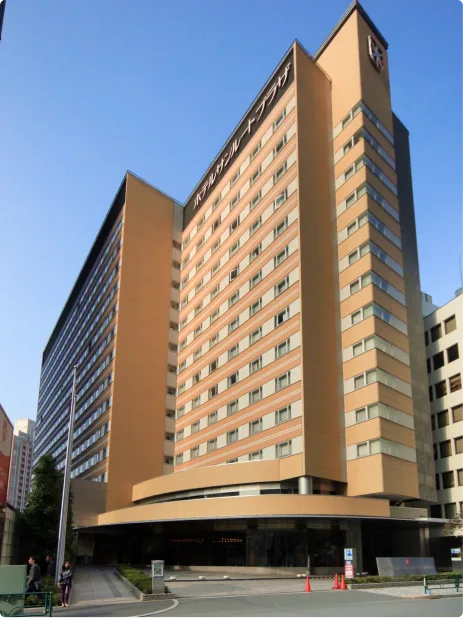
Hotel Sunroute Plaza Shinjuku has an unusually useful front door for a Tokyo hotel: airport limousine buses serving Haneda and Narita stop there, JR Shinjuku's South and Koshu-kaido exits are listed at three minutes, and Busta Shinjuku is also three minutes away. That combination matters when a trip actually uses more than one of those southern transport points. The address loses some of its premium if every day begins toward eastern Tokyo or ends on the Kabukicho side of the station.
There is a room decision behind the location decision. The entry Standard Single can be sold to two people as an Economy Double, but its published area is 15.7 m² and its one bed is 140 cm wide. Two travellers staying several nights with large cases should compare the named 23.1 m² Standard Twin before deciding that Sunroute is cheaper than another Shinjuku hotel. A direct airport bus solves a difficult arrival; it does not create floor space during the rest of the stay.
↔ Scroll table left or right
| Travel pattern | Where Sunroute gains | Where the case weakens |
|---|---|---|
| Flight, direct hotel bus and a later Busta day | Two luggage-heavy transfers end near the same front door | No suitable bus at the actual flight times |
| One or two lightly packed nights | Compact Economy Double may suffice for a location-first stay | Two open cases or much time working in the room |
| Three to five nights with separate beds | 23.1 m² Standard Twin plus laundry can support the stay | Twin rate erases the apparent advantage over a larger alternative |
| Mostly Asakusa, Ueno, Ginza or Tokyo Station | Southern Shinjuku access may matter on arrival | Repeated cross-city journeys outweigh that one advantage |
| Very late arrival or very early flight | Only a correctly timed hotel-stop coach helps | Rail, taxi or an airport night is the practical fallback |
The bus stop is useful only in the direction and hour you need
The hotel lists approximately sixty minutes for its Haneda airport coach and 120 for Narita, with displayed adult fares of ¥1,400 and ¥3,600. Those are published estimates, not a promise of how long immigration, baggage claim, waiting and road travel will take for a particular flight. Arrivals and departures work differently: a traveller reaching Japan buys the appropriate airport-origin ticket there, while a hotel departure needs the relevant timetable and reservation arrangement. A direct stop at the property is valuable only when the coach exists after a realistic arrival margin or early enough before a departing flight.
Work from the real flight, not the word “airport” in the hotel's location description. On arrival, add a generous immigration and baggage window before looking for a hotel-bound service. On departure, start with the airline's terminal check-in target and allow for road delay, then see whether a hotel pickup still works. Finally, decide whether a missed coach would leave a manageable rail or taxi fallback with your actual luggage. A late Haneda arrival can warrant a different first-night hotel if central-Tokyo transport is already thin.
The difference matters for a family with a stroller and two big cases: avoiding station lifts, stairs and an extra hotel walk can be substantial. A solo traveller with one backpack and a direct rail option may gain very little. If neither flight direction fits the coach timetable, price Sunroute as a South Exit hotel and remove the imagined bus saving from the comparison. A Haneda airport-hotel comparison is relevant when a very early terminal arrival makes a city coach impractical. Tokyo's first and last day can also reveal whether the airport transfer is the only difficult movement.
Even when a coach fits, verify its stop, terminal, payment and date before buying a non-refundable room. The hotel may be the sensible arrival base but a poor departure base, or the reverse. That asymmetry is normal. It can justify a hotel choice for a short stay without making the same room attractive for a whole week.
Three different Shinjuku exits lie behind the advertised walk
Sunroute names a three-minute walk from JR Shinjuku South Exit or the Koshu-kaido gate, about one minute from Toei Oedo Line Exit A1 at Mines Tower, and roughly three minutes from Busta Shinjuku. The JR-side route crosses the Nishi-Shinjuku 1-chome intersection and continues about fifty metres. These instructions are more useful than a city-level map pin: walking out of a distant Shinjuku exit can consume the saving before the guest reaches the correct side of the tracks.
The short South Exit route is useful for a highway-bus day, a south-Shinjuku train arrival and trips toward Shibuya or Harajuku. It does not place the hotel beside every line's platform, and it is not a short cut to all of Kabukicho. If several late nights finish near Seibu-Shinjuku or Golden Gai, compare the eastern and northern side of the station instead. Gracery versus Blossom frames that east-versus-south decision; Hotel Groove's Kabukicho approach is useful for a nightlife-centred stay.
A practical test is to write down arrival, departure and the two most difficult local movements. If this south-side corridor simplifies two or more, a modest room premium may return in saved handling and easier mornings. If only the first airport arrival benefits, Shinjuku versus Shibuya or Ueno versus Shinjuku may expose a better base for the full itinerary. A trip built around Tokyo Station deserves the Tokyo Station comparison before paying for southern Shinjuku.
The 15.7 m² rate is not the price of a useful twin
The room menu changes the hotel calculation. The Standard Single/Economy Double has one 140 cm bed in 15.7 m² and may legally sleep two. The Standard Double has a 160 cm bed in 18.7 m². The Standard Twin gives two 120 cm beds in 23.1 m². A Deluxe Twin capable of triple occupancy publishes 28.2 m² with two 120 cm beds and a sofa bed. These are different products even when a search result puts all four under one hotel name.
↔ Scroll table left or right
| Sunroute category | Published room and bed | Best use to price |
|---|---|---|
| Standard Single / Economy Double | 15.7 m²; one 140 cm bed; up to two people | Solo guest or lightly packed couple for a short stay |
| Standard Double | 18.7 m²; one 160 cm bed | Couple prioritising a wider shared bed |
| Standard Twin | 23.1 m²; two 120 cm beds | Separate sleepers or two adults with more luggage |
| Deluxe Twin / Triple | 28.2 m²; two 120 cm beds plus sofa bed | Three travellers who book the actual third sleeping place |
The Twin adds 7.4 m² over the Economy Double, about 47% of the smaller room's published area. The extra area is meaningful, but it is not proof that a pair of 28-inch cases can stay open without blocking the path; bed and desk placement decide that. The 18.7 m² Double adds only 3 m², and its clearer advantage is the 160 cm bed. For two friends requiring separate beds, the economy rate is not a comparable offer at all. Solo Tokyo room choices also show why legal occupancy and usable space should be kept separate.
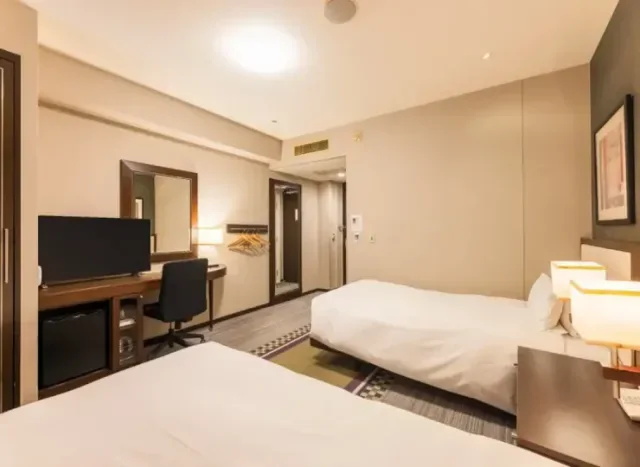
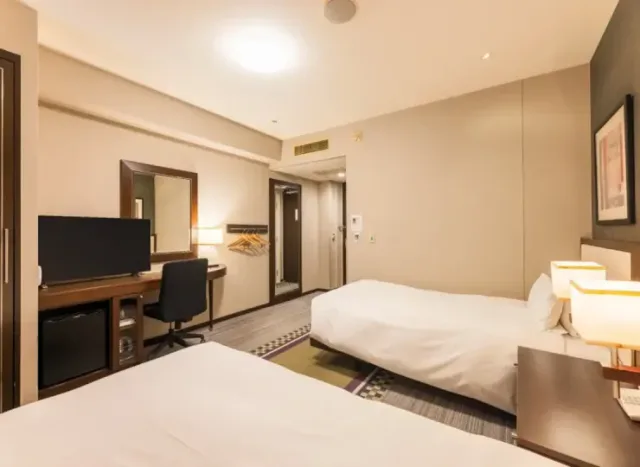
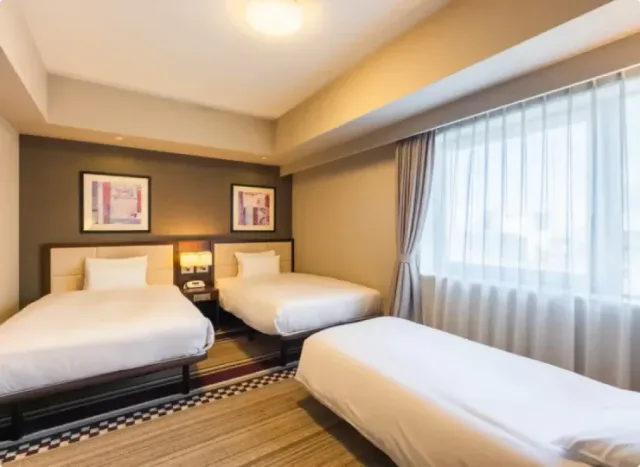
The twin photograph shows beds, a desk and a television but not every walkway or suitcase position. The triple image shows three beds beside a broad window; do not assume a sofa in another category is already made up as that third bed. Price the exact room and occupancy for the dates, then compare cancellation and breakfast on the same terms. A pair who need space every evening should not buy six nights in a 15.7 m² room simply because the airport bus made arrival easy.
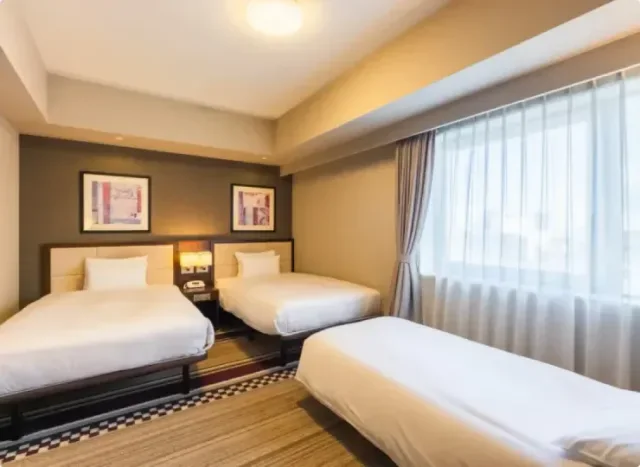
There is also a stopping point for upgrades. If Sunroute's Twin or Deluxe becomes as expensive as a better-fitting alternative, reopen the hotel choice instead of climbing one room category further without comparison. A five-to-seven-night Tokyo hotel checklist puts daily room use and laundry alongside station access. Family rooms beyond Disney may suit a party whose beds and cases overwhelm a compact Shinjuku room.
Long stays gain laundry, but still live in the booked room
Sunroute's FAQ lists 24-hour shared laundry on floors 5, 8, 9, 11, 13 and 14. The hotel has described twelve fully automatic machines, and the room television can show machine status. Current FAQ pricing lists ¥600 per wash with detergent included. That can make a four-to-seven-night stay easier to pack for, though it does not enlarge the room for shopping bags, two open cases or a work setup. Laundry is helpful if it removes clothes from the suitcase; it is not a substitute for a usable floor plan.
Housekeeping on consecutive nights is request-based: a blue card by 14:00 requests a full clean and an orange card requests towel-only service. The hotel says it enters for a hygiene clean every fourth night. This matters to a guest who expects the room to be reset daily without asking, especially when limited floor area makes clutter more noticeable. The current facilities listing places shared microwaves on floors 3, 4, 6, 7, 10 and 12, separate from the laundry-floor list. Tokyu Stay Shinjuku Eastside is a more direct alternative when an in-room washer is a repeated need rather than one mid-trip wash.
Sunroute's general check-in is 15:00 and checkout 11:00; a member booking may carry different hours. That means an evening airport arrival can be simple, while an early arrival still needs luggage storage or another arrangement. A split Tokyo stay may look attractive on a booking screen but spend a substantial sightseeing block moving between rooms. A Tokyo split-stay calculation helps decide whether one room change saves enough travel to justify itself.
Breakfast may be unavailable on the morning that justified the hotel
VILLAZZA serves a Japanese and Western buffet from 06:30 to 10:00, with last entry at 09:30. The hotel FAQ gives ¥3,300 for guests aged thirteen and above, ¥1,650 for ages seven to twelve and no charge through age six. Those prices and the room rate should be checked together for the actual booking. A Busta departure, airport coach or early rail day can erase the useful breakfast window even though the dining room opens comparatively early.
Work backward: breakfast needs enough time to eat, collect bags, check out and still reach the bus or train. A 06:30 hotel buffet cannot help a traveller who should be at an airport coach stop before then. Room-only with a station breakfast may be a better purchase. A nine o'clock sightseeing departure has very different value. The same trip can therefore justify Sunroute for its airport stop while providing no reason to prepay its breakfast. First- and last-day timing is useful here because these are the mornings most likely to be compressed.
Blossom Shinjuku changes the room comparison
JR Kyushu Hotel Blossom Shinjuku is nearby enough to serve many of the same city days, but the room categories need matching. Blossom publishes an 18 m² Standard Double and a 19 m² queen option. Its 25 m² Superior Twin has two 120 cm beds, a table and sofa; its 30 m² Deluxe Twin can take a third guest after an extra bed is added for a charge. Sunroute's 23.1 m² Standard Twin should be compared with Blossom's Superior Twin for two friends, not with Sunroute's lowest Economy Double. For a couple, compare actual doubles and bed widths. For three people, confirm the third bed is included on the final quote at either property.
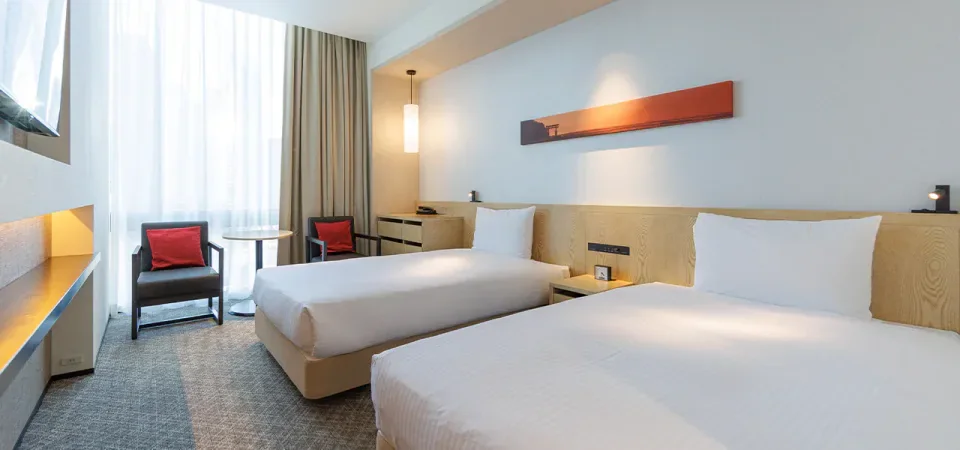
The photograph above belongs to Blossom: it shows its two beds, chairs and a small window table. It is not an image of Sunroute's room. The two Sunroute photographs nearby show its twin and triple arrangements. They help distinguish sleeping surfaces, but photographs cannot establish the free floor left for every traveller's cases.
↔ Scroll table left or right
| Question | Blossom Shinjuku | Sunroute Plaza |
|---|---|---|
| Two separate beds | 25 m² Superior Twin, two 120 cm beds | 23.1 m² Standard Twin, two 120 cm beds |
| Three adult sleepers | 30 m² Deluxe Twin with paid extra bed | Book a triple-capable named category and verify its third bed |
| Airport coach at the hotel door | Not the reason to choose it | Listed hotel stop, valuable only if timed to the flight |
| Main avoidable mistake | Paying for a larger room not used during a short stay | Buying the small economy rate while expecting twin-room space |
For a late flight landing with two cases, a suitable Sunroute coach can eliminate station navigation after the tiring journey. Blossom can be more attractive when a simple rail arrival puts the party near a 25 m² twin that will be used over several nights. At ten o'clock after a Shibuya evening, both hotels remain southern Shinjuku choices; where the train emerges matters more than one hotel's airport stop. If the evenings belong to Kabukicho, the east-versus-south hotel comparison is the next filter.
A same-date quote should contain every guest's age, the named room, bed layout, breakfast selection, total tax, cancellation deadline and expected airport route. Sunroute can win with a well-timed coach and a room that actually holds the party. Blossom can win when more usable space is gained on every night and the airport route works without a hotel-door bus. The Blossom Superior Twin review gives more detail on its room offer. If both prices or bed layouts fail, widen the search before committing to Shinjuku.
Our seven Sunroute Plaza Shinjuku ratings
This assessment assumes an airport coach whose times actually fit the flight, plus at least one South Exit or Busta departure. The 15.7 m² entry room is not scored as a full twin.
| Dimension | Our rating | The booking consequence |
|---|---|---|
| Location | The airport coach stops at the hotel and Busta is close, subject to the real timetable. | |
| Room | The 15.7 m² Economy Double is tight for two large cases; price a true twin separately. | |
| Cleanliness | Recent upkeep assessments are moderate relative to the transport advantage. | |
| Service | A large stay sample supports competent service without making it the chief reason to book. | |
| Facilities | Laundry helps a longer stay, but does not enlarge the room used every night. | |
| Food | Breakfast earns little on a morning when an early bus or train makes it unusable. | |
| Value | The hotel wins when a timed coach and South Exit route remove real transfers. |
Our overall airport-linked read is 7.9/10 with a room sized for the party. Without the coach, a larger Shinjuku room may be the better complete stay.
The stay that repays the southern address
Sunroute is most compelling when an airport coach, a South Exit movement and perhaps a Busta day trip create several hard transfers that the hotel simplifies. A three-night plan could arrive by coach, spend a day around Shinjuku, Harajuku or Shibuya, use Busta for a day trip, and leave by a convenient coach or train. A different three-night plan arriving by rail, touring Ueno and Asakusa every day and departing from Tokyo Station receives little from the hotel stop. A Kawaguchiko day-trip transport choice is one example of a Busta-led morning where the address matters.
For one or two lightly packed nights, the 15.7 m² Economy Double can be a deliberate choice. For two large cases, three nights or more, and especially two separate sleepers, compare the 23.1 m² Twin before accepting a nightly price. If that upgraded quote approaches a roomier alternative, the location has to solve enough difficult movements to earn its cost. Compare rooms near Sunroute Plaza Shinjuku using the exact room and cancellation conditions that suit the trip.
Hotel details
Related guides: Hotel Gracery Shinjuku vs HOTEL GROOVE SHINJUKU: JR Walk or Airport Bus? · KAZENO KURAYOSHI Review: Which Heritage Room Is Worth Booking? · Hotel Sosei Sapporo Review: Is a 39 m² Twin-Queen Room Worth a 15-Minute Walk from Sapporo Station? · Southwest Grand Hotel Okinawa Review: Is a 45 m² Room and Pool Worth the Urban-Resort Premium? · lyf Tenjin Fukuoka Review: Is a 12m² Room Worth the Shared Kitchen and 24-Hour Lounge? · JR East Hotel Mets Premier Akihabara Review: Is a 17 m² Room Worth the 1-Minute Location? · JR Kyushu Hotel Blossom Shinjuku Review: Is the 25m² Superior Twin Worth It? · New Chitose Airport to Niseko: Bus, Private Transfer, Train or Rental Car? · HOTEL ANTEROOM NAHA: Is a 12-Minute Walk from Miebashi Worth Every-Room Harbour Views? · Haneda Airport Hotel Comparison: Villa Fontaine Grand vs The Royal Park
Tokyu Stay Hida-Takayama Musubi no Yu: Which Room Works for Two Suitcases and Three Nights?
Komatsu Airport or Noto Airport: Kanazawa, Wajima and Wakura
La Vista Furano Hills: Is a Small Room Worth It for a One-Night Furano Stay?
Further hotel and route reading: Tokyu Stay Shinjuku Eastside · Shinjuku versus Shibuya decision · Sunroute Plaza guide · Tokyo Station-side hotel · Compare Blossom Shinjuku's double and twin rooms · Check Sunroute Plaza Shinjuku rooms for your dates · Hotel Sunroute Plaza Shinjuku — access and airport-bus information · room sizes and beds · FAQ and breakfast information