
The useful difference between Hotel Gracery Shinjuku and HOTEL GROOVE SHINJUKU is measured at the edges of a day. Gracery is closer to the published JR East Exit approach; GROOVE occupies the tower where direct airport coaches stop and is especially near Seibu-Shinjuku. Both put Kabukicho restaurants and late evenings within reach. For four or five nights, count the movements you will actually repeat before paying for the one transfer that feels easiest on arrival.
A traveller arriving at Haneda with two heavy cases may value walking straight into Tokyu Kabukicho Tower. Yet Gracery's own access advice puts that same coach stop roughly two minutes away. The comparison is a covered building hand-off against a short outdoor roll, rather than access against no access. The coach must also run at the required hour. A party using JR Shinjuku most mornings may make the shorter Gracery walk many more times than it uses the airport bus. Shinjuku or Shibuya as a base is the prior decision if the neighbourhood itself is unsettled.
| Trip pattern | Initial lead | Check before booking |
|---|---|---|
| JR East Exit journeys recur | Gracery | Room category and the actual route from the train platform |
| Seibu-Shinjuku is the routine departure | GROOVE | Whether the trip really uses Seibu rather than JR |
| Airport coach fits both flights, with large bags | GROOVE | First and last services, traffic margin and room premium |
| Two guests need floor area to open cases | Compare rooms | Gracery Twin versus a named GROOVE room, not entry rates alone |
| Kabukicho dinner is the main draw | Neither from location alone | Both properties already serve that district |
The two airport coaches and their real limits
Tokyu Bus serves the Kabukicho Tower stop from Haneda and Narita. Its current Haneda timetable lists twelve departures from the tower and eleven back from the airport each day, at ¥1,400 for an adult one way. The operator gives about 75 minutes as a journey guide. The first tower departure is 05:50; the last listed Terminal 3 departure back to Kabukicho is 22:05, reaching the tower at 23:00. Those figures describe this timetable, not a guarantee against traffic or a service for every possible flight.
Narita offers fewer useful choices: six listed departures in each direction, an adult one-way fare of ¥3,600 and an approximate 125-minute journey. The first tower bus leaves at 06:30. The final Narita Terminal 1 departure shown is 19:40 and arrives at the tower at 21:20. If a plane lands late enough that immigration, bags and reaching the stop consume the remaining margin, the tower hotel cannot make that last bus wait. The late-Haneda arrival decision explores the broader question of sleeping at the airport or continuing into Tokyo.
For either airport, start with the flight's terminal and a realistic post-landing or pre-departure margin. Then see whether a tower departure meets it. A very early outbound flight may be poorly matched even when the hotel shares the bus building. An airport transfer bought for a specific timetable is more useful than a vague promise of a direct bus. Sunroute Plaza Shinjuku's airport-bus trade-off is a separate hotel comparison if bus access matters more than Kabukicho.
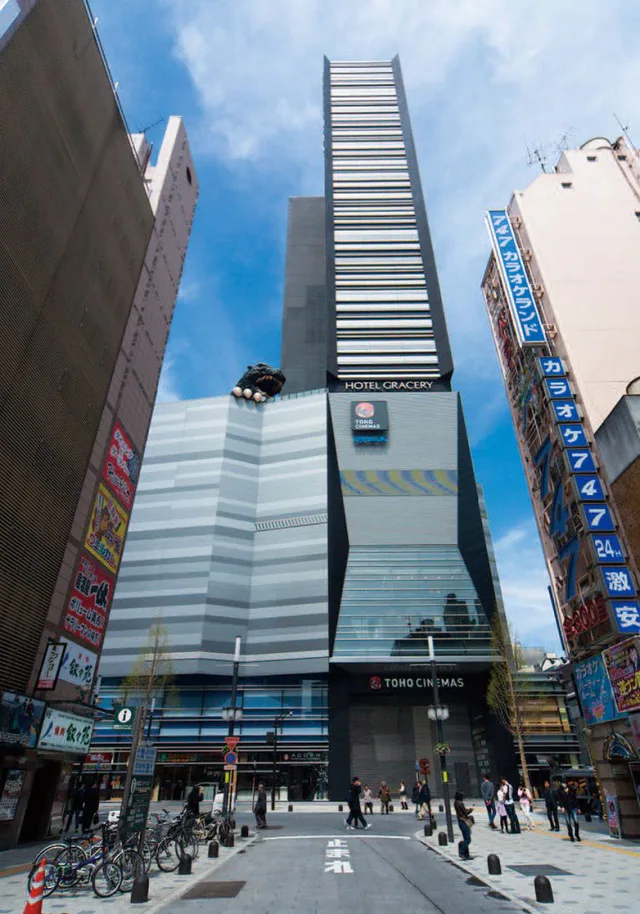
The Gracery entrance is on the rear side of the Shinjuku Toho Building, and reception is on the eighth floor. The tower photograph helps identify the landmark, but guests still need the correct hotel entrance rather than a cinema or shop door. From the airport coach stop, GROOVE's tower location removes that final outdoor approach. Gracery's roughly two-minute roll may be trivial in dry weather with one cabin bag and more noticeable with two large cases in rain. The Gracery building and room guide gives a closer look at that arrival.
JR, Seibu and the walk after reaching street level
Hotel Gracery publishes about five minutes on foot from JR Shinjuku's East Exit and about three minutes from Seibu-Shinjuku. GROOVE's access information places it about seven minutes from Shinjuku Station on JR and private railways, around six from Shinjuku West Exit Station, and only about one minute from Seibu-Shinjuku. These are hotel-to-exit estimates; they do not include locating the correct exit below ground, moving through crowds or getting from a platform to the street.
Someone who starts each day on a JR train and returns to the East Exit gains two published outdoor minutes per direction at Gracery. Over five days that is a recurring convenience, though it remains a small part of a complete journey. Someone regularly using Seibu reverses the comparison. An airport coach may be used only twice, whereas an ordinary station approach can happen ten times. Count actual legs, including days when the group leaves from another station or takes a taxi; do not multiply a walking advantage across days on which it will not occur. Tokyo's main lodging areas help test whether this station will be central to the itinerary at all.
Building vertical travel belongs in the door-to-platform time too. Gracery's eighth-floor reception and GROOVE's rooms high in the tower add lifts and an unfamiliar entrance on Day 1. Neither hotel's advertised street walk captures that. A group rushing for a booked departure should allow time to find the lift, retrieve stored bags and navigate Shinjuku Station itself. A Kawaguchiko departure from Shinjuku is a good example of why the exact rail or bus boarding point matters more than the district name.
Compare the rooms you would actually accept
Gracery's 18 m² Standard Double is the compact starting product. Its Standard Twin is 24 m² and the Comfort Twin reaches 32 m². GROOVE's Superior categories begin around 21–22 m², while Deluxe rooms are roughly 25–28 m²; larger Premier categories sit above them. The dimensions are category descriptions, not proof that every shape of suitcase fits in the same way. A bed, chair and door swing can occupy much of the usable floor. Gracery versus Blossom uses the same principle when comparing two named twins.
Two adults with two full-size cases should inspect a Gracery Twin against the specific GROOVE room that is available on their dates. Using Gracery's cheapest Double on one side and a larger GROOVE Deluxe on the other creates a price comparison between unlike rooms. The reverse mistake is to assume the 32 m² Gracery Comfort Twin is standard merely because the property sells it. Check bed count, whether two cases can lie open, bathroom access and any need for a work surface. For a single night, a compact room may be perfectly acceptable; over five nights, repacking in a narrow passage can become a repeated nuisance.
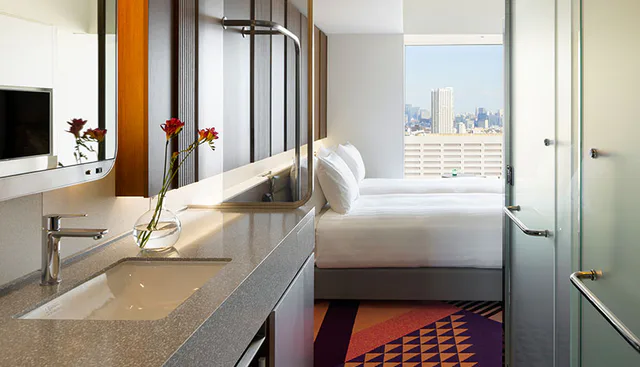
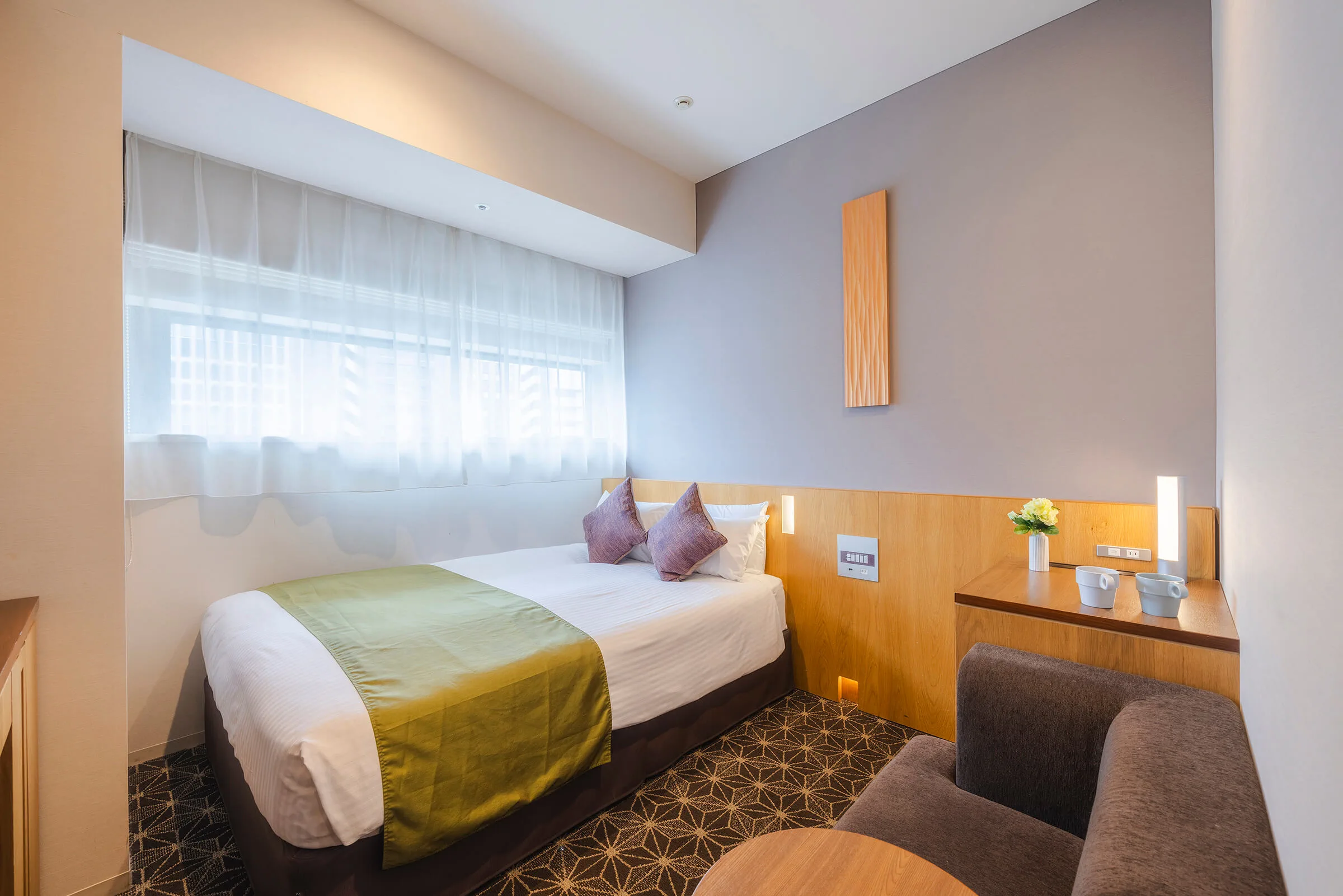
The GROOVE photograph shows a guest room and bathroom area with city views. It is a useful impression of one room, not a floor plan for every category. Likewise, the Gracery photograph below shows a single-bed setup; it should not be used as evidence that the 24 m² Standard Twin has the same furniture arrangement. Read the room name on the rate you select, then match it to that hotel's own floor area and image set. The separate GROOVE review gives more context on that tower stay.
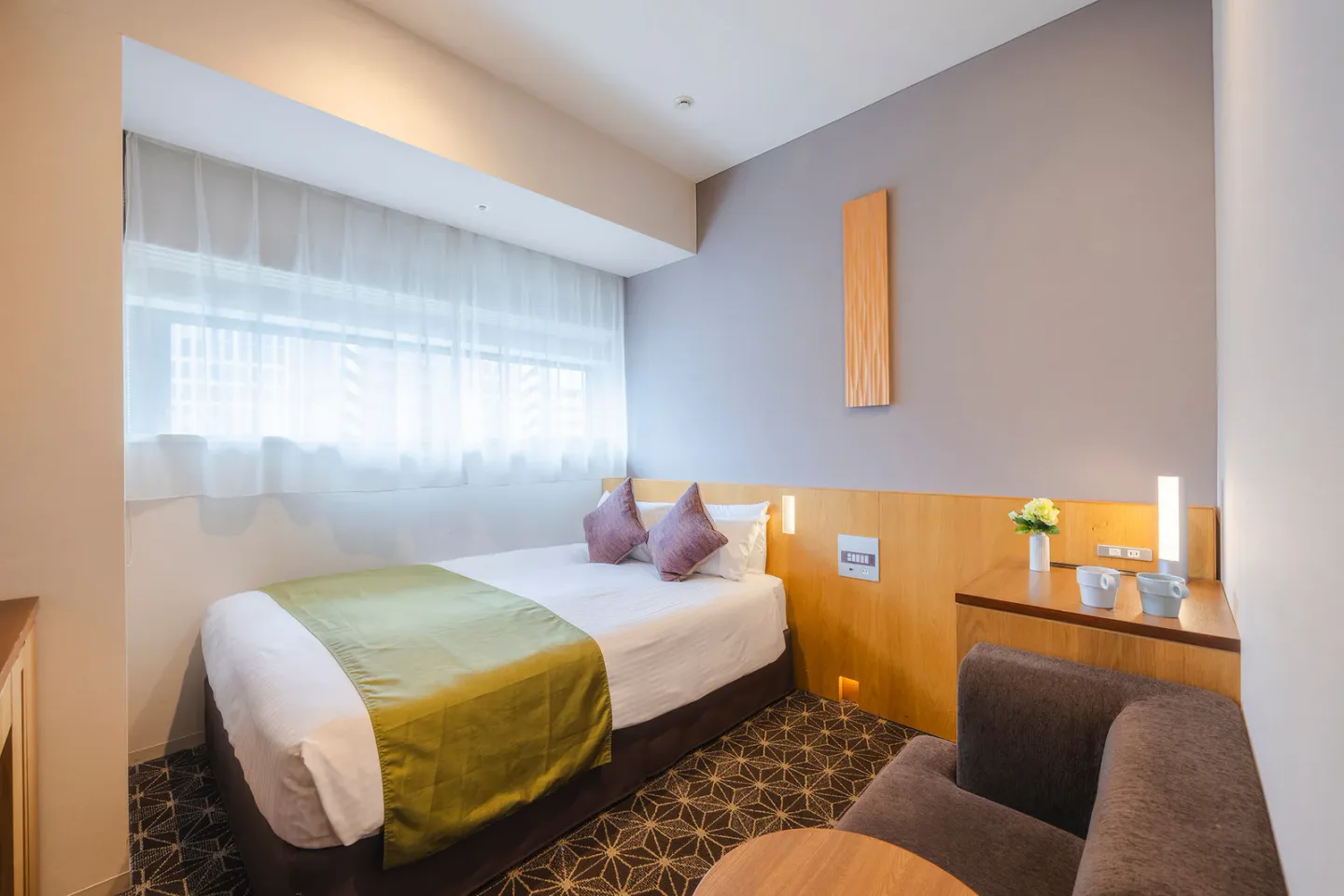
Room shape can reverse an access-led preference. If the airport coach is well timed but a suitable GROOVE room costs much more, a Gracery Twin and a two-minute outdoor luggage roll may be the better purchase. If Gracery's available rate leaves two cases obstructing circulation while a comfortable GROOVE room is only slightly dearer, avoiding the cramped layout may matter on every day of the stay. The only credible comparison uses the same nights, guest count, breakfast choice, tax treatment and cancellation terms.
Why the evening neighbourhood does not decide this pairing
Both hotels put the guest in Kabukicho. A plan built around dinner, shows or late returns in this district does not give one of them a unique neighbourhood advantage. What differs is the next morning's exit and the end of the airport trip. Returning from western Tokyo on JR may make Gracery's East Exit orientation useful; arriving by coach with heavy baggage points toward GROOVE's tower. A guest planning quiet early nights on the other side of the city may need a different base altogether. Ueno versus GROOVE tests that wider geography.
There is also a distinction between being near nightlife and spending time inside the hotel. A traveller who works in the room, lets a child rest in the afternoon or stays five nights may care more about the named room area than a small difference in the published station walk. A group that sleeps and leaves early may get little value from a larger room. An onsen hotel elsewhere in Shinjuku would be a different way to prioritize the time spent on site.
Four or five nights turn a small nightly gap into a decision
Multiply the actual nightly price difference by the number of nights before treating an airport hand-off as worth the premium. For example, a hypothetical ¥4,000 difference becomes ¥20,000 over five nights; those numbers illustrate arithmetic and are not quoted hotel rates. If the more expensive room also supplies space used every day, the premium buys more than the arrival convenience. If its only tangible advantage is one coach arrival and one departure while JR is used throughout the stay, the case is weaker.
Make the calculation in both directions. A cheaper Gracery Double is not necessarily a saving if guests need to buy its Twin to live comfortably with luggage. GROOVE may be the lower total after a room-category match, even if its headline starting rate looks higher. Airport rail or a taxi can also change the financial comparison: the tower coach matters only when the booked flight makes it practical. Forwarding one case can change the value of a larger room or an airport bus if this is a brief stop within a longer trip.
| Decision dimension | Gracery evidence | GROOVE evidence |
|---|---|---|
| Repeated JR approach | About five minutes from East Exit | About seven minutes from Shinjuku Station |
| Seibu-Shinjuku | About three minutes | About one minute |
| Airport coach with bags | Same tower stop, about two minutes outdoors | Stop at the hotel complex |
| Room categories | 18 m² Double; 24 m² Twin; 32 m² Comfort Twin | About 21–22 m² Superior; 25–28 m² Deluxe |
| Kabukicho evenings | District location | District location |
| Long-stay cost | Price acceptable room over all nights | Price comparable room over all nights |
| Early or late flights | Check coach timing before counting the stop | Same timetable limit despite tower location |
The table records seven practical dimensions, not guest-review scores. Breakfast, views and a larger suite may become personal deciding factors, but neither can be given a universal value without the actual rate and room selected. An early Tokyo morning plan can also show whether the hotel will be used for breakfast or only for sleep.
Coach door or JR walk: seven hotel scores
| Dimension | Gracery Shinjuku | HOTEL GROOVE |
|---|---|---|
| Location | 9/10 — The East Exit approach is shorter for repeated JR journeys; the Kabukicho Tower coach stop remains a brief walk away. | 9/10 — The Haneda and Narita coach stop sits at Tokyu Kabukicho Tower; JR departures need a longer walk. |
| Room | 7/10 — The 24 m² Standard Twin is workable for two cases, while the entry Double is only 18 m². | 8/10 — Superior rooms start near 21–22 m², with a Deluxe choice around 25–28 m² and higher-floor outlooks. |
| Cleanliness | 8/10 — A large recent stay sample gives more mixed room-upkeep results than GROOVE's newer rooms. | 9/10 — The newer rooms have a notably strong upkeep record. |
| Service | 9/10 — Staff support remains solid at this large Kabukicho hotel. | 9/10 — Staff performance stays high across a substantial recent review base. |
| Facilities | 7/10 — The eighth-floor laundry helps on longer stays; the building offers fewer hotel-only spaces. | 8/10 — The tower setting and newer public spaces help, although the airport coach is the real practical feature. |
| Food | 8/10 — Sizzler breakfast and nearby Kabukicho meals give plenty of choice, though the buffet is costly. | 8/10 — Tower dining and hotel breakfast serve an in-house evening, with Kabukicho options beyond. |
| Value | 7/10 — Its advantage depends on the actual twin rate and repeated JR East Exit use, not the Godzilla facade. | 8/10 — The premium earns more when the coach and a room above the Superior entry level are used. |
JapanLayer overall scores for a four-night Shinjuku stay: Hotel Gracery Shinjuku 7.9/10 and HOTEL GROOVE SHINJUKU 8.4/10. GROOVE has the stronger room and upkeep case when the airport coach stops in its tower; Gracery can still be the useful quote when JR East Exit walks repeat daily and its 24 m² Standard Twin is available at the right rate.
Test the choice against the flight and the daily route
For a four-night visit with one large bag per person, a late Haneda arrival and several JR day trips, Gracery is a sensible starting point if the tower coach does not fit the landing. Its shorter published JR approach then repeats, while GROOVE's strongest airport claim has vanished. If the same party lands when the coach runs, uses Seibu-Shinjuku for two days and books a larger GROOVE room at a modest total premium, the decision can flip. Neither example promises a fixed travel time or room price.
For a five-night visit arriving at Narita after the final tower coach, do not count a direct bus in GROOVE's column. Plan the actual rail or road transfer and then judge the rooms and daily station use. For an early return flight, work backwards from airline check-in and compare it with the first coach; a hotel in the bus-stop building does not solve a mismatch. A Sapporo hotel walk comparison illustrates the same distinction between published walking minutes and an entire transport chain.
If two travellers mostly eat nearby and take taxis or walk to their activities, neither JR nor Seibu walking difference deserves much weight. Room area, the total rate and whether the airport coach works become the live questions. If they head to the station every day, an attractive hotel image or dramatic tower view should not substitute for plotting those trips. The South Exit hotel comparison is more useful if Busta buses recur.
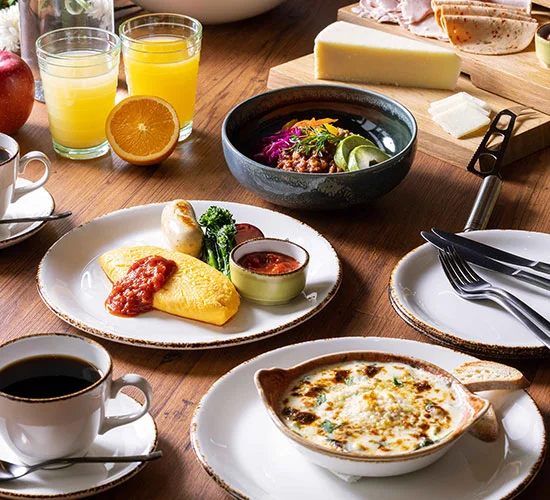
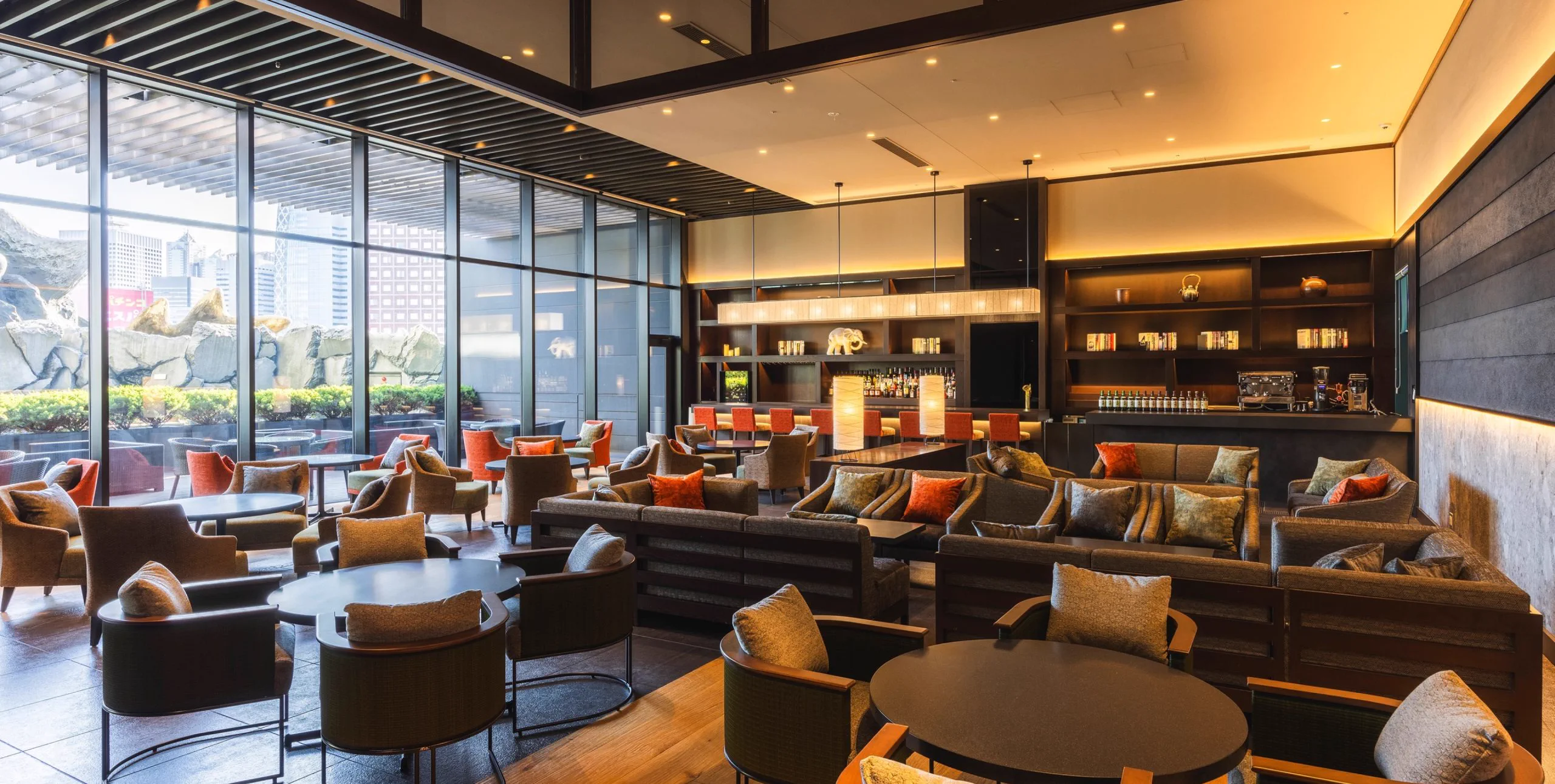
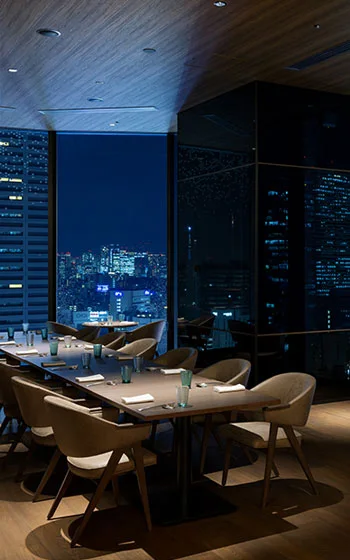
The breakfast photo illustrates food served at GROOVE; it does not establish a package price or opening time for your date. Those details belong in the room-rate comparison, especially before an early coach. The evening dining image in the gallery likewise shows a hotel space, not proof that a particular restaurant table or skyline seat comes with a guest-room booking.
Compare Gracery's available room categories with GROOVE's rooms on the same dates. If both acceptable rooms price similarly, give the lead to the building whose transport edge you will genuinely use. If the totals differ sharply, ask whether the dearer option solves a repeated problem rather than only making one luggage arrival easier. Save the coach timetable and the correct station exit before either stay; both routes have details a hotel name alone cannot convey.
Hotel access and coach timetables
Hotel Gracery Shinjuku — access and hotel information · Tokyu Hotels — HOTEL GROOVE SHINJUKU access · Tokyu Bus — Tokyu Kabukicho Tower ↔ Haneda Airport · Tokyu Bus — Tokyu Kabukicho Tower ↔ Narita Airport
Other area and hotel comparisons
Hotel Gracery Sapporo: Is a 1-Minute Station Walk Worth a 15 m² Room? · Hotel Gracery Sapporo: Is a 1-Minute Station Walk Worth a 15 m² Room? · New Chitose Airport to Niseko: Bus, Private Transfer, Train or Rental Car? · OMO5 Otaru: Is a 9-Minute Station Walk Worth Staying by the Canal? · Oriental Hotel Okinawa Resort & Spa Review: Is the 170m Pool Worth a 7-Minute Beach Walk? · karaksa hotel grande Shin-Osaka Tower: Is a 5-Minute Station Walk Worth It Before an Early Shinkansen? · Hotel Sonia Otaru: Is a Canal-View Room and Rooftop Onsen Worth the 8-Minute Station Walk? · Keio Plaza Hotel Sapporo: Is a 33.2 m² Twin Worth the Winter Walk? · Hotel Torifito Otaru Canal: Is a 7-Minute Walk from Otaru Station Worth It?