
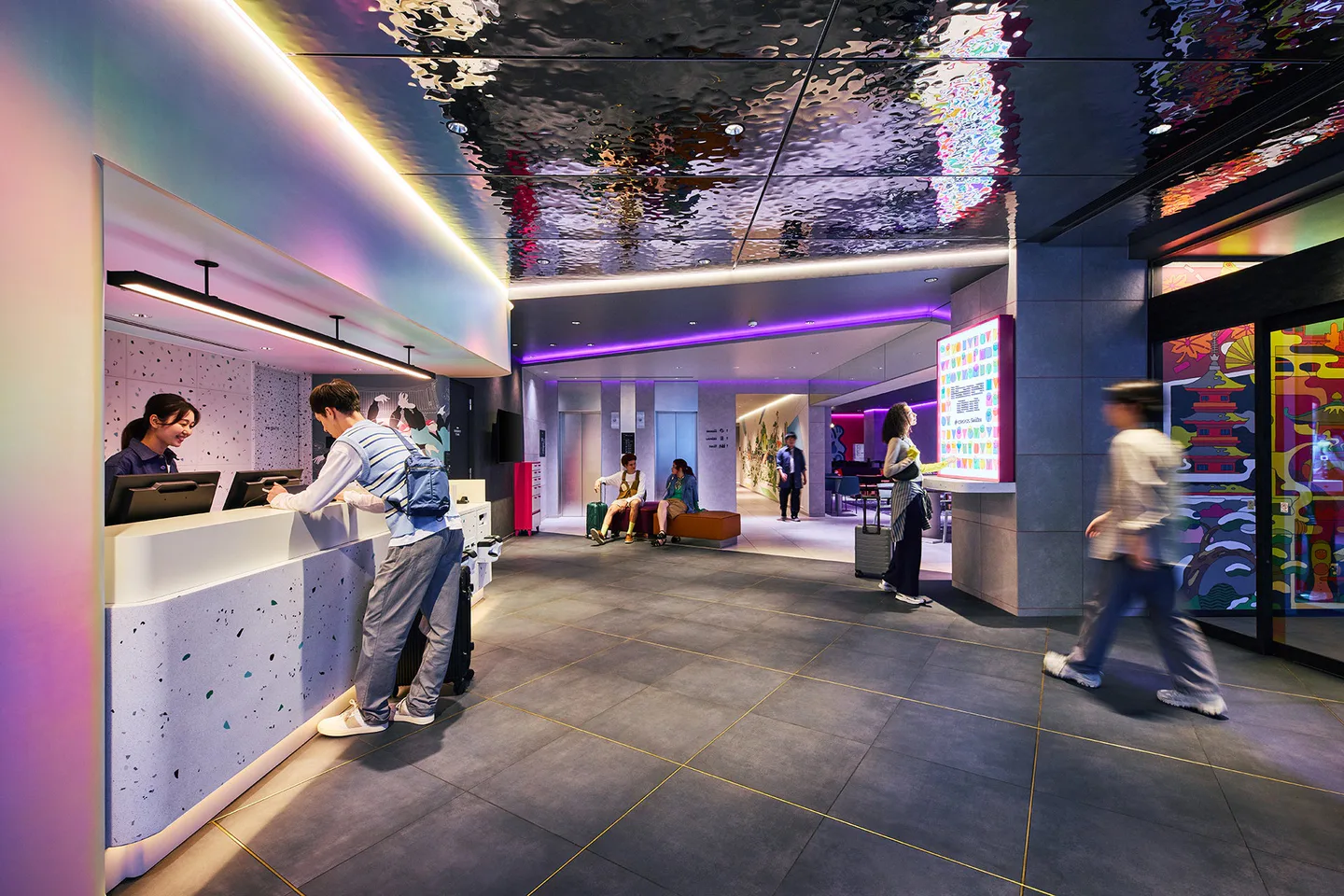
CROSS Suites Tokyo Asakusa has room categories for two to six people, but the capacity number alone does not settle a group booking. A six-guest suite has four fixed semi-double beds and two secondary sleeping surfaces. A five-guest Deluxe Family has only two fixed semi-doubles, with stacking and sofa beds added for the rest. Those arrangements can suit parents and children; six adults paying equal shares may feel very differently. Check bed equality, bathroom turns, luggage and privacy before comparing one large room with two conventional rooms.
The apartment-style hotel opened on 3 July 2026 with 78 rooms across 11 listed types. Its room sizes run from 25 to 63 m². The address is close to Senso-ji, while access to each railway called “Asakusa Station” differs. For two travellers on a short stay, the 25 or 30 m² categories may be enough. For a group, choose by the first constraint the smallest room must solve. The Tokyo family-hotel capacity guide makes the same distinction between permitted occupancy and a workable room.
↔ Scroll table left or right
| Party and first constraint | Room to examine | Bed trade-off |
|---|---|---|
| Two adults, short stay | 25 m² Standard or 30 m² Superior | Two fixed semi-double beds; third guest would use a stacking bed. |
| Three adults wanting equal beds | 32 m² Superior Triple | Three fixed semi-double beds. |
| Four adults | 39–40 m² Deluxe Triple or 54 m² ASAKUSA Tatami | Three beds plus sofa versus four equal futons. |
| Five people | 54 m² Deluxe Family or a larger suite | Family room has two fixed beds, two stacking beds and a sofa bed. |
| Six people | 56 m² Suite, 60 m² Junior Suite or 63 m² Premium | Four fixed beds plus either stacking and sofa, or two stacking beds. |
The small categories already solve many two- and three-person stays
Standard is 25 m², with two 110 cm semi-double beds and a 97 cm stacking bed for a possible third guest. It has a shower rather than a bathtub. Superior grows to 30 m² and adds a bathtub while keeping two main beds and a stacking-bed third position. If only two people are travelling, compare that bath and five-square-metre gain against the total room-price difference before paying for a family suite. The hotel is designed for groups, but its smallest category is already larger than many urban doubles.
For three adults who all want a normal bed, the 32 m² Superior Triple is the more direct solution: three 110 cm semi-doubles. A Standard or Superior may legally take a third person, yet the third bed is different. The Triple remains a compact room for three full-size cases, so a longer stay with daily shopping might justify comparing the Deluxe Triple's 39–40 m². That is a luggage and living-space question, not a reason to buy a six-person suite automatically. MIMARU's Ueno versus Shinjuku family comparison provides a useful check when the district and room layout both matter.
Every room has a counter with sink, microwave, refrigerator/freezer and tableware, but the hotel does not install an IH or gas hob in the room. It is a place for takeaway meals, reheating and simple breakfast preparation rather than full in-room cooking. A public kitchen is available separately, along with communal laundry. If cooking together is a hard requirement, inspect that shared kitchen arrangement instead of treating the word “mini-kitchen” as a private stovetop promise.
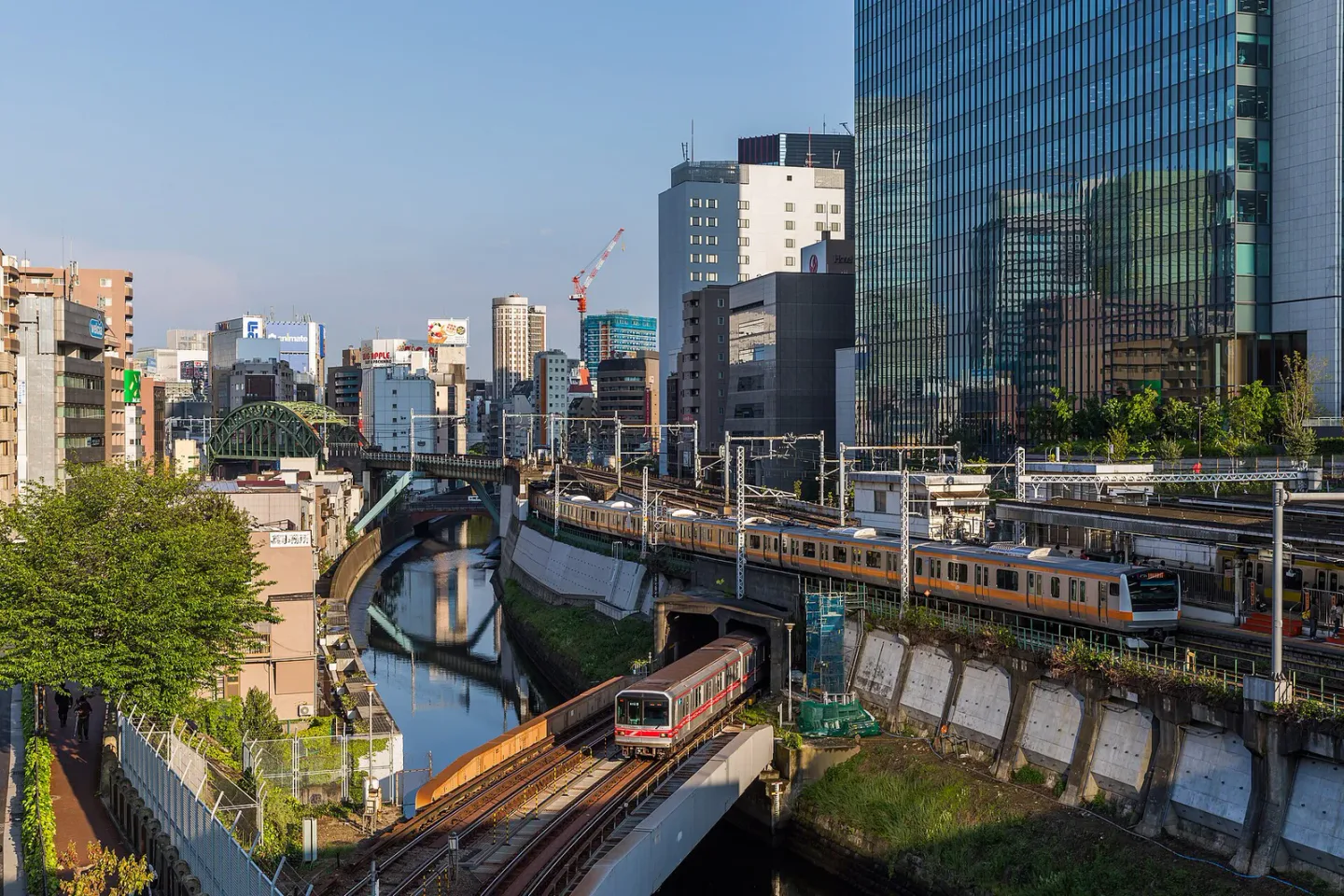
The first room photograph retained here is a Tokyo rail and canal scene, not a CROSS Suites bedroom. It provides city-travel context, while the later images show actual hotel rooms. Compare the correct station approach when a train journey ends with several cases.
Four people must choose between a sofa and futons
Deluxe Triple covers 39–40 m². It has three 110 cm semi-double beds, with a 90 cm sofa bed added for a fourth person. Some examples have a low table instead of a dining table, so the furnished room may not look identical to every promotional image. If the fourth traveller is a child or an adult happy with the sofa, this can be an efficient one-room booking. A party of four adults with equal-payment expectations should decide who gets that bed before checkout.
The 54 m² ASAKUSA Room takes a different route: four 97 cm futons on tatami, with a living area and Senso-ji-oriented concept. There is no one person relegated to a sofa bed, but everyone sleeps at floor level. Mobility, knees and personal sleep habits therefore matter more than whether the decorative theme appeals. For guests who rise at different times, two separate hotel rooms may still provide more privacy than either group layout. An Asakusa-first seven-day Tokyo plan helps test whether enough evenings will be spent in the neighbourhood to use that shared space.
In both cases, ask about the bathroom count and floor plan before booking if four people need to get ready simultaneously. Published capacity does not establish multiple bathrooms, and more square metres do not automatically solve the 07:30 queue. A Disney-area family room comparison is another reminder that room labels can obscure the exact sleeping surfaces.
Five guests expose the Deluxe Family bed hierarchy
At 54 m², Deluxe Family has a dining table and room for a group to sort takeaway food, devices and luggage away from the beds. That common area is a real advantage over two tiny rooms when a family wants to stay together. Its current bed list, however, is two 110 cm fixed semi-doubles, two 97 cm stacking beds and one 90 cm sofa bed. The older four-fixed-bed description is inaccurate. For five adults, three guests therefore use secondary surfaces; compare two rooms or a suite with four main beds rather than assuming “sleeps five” means five equal beds.
The family room can still be an excellent answer for parents with children whose bed preferences differ from an adult group. If the fifth guest is a child sharing a family routine, common dining and one-room supervision may outweigh equal-bed concerns. If five friends will split the rate evenly and sleep at different hours, two rooms may be fairer despite losing a single shared living area. The Disney hotel-area comparison shows another context where a group should decide room logistics and morning travel together.
Six guests: three layouts, not a simple size ladder
The 56 m² Suite has four fixed 110 cm semi-doubles, one 97 cm stacking bed and one 90 cm sofa bed. The 63 m² Premium Suite currently lists the same bed hierarchy, despite its extra seven square metres and more clearly separated living, dining and sleeping areas. The old article assigned a second stacking bed to Premium; the live room list shows one stacking bed and one sofa instead. The 60 m² Junior Suite is the alternative with four fixed semi-doubles plus two 97 cm stacking beds. If the sixth adult strongly dislikes a sofa bed, this middle-sized category is more relevant than paying for the largest floor area.
All three suite types list a washer-dryer, which can matter halfway through a longer Japan trip. The seven-square-metre Premium gain is roughly one-eighth of the 56 m² Suite's published area, yet it should be bought for the living-zone separation or circulation it actually provides, not as an invented promise of two equal additional beds. A concept TOKYO Goldfish Suite also measures 63 m² and lists four fixed beds plus two stacking beds; its aquarium-linked design is a different reason to select it. Check the named category on the live rate because “suite” alone hides these differences.
↔ Scroll table left or right
| Six-person option | Area | Fixed beds | Fifth and sixth surfaces | Other deciding feature |
|---|---|---|---|---|
| Suite | 56 m² | Four 110 cm semi-doubles | 97 cm stacking bed; 90 cm sofa bed | Dining area and washer-dryer. |
| Junior Suite | 60 m² | Four 110 cm semi-doubles | Two 97 cm stacking beds | Washer-dryer; avoids sofa sleeping. |
| Premium Suite | 63 m² | Four 110 cm semi-doubles | 97 cm stacking bed; 90 cm sofa bed | Greater separation of living and sleeping areas. |
| TOKYO Goldfish Suite | 63 m² | Four 110 cm semi-doubles | Two 97 cm stacking beds | Distinctive Sumida Aquarium collaboration design. |
Six people with six full-size cases also need circulation, a meal surface and a bathroom routine. The washer-dryer can reduce how much clothing everyone brings, but it cannot turn four main beds into six equal ones. Consider whether two people want to stay awake in the lounge area while others sleep. A group that leaves at dawn and returns only to sleep may use less of Premium's separation than one that eats breakfast and takeaway dinner in the room.
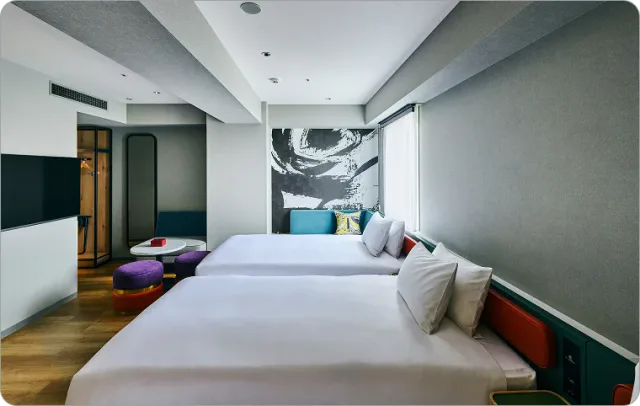
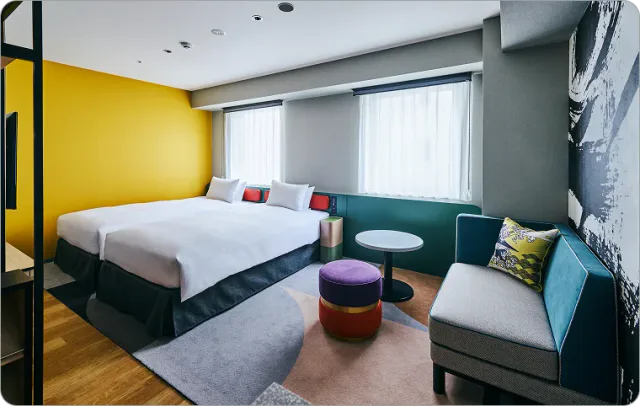
The hotel lobby and the two room photographs appear together in the gallery below. The room photos show useful design details, but a particular sofa, bed layout or window must be matched to the category named in the booking.
One room against two: cost is only one column
Divide the full stay total by the number of guests only after accounting for what the party needs. One suite gives shared dining, easier supervision of children and possibly in-room laundry. Two rooms can offer a second bathroom, a separate lights-out time and more equal fixed beds. A six-person suite can be cheaper per guest yet still be a worse choice for six adults if two dislike auxiliary bedding. Conversely, a family with younger children may pay more for two rooms while losing the common area it would use every day.
Compare the same dates, occupancy, tax, breakfast, cancellation deadline and laundry access. Then write down the non-price vetoes: must there be six equal beds, two bathrooms, a private kitchen, or a quiet room for early sleepers? The hotel's public room descriptions do not prove a multiple-bathroom arrangement for the large suites. Ask the property about the exact floor plan if that is a booking condition. KOKO HOTEL Residence Oshiage is another East Tokyo space model to compare when the room, rather than the brand, drives the decision.
In-room washer-dryers are listed for certain larger categories, including the three suites above and the Goldfish concept suite; they are not a hotel-wide room amenity. Communal laundry exists for other guests, but it is a different task from starting a wash inside the family's room. On a one-night stop this distinction may barely matter. Midway through a two-week trip, it can determine packing volume and how the adults spend an evening. Tokyo shopping hotel choices illustrate why purchases and laundry can influence a longer urban stay.
Four Asakusa stations mean four final walks
The property is about two minutes on foot from Senso-ji, but the rail walk depends on the operator and exit. Tokyo Metro Ginza Line Asakusa Exit 6 is about five minutes; Toei Asakusa Line Exit A5, Tobu Skytree Line North Exit and Tsukuba Express Exit A1 are each listed at about eight minutes. These are surface-walk estimates, not a door-to-platform guarantee. Six travellers pulling cases should identify the exact line and exit their airport route will use before assigning value to a generic “Asakusa Station” pin.
↔ Scroll table left or right
| Rail arrival | Published walk | Planning implication |
|---|---|---|
| Tokyo Metro Ginza Line, Asakusa Exit 6 | About 5 minutes | Useful for a Ginza Line route toward Ueno and central Tokyo. |
| Toei Asakusa Line, Asakusa Exit A5 | About 8 minutes | Check airport through-service and luggage exit route. |
| Tobu Skytree Line, Asakusa North Exit | About 8 minutes | Use the correct rail operator rather than another Asakusa entrance. |
| Tsukuba Express, Asakusa Exit A1 | About 8 minutes | Do not confuse this separate station with the Ginza Line walk. |
For a Narita or Haneda arrival with children and luggage, the easiest final transfer may matter more than the fastest timetable. A Ueno luggage-route hotel can be a closer fit if the Skyliner is central to the trip. If most daily activities are in Shinjuku, Shibuya or western Tokyo, test the cross-city journeys in the first-time Tokyo base guide before allowing a large Asakusa room to decide the whole itinerary. Tokyo's attraction-area map is useful for seeing which days can be grouped rather than crossed repeatedly.
If several mornings begin with an intercity train, the size of this Asakusa room is only half the calculation. Tokyo Station versus Shinjuku helps locate the departure axis before the family accepts repeated journeys from Asakusa. A single long-distance day may be manageable; a rail-heavy itinerary can make the larger room a false saving.
Seven dimensions for a group booking
↔ Scroll table left or right
| Dimension | What the property provides | The group decision |
|---|---|---|
| Bed fairness | Fixed semi-doubles, stacking beds, sofa beds or futons by category. | Assign the actual sleeping surfaces before sharing cost. |
| Room area | 25–63 m² among the compared room types. | Count cases, dining and hours spent together inside. |
| Bathroom routine | Capacity is published; multiple bathrooms are not assumed. | Ask for the floor plan if morning congestion is a veto. |
| Food preparation | In-room sink, microwave and refrigerator/freezer; public kitchen. | Do you need reheating or actual cooking? |
| Laundry | Shared machines and named suites with washer-dryers. | Choose the exact room that provides the intended laundry convenience. |
| Transit | Four different Asakusa rail walks of about five or eight minutes. | Map the airport and daily routes for the entire party. |
| Value and privacy | Large shared rooms versus two smaller rooms. | Compare complete totals with sleep schedules and second bathroom value. |
The strongest use case is a group that wants to stay together for several nights, will actually use the dining space, and can agree on the secondary beds. An Asakusa-first itinerary may also make the two-minute Senso-ji approach meaningful in the morning. Tokyo's low-cost sightseeing routes and a Nikko day-trip decision can help check whether the base supports the family's actual days. For two people who spend every day west of the city centre, the group's unused extra space may have little value; Ueno versus Shinjuku is a better first question.
Choose the smallest named category that satisfies the group's bed and bathroom requirements, then compare its total price with two rooms. The 32 m² Superior Triple is the clean three-adult baseline; four adults must resolve sofa versus futons; five guests should scrutinise Deluxe Family's two fixed beds; six guests need to compare Suite, Junior and Premium bed arrangements. When the room is settled, compare CROSS Suites Asakusa stays with the same dates, guest count and cancellation conditions.
Other Tokyo room and itinerary comparisons
Where to Stay in Tokyo · CROSS Suites Tokyo Asakusa — · CROSS Suites Tokyo Asakusa — · ORIX HOTELS & RESORTS — · Tokyo Disney Room-Only vs Vacation · MiraCosta Harbor Room: Harbor View · Aso Day Trip or Overnight: · The Orion Hotel Motobu vs · Kinosaki Ryokan Dinner Included or · Happo vs Goryu: Which Hakuba · lyf Shibuya Tokyo: Is the · MiraCosta Terrace Room vs Balcony