
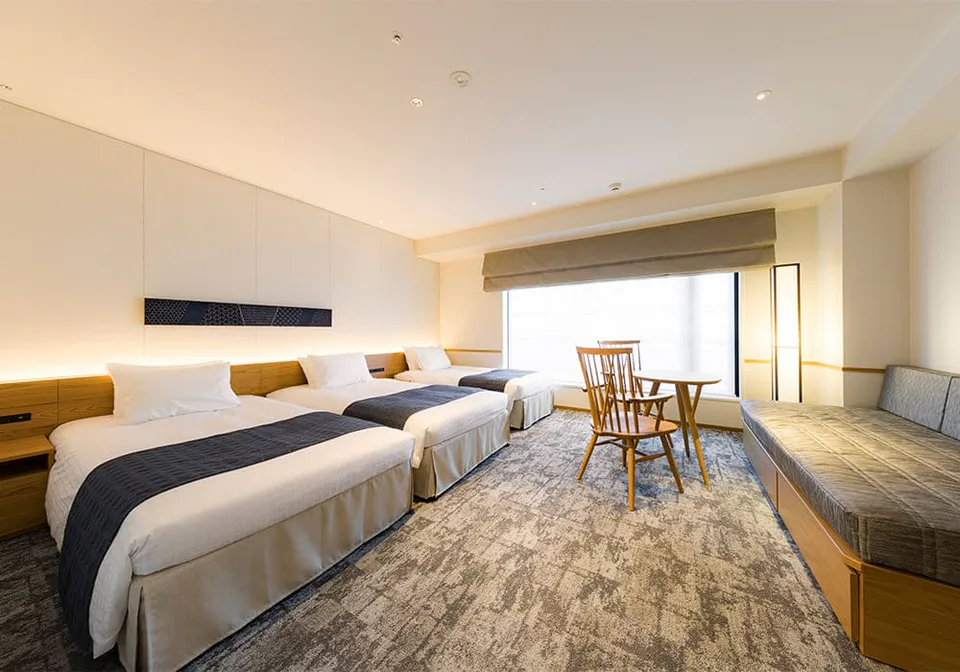
Tokyu Stay Hida-Takayama Musubi no Yu earns its place in a Takayama itinerary through a short station walk and useful long-stay rooms. For two people with large cases who will spend three nights here, I would price the Residential Twin before booking the lowest double. Its 28 m² layout, in-room washer-dryer, microwave and kitchenette can remove one or two laundry stops from a wider Japan trip. If you are only sleeping here between trains, a smaller room may be enough. The hotel's name alone does not tell you which equipment is inside the room you selected.
The hotel is about two minutes on foot from JR Takayama Station and about ten minutes from the old streets. That location can save repeated luggage moves for travellers taking a Shirakawa-go bus or an early regional departure. A driver has a different calculation: the hotel has 26 paid parking places, allocated in arrival order. Your real question is whether the station and room functions will be used often enough to justify the chosen rate.
Choose the room by what you will do with it
| Stay pattern | First room to price | Useful function | Check before paying more |
|---|---|---|---|
| One light overnight for two | 20 m² Double or compact Twin | Station access and public onsen | Whether two open suitcases still fit |
| Two or three nights with large cases | 27 m² Residential Hollywood Twin or 28 m² Residential Twin | More room plus washer-dryer, microwave and kitchenette | Price difference and actual plan to use the equipment |
| Three or four guests | 37 m² Family Twin or Japanese-Western Twin | Space and long-stay functions | Bed type and who sleeps where |
| Car-based late arrival | Compare other Takayama hotels too | Station premium matters less in a car | Unreserved parking and off-site fallback |
| Early bus on several mornings | Any room that meets the sleeping need | Two-minute station-side geometry | Whether paid breakfast is usable before departure |
A one-night couple may spend too little time indoors to benefit from a kitchenette. A pair travelling for weeks can get substantial value from a machine that actually lets them pack fewer clothes. If the onward route is Takayama, Shirakawa-go and Kanazawa, a station-side base also keeps the bus morning simple. If you are still deciding whether to stay at all, compare a Takayama day trip with an overnight before paying for a room feature that never enters the plan.
What the washer-dryer changes over three nights
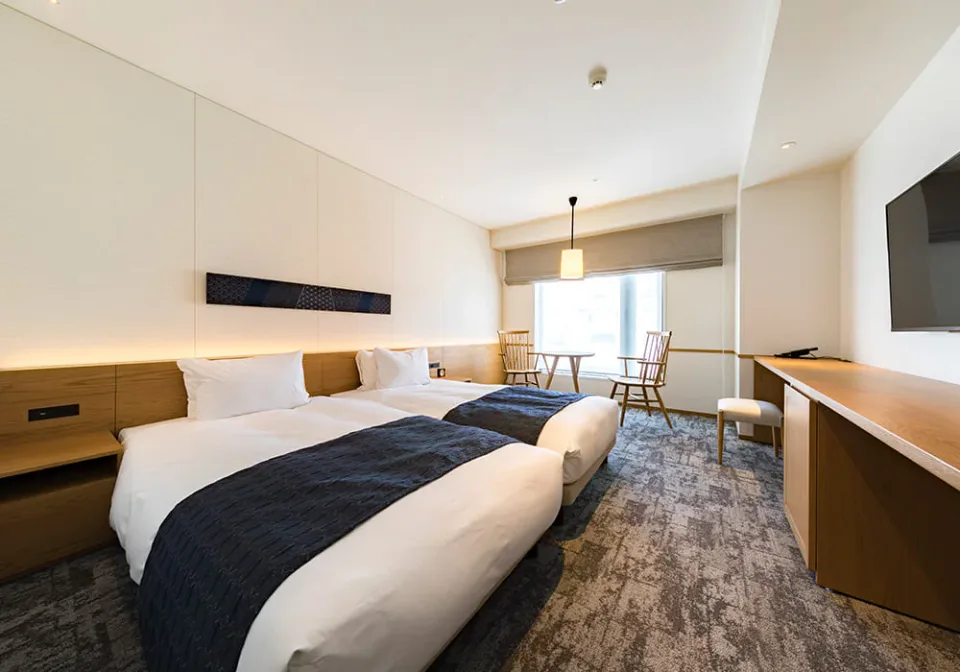
The Residential Hollywood Twin is listed at 27 m² and the Residential Twin at 28 m². Both show a washer-dryer, microwave and kitchenette in their room details. The hotel estimates about 170 minutes for a wash-to-dry cycle and provides detergent for washer-equipped rooms at check-in. This makes timing concrete: start a load while you have dinner or use the bath, then finish packing before bed. Starting it close to midnight is a poor way to prepare for an early bus.
Count the clothes that can stay out of your luggage before assigning value to a Residential upgrade. One load during a single overnight rarely justifies a large premium. Across three nights, a couple arriving after hiking or several cities may run the machine more than once, and the extra floor area makes it easier to keep two cases open. This is the same equipment-versus-room-space problem that appears in Tokyu Stay Fukuoka Tenjin versus a larger Fukuoka room; the answer depends on whether you will actually use the machine.
Do not buy a cheap Tokyu Stay room by assuming all of its rooms have laundry. The property explicitly warns that equipment varies and some rooms do not have a washer-dryer. Its 20 m² Comfort Double description does not display the washer-dryer, microwave and kitchenette icons that the Residential rooms do. The 37 m² Japanese-Western Twin shows washer-dryer and microwave, but a kitchenette should still be checked for the exact category. Before paying, read the room's equipment list alongside occupancy and bed configuration.
Think through where the laundry will sit in the stay. On arrival night, you may be tired from the train and have dinner plans in the old town; washing the first load then is optional. The middle night is usually easier, because the day's worn clothes can go into the machine while tomorrow's outfit is already available. On the final night, a nearly three-hour cycle competes with repacking and an early checkout. If you only have that last-night window, a Residential rate should be judged mainly by its extra space rather than by a laundry benefit you may never use. Two travellers can also share one load, making the equipment more useful than a hotel laundry room that requires several trips to check a machine.
| Length of stay | Likely use of in-room laundry | Room implication |
|---|---|---|
| One night | Little time for a full cycle | Buy Residential mainly for space or kitchenette use |
| Two nights | One mid-stay load can replace a laundry stop | Compare the actual rate premium with the saved packing |
| Three or four nights | One or more loads can support a smaller suitcase | Residential becomes more valuable if both travellers use the function |
| Longer Takayama base | Repeated wash cycles can become part of the routine | Check whether the regional itinerary itself is too transfer-heavy |
The station address pays back on transfer days
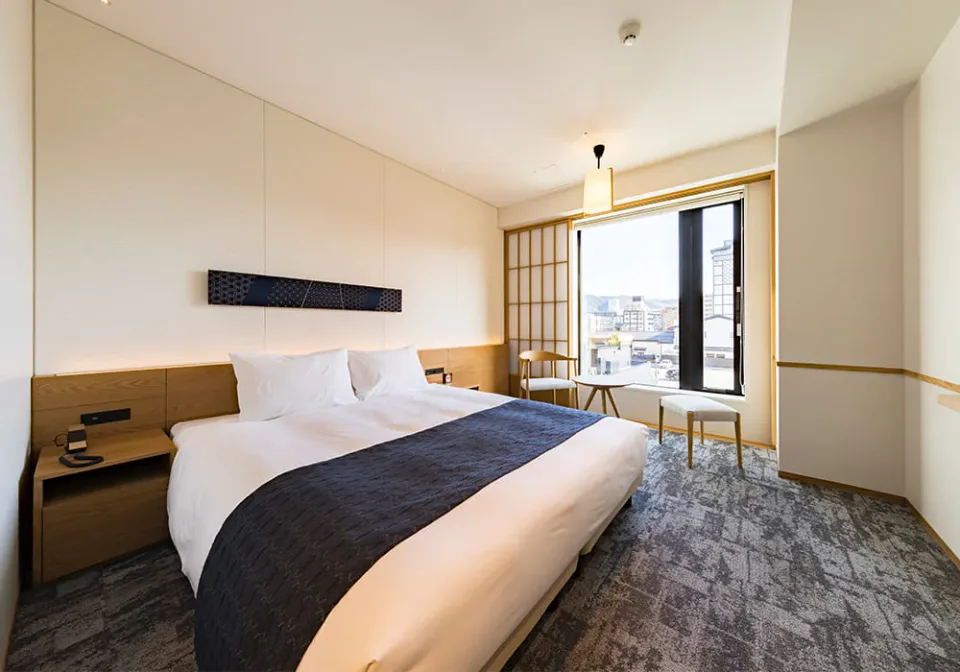
Two minutes from the station sounds like a small saving until it happens several times: arriving with large cases, visiting the Nohi bus centre, returning after a regional day, and collecting stored luggage before the next train. The front desk can keep bags around check-in, which can free the arrival afternoon. A ten-minute walk to the historic streets is still reasonable, but this is mainly a transport-facing base rather than a room embedded in the old town.
For Shirakawa-go by bus, station-side nights reduce the chance that a morning suitcase drag determines which departure you catch. If the trip extends into a wider Hokuriku route, a Takayama stay can work as one stop rather than a permanent base. A room with laundry helps a multi-city route, but it cannot fix a schedule that returns to Takayama after long transport every day. Compare the luggage-forwarding choices if the next bus or train leg makes carrying large cases the more serious problem.
Seasonal visits change the station value too. The Takayama autumn route may include the old town, Hida Folk Village and onward buses, while the October festival night puts a stronger premium on where you return late. If festival dates are the reason to stay, compare Tokyu Stay and Hida Hotel Plaza for that specific trip; a general three-night recommendation is not a festival-room guarantee.
Drivers should price the parking uncertainty
The on-site lot holds 26 cars and costs ¥1,500 per vehicle per night under the current hotel terms, covering 15:00 to 11:00. Spaces cannot be reserved and are taken in arrival order. If full, guests use nearby paid parking. Oversized vehicles and motorcycles are not accepted in the hotel lot. A driver can therefore pay for a room beside the station and still need to find a different parking place at the end of the day.
For rail and bus users, the station is an advantage that repeats. For a driver, it may be a premium with little payoff. Compare an alternative with the exact car space you need before deciding that the hotel has “parking available”. If the next morning is a drive toward Furukawa or the mountain villages, consider the cost and walking route of the fallback lot, not only the ¥1,500 published hotel charge. Do not assume that a paid place is a reserved place.
A mixed trip creates a narrower case for this hotel. If you arrive by train, rent a car only for one Takayama day and return it before moving on, the station location still helps on the other days; pay attention to the rental pickup point and the one parking night. If you bring the same car for the entire stay, the balance shifts. This is why a three-night recommendation cannot be transferred unchanged between a rail itinerary and a self-drive itinerary. The room functions may be identical, but the transport saving that made the hotel's location appealing has changed.
Public bathing is dependable; a private slot is conditional
The second-floor public hot-spring baths operate 15:00–24:00 and 06:00–11:00, with the two bath layouts alternating between men and women. On the ninth floor there are three private outdoor baths and a footbath. The private bath currently costs ¥2,750 per room for 45 minutes, runs during the afternoon and evening, and is booked at the front desk on the day of use in arrival order. It is a possible upgrade, not a reserved part of your stay simply because the hotel advertises it.
A couple mainly seeking a hot bath after a long Takayama day can count on the public-bath feature during its stated hours, subject to normal operations. A family that requires a private session at a specific hour should not base the entire hotel purchase on a first-come bath. Compare a property with an in-room or advance-bookable bath if that is essential. The footbath can be used in the morning as well as evening, but it is a different experience from a private open-air soak. A room-focused stay and a bathing-focused stay deserve different price comparisons; Nikko versus Kinugawa Onsen illustrates how changing the purpose of the night changes the best base.
Breakfast must fit the bus you are taking
Restaurant YUI currently serves breakfast from 07:00 to 10:00, with last order at 09:30, for ¥2,500. The dinner set is currently ¥6,500, with service to 21:00 and a last order at 20:30. These are genuine amenities for a slow morning or an evening in the hotel. They are less useful if the station location is being used to catch a bus before the restaurant opens. Count the number of mornings you can actually eat before adding breakfast to every night.
A three-night booking might have one unhurried Takayama breakfast and two early regional departures. In that case, compare a breakfast-included offer with room-only plus one breakfast, rather than treating the buffet as a daily saving. The kitchenette also changes the calculation for people who would buy simple supplies, although it is not a substitute for the restaurant's prepared meal. If you return from a late Gujo Odori night, a paid early breakfast may have even less value the next morning.
Our seven ratings for three nights in Takayama
A two-minute station position has unusual value when the stay includes a bus departure or several regional transfers. The room score assumes a Residential twin, not the cheapest category.
| Dimension | Our rating | The booking consequence |
|---|---|---|
| Location | The short station and bus-terminal walk helps with two cases and early regional departures. | |
| Room | The 27–28 m² Residential twins support two cases and three nights; smaller rooms do not share their equipment. | |
| Cleanliness | Current guest assessments are strong across more than one market. | |
| Service | Most recent feedback is positive, though administrative lapses appear in individual reports. | |
| Facilities | The public hot spring has broad hours; a private bath still needs a booked slot. | |
| Food | The ¥2,500 breakfast suits a slow Takayama morning but starts too late for some buses. | |
| Value | Station access, a usable onsen and in-room laundry can all earn their place across three nights. |
Our overall three-night read is 8.7/10 with a Residential twin and a rail-led route. Drivers should reassess it after accounting for first-come parking and the nightly charge.
Four guests need the actual sleeping plan
The 37 m² Japanese-Western Twin accepts up to four guests and lists 110 cm beds, a washer-dryer and microwave. The Family Twin is another 37 m² category. The larger footprint can provide the luggage and walking room that a compact double cannot. Capacity four, however, does not say that four equal Western beds are waiting. Look at the exact beds, any futon or extra-bed arrangement, child sharing rules, and the remaining floor space once cases are open.
For four adults or older children, a room that technically permits the group may still be the wrong purchase. If no one plans to use in-room laundry, a different Takayama hotel with a clearer sleeping setup may be better. The same principle appears in Osaka rooms for four adults: count usable beds, not just the occupancy number. If this Takayama stop is part of a long hotel sequence, compare long-stay laundry value in Osaka so you do not pay for an in-room machine twice when one well-timed wash would do.
| What to verify on the chosen rate | Why it matters |
|---|---|
| Named room category and floor area | “Twin” spans materially different layouts here |
| Washer-dryer, microwave and kitchenette icons | Equipment is not uniform across rooms |
| Sleeping places for every guest | Four-person capacity does not promise four equal beds |
| Parking fallback or bus departure | Arrival method decides whether the station address pays back |
| Breakfast days | Opening at 07:00 may miss early departures |
| Private bath expectations | Same-day first-come booking does not secure a specific slot |
For two people with two large cases and three nights, the Residential Twin remains the most useful first quote. On a single night, I would give more weight to the two-minute station walk and bath than to the washer. If the car is doing all the transport, compare parking certainty before paying the station premium. Other Tokyu Stay rooms are not uniform either: Mercure Tokyu Stay Osaka Namba and Tokyu Stay Hakodate show why the exact room type matters more than the chain name. Compare rooms around Takayama Station on your dates, then verify the selected room's equipment and beds before booking.