
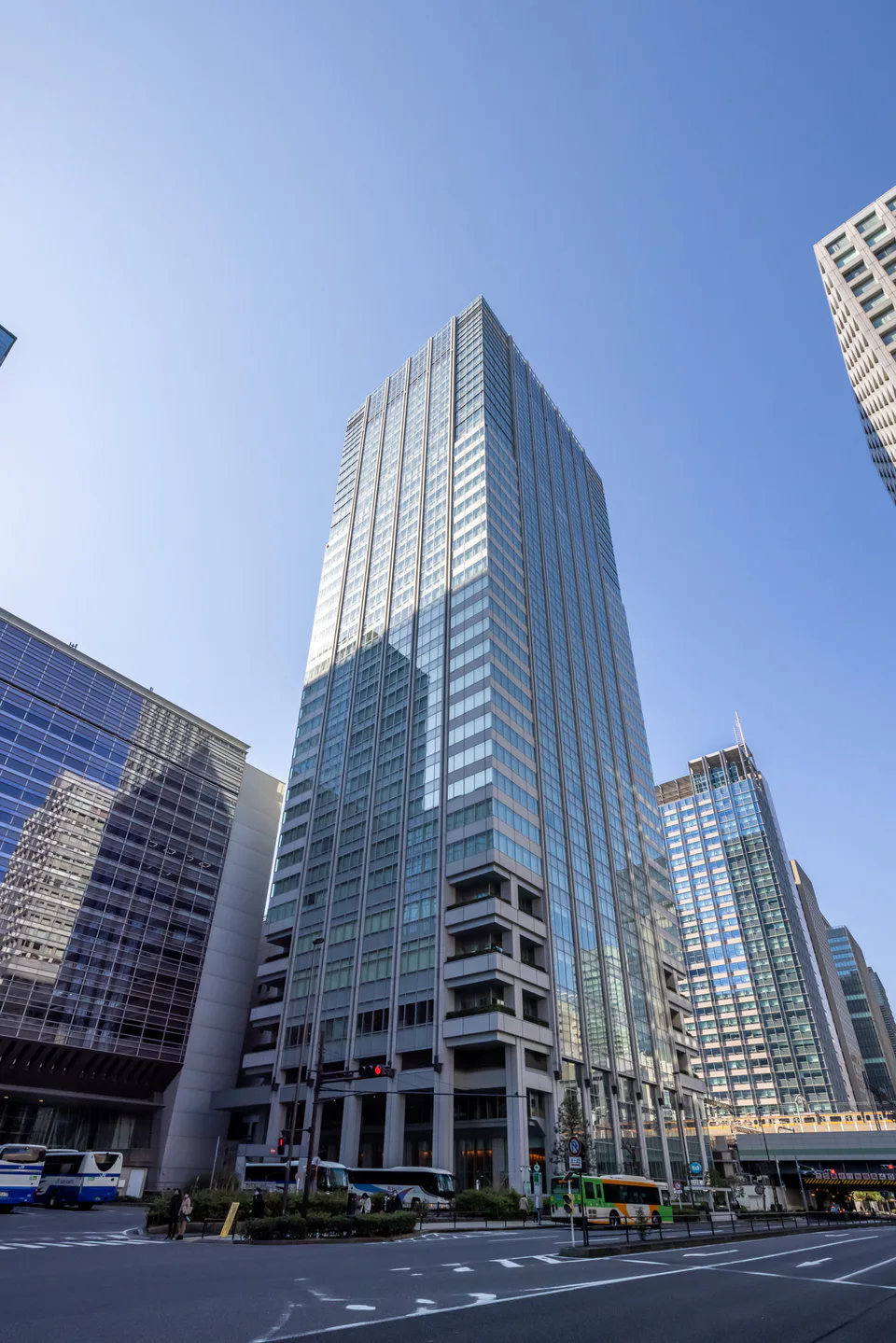
A Tokyo Station hotel can save a wet walk with luggage, or it can give two travellers more space to unpack. Hotel Metropolitan Tokyo Marunouchi attaches to the station's Nihombashi Exit; Hotel Ryumeikan Tokyo stands a short street-level walk from Yaesu North Exit and sells a named Standard Twin of 32.5 m². The difference matters most when an early Shinkansen and large cases meet at the same time. If the station departure is relaxed but the pair will spend several nights sorting luggage, the room category may matter more than the last few minutes outside.
Neither address makes the journey from bed to Shinkansen platform instantaneous. Both guests still need the hotel lift, the correct station entrance, the right ticket gate and a boarding margin. The direct connection removes one outdoor segment. The Standard Twin supplies a published room area and two separate beds; the hotel does not promise that every room has those dimensions. Compare the exact room and train, rather than two generic hotel search results. The Metropolitan's own room-and-station trade-off is useful if you have already settled on the Nihombashi side.
↔ Scroll table left or right
| Trip condition | Stronger starting choice | What could change it |
|---|---|---|
| Early Shinkansen, rain risk and two large cases | Metropolitan: direct Nihombashi Exit connection | A large rate premium or a Metropolitan room too small for the pair |
| Two or more nights with daily luggage organisation | Ryumeikan Standard Twin: 32.5 m² and large wardrobe | That named category is unavailable or an early train makes the street walk costly |
| Late checkout day with no early train | Metropolitan: published 12:00 checkout | Ryumeikan's 11:00 checkout may be enough for the itinerary |
| Tokyo Station is not a repeated transport hub | Reconsider both addresses | Another neighbourhood may cut more total travel |
What the station connection actually removes
Metropolitan occupies the Sapia Tower complex at JR Tokyo Station's Nihombashi Exit. The connected approach helps most on arrival with heavy bags and on a departure morning when it rains. It also reduces the chance of looking for the hotel entrance at street level after a late train. It does not remove the walking inside Tokyo Station, which can be substantial depending on the arrival platform and Shinkansen gate. A traveller should trace the specific line and gate before estimating a morning departure time.
Ryumeikan describes itself as about three minutes from the Yaesu North Exit, while another access description allows roughly four. Treat that as a short outdoor leg rather than a guaranteed door-to-platform stopwatch. Crossings, luggage, weather and the need to locate the right exit alter the real journey. The Nihombashi and Yaesu exits are also not interchangeable labels: arriving on one side of the station does not make the other hotel equally close. If a train is especially early, walk the intended gate route the previous day or allow additional time without assuming that a hotel's advertised walk covers the full station.
The street segment matters less when bags are light and the party leaves after the morning rush. Over a four-night Tokyo stay, a guest may use station access on arrival, departure and a couple of excursions, while using the room every evening. But an itinerary that repeatedly departs on JR from Tokyo Station can reverse the balance. A second Tokyo Station hotel comparison gives another room-versus-exit option; early-morning Tokyo ideas help distinguish an actual train deadline from a merely early sightseeing start.
The 32.5 m² figure belongs to one Ryumeikan room
Ryumeikan's Standard Twin has a published area of 32.5 m² and two 120 × 205 cm beds. The room listing describes a large wardrobe and a separate sink. These details are useful for two adults with cases, coats and purchases: bags need a place while both guests move around the room, and separate beds may be non-negotiable. The area is a category specification, not a measured promise of open suitcase floor after the furniture. Check the current floor plan and photographs, and identify the exact category in the final reservation.
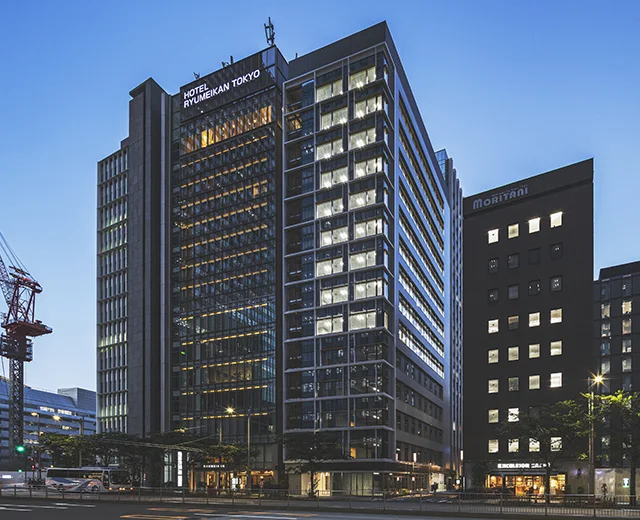
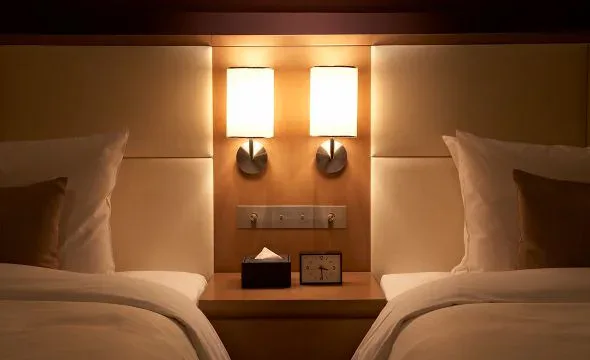
The photograph of Ryumeikan's beds shows two sleeping surfaces and a narrow bedside table between them. It cannot show the full 32.5 m², the wardrobe or a suitcase laid open. The exterior photograph shows the glass-fronted building at dusk; it confirms neither the walk time nor the state of the pavements in rain. Those limits matter because the decision turns on space and route, two things photographs can suggest without proving. Luggage forwarding could remove one large case for a middle Tokyo stop and change which hotel makes sense.
The room advantage disappears if the Standard Twin is sold out and the available Ryumeikan offer is a smaller category. Equally, Metropolitan's size has to be assessed from its particular room listing; the hotel's connection says nothing about that room's clear floor. Two adults sharing one bed might not need the twin layout at all. Another pair may place a high value on separate sleeping surfaces after a long flight. Enter both guests and any child ages, inspect bed configuration, and compare like room types rather than judging either hotel by its cheapest advertised rate.
A direct station door still leads to a particular Metropolitan room
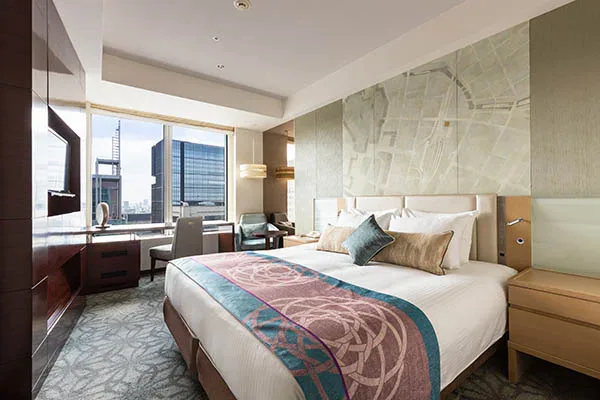
The Metropolitan photograph here shows a king bed, desk and city-facing window. That is one visible arrangement, not a visual substitute for the dimensions of every bookable category. If the pair needs twin beds, check a twin room rather than using the king image to decide. If they intend to work or repack in the room, judge the desk, circulation and storage together. It is possible to value the Nihombashi connection and still reject a specific room offer on space or bed layout.
The station-linked property is especially appealing for a one-night buffer before an early train. The traveller arrives, keeps the next day's essentials accessible, sleeps, then heads toward the station without another outdoor navigation step. That sequence reduces one type of uncertainty, but it does not make a room upgrade or expensive breakfast automatically worthwhile. If the train leaves late enough for breakfast and repacking, the extra room hour at checkout may be irrelevant. If the train leaves before dawn, the room is primarily a place to sleep and the station door gets more weight.
For a longer trip, locate Tokyo Station within the actual route. A Shinkansen to Kansai, a train to Nikko and a transfer toward Fuji do not necessarily use the same gate or even the same station in every itinerary. Tokyo to Hakone transport choices can move the useful departure point away from the JR station; Tokyo to Kawaguchiko options make the bus-versus-rail choice explicit. Do not pay a station premium for a route that begins somewhere else.
Breakfast hours matter only if a train leaves room for breakfast
Metropolitan's TENQOO breakfast starts at 06:00 on the 27th floor. Its current breakfast page gives a 10:00 last entry and 10:30 finish. Ryumeikan's Hanagoyomi buffet on the 15th floor starts at 06:45 and runs to 10:00, with last order at 09:45. That 45-minute opening difference is real, but it needs to be placed against hotel checkout, station navigation and boarding. A 06:10 departure makes neither hotel breakfast useful; an 08:30 train may accommodate either if the guests are organised and leave enough platform margin.
Ryumeikan's buffet price rose to ¥3,200 from 1 October 2026. Its English breakfast page still displays an older ¥2,800 amount alongside the price-change notice; the current restaurant and FAQ pages show ¥3,200. Guests who booked before the change can retain their earlier reserved price under the hotel's notice. This is a reason to compare the actual breakfast-inclusive rate with room-only, not to assume every booking will be charged the same add-on. A long sightseeing day may be better served by a relaxed breakfast; an early Shinkansen may make room-only the sensible selection.
↔ Scroll table left or right
| Morning factor | Metropolitan | Ryumeikan | Decision use |
|---|---|---|---|
| Breakfast begins | 06:00 | 06:45 | Include eating time and station navigation before the train |
| Standard checkout | 12:00 | 11:00 | Relevant for a late departure, not an early train |
| Hotel to station | Nihombashi Exit connection | Approximately 3–4 minutes on foot from Yaesu North | Outdoor segment versus room-area benefit |
| Room-space claim | Depends on named category | Standard Twin is 32.5 m² | Confirm exact category before paying |
Published breakfast hours may change on exceptional dates, so the booked meal plan and the property's current notice matter. The simple arithmetic is to start with the train time, subtract a realistic boarding margin and station walk, then ask whether breakfast is still possible. When the hotel restaurant is closed before the traveller needs to leave, its buffet should have no value in the comparison. The early-Shinkansen hotel question in Osaka uses the same logic: one night's position can be worth more than a restaurant feature that the timetable rules out.
Laundry gives the multi-night stay a different calculation
Metropolitan lists a 27th-floor coin laundry operating around the clock; the posted all-in-one washing and drying course is ¥600 for 120 minutes. Ryumeikan lists coin laundry on the 10th and 12th floors, with ¥200 washing and ¥100 per 30 minutes of drying. The Ryumeikan machines take up to 4.5 kg and dispense detergent automatically. The prices are hotel-posted facility charges, not a guarantee that a machine will be available whenever a guest reaches it.
For one night before a train, neither laundry setup is likely to decide the room. On a longer Tokyo stay between other Japanese cities, it may allow fewer clothes and a smaller bag. Metropolitan's combined cycle asks for a block of time; Ryumeikan's separate washer and dryer calls for another transfer and potentially more trips between room and laundry floor. A guest who needs to wash after an evening out should consider machine availability, sleep time and whether everything will be dry before checkout. Neither property offers the same certainty as having a washer inside the booked room.
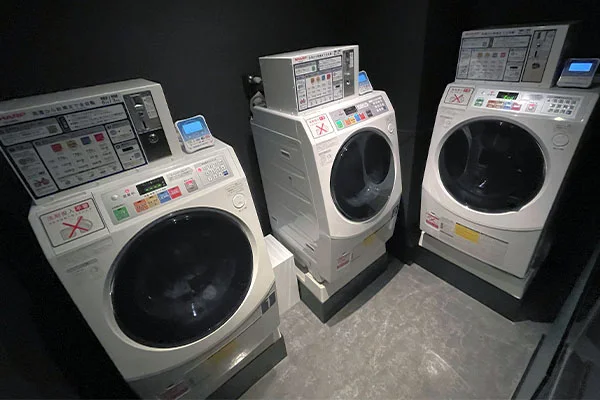
The pictured Metropolitan machines show the shared laundry setting, not an availability indicator. Keeping one late evening free for a wash can be useful, but a full machine queue would make a tight departure morning unreliable. Room space and packing quantity still decide how much this facility changes the stay.
Ryumeikan also describes a staffed guest laundry service, separate from self-service machines. The service is for a different budget and handover schedule; it should not be confused with the ¥200 coin-wash price. Its FAQ says items left before 10:00 can generally be ready by 19:00, subject to its posted terms. For travellers moving on the next morning, the timing may fit; for someone arriving late, it may not. Tokyo solo hotel choices illustrate why room size, laundry and location should be compared as used facilities rather than as a feature tally.
Two common itineraries show where the preference changes
Consider a single night between an inbound flight or another Japanese city and a 07:30 Shinkansen. Two adults bring large wheeled cases; the morning may be wet. Metropolitan's connected entrance removes an outdoor step and keeps breakfast available from 06:00 if the party can eat quickly without compressing its station margin. A room with insufficient space for both cases could still be uncomfortable, so verify the named category. Ryumeikan's larger Standard Twin would feel less cramped during repacking, but the street walk and later 06:45 breakfast have less room to help this particular schedule.
Now consider three Tokyo nights with one relaxed day trip and a midday departure. The pair repeatedly opens their luggage, sorts purchases and wants separate beds. If a 32.5 m² Standard Twin is available on matching dates, Ryumeikan has a concrete reason to win despite its outdoor approach. Breakfast at 06:45 leaves ample time, and an 11:00 checkout may be adequate. This is an example, not a promise that every Standard Twin rate is lower. If the Metropolitan offers a suitably spacious twin at a better total price, the original comparison should be rerun.
The same trip can also expose an area mismatch. A Tokyo itinerary centred on Shinjuku nightlife, western Tokyo sights or a morning Romancecar departure may lose more time commuting back to Tokyo Station than the hotel connection saves. A Shinjuku hotel comparison shifts the transport hub; a Shibuya room comparison tests a different small-room trade-off. Choose the area before elevating one convenient station exit into the whole travel plan.
↔ Scroll table left or right
| Question to resolve | What to examine | Why it changes the winner |
|---|---|---|
| Which morning is timed? | Train departure, gate and boarding margin | The connected door matters most under a real deadline |
| How many nights use the room? | Room time, case size and bed preference | The Standard Twin area accumulates value across nights |
| What does the rate include? | Breakfast, taxes, cancellation and exact room | A nominally cheaper listing may be a different product |
| Is Tokyo Station the useful hub? | Actual onward lines and day-trip starts | A different district can reduce repeated travel |
The rate comparison has to name the room
Set the same dates, number of adults, any children, breakfast choice and cancellation deadline before comparing prices. At Ryumeikan, confirm that “Standard Twin” appears in the final booking details. A cheaper room of another name cannot deliver the 32.5 m² advantage merely because it is in the same hotel. At Metropolitan, inspect the category's own dimensions and beds; a king photograph does not verify a twin room. Local taxes and inclusion of breakfast can move the total even when the headline nightly amount looks close.
Cancellation terms deserve attention when Shinkansen plans may shift. A refundable room can be useful while rail tickets or arrival flights are unresolved, but only until its stated deadline. Compare the full stay total at the same point in the booking flow. If Metropolitan's connected-entrance premium is small relative to the total trip and the train is truly early, the saved outdoor step may be a rational purchase. If it is large and the party will use the room for several nights, Ryumeikan's Standard Twin deserves an exact quote.
Both hotels remain close to Tokyo Station, so neither is an absurd choice for the other itinerary. The better answer changes with the booked room and the number of mornings that actually use the connection. Compare Metropolitan rooms by the station and compare the named Ryumeikan Twin on matching dates after fixing the route and room requirements.
Seven points for a hotel decision
↔ Scroll table left or right
| Dimension | Metropolitan evidence | Ryumeikan evidence |
|---|---|---|
| Station route | Direct Nihombashi Exit connection | Short outdoor Yaesu North walk |
| Room and beds | Category-dependent; inspect exact offer | Standard Twin: 32.5 m², two 120 × 205 cm beds |
| Luggage storage | Inspect the chosen floor plan | Standard Twin lists a large wardrobe |
| Morning food | Breakfast from 06:00 | Breakfast from 06:45, current buffet ¥3,200 |
| Laundry | 27F all-in-one course, ¥600/120 min | 10F and 12F separate wash and dry charges |
| Departure day | Standard checkout 12:00 | Standard checkout 11:00 |
| Price and flexibility | Judge booked room, meal and cancellation terms | Same, ensuring the 32.5 m² category is selected |
These route and room details show which trade-off repeats during the stay. For an early Shinkansen with large luggage, start with Metropolitan's connected approach and confirm the room meets the party's space needs. For several nights with twin-bed and storage needs, price Ryumeikan's Standard Twin before treating its three-to-four-minute walk as a disqualifier. If neither station timing nor room organisation is unusually demanding, look at where the rest of the Tokyo itinerary actually happens.
Seven Tokyo Station hotel scores
| Dimension | Metropolitan Marunouchi | Ryumeikan Tokyo |
|---|---|---|
| Location | 10/10 — The Nihombashi Exit connection removes the final street segment with cases. | 9/10 — Yaesu North is a short street-level walk, with no indoor final link to the hotel. |
| Room | 7/10 — Room and bed layouts vary by named category; the visible king-room photo cannot promise twin space. | 9/10 — The named Standard Twin provides 32.5 m², two 120 × 205 cm beds and a large wardrobe. |
| Cleanliness | 8/10 — Recent stay scores are strong, but the hotel's hosted category evidence is less uniform on bathrooms. | 9/10 — Rooms have a consistently strong upkeep record in two independent stay sets. |
| Service | 9/10 — Staff and housekeeping support remain a reliable part of this station-linked stay. | 9/10 — Staff support is steady across short Tokyo Station stays. |
| Facilities | 8/10 — The 27F combined washer-dryer runs around the clock, though its 120-minute course takes planning. | 8/10 — Separate coin washers and dryers on floors 10 and 12 help longer stays, with extra handling between cycles. |
| Food | 9/10 — TENQOO starts breakfast at 06:00, useful when a train leaves enough time to eat. | 8/10 — Hanagoyomi breakfast begins at 06:45; the October 2026 buffet price is ¥3,200. |
| Value | 7/10 — Paying for the connected door makes most sense on a genuinely early or wet departure. | 8/10 — The larger twin rewards multi-night luggage space when the outdoor station walk is acceptable. |
JapanLayer overall scores for two adults: Hotel Metropolitan Tokyo Marunouchi 8.3/10 and Hotel Ryumeikan Tokyo 8.6/10. Metropolitan is the cleaner plan for an early Shinkansen in rain and has the earlier breakfast. Ryumeikan earns its room mark only when the reservation names the 32.5 m² Standard Twin; its short outdoor walk remains part of the departure morning.
Hotel details
Related guides: Hotel Metropolitan Tokyo Marunouchi: Is Tokyo Station Access Worth It Before an Early Shinkansen? · Tokyo Station Hotel Comparison: Hotel Metropolitan Tokyo Marunouchi vs karaksa hotel TOKYO STATION · karaksa hotel grande Shin-Osaka Tower: Is a 5-Minute Station Walk Worth It Before an Early Shinkansen? · Early Morning Things to Do in Tokyo: What Actually Works Before 10 a.m. · Japan September Weather: Tokyo Starts Near 30°C, Sapporo Is Already in Early Fall · lyf Shibuya Tokyo: Is the PARCO Location Worth a 12m² Room? · Hilton Tokyo Bay Happy Magic vs Family Happy Magic: Which Room? · Early Shinkansen from Osaka: Should You Stay in Shin-Osaka or Move Only for the Last Night? · Tokyo Solo Hotels: Don’t Start With the Smallest Room · Tokyo Disney Room-Only vs Vacation Package: Which Opens First?
Japan Autumn Leaves December: Tokyo, Kyoto, Osaka, Nara and Kyushu
Japan Autumn Leaves Late November: Kyoto, Tokyo, Nara, Miyajima and Kyushu
Tokyo rainy-day route around Tokyo Station and Ginza · Japan travel guide for seniors and children · Japan autumn reservations for hotels and trains · Japan autumn reservations for hotels and trains · when to book hotels for Japan’s peak autumn season · Tokyo, Kawaguchiko and Hakone three-day itinerary · Tokyo to Nikko transport planning · Tokyo autumn leaves by area and timing · how many nights to stay at Lake Kawaguchi · Lake Kawaguchi vs Lake Yamanaka · Hotel Metropolitan Tokyo Marunouchi · Hotel Ryumeikan Tokyo