
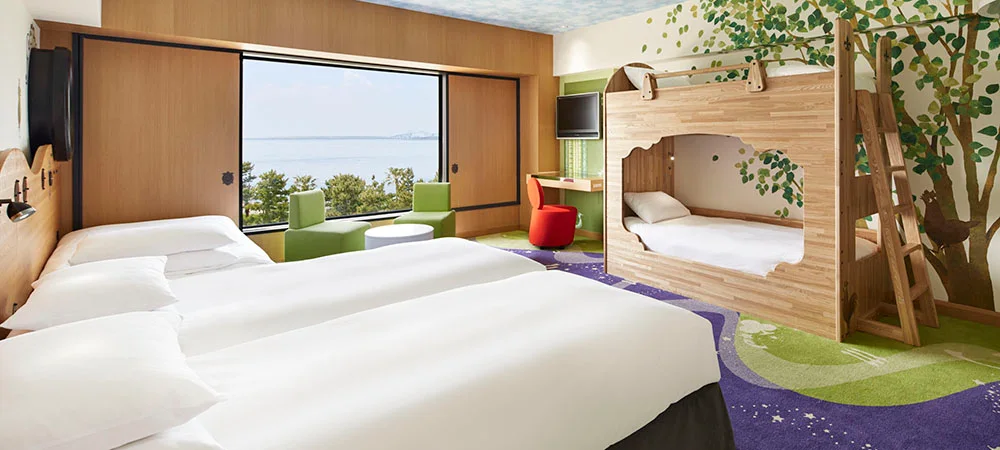
At Hilton Tokyo Bay, the word “Family” in Family Happy Magic identifies extra sleeping capacity, not a substantially larger room. The hotel puts both Happy Magic and Family Happy Magic in the same approximate 35–40 m² range. The Family design adds a bunk bed. That can bring a party of five or six into one themed room, but it also leaves more people and belongings sharing much the same floor area. The right booking follows your guest count, preferred side of the building and a sleeping assignment that respects the upper-bunk age rule.
A group of four may need only Happy Magic Ocean. A group of four determined to face the Park side is a different case: the currently listed Happy Magic Park sleeps three, so Family Happy Magic Park is the themed Park-side option with enough stated capacity. For six guests, Family Happy Magic Ocean is the relevant one-room listing. These distinctions are more useful than assuming the dearer room is an upgrade for every family.
Park and Ocean names change the occupancy ceiling
| Hilton room listing | Current listed occupancy | Area band | Likely reason to compare it |
|---|---|---|---|
| Happy Magic Park | 3 | About 35–40 m² | Small party seeking the themed Park side |
| Happy Magic Ocean | 4 | About 35–40 m² | Four guests who can accept the Ocean side |
| Family Happy Magic Park | 5 | About 35–40 m² | Five guests, or four requiring themed Park-side capacity |
| Family Happy Magic Ocean | 6 | About 35–40 m² | A six-person party that wants one room |
Hilton's room overview separates the four names and capacities above. The local room pages give Happy Magic a 3–4-person range and Family Happy Magic a 5–6-person range. Use the exact Park or Ocean listing in the sellable rate: the range on a category page is not permission to put four people into Happy Magic Park or six into Family Happy Magic Park. If a particular offer shows a different occupancy, resolve it with the hotel's booking terms before paying.
The room names also encode an orientation preference. A four-person family may prefer a Park-side view enough to choose Family Happy Magic Park even though it does not need the fifth place. That is a view and capacity purchase within roughly the same area band. If the view is unimportant and Happy Magic Ocean is available at a lower comparable rate, the extra bunk capacity may simply take space the party could leave unused.
The bunk is a sleeping plan, not a room-size increase
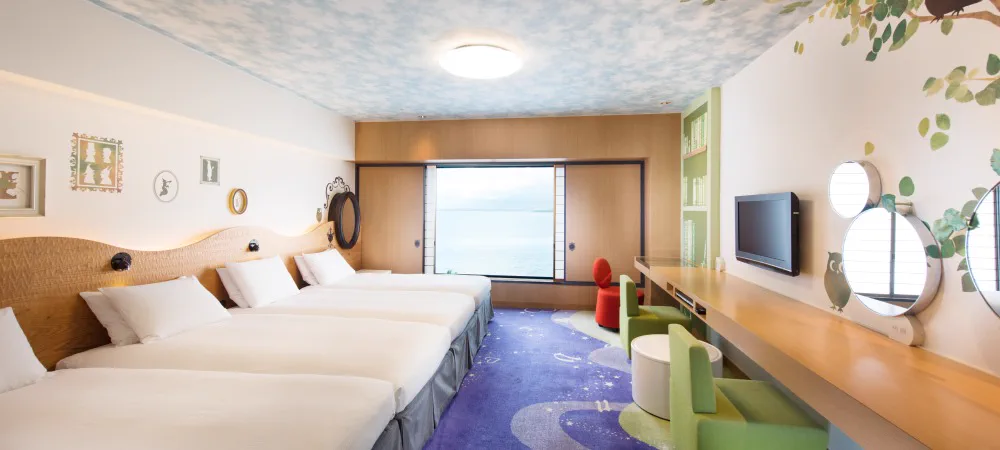
Family Happy Magic preserves the illustrated woodland atmosphere and adds an original bunk bed. The hotel limits the upper level to a guest aged at least ten. That restriction applies to the person actually using it, not to the presence of any child in the party. An older teenager or adult can take the top if the room arrangement suits them. A child under ten cannot be assigned there merely because the booking engine accepts the party size.
Before reserving for five or six, write down who gets each bed. If the only people keen on the bunk are younger children and the adults would not use its upper level, the nominal six-person room may not produce a comfortable six-person sleeping plan. Conversely, an older child who actively wants the top bunk can make the design useful beyond its occupancy count. A room photograph is valuable for this exercise because it shows the bunk's location relative to the other beds; it does not establish that every member of an actual group will sleep comfortably.
The published beds are about 97 by 205 cm on the local room pages. Do not compare the Family label with a four-permanent-bed room elsewhere as if these are equivalent surfaces. Grand Nikko's Deluxe Family room, for example, distinguishes four 120 cm beds from a higher tier with four 140 cm beds. A family needing six legal places may favour Hilton; four adults seeking four comparable wide beds may choose a quite different category or hotel.
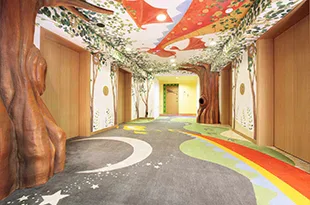
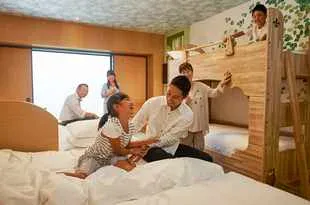
The existence of a bunk is also a reason to inspect the particular photograph rather than a generic “family room” image. The wide Hilton photo shows two full beds near an ocean window and the timber bunk against the other wall. The two smaller images in this article show the themed corridor and a family using the sleeping area. Those views help locate the feature, but the room plan and each guest's age should still decide whether it works.
Four guests: choose the side, then compare the price
Happy Magic Ocean currently admits four and avoids buying two additional places only to leave them empty. That does not mean it will always be cheaper than Family Happy Magic; rates change by date and availability. It means the standard Ocean listing is a valid benchmark for a party of four. Compare complete totals on equal meal and cancellation terms, then ask whether the Family premium pays for a wanted Park orientation, the bunk experience or another specific feature.
Happy Magic Park currently admits three, so it cannot serve as the benchmark for four unless the booking plan explicitly changes its permitted occupancy. A four-person party fixed on the themed Park side should compare Family Happy Magic Park with other four-person hotel rooms, not make an invalid three-person room look attractively cheap. The wider Disney family hotel shortlist is relevant once the preferred side makes the Hilton room unexpectedly expensive.
Four adults have another issue. Even if the listed capacity permits four, the room's playful design and additional bunk do not guarantee four equivalent adult beds or generous room circulation. If the theme itself is the reason for booking, that may be perfectly acceptable; if the priority is an undisturbed night's sleep and enough luggage space, inspect non-themed Hilton configurations as well. Grand Nikko versus Hilton examines the hotel-level trade rather than presuming a Magic room wins.
Do not let a two-park-day itinerary answer the room-category question for you. Staying in the Bayside area may save repeated travel compared with moving from central Tokyo, yet that says little about whether a four-person family needs a bunk built for a larger party. Choosing one or two Disney park days addresses the length of the park visit; the room choice still begins with the occupants and available beds.
Five and six guests gain one-room capacity, with less spare floor
Five travellers can compare Family Happy Magic Park and Ocean. Six must begin with the Ocean listing under the current Hilton room overview. Keeping the party together can matter to parents who would otherwise need two rooms, particularly for a short stay. Yet six people in 35–40 m² also mean more shoes by the entrance, charging devices, park bags and luggage around the beds. Published occupancy establishes how many can stay, not how much clear floor remains when everyone unpacks.
A one-night group arriving with cabin bags may accept that density readily. Four large suitcases, a stroller and several nights of clothing produce a different practical test. Ask which cases need to open simultaneously and where they can lie without blocking the door or bunk ladder. In a longer stay, repeated morning packing and evening returns expose this circulation issue more often. Sending some luggage ahead can help if the family is using Hilton only for the park portion of a wider Japan trip.
Do not confuse maximum capacity with a promise of six conventional single beds. The bunk changes the mix of sleeping surfaces, and the top-level age restriction remains in force. For a five-person party with one older child keen on the bunk, this could be precisely the right configuration. For six adults, the same configuration may be legal but less pleasant than two rooms or a larger suite. Compare the total cost and the actual sleeping assignment instead of assuming that a single-room result is automatically the best deal.
Hilton also lists a Happy Magic Suite for four to six people at a materially larger roughly 70–80 m². It belongs in the search when the problem is space rather than basic occupancy. A suite moves the decision into another rate tier, so it is not a free alternative to Family Happy Magic; its role is to prevent paying extra for a 35–40 m² Family room while still wishing that the floor area had doubled. The “sleeps four” space distinction applies to large parties even more strongly.
Count the children as the hotel will charge them
Hilton's local booking notice says children aged six or over are charged at the adult rate and should be entered in the adult count. It also asks guests to count a younger child as a paying guest when that child needs a separate bed. Bed-sharing rules can differ from the sleeping plan imagined from an occupancy headline. Search with the actual ages and bed needs first; a quoted room or price for two adults alone may disappear when two school-age children are added.
Consider a party of two adults, an eleven-year-old and a seven-year-old. Both children affect the charged guest count even though the family may regard them as children in ordinary speech. A separate-bed requirement adds a further constraint. A second party of two adults and two preschool children may enter the booking flow differently, but the bunk upper level still cannot be allocated to a child under ten. There is no useful shortcut from a generic “family of four” label to the room that can be booked.
A sensible order is guest ages, paid guest count, separate-bed needs, preferred Park or Ocean side, upper-bunk assignment, then price. This order prevents an invalid comparison between a three-person Happy Magic Park rate and a five-person Family Happy Magic rate. It also brings the cancellation deadline into view before the family starts rationalising a higher rate for a room it cannot actually use as intended.
What the woodland theme contributes
Both categories share Hilton's Happy Magic look: leaf green and blue-purple accents, illustrated animals and a sky-like ceiling. The themed corridor begins the visual experience before the room door. For children who want that setting, moving from Happy Magic to Family Happy Magic does not buy a wholly different world. The upgrade adds the bunk arrangement and changes capacity. If the standard room fits, the core theme is already present.
A child may be especially excited by climbing into the bunk; in that case the Family premium can be justified by a planned experience rather than by size. Apply the ten-plus top-bunk rule first. Families whose children are unlikely to notice or use the bunk should be cautious about paying for unused capacity. The hotel also advertises family amenities and loan items, but those general services are not exclusive reasons to buy Family Happy Magic over Happy Magic.
The children's reaction is difficult to price before travel. Avoid treating a promotional room photograph as evidence that every child will prefer the themed bunk, or that the novelty will matter more than sleep after a late park return. An older child who wants privacy might prefer a conventional separate bed. A younger child may like the woodland corridor while still being too young for the top bunk. These are real reasons to discuss the sleeping plan with the people who will use it.
A shutdown date overrides the usual room comparison
Hilton currently posts a hotel-wide power-shutdown notice for 15:00 on 18 January through 07:00 on 19 January 2027, with temporary closure during that window. A booking that touches those hours needs the hotel's current operating instructions before any Park-versus-Ocean or bunk decision. Restaurant and facility arrangements may be updated separately. Do not infer from an available search result that normal hotel operation will continue through the announced interruption.
For other dates, prices, sellable configurations and policies can still change. The age limit on the upper bunk and the named capacities are the key structural restrictions, while the rate is an exact-date comparison. Someone visiting during a different season should not treat an old promotional offer, old pool access term or historical room price as a current inclusion in either Magic category.
Seven practical checks before booking
These site scores assess Hilton Tokyo Bay as a themed family hotel while the reader compares two Happy Magic room families. They apply to normal operating dates; the announced 18–19 January 2027 power-shutdown window needs a separate booking decision.
| Hotel dimension | Our score | Why |
|---|---|---|
| Location | The Bayside Station shuttle and short possible walk keep both Disney parks reachable; the advantage repeats on every park return. | |
| Room | All four Park/Ocean room listings are roughly 35–40 m². Happy Magic lists three or four guests; Family Happy Magic reaches five or six through a bunk, with upper-bunk users at least ten. | |
| Cleanliness | Guest cleanliness feedback is strong; the woodland room theme does not by itself prove cleaning quality or spare floor for cases. | |
| Service | Current guest staff feedback is strong. Enter every child’s age because Hilton counts age six and above as an adult for rate purposes. | |
| Facilities | Pools and other resort facilities can occupy a rest afternoon, while operating and inclusion terms must be checked for the booked date. | |
| Food | On-site dining gives an alternative to park food; a full park day leaves less time to use a hotel meal package. | |
| Value | Family Happy Magic earns its rate for a valid five/six-person one-room group, not merely as a larger room for four; Park or Ocean side can change capacity. | |
| Overall | useful family capacity and Disney-area access, with bunk suitability, floor space and the 2027 shutdown period overriding a generic score. |
None of those checks requires an invented numerical hotel score. A six-person family can value one-room capacity highly even when the floor area is tight; a four-person party can rationally pay for the Park side despite not using a fifth place. The purpose is to identify what the extra rate does for the actual group.
Compare Hilton Tokyo Bay room options for your party and dates after entering every guest correctly. Happy Magic Ocean is the starting benchmark for four when that side is acceptable. Family Happy Magic is the practical route for five or six, or for four seeking themed Park-side capacity, provided the upper bunk can be assigned safely. A group buying the Family label in expectation of a larger room should look instead at the Happy Magic Suite or a different hotel room with a genuinely larger footprint.
Room specifications and booking conditions: Happy Magic room · Family Happy Magic room · Park and Ocean occupancy list · children's stay conditions.
Related Disney room choices
Grand Nikko vs Hilton Tokyo Bay · Stay Near Tokyo Disney or in Tokyo? · Hilton Tokyo Bay vs Toy Story Hotel · Best Tokyo Disney hotels for families of four · Tokyo Disney Room-Only vs Vacation Package: Which Opens First? · CROSS Suites Tokyo Asakusa: Which Room Fits 2–6 Guests? · Hotel Metropolitan Tokyo Marunouchi vs Hotel Ryumeikan Tokyo: Early Shinkansen or 32.5m² Room? · Centara Grand Hotel Osaka: Is the 40m² Family Room Worth It for Four? · Tokyo Solo Hotels: Don’t Start With the Smallest Room · MiraCosta Terrace Room vs Balcony Room: Which Outdoor Room Is Worth It? · KAZENO KURAYOSHI Review: Which Heritage Room Is Worth Booking? · NOHGA HOTEL UENO TOKYO vs HOTEL GROOVE SHINJUKU: Which Base Saves More Friction? · MiraCosta Harbor Room: Harbor View vs Piazza View — Which Is Worth It? · Hotel Keihan Namba Grande: Family Room or Connecting Rooms for 4–5 People? · Tokyu Stay Hida-Takayama Musubi no Yu: Which Room Works for Two Suitcases and Three Nights? · NOHGA HOTEL UENO TOKYO: Which Ueno Route Works with Large Luggage?