
Four complete Tokyo city days are a sound first-trip allocation. With three, choose what to leave out before arrival. Five is useful when it has a specific assignment: a Disney park, a day trip, a fixed event, slower family travel or a deeper interest that cannot share a crowded afternoon. The number on a hotel booking is a poor substitute for counting the days you can actually use.
A five-night stay might contain only four full city days when a flight lands late and the onward train leaves early. A five-calendar-day visit might contain just two city days if one day is a Disney park, another goes to Hakone or Kawaguchiko, and both edge days are short. Count the usable block first, then judge whether Tokyo needs more time.
↔ Scroll table left or right
| Usable Tokyo time | What fits comfortably | The decision that can change it |
|---|---|---|
| Three city days | One eastern, one western and one central or personal-interest day | A park, long excursion or major timed booking removes one of those city days. |
| Four city days | East, west, central/interest and one flexible or deeper day | Keep the fourth open if weather, a museum or shopping may run long. |
| Five city days | Four strong city days plus one slower or specialist day | Compare the fifth day's value with Kyoto or another destination. |
| Four city days plus one park/excursion day | A complete first Tokyo visit with a full-day commitment kept separate | A second park or major excursion requires another day or a conscious city cut. |
Turn hotel nights into usable days
Write each calendar date as one of three types. A city day is mostly Tokyo neighborhoods, food, museums, shopping or attractions. A commitment day belongs to Disney, Hakone, Kawaguchiko, Nikko, Kamakura or another experience that consumes most daylight. An edge day is shortened by arrival, departure, check-in, luggage or an intercity move. Calling all three “Tokyo days” makes a crowded itinerary seem generous on paper.
For example, a five-date block with an 18:00 arrival, Disney on the fourth date and a pre-lunch Kyoto departure on the fifth contains about two full city days, one park day and two edge days. That can still be a good trip, but it cannot also promise Asakusa, Shibuya, Ueno, Ginza, teamLab and several museums. The whole-Japan day allocation should use the same accounting; otherwise Tokyo quietly borrows time from Kyoto or an onsen stay.
Three city days: choose a deletion list
A focused first look can work in three complete days. Reserve one for eastern Tokyo, perhaps Asakusa and Ueno; one for the west, such as Meiji Jingu, Harajuku and Shibuya; and make the third reflect the strongest personal interest. That last day might be Ginza and Tokyo Station, a serious museum visit, Roppongi and teamLab Borderless, shopping, Warner Bros. Studio Tour or a child-centered attraction. Those are alternatives, not one compressed route.
The question is what you are willing to miss. Tokyo's area map keeps geographically compatible stops together, while whole-day attraction choices show how much a headline visit actually consumes. If admission cost is the concern, free Tokyo sights by neighborhood can prevent a long detour made solely to avoid a ticket price.
Do not describe three dates as three city days when one is Disney. The park then leaves two Tokyo days, which is a different visit. A Kamakura excursion similarly replaces a city day, even though the train begins in Tokyo.
Four days: where the breathing room goes
The fourth usable city day does not have to add a fourth district checklist. It lets a museum take the time it deserves, absorbs a wet afternoon, or gives one shopping neighborhood more than the leftover hour after a transfer. A reasonable skeleton is east Tokyo, west Tokyo, a central or interest-led day, and one flexible day for whatever would otherwise be squeezed. That flexibility is why four works as a first-time default.
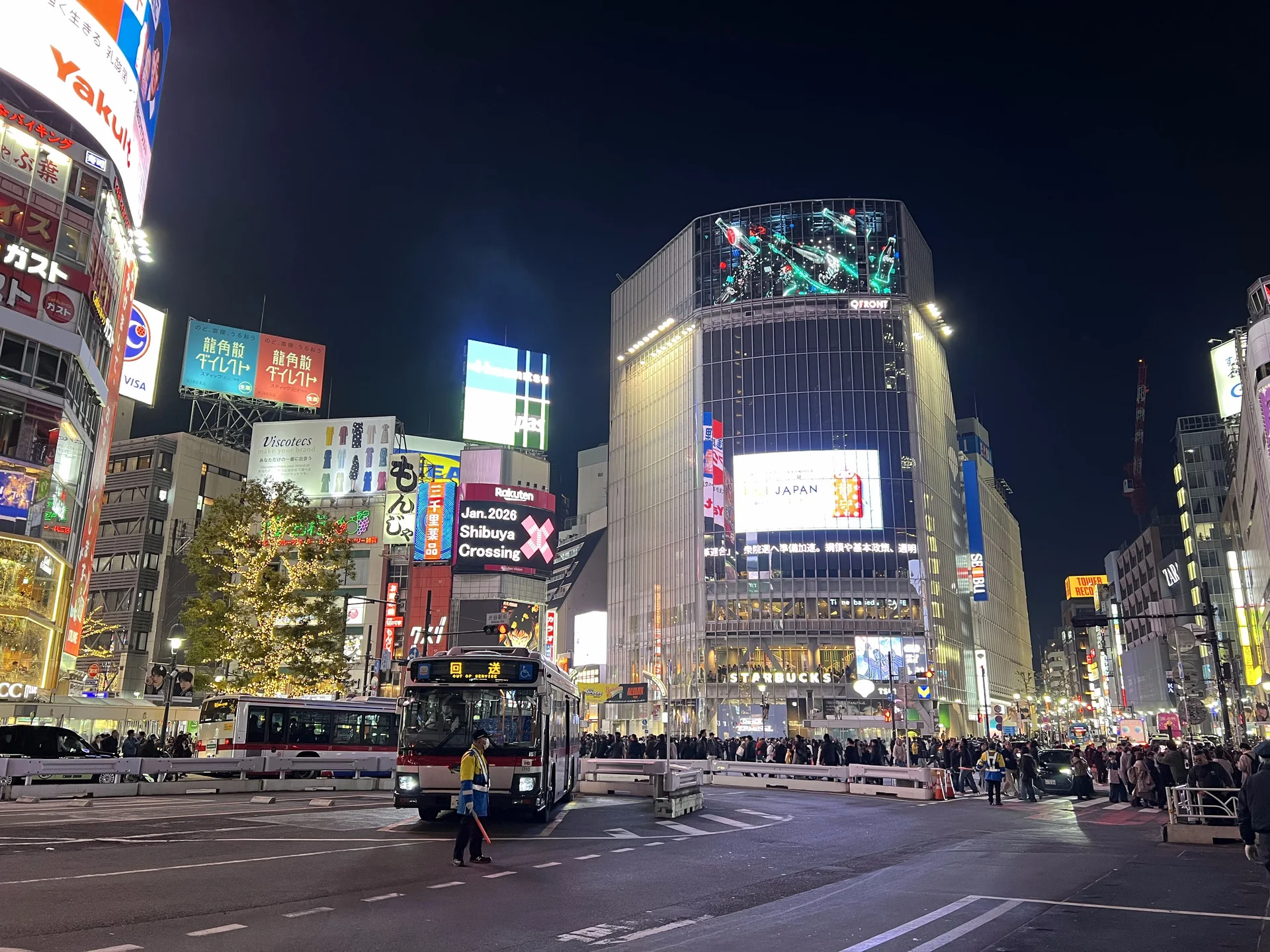
Western Tokyo could pair Meiji Jingu and Harajuku with Shibuya, then continue to Shinjuku only if there is energy after dinner. The photograph below shows the nighttime Shibuya crossing; an evening there has a different pace from trying to insert it between two museums. The early-hours guide helps if one day starts before shops open.
Rain does not automatically invalidate a Tokyo day, but it can reorder what should be indoors and outdoors. Keep the fourth day's outline movable and use the rain-severity alternatives only when the forecast makes them relevant. A fixed sunset ticket or an event that cannot move should be placed first; the flexible neighborhood day can shift around it.
The fifth day has to win a trade-off
Tokyo easily contains enough for five or more days. On a first wider Japan trip, the fifth day is competing with the best alternative elsewhere, not with an empty calendar. Keep it if it protects four city days while giving a park its own date, makes room for a full Fuji-area outing, accommodates a concert or exhibition with a fixed time, allows young children or older parents to travel at a sustainable pace, or serves a serious museum, architecture, anime, game, food, photography or shopping interest.
If its only job is “there are more places in Tokyo,” test what it removes. Could that night support a Kyoto morning, an onsen stay or an additional region you value more? The Kyoto–Osaka base choice and 10-, 12- or 14-day Japan plan put the cost in the whole journey. A fifth day can be exactly right, but it should be named before the room is booked.
GO TOKYO's five-day city sightseeing model, updated 11 March 2026, recommends at least five days for the major highlights without rushing. Its outline covers eastern, northern, central, western and southern areas. That is a useful Tokyo-led benchmark. A wider trip allocating four complete Tokyo city days plus one separate park or excursion day answers a different scheduling question while still giving Tokyo substantial time. The distinction is which days are city days and what other destinations must fit.
Disney and regional outings are full-day commitments
If one Disney park is essential, three city days plus one park day is compact; four city days plus one park day preserves the wider Tokyo visit. Both Disneyland and DisneySea can justify two separate park days when they are major priorities. Decide with the two-park comparison and the one- versus two-day park plan before extending the hotel block. If consecutive park nights are confirmed, Maihama-area versus city hotels may save repeated late travel; the hotel choice follows the park schedule.
Hakone, Kawaguchiko, Nikko and Kamakura need the same honest accounting. On four total usable dates, a long outing leaves only three city days. On five, one excursion can sit alongside four city days. With six or seven, one excursion and one park or specialist day can coexist more comfortably. A Fuji-area choice also depends on weather and transport; compare Hakone with Kawaguchiko and the Kawaguchiko transport options before reserving a generic “Tokyo day trip” slot.
Slower travel uses the extra day differently
Young children, older parents and mobility needs make station exits, elevators, toilets, meals, strollers and hotel returns consume more of a day. A five-day Tokyo block can be right with no Disney or excursion if it spreads the same shortlist across gentler days. An extra date should not automatically mean another attraction. The parents' hotel trade-offs and six base areas for first visitors matter here because a bad daily return can erase the time gained by an extra night.
The edge dates need the same realism. A late arrival is a recovery evening near the hotel, not an eastern Tokyo day. An early departure should not carry a fresh neighborhood plan. A midday edge might support a museum or shopping area aligned with the station or airport direction, but not a cross-city headline sequence. Count complete local-start mornings before buying fixed-time tickets.
The base can recover time without another night
Tokyo has more than one useful center. Shinjuku can suit repeated western evenings and departures toward Hakone or Kawaguchiko. Ueno can suit an east-Tokyo-heavy route with Narita at both ends. Tokyo Station can be worth paying for when an early Shinkansen follows a short stay. These are route-dependent choices, not a ranking of neighborhoods. Compare Ueno with Shinjuku and Tokyo Station with Shinjuku before adding a night solely to repair repeated transfers.
Write five lines before finalizing the booking: complete city days, full-day park or excursion commitments, partial edge dates, the specific job of the next Tokyo day, and the destination elsewhere that would lose it. Three city days need firm omissions; four give most first visitors a workable pace; five is valuable for a named commitment, depth or recovery. Keeping those categories separate prevents the hotel-night total from promising sightseeing time it cannot supply.
Count nights only after the departure is fixed
Four hotel nights can produce three complete city days if the first flight lands late and the final train leaves early. A traveller who says “four days in Tokyo” may mean four dates on a booking screen, four full local mornings or four nights in the same bed; those are different plans. Put the flight arrival, airport transfer and hotel check-in on the first date, then mark the time needed to leave for the next city or airport on the last. What remains is the usable Tokyo block. Buy a timed museum, park or show entry only after that block is visible.
The difference matters most when a full-day commitment sits inside a short stay. Disney, a Fuji-area excursion or a long Nikko trip does not leave a complete Tokyo neighborhood day merely because the train returns in the evening. If only three complete dates remain, decide which city areas will be omitted before assigning one to a park. With five complete dates, an excursion can sit alongside several city days without turning each evening into a recovery transfer. That is the stronger reason for an extra Tokyo night than the abstract size of the city.
Hotel location can also reclaim time. An east-side plan with Ueno, Asakusa and a Narita departure should not be measured using a Shinjuku commute; a western schedule and Hakone departure suggests another base. Sketch the repeated journeys from the room before paying for a fifth night to compensate for a poorly placed hotel. The extra night is worthwhile when it makes space for a specific interest or gentler pace after the route itself has been made sensible.
Once the three-to-five-day route is fixed, compare Tokyo hotel areas for your dates against the journeys you would repeat from the cheapest room.
More Tokyo and Japan routes
Where to Stay in Tokyo for First-Time Visitors · Tokyo Itinerary 2026: 4, 5 or 7 Days · Tokyo Rainy-Day Itinerary Backup · GO TOKYO — five-day Tokyo itinerary, updated March 11, 2026 · Fukuoka Itinerary: 3 Days for First-Time Visitors · Hotel Monterey Okinawa Spa & Resort: How Much Resort Time Do You Need? · Chiikawa Park Tokyo 2026: ¥3,500 Is Not a Shopping Fee — Check the Time Slot First · The Busena Terrace: How Much Resort Time Do Two Nago Nights Need? · Things to Do in Kyoto: 1-, 2- and 3-Day Itineraries for First-Time Visitors · Where to Stay in Osaka for First-Time Visitors: Best Areas · How Many Days in Fukuoka? 2, 3 or 4 Days for a First Visit · Tokyo Game Show 2026: Fast Ticket, First-Hall Trap and Family Cost · JR TOKYO Wide Pass 2026: Don’t Bundle Skyliner or Subway Tickets Until You Map These 3 Days · Lotte Hotel Busan vs Arban Hotel: Is the Five-Star Premium Worth It in Seomyeon? · Nara Ikimono Museum Is Great With Kids — But It Can Hijack a First-Time Nara Day Trip