
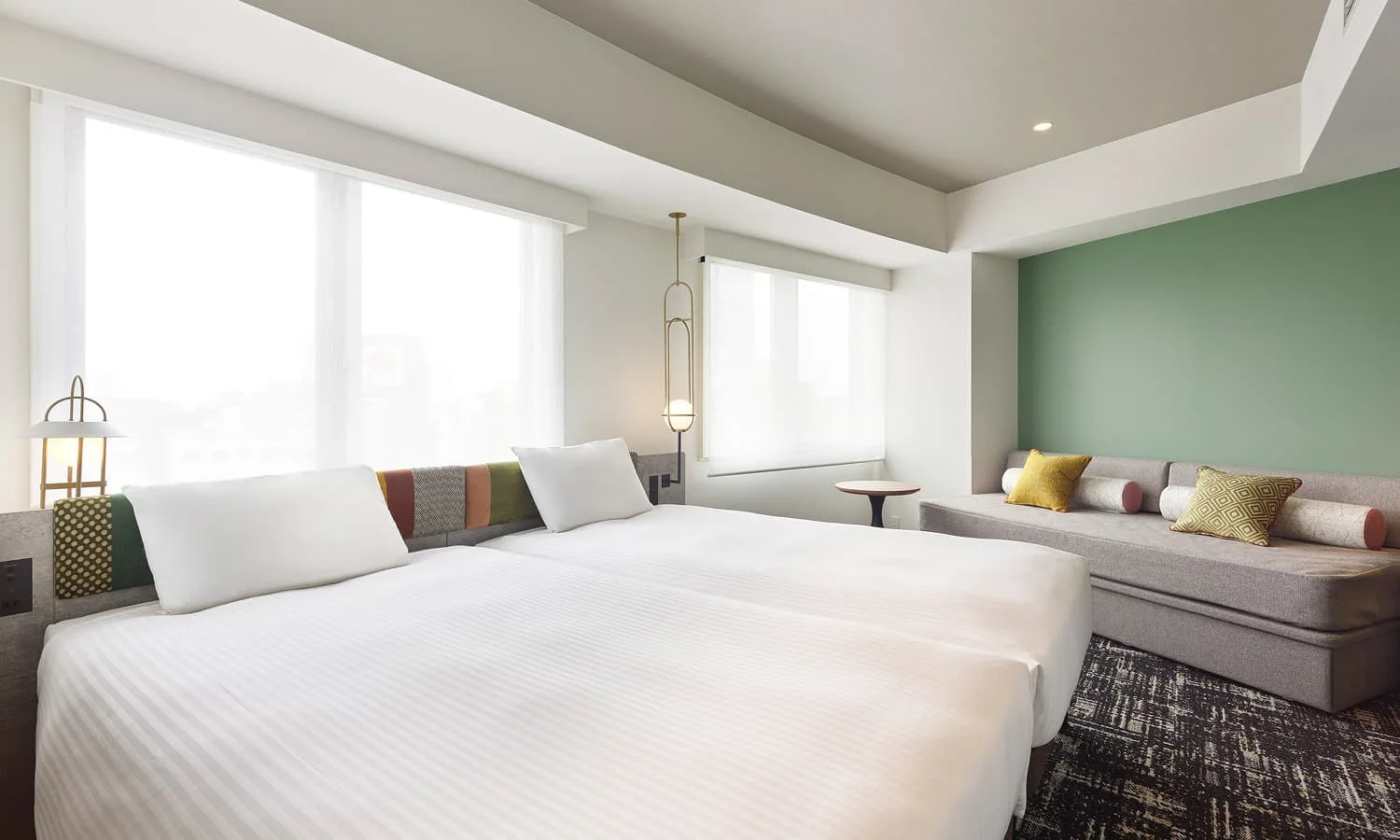
Mitsui Garden Hotel Ueno asks you to accept a longer walk with airport luggage in exchange for much shorter walks on ordinary Tokyo days. The hotel places itself six minutes on foot from Keisei Ueno, two minutes from JR Ueno’s Asakusa Exit and one minute from Tokyo Metro Ueno Exit 1. If you arrive and leave by Narita’s Skyliner but use JR or Metro morning and evening for four nights, those repeated station trips can be the more important distance. On a single transit night, the same six-minute suitcase walk occupies a much larger share of the stay.
The address alone does not settle the booking. Standard rooms are 18 m², breakfast begins at 07:00, and the shortest Metro exit is not necessarily the step-free route. A couple carrying two big cases or a family using a stroller should evaluate the room and station path alongside the Narita transfer. The Mitsui Garden Ueno versus NOHGA comparison is the natural next hotel decision once you know which journey you repeat most often.
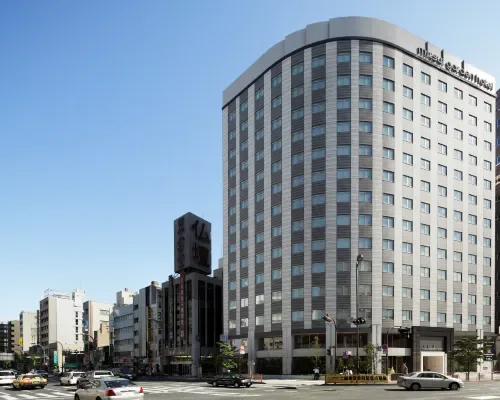
The six-minute airport walk is paid twice; the short JR walk repeats
Keisei’s current Ueno travel page gives about 41 minutes on the Skyliner from Narita Airport Terminal 2·3 to Ueno and ¥2,470 for a standard adult one-way ticket. From that arrival station, the hotel’s six-minute walking estimate is a direction rather than a stopwatch: platform exit, crossing, rain and rolling bags can change the experience. But a Narita round trip normally means only two Keisei-to-hotel walks. A three-day Tokyo stay can involve six or more returns through JR or Metro.
That frequency explains the hotel’s appeal. A room beside JR Ueno can suit the Yamanote Line, northbound rail, a Shinkansen departure or a traveller who comes back before dinner. Metro’s Ginza and Hibiya lines broaden the daily options. The Ueno versus Shinjuku base comparison is useful before assuming that easy Narita access makes eastern Tokyo right for a trip spent mainly around Shibuya or Shinjuku.
A rough trip count is more useful than a single distance. Narita in and out gives two Keisei walks; three sightseeing days can create at least six hotel-to-JR or hotel-to-Metro walks; a northbound rail day adds another pair. If you plan a late evening return, the short JR finish can matter when you are tired. If the room is only for a Narita stopover, almost none of that repeated value materialises. The Narita late-arrival airport-versus-city guide should settle the transport leg before a Ueno hotel shortlist.
A route built around Asakusa, Ueno and Akihabara gives this address more daily use than a route that only sleeps here after Narita. Compare the movements in a seven-day Tokyo itinerary with an Asakusa start. If the holiday is mostly retail, the Tokyo shopping hotel-area comparison may point elsewhere. A JR Tokyo Wide Pass plan matters when a northbound excursion, airport train and subway are being mistaken for one interchangeable rail product.
↔ Scroll table left or right
Trip pattern | How this hotel usually compares | Question to settle |
|---|---|---|
Narita round trip and three to five nights using JR or Metro | Location has a strong case | Will the room size suit the same multi-night stay? |
One night after a late Narita flight | More conditional | Is Keisei-to-bed simplicity the only job? |
Two adults each carrying a large case | Room choice may overturn the location win | Can the selected room accommodate the luggage without daily obstruction? |
Most days in Shinjuku or Shibuya | Reconsider the Ueno base | How many cross-city rides replace the convenient airport transfer? |
Early JR or Shinkansen departure | Station access grows in value | Will a 07:00 breakfast be usable? |
Wheelchair or stroller route | Shortest Exit 1 claim is incomplete | Which lift route actually reaches the street? |
Large luggage changes what six minutes means
A six-minute estimate usually assumes a normal walking pace. Keisei Ueno to the lobby may feel different with two 28-inch cases, a child who has fallen asleep, or a flight that lands late. Do not confuse the hotel’s location relative to JR Ueno with its location relative to the Skyliner terminus: they are different stations and different luggage journeys. If that first walk dominates the stay, the NOHGA Ueno Narita and luggage route offers another way to compare the arrival geometry.
The counterweight is the rest of the trip. Saving a few minutes with luggage once can mean adding a longer walk or transfer every sightseeing day. For Ueno Park, Asakusa, Akihabara, Ginza and northbound trips, the hotel’s JR and Metro positions may be reused repeatedly. A hotel close to Keisei Ueno is still a better choice if the airport leg is unusually difficult and the daily journeys are few. The point is to price the actual movements, not to decide that six minutes is either universally trivial or universally excessive.
A Narita arrival does not automatically make Ueno the only sensible eastern base. The NOHGA Ueno versus Akihabara remm departure comparison focuses on the final airport-bound bag route, while the NOHGA Ueno versus Shinjuku location choice tests how often the daily itinerary pulls west. The Narita versus Haneda hotel-transfer guide is relevant if the airport itself is still flexible or the return flight uses the other one.
A step-free route needs separate attention. Tokyo Metro lists lifts and accessible paths for Ueno, but the hotel’s one-minute Exit 1 instruction is a shortest-path description. It does not promise that Exit 1 is the lift route suitable for a wheelchair or stroller. A longer accessible exit can change the hotel’s effective Metro distance. If accessibility is central to the decision, use the station map for the specific line and platform, then compare the last street crossing and the hotel entrance.
An 18 m² room can erase the station advantage
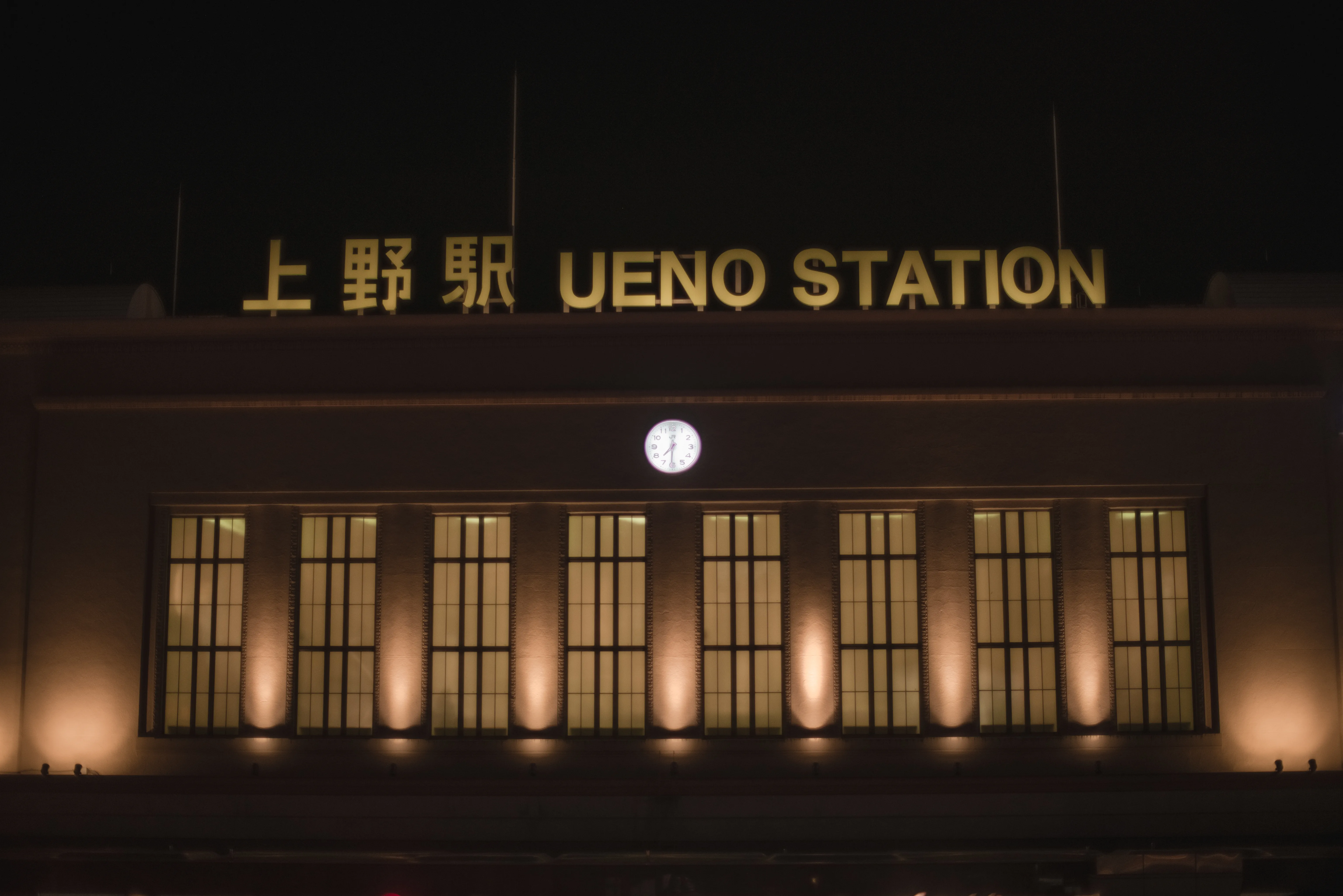
The hotel lists an 18 m² standard Hollywood-style twin and an 18 m² standard queen. That area can work for a solo guest, lightly packed couple or short stay; it says little about whether two particular large cases can stay open while the door and walking route remain clear. The room plan should be checked before treating the cheapest rate as the product you actually want. A published square-metre figure is evidence of size, not a suitcase-fit guarantee.
For four or five nights, floor space becomes a daily cost. Put the larger room categories beside the 18 m² rate and the total stay price beside a roomier Ueno competitor. If the required upgrade removes most of the apparent saving, compare the hotels again. The Mitsui Garden Ueno versus NOHGA room trade-off is particularly useful for travellers willing to give up a few minutes of station access in return for more room.
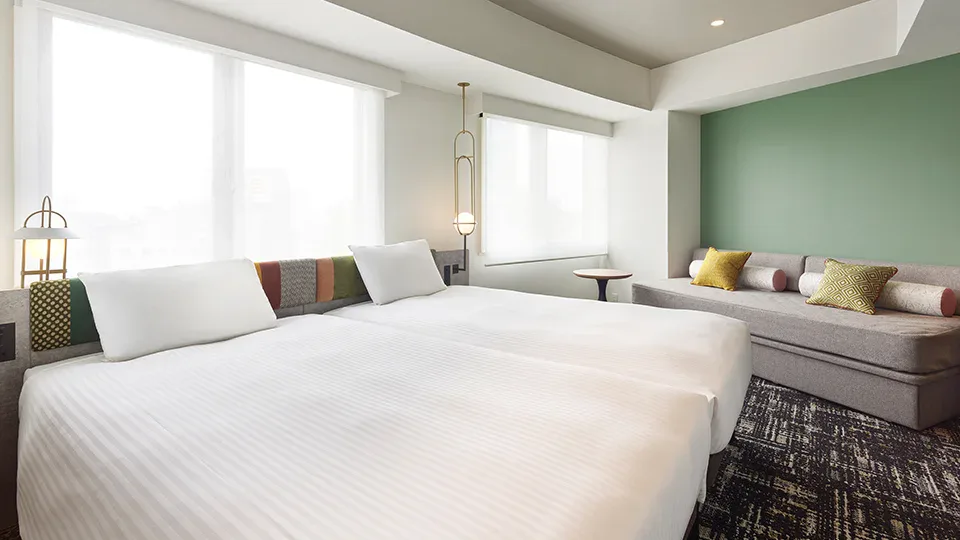
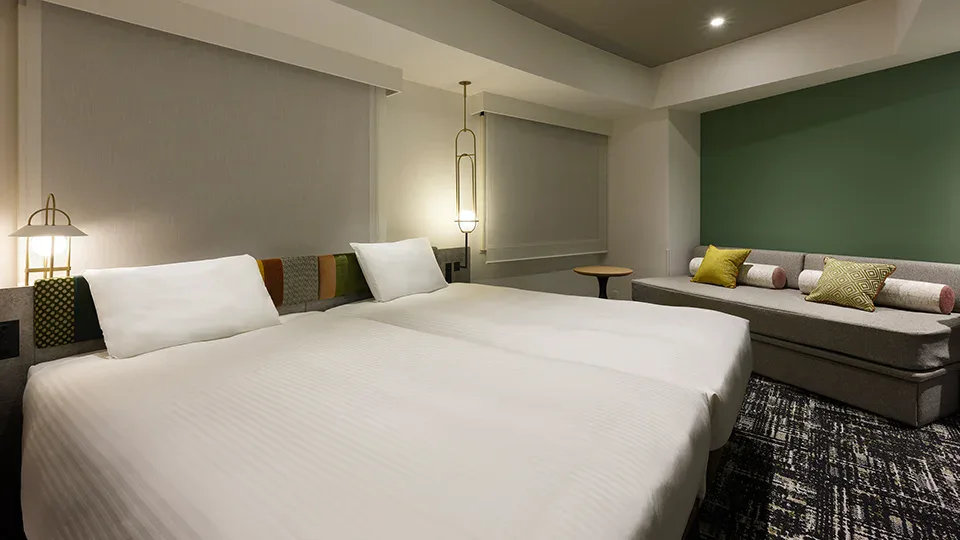
The room photographs show a superior twin layout with a sofa, but they are not photographs of every category. Book by the exact room name and bed count, not a page-wide gallery. The hotel publishes room layouts and areas, while actual luggage storage depends on the cases and furniture position. The sensible veto is simple: if the room needed for your cases is beyond budget, a station advantage does not rescue an uncomfortable multi-night stay.
Families can compare a different type of inventory in the MIMARU Ueno East versus Shinjuku West apartment-hotel decision. A solo guest who values a very short platform walk can assess the Akihabara Hotel Mets room and location rather than assuming Ueno is the only eastern option. The Mets versus remm Akihabara room comparison illustrates how a one-minute exit can still lose to a better bed or bathroom for a particular traveller.
Longer stays gain laundry and microwave access
The current hotel information places coin-operated laundries on floors 3, 8 and 13 and microwaves on 4, 9 and 14. Those facilities are modest but concrete advantages when a Tokyo base lasts several nights: laundry can reduce packed clothing, and a microwave can make an early train or late arrival meal easier. Their value depends on the room and itinerary. A traveller staying only one night is unlikely to use either often.
The hotel also lists a front-desk laundry service: laundry handed in before 10:00 is normally returned after 19:00 the same day, excluding Sundays and public holidays, with possible other unavailable days. That is a different service from the self-service machines. Anyone whose schedule depends on a same-day return should choose the method deliberately and ask about that date’s availability. For a long trip with big luggage, this can be part of the decision to pack less, but it does not create extra floor area once two suitcases are in the room.
Breakfast and early rail departures may clash
Breakfast is currently an Italian-style buffet from 07:00 to 10:00, with last entry at 09:30, at ¥2,530. It can be convenient on a normal museum or shopping morning. Ueno, however, is often chosen for a very early rail departure. If the first Shinkansen or airport train you intend to use leaves before a relaxed hotel meal is possible, a breakfast-inclusive rate may buy something you will skip.
The transport and meal choices can therefore pull in opposite directions. Being two minutes from JR Ueno may make an early northbound journey appealing, but a 07:00 dining start cannot serve every early plan. Compare the room-only and breakfast rates against the actual departure time. The Ueno versus Shinjuku itinerary choice also helps identify whether the northbound advantage is something your trip uses or only a feature on a map.
On a slower morning, the buffet’s timing is straightforward and the restaurant can remove a search for a meal before the first activity. That is a real benefit if you want it, but not a reason to pay in advance without looking at the daily schedule. A four-night stay may include both early and relaxed mornings; room-only with selective breakfast purchases can fit that pattern better than a blanket package.
A delayed Narita arrival needs a message to the hotel
Check-in begins at 15:00 and checkout is at 11:00. The hotel asks guests to notify it of a late arrival and warns that a reservation may be cancelled if someone appears more than two hours after the scheduled arrival time without notice. For a delayed Narita flight, this is a practical task rather than a theoretical cancellation clause. Save the property contact and message it as soon as the planned arrival time slips.
The Skyliner runs directly to Keisei Ueno, but it cannot solve a final-service problem after a very late flight. If the airport-to-city chain has become fragile, decide whether to sleep near Narita before evaluating this hotel’s six-minute walk. The Narita airport stay versus Tokyo arrival guide handles that choice; the Narita capsule versus shuttle-hotel comparison examines the airport-side fallback. The hotel’s strong everyday rail access only matters if you reach it without turning the first night into a race.
Panda rooms have a different purpose
A dedicated panda-themed floor has 20 rooms across six types, with themed hallways and room details. For a family visiting Ueno Zoo, the room itself may be part of the holiday. For a guest comparing train walks and luggage, the theme does not shorten the Keisei route or enlarge a standard category. Price it as a room experience and verify the specific panda room’s bed layout and area rather than treating the panda name as a universal upgrade.
The same amount of money could instead buy a larger ordinary room, breakfast on days you can use it, or a different hotel with more suitcase clearance. A child who cares about the panda stay can justify the premium in a way a purely logistical traveller may not. The distinction keeps a pleasant feature in the comparison without allowing it to substitute for bed and access facts.

Three stays expose different weak points
For a couple spending four nights with one large suitcase each, the repeated JR and Metro access is persuasive, but only after comparing a larger room with the 18 m² base categories. A solo guest spending two nights mainly in Ueno, Asakusa and Akihabara can make good use of the smaller room and short daily station walks. Neither example turns a six-minute Keisei walk into a fact about every traveller; they show where the value moves once bags and nights change.
For a family with a stroller whose days are in Shinjuku and Shibuya, the first question is whether Ueno is the right base at all. The Skyliner advantage may be overwhelmed by repeated cross-city travel, and the one-minute Metro exit is not automatically the accessible one. The Ueno versus Shinjuku base guide should come before a Mitsui-versus-NOHGA price comparison. A Shinjuku hotel access example shows how another station walk can matter differently in a western-Tokyo itinerary.
One-night travellers should ask an even narrower question: is the room primarily a safe bed between Narita and tomorrow’s rail journey? The hotel’s JR access may help if a northbound train is next, but an 18 m² room and a second station walk may offer little if the only aim is sleep. Several nights allow the daily network advantage to accumulate; a short stopover gives the Keisei arrival more weight.
↔ Scroll table left or right
Booking dimension | Question at Mitsui Garden Ueno | When another hotel may win |
|---|---|---|
Airport approach | Can you make the six-minute Keisei walk with your actual luggage? | Only one night or difficult luggage/mobility transfer |
Repeated city access | Will you use JR Ueno or Ginza/Hibiya Metro most days? | Days centre on western Tokyo |
Room category | Is 18 m² enough or is a priced larger room needed? | Larger competitor closes the total-price gap |
Breakfast | Can a 07:00 start serve your departure schedule? | Several early rail mornings |
Laundry | Will the 3F, 8F or 13F machines matter? | Very short stay or an alternate laundry plan |
Accessibility | Does the usable elevator route fit the traveller? | Shortest Exit 1 path cannot be used |
Theme | Is a panda-room stay an intended activity? | Premium would be better spent on space |
Seven site scores for a Ueno arrival
Dimension | Site score | How the Ueno stay earns the mark |
|---|---|---|
Location | JR Ueno is close and the Keisei Skyliner remains walkable, although the six-minute outside leg matters with large cases. | |
Room | Compact 18 m² categories can undermine the luggage advantage; a named larger twin needs checking before payment. | |
Cleanliness | Current aggregated guest cleanliness categories are around 8.9–9.0/10. | |
Service | An aggregated staff-and-service category is around 9.0/10; the property also publishes a late-arrival notification rule. | |
Facilities | Coin laundry on three floors and microwaves on three floors support multi-night rail trips without adding resort facilities. | |
Food | The breakfast buffet is an option for a slower morning, while an early Narita or Shinkansen departure may leave little time for it. | |
Value | Repeated Ueno rail departures and a correctly sized room justify more of the rate than a single light-bag night. | |
Overall | A capable rail base when the chosen room absorbs luggage and the Keisei-to-hotel walk is acceptable. |
These /10 site scores address a Ueno rail stay with luggage. Cleanliness and Service draw on aggregated guest categories; the other marks apply the published room, access and facility conditions to that travel pattern.
The booking test
Mitsui Garden Hotel Ueno earns its place on a shortlist when a Narita arrival leads into several days of eastern or northern Tokyo travel. Two Keisei luggage walks can be exchanged for repeated short trips to JR Ueno and Tokyo Metro. The trade weakens for a single overnight, an inaccessible station path, or a room category that is too small after the cases are inside. Breakfast timing and laundry become meaningful only when the stay is long enough to use them.
Compare the specific room rather than an unspecified hotel rate. Check the size and bed arrangement, the walk from the transport mode you will actually take, and the time of your first departure. Browse Mitsui Garden Hotel Ueno room options alongside other Ueno stays. A six-minute airport walk is worth paying when the shorter everyday walks and the booked room both work for this itinerary.
Related hotel and station decisions
Other station and room choices: Ueno Mitsui versus NOHGA, Ueno or Shinjuku as a base, NOHGA luggage route, Narita arrival-night bed, Hakodate Kokusai access and bath.
Other station and room choices: BLOSSOM Hakata room and bath, Hotel Gracery Shinjuku station route, Jingugaien hotel and Stadium Station, Osaka Premier and Nakanoshima, Torifito Otaru canal-side location.
Other station and room choices: Park Front USJ gate access, Osaka Station hotel routes, Fukuoka Gion triple-room space, OMO5 Otaru station-to-canal route, Naha Terrace room and checkout.
Other station and room choices: Vessel Susukino late bath, Zentis and voco long-stay trade, YUEN Sapporo onsen access, Hotel Sosei twin-queen room.
Property and transport details: hotel access, room categories, breakfast hours and price, laundry and hotel facilities, Keisei’s Ueno journey and Tokyo Metro Ueno lift routes.