
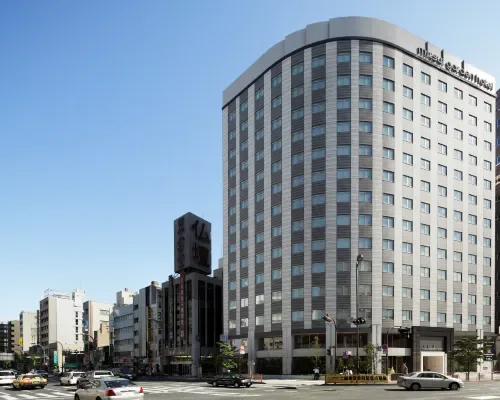
There is a room-size trap in this Ueno hotel comparison. Mitsui Garden Hotel Ueno and NOHGA HOTEL UENO TOKYO both sell an 18 m² entry room. Paying more for NOHGA's design does not buy extra floor space until you select a larger category. Mitsui Garden puts the JR and subway exits closer to your door; NOHGA has a more explicit lift route for large luggage and a broader ladder of 23–36 m² rooms. Start with the room on the actual rate screen, then count how often you will use Ueno Station.
For two nights of sightseeing with a small case, we would price Mitsui first. For four or five nights with two large cases, compare NOHGA's 23 or 26 m² categories against Mitsui's 22 and 25 m² options. If the larger NOHGA room carries a big premium, the room difference may be less useful than the money saved. If Ueno itself is still undecided, settle the Ueno versus Shinjuku base before deciding between buildings a few streets apart.
First compare the journey you will repeat
Mitsui Garden's published final walks are about two minutes from JR Ueno's Asakusa Exit, one minute from Tokyo Metro Ueno Exit 1 and six minutes from Keisei Ueno. NOHGA lists five minutes from JR Ueno, three from the Metro and seven from Keisei Ueno. Those are outdoor exit-to-hotel estimates. Neither number includes walking inside a major station, choosing the right gate, waiting for a lift or carrying cases from a platform.
The one-minute Keisei difference occurs on arrival and perhaps departure. The JR and Metro difference can recur every time you leave and return. A guest going out once each morning and coming back at night uses the route twice a day; a midday rest doubles that. The Mitsui Garden Ueno access breakdown is useful if the Skyliner is your main concern, but the rest of a multi-night itinerary should decide whether the shorter walks deserve a premium.
↔ Scroll table left or right
Approach | Mitsui Garden Ueno | NOHGA Ueno | Booking implication |
JR Ueno | About 2 minutes from Asakusa Exit | About 5 minutes | Mitsui saves a small walk each time JR is used |
Tokyo Metro Ueno | About 1 minute from Exit 1 | About 3 minutes | Count daily Ginza/Hibiya Line trips |
Keisei Ueno | About 6 minutes | About 7 minutes | Too small a one-time difference to settle a room upgrade |
Metro route with heavy luggage | Check the lift and exit that suit your arrival | Lift between Exits 2 and 3 is described for large bags | The easiest route may be longer than the shortest published walk |
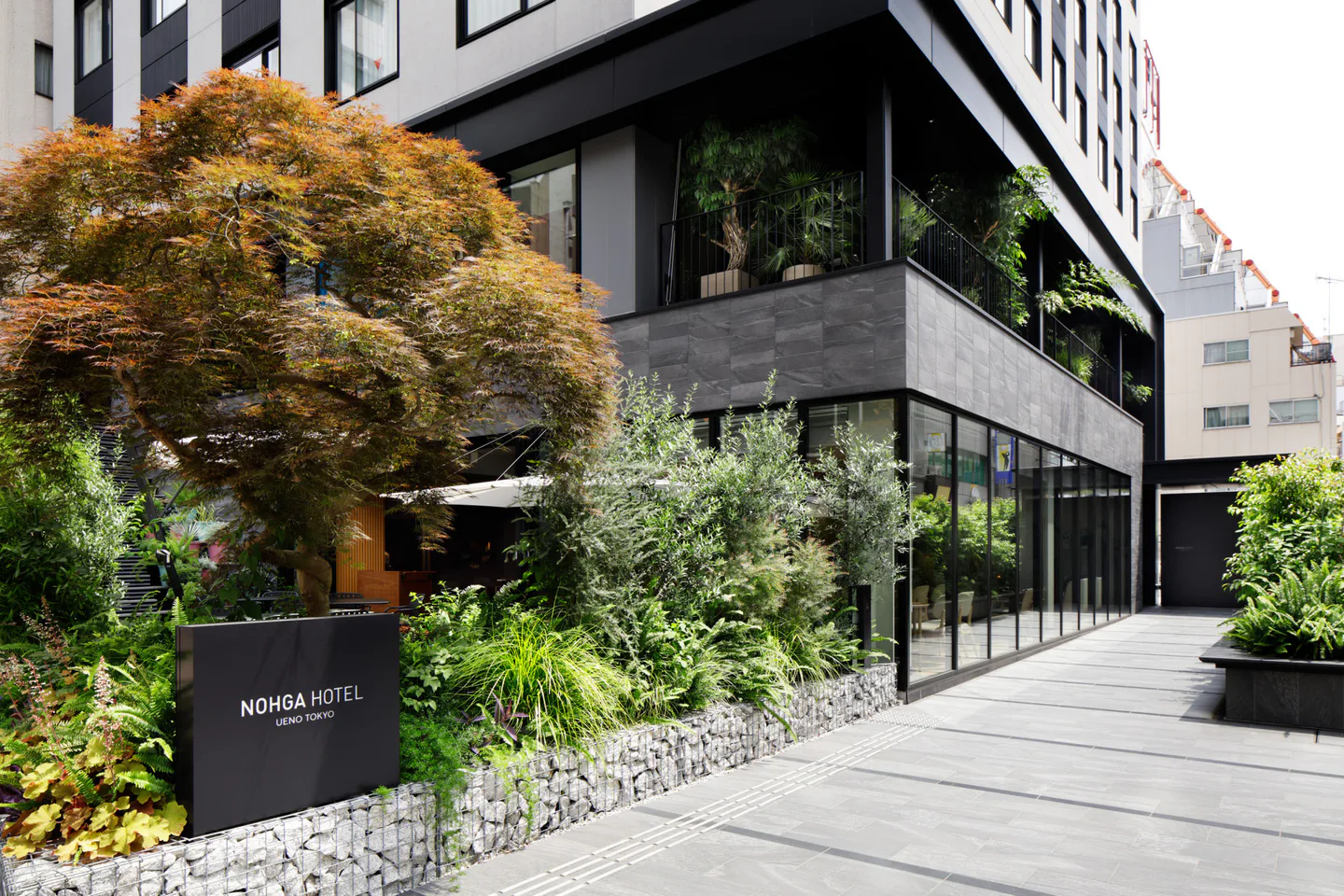

NOHGA's Metro directions specifically identify the lift between Exits 2 and 3 towards Showa Dori for travellers with larger bags. That can matter more than two minutes on a map when you have a stroller, a rolling case or limited tolerance for stairs. It does not erase Mitsui's repeated access advantage for someone carrying a day bag. The NOHGA luggage-route guide follows the last part of the arrival in more detail.
Airport arrival also deserves a separate decision. The Narita and Haneda transfer comparison starts before the hotel walk, where train choice and last easy transfer often save more effort. If you arrive after the useful onward trains, the Narita late-arrival decision may change whether Ueno is even the first night's base. Do not turn a one-minute Keisei difference into a verdict on the entire airport-to-room journey.
What the rate buys inside the room
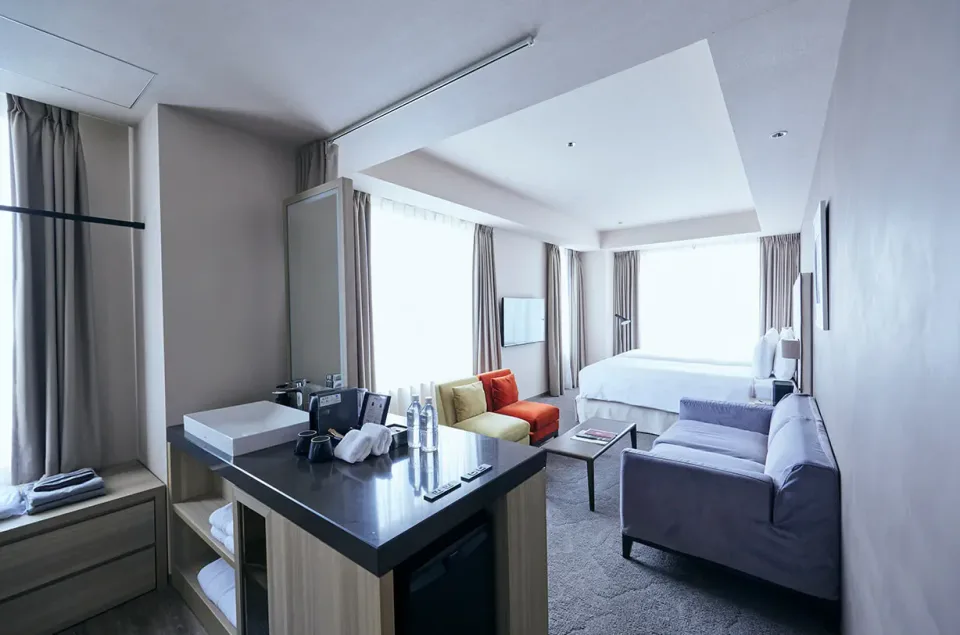
The entry comparison is simple: Mitsui has an 18 m² Standard Double and NOHGA an 18 m² Queen. Mitsui's 18 m² room can have a 140 cm Double, while a separate 18 m² Queen category offers a 164 cm bed. NOHGA's 18 m² Queen lists a 160 cm bed. A couple should check both width and category, because matching floor area does not make every bed equally comfortable. If a rate result only says “Double”, open the room details rather than assuming the photo shows the room being sold.
Mitsui's next meaningful space steps include a 20 m² Superior Queen, a 22 m² separate-style Twin and a 25 m² Superior Twin that can take an extra bed. NOHGA moves through a 20 m² King, 23 m² Superior King, 26 m² Deluxe King or Corner King, and a 36 m² Deluxe Twin. The 36 m² room is a different spending decision from its 18 m² Queen; using it to argue that all NOHGA bookings are spacious would mislead a guest looking at the lowest rate.
↔ Scroll table left or right
What you need | Mitsui Garden category to price | NOHGA category to price | Check before paying |
One or two people with compact bags | 18 m² Standard Double or Queen | 18 m² Queen | Actual bed width and cancellation terms |
More floor space for two | 20 m² Superior Queen or 22 m² Twin | 20 m² King or 23 m² Superior King | Whether the extra area solves a bag or work-space problem |
Two cases open over several nights | 25 m² Superior Twin | 26 m² Deluxe or Corner King; 36 m² Deluxe Twin | Full multi-night premium and the room layout |
Third sleeper | Confirm the Superior Twin extra-bed setup | Confirm the Deluxe King or Deluxe Twin extra bed and charge | Capacity and the third bed, not just the category name |
For a couple with two large cases, the question is whether they need to open both cases every day, work at a table, or simply sleep between long days out. Five square metres used twice daily across five nights can be more valuable than the same space on an overnight stop. A solo visitor with one carry-on may never notice the upgrade. There is no stable yen threshold: compare the total for the exact category and dates, then divide the difference by the number of nights you will use the extra room. The Tokyo shopping-hotel guide helps if the luggage pressure comes from a planned shopping leg rather than arrival bags.
If children are travelling, the 25 m² Mitsui category and NOHGA's larger rooms need a proper occupancy check. A sofa or extra bed changes circulation around suitcases; a large published area does not guarantee that three people will have three equivalent beds. For a larger family, MIMARU Ueno East versus Shinjuku West is a different room-format comparison. Do not force either 18 m² entry room into a family booking just because the station is convenient.
Shared laundry is available at both hotels
Long-stay facilities should only enter the decision when they change what you pack or how you spend an evening. Mitsui lists coin-operated laundry on floors 3, 8 and 13, and microwaves on floors 4, 9 and 14. NOHGA lists 24-hour access to its laundry area, with a microwave there. NOHGA currently states ¥400 for a wash and ¥100 for 30 minutes of drying. These are shared machines; a published facility does not promise an empty machine when you get back.
For one or two nights, laundry is usually an emergency option. For five nights after a humid summer day or before an onward city, it can make a smaller packing list possible. NOHGA's facility is a clearer night-time plan because access is explicitly 24 hours. Mitsui has several laundry floors, which may reduce the distance from a room depending on the floor assigned, but machine availability cannot be known in advance. A traveller who will not run a load should ignore both advantages. The luggage-forwarding decision offers another way to reduce the weight you carry between Japanese cities.
NOHGA also lists a guest fitness area and a library lounge. That can make an indoor hour more pleasant on a longer stay, but those features should not outrank a poor room fit or route. Mitsui's panda-themed rooms are a specific room choice, not a benefit that comes with every booking. A panda display in the lobby does not turn an ordinary Double into a panda room. Check the named inventory when that theme is the reason for choosing Mitsui.
Two nights and five nights produce different answers
With two nights, a short JR or Metro walk gets used immediately, while a larger room has less time to pay for itself. Mitsui is the first price we would check for a two-person city stay if both hotels have suitable 18 m² rooms. NOHGA can still win when its actual room, bed and cancellation conditions are better for a small price difference. Compare the nightly total after taxes, not a generic brand preference.
On a five-night stay, look harder at the larger NOHGA categories. Two people carrying big cases will have to live with the floor plan every night, and NOHGA's 23 and 26 m² choices give a clearer route out of an 18 m² entry room. Mitsui still deserves a quote for its 22 or 25 m² alternatives, particularly when JR and Metro journeys happen most days. The difference is not “short stay versus long stay” by itself; the room you actually buy and the trips you actually repeat determine the result.
A Tokyo base can also fail before either hotel is considered. If most days are in Shinjuku, Shibuya or west Tokyo, use the Tokyo Station versus Shinjuku base comparison and the seven-day Tokyo route to count the cross-city journeys. Ueno works particularly well for the east side, Asakusa and certain northbound departures, but a short Ueno hotel walk will not erase a long commute across Tokyo every evening.
For a museum-heavy day, staying in Ueno can also let you return to the room without crossing the city. The Nature and Science Museum visit plan shows why a few hours in the park can fill most of a day; the hotel decision then turns on how often you leave the neighbourhood afterward. If Akihabara becomes the main evening base, compare the two Akihabara station hotels before paying for Ueno access you will use less.
↔ Scroll table left or right
Pattern | Start with | Reason to change the answer |
Two nights, small bags, repeated JR/Metro trips | Mitsui Garden Ueno | NOHGA has a better named room at a close final price |
Skyliner arrival once, little JR use later | Compare both | The one-minute Keisei gap is too small to dominate |
Four or five nights, two large cases | Price NOHGA's 23–26 m² rooms | Mitsui's 22–25 m² room is materially cheaper or better placed for daily trips |
Family or third sleeper | Compare exact eligible rooms | An extra bed changes how much usable floor remains |
West Tokyo every night | Reconsider Ueno as a base | The city journey can outweigh differences between the two buildings |
Seven site scores for two Ueno addresses
Dimension | Mitsui Garden /10 | NOHGA /10 | What drives the difference |
|---|---|---|---|
Location | Mitsui's shorter published JR and Metro approaches repeat daily; NOHGA has a clearer large-bag Metro lift route. Keisei is roughly six versus seven minutes. | ||
Room | Both entry rooms are 18 m²; NOHGA has more 23–36 m² upgrade steps, while Mitsui offers 22 and 25 m² choices. | ||
Cleanliness | Both properties have current aggregated cleanliness categories near nine out of ten. | ||
Service | Current aggregated staff-and-service categories are strong at both properties; these marks do not presume a personal stay. | ||
Facilities | Mitsui has laundry and floor microwaves; NOHGA adds a fitness area and publishes 24-hour laundry access. | ||
Food | Mitsui's breakfast can miss an early train; NOHGA's bistro offers later meals as well as breakfast. | ||
Value | Mitsui pays back through repeated short station walks, while a larger NOHGA room can justify its rate on a longer stay. | ||
Overall | The practical tie is broken by the rail exit used, baggage route and actual room category, not the equal-weight score. |
These /10 site scores describe two people using Ueno as a rail base with an entry-room comparison. Cleanliness and Service use aggregated guest categories; the remaining marks apply published routes, room sizes and facilities. Re-price a larger named room before using the Room or Value marks.
These are editorial route-and-room scores for the stated stay, not reports of a personal night at either hotel. The room-space rows assume an 18 m² entry booking. We would recalculate them after selecting a larger named room; a high-end room shown in a gallery cannot improve the score of a cheaper room on the rate screen.
Fix the room category before opening the rate map
Set the same dates, two guests, bed type, breakfast basis, tax treatment, payment currency and cancellation deadline. Then compare Mitsui's specific room with NOHGA's specific room. A lower non-refundable 18 m² rate is not a fair benchmark for a flexible 26 m² booking. If your departure is by Shinkansen from Tokyo Station rather than Ueno, the Tokyo Station hotel decision may be more consequential than this comparison.
For a Narita departure with cases, NOHGA versus remm Akihabara tests whether Ueno is worth preserving for the final night. For a family group, the Asakusa room-capacity guide changes the comparison again. If the night is tied to an Asakusa event, the Senso-ji versus Ueno hotel decision shows when staying by the temple saves more travel than either Ueno building can.
Use the Ueno Station hotel map to compare availability for the chosen room and dates. Our booking order is to price a suitable Mitsui room first when repeated station access matters, then check whether NOHGA's larger named room is worth its actual premium. If both quotes are for 18 m², choose by route, bed and final terms. If the NOHGA quote is for 23–26 m², compare the space you will use each night with Mitsui's 22–25 m² alternatives before deciding.