
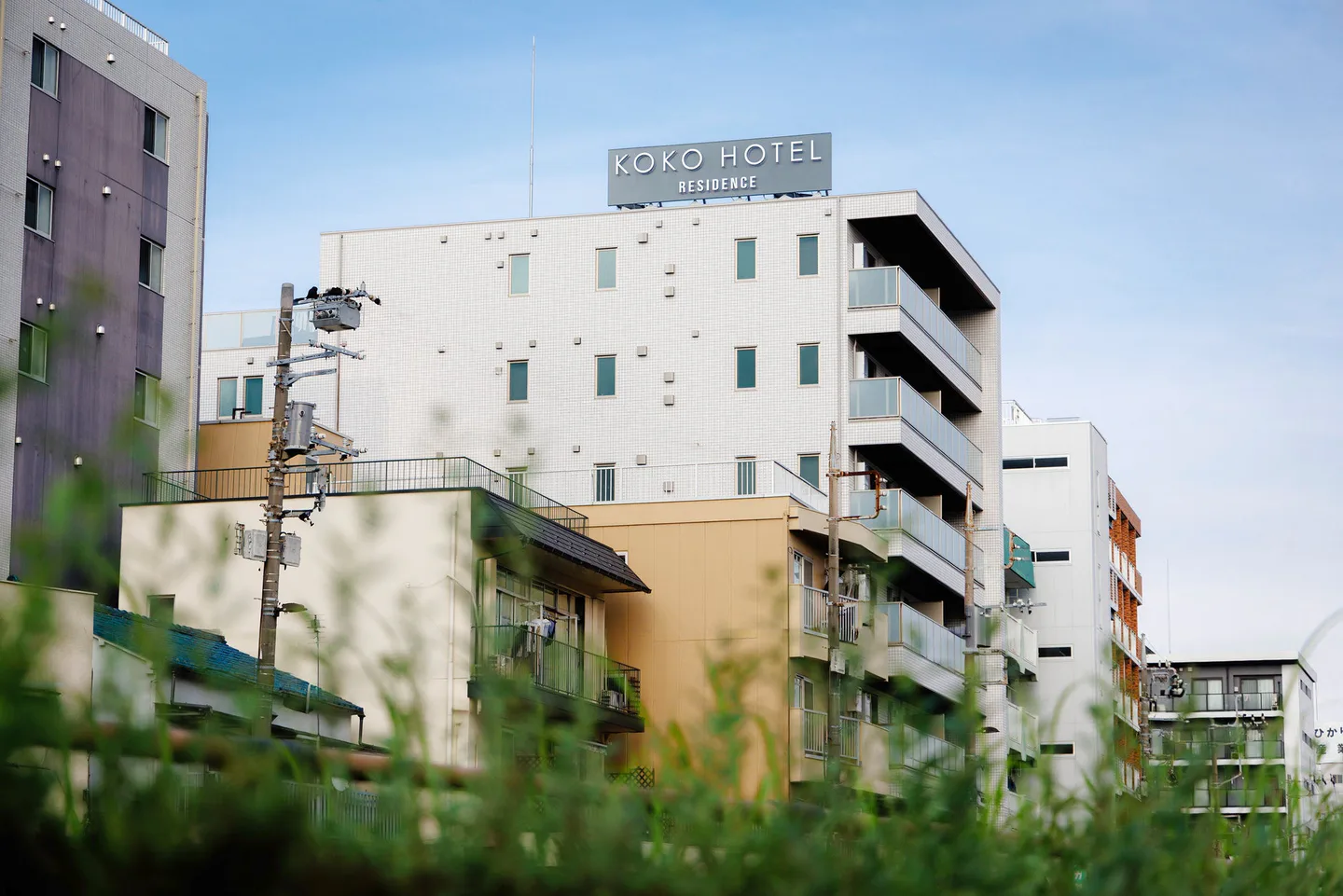
The entrance to KOKO HOTEL Residence Tokyo Oshiage, which began welcoming guests on 16 July 2026.
KOKO HOTEL Residence Tokyo Oshiage makes most sense when the room will do some of the work of a small apartment. Its 25 rooms span 42.3 to 58.2 square metres, with kitchen facilities and an in-room washing machine. The property opened on 16 July 2026. Those details can be valuable for a family or a group staying several nights, though a spacious room is of little use if everyone spends the day and evening across town.
The address is the other half of the decision. Oshiage gives you a short walk to Tokyo Skytree and a practical rail approach to Asakusa, plus the possibility of a through train from either airport. A stay built around Shinjuku or Shibuya asks you to cross Tokyo repeatedly. Compare the cumulative journey with the room space, not merely the first trip from the airport.
Who gets value from an Oshiage residence?
↔ Scroll table left or right
Party and trip | Why the residence may work | Comparison to make |
Three to seven travellers for at least four nights | Kitchen, washer and floor area can be used repeatedly | Check the actual beds and whether two rooms would be easier |
Two or three travellers on a short east–west itinerary | The space is pleasant but may be underused | Price a smaller hotel nearer the evening stops |
West-side nights, a rental car or daily-cleaning needs | Repeated journeys, paid parking and service differences add up | Compare a base and service model that fits those priorities |
There is no abstract answer to whether eastern Tokyo is too far away. Plot where you will finish each evening, as well as where you will start. A family returning to the room to wash clothes and make breakfast uses the location differently from a couple coming back from west-side restaurants after midnight. The same address can be a sensible base for the first trip and an avoidable commute for the second.
A small building with unusually large rooms
The building has seven floors and 25 guest rooms. Its published room categories are Standard, Comfort, Moderate, Superior and Deluxe. The developer and operator describe an area range of 42.3–58.2 m², along with a refrigerator, kitchen, microwave, washing machine and separate bath and toilet. That is a different proposition from choosing among compact city-hotel rooms by bed width alone.
A living zone has practical value when several people need to sort luggage, eat at different times or wait for someone else to get ready. The refrigerator and microwave can handle a breakfast before an early departure; the washer can remove one laundromat visit from a longer trip. These are reasons to consider the room, not guarantees that the layout will feel spacious for every group.
Check the particular room before paying. Floor area does not tell you how many conventional beds are supplied, whether a sofa must become a bed or how much space remains once bags are open. An advertised maximum occupancy also includes children in some configurations. Match the rate, bed diagram and guest ages to the people actually travelling.
The last walk from Oshiage Station
The hotel is about five minutes on foot from Oshiage Station using the A1 or B3 exits. Tokyo Skytree Station is roughly ten minutes away, as are Skytree and the Solamachi shopping complex. With multiple cases, the distance from the platform to street level and then to the entrance matters more than a map pin alone. The short final walk is particularly useful on arrival day; it also makes an unplanned return to the room less costly during an east-Tokyo day. Further reading: Chiikawa × Tokyo Skytree 2026
Oshiage receives through services from Narita Airport on some trains and from Haneda via the Keikyu–Toei Asakusa Line pattern. That can spare a group a platform change while carrying luggage. It does not make every airport departure direct, so check the train for your terminal and arrival time before building the first night around a no-transfer claim. A late arrival may make a direct route more valuable than a marginally shorter total journey involving changes.
Airport transfers and the first night
Count the whole arrival sequence: immigration, the correct train, the transfer if one is needed, and the walk from the station. When a direct train aligns with a flight, Oshiage can make a heavy-bag arrival relatively simple. It is still worth comparing a central hotel if that address reduces travel on several later days. One convenient airport leg cannot by itself settle a four-night booking.
Travelling onward with large suitcases changes the calculation again. The luggage-forwarding guide below covers hotels, lockers and an overnight bag. The Fuji and Hakone guide deals with the narrower problem of moving on from Tokyo while the main case takes another route. Further reading: Japan Autumn Luggage Forwarding: Hotels, Lockers and Mountain Overnight Bags · Luggage Forwarding for Kawaguchiko and Hakone: What Actually Works
What an east-side base changes during the trip
Skytree and Solamachi sit within walking distance; Asakusa is a short rail trip away. Ueno and other north-eastern stops can be grouped with these days without repeatedly crossing the city. Oshiage is on the Hanzomon Line, so some westbound journeys remain direct, but direct does not mean quick enough to ignore on a repeated itinerary. The location works best when the places you actually visit cluster around it.
Shinjuku and Shibuya can still be visited from here. The question is how often you will make the return ride, particularly after dinner with tired children or an early start next morning. Four people using the kitchen, laundry and extra floor area might welcome the trade. Two people on a brief nightlife-focused visit may find a smaller west-side room easier and cheaper once their transport is counted.
Routes that change the hotel calculation
A Tokyo foliage trip can spread its days across gardens, Mt Takao and Okutama; the linked timing guide helps locate those days. Nikko calls for its own departure and return plan. If you intend to keep one Tokyo room while making several trips, the one-base route guide below helps test whether avoiding hotel changes offsets extra daily rail time. Further reading: Tokyo Autumn Leaves: Timing for Mt. Takao, Okutama, Gardens and Ginkgo · Tokyo to Nikko Autumn Leaves: Trains, Passes, Day Trips and Overnight · Japan Autumn Leaves Without Changing Hotels: Tokyo, Sendai, Osaka and Fukuoka Bases
Five room categories, two occupancy questions
Standard covers 42.8–44.1 m² and Comfort 42.3–43.0 m², with listings that allow up to five in particular arrangements. Moderate has 45.1 m² and uses a large sofa as a bed for its stated five-person limit. Superior expands to 54.1 m²; Deluxe reaches 58.2 m². The latter two categories are offered for as many as seven. Read those figures alongside the bed plan, because an area increase and a higher permitted headcount answer different needs.
↔ Scroll table left or right
Category | Area | Published occupancy or bedding point | What to inspect on the rate |
Standard | 42.8–44.1 m² | Listings show arrangements for up to five | Bed widths and remaining luggage space |
Comfort | 42.3–43.0 m² | Up to five guests on the category details | Beds, price and cancellation terms versus Standard |
Moderate | 45.1 m² | Sofa can become a bed for up to five | Who will sleep on the sofa and how the living area changes |
Superior | 54.1 m² | Up to seven guests | Total sleeping layout versus two separate rooms |
Deluxe | 58.2 m² | Up to seven guests | Whether the extra living area justifies the rate |
For five travellers, price Standard, Comfort and Moderate first, then inspect exactly where each person sleeps. A larger room may still be justified if the group will spend real time together indoors. Six or seven guests have a clearer reason to look at Superior or Deluxe, but two rooms elsewhere may buy more privacy and an easier bathroom routine. Compare total room cost on matching dates and cancellation terms before treating the headline capacity as a bargain.
The separate bath, toilet and washbasin have more everyday value for a multi-generation group than a decorative feature might. One person can bathe while someone else uses the toilet or mirror. That can shorten a crowded morning, although it does not replace checking the number and placement of actual beds.
A kitchen and washer are useful only if you use them
The listed room equipment includes an IH hob, microwave, kettle, washing machine, plates, glasses and basic kitchen tools across the main categories. Think of it as a way to assemble a simple breakfast or heat food, rather than promising full-scale cooking. Families can feed a child before everyone is ready to go out; a group with staggered departures can eat without waiting for the last person. The current room and service details show the equipment to confirm against your exact category.
Laundry becomes more persuasive over four to seven nights or midway through a longer Japan journey. Washing a small load in the room can reduce what you pack and avoid spending an evening at a separate laundromat. On a two-night stay, the same appliance may never be switched on. If it is essential to your travel plan, reconfirm it against the booked room category rather than relying on a general property amenity.
A kitchen changes more than the meal bill. Five people need not agree on one breakfast time, and snacks can be kept for a late return. Do not assume the supplied tools suit a particular recipe or dietary arrangement; the equipment list is a starting point, and a group intending to cook regularly should ask the hotel about specific utensils.
How the residence service schedule works
The published service details give a full room clean once every three days, with an additional clean listed at ¥4,000 per day. Front desk hours are shown as 5:00 a.m.–1:00 a.m.; regular check-in begins at 3:00 p.m. and check-out is 11:00 a.m. These are operating rules that can change, so confirm them for your travel dates, particularly if a late arrival or extra cleaning affects the booking.
A four-night guest should expect a different cleaning rhythm from a conventional hotel with a daily reset. That may be perfectly workable when everyone can do small jobs in the room and use its washing machine. It will be a material disadvantage if fresh daily housekeeping is part of why you book a hotel. Add the paid cleaning cost to the comparison if you know you will request it.
The rooftop terrace is listed for 7:00 a.m.–9:00 p.m. and faces the Skytree area. It may fit a morning pause or an early return, but a party coming home after 9 p.m. should not count it as a late-night amenity. A sunset plan also needs the actual closing time and weather, which can affect access to outdoor space.
A four-night stay puts the equipment to work
Consider a sample trip rather than a claim about a stay we made. On arrival, a useful through airport train and the five-minute station walk reduce luggage transfers. The next evening might be the moment to wash clothes. A different morning could use the kitchen to feed the group before a timed excursion. This sequence is where an apartment-style room earns its rate; a stay spent entirely outside the room has a weaker case.
After landing, take a through train if one suits the flight; allow for the five-minute walk from Oshiage and unpack only once.
On a later night, wash a small load instead of carrying those clothes into the next leg of the trip.
Use the kitchen for a quick breakfast before an early outing; keep bags in the living zone rather than across the beds.
If the group wants the Skytree view from the rooftop, go before the listed 9:00 p.m. closing time.
Plan the fourth day with the three-day standard cleaning rhythm in mind, or arrange the paid extra service.
If the washer stays idle, nobody prepares food and the group only returns to sleep, pay close attention to the price difference against smaller rooms nearer the evening itinerary. Floor space alone may still be welcome, but the residence amenities will no longer be saving time or purchases elsewhere.
Facilities that affect the booking
↔ Scroll table left or right
Facility | Published provision | Booking consequence |
Kitchen | IH hob, microwave and basic utensils in main categories | Useful for simple meals on a multi-night stay |
Washing machine | Inside the main guest-room categories | Can replace a laundromat visit and reduce packing |
Separate bath, toilet and basin | Shown in room descriptions | Helps several people get ready at once |
Rooftop | Listed opening 7:00 a.m.–9:00 p.m. | Only useful when your schedule returns before closing |
Room cleaning | Standard clean every three days; extra clean listed at ¥4,000 | Price the service difference if daily cleaning matters |
Parking | No property parking; local paid lots suggested | Include the car cost in any room comparison |
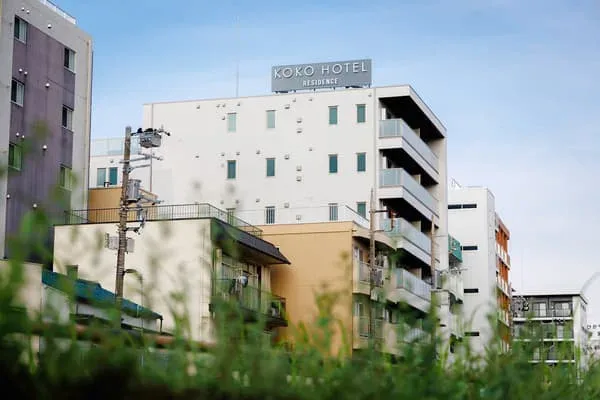
The room and building images show the property, but a photograph of one category is not a promise about the configuration of another. Check the booked room name and floor plan before using a picture to judge where seven travellers or their luggage will fit.
Itineraries that pair well with Oshiage
↔ Scroll table left or right
Trip pattern | Where Oshiage helps | What to check | Practical call |
Skytree, Solamachi and Asakusa | Skytree area is walkable; Asakusa is close by rail | Exact last walk with bags | Strong fit for an east-side stay |
Ueno and northern or eastern Tokyo | Less repeated travel across the city | Rail connections for each day | Good if the room amenities also get used |
Daily Shibuya or Shinjuku plans | Some direct routes exist | Time spent returning east each night | Compare a west-side hotel |
Nikko outing | Closer to Asakusa-side Tobu departures than a far-west base | Departure station and late return | Works with a carefully timed day |
Kawaguchiko or Hakone outing | Room can remain a Tokyo base | Intercity start point and bag handling | Consider forwarding or an overnight bag |
Narita or Haneda with several cases | Some services reach Oshiage without a transfer | Exact train for the flight time | Add weight when the through service matches |
A Kawaguchiko or Hakone detour can make the hotel base less obvious because departures may work better from Shinjuku, Tokyo or Shinagawa. Compare the rail or bus journey door to door. The linked transport and three-day itinerary guides also explain when sending a large case ahead and carrying an overnight bag simplifies the detour. Further reading: Tokyo to Kawaguchiko: Train, Bus or Tour Compared · Tokyo, Kawaguchiko and Hakone 3-Day Itinerary
Four costs hidden behind a large floor plan
First, work out how often your route pulls you away from eastern Tokyo. A hotel near Ueno, Tokyo Station or a west-side hub may shorten several days even if its walk from a station is longer. Write down the neighborhoods for each evening and test the return journey, instead of comparing station distances in isolation.
Second, allow for the three-day cleaning cycle. If you want a refreshed room daily, include the published ¥4,000 extra-cleaning charge in the room comparison or select a property whose service pattern already matches that expectation. A kitchen and washer do not turn this into a daily-service hotel.
Third, distinguish maximum occupancy from ease of sharing. Seven adults, large cases, differing bedtimes and one bathroom area create a different stay from a family with young children. Ask who uses the sofa bed and whether two rooms at another address would make mornings and sleep simpler. The 54.1 and 58.2 m² options need to be judged against that alternative.
Fourth, a July 2026 opening leaves less operating history than an established hotel. New equipment and a recently opened building are observable facts; mattress comfort, sound isolation and how queues develop are not established by the opening date. Look for recent, room-category-specific guest feedback if those points are decisive.
Compare the Tokyo base before the room rate
Compare hotels in the Tokyo areas you will use most, then put the same KOKO category, guest count and dates alongside a plausible alternative. Check breakfast inclusion, tax display, the cancellation deadline and when payment is taken. A five-person flexible rate cannot fairly be compared with a two-person non-refundable offer. Confirm the sleeping arrangement on whichever rate you select.
Compare Tokyo hotel areas and rooms
Compare Oshiage family-size rooms for your dates
The Tokyo hotel comparison covers other areas as well as Oshiage. For this property, room names, availability and cancellation conditions can vary by date. Read the final rate details before paying.
The deciding question is where you spend your time
↔ Scroll table left or right
When to choose it | Reasons | Countercheck |
Group of three to seven, around four nights or more | Space, laundry and simple meals have repeated value | Confirm bedding, cleaning and east-side route |
Two or three guests for two or three nights | The room may still be appealing | Compare its price with a smaller hotel near the evenings |
Mostly west-side nights, car use or daily service expected | The address or operating model creates recurring costs | Choose the more useful location or service pattern |
This residence is strongest when several travellers can use its area, food preparation and laundry while their route favours eastern Tokyo. It becomes a less clear purchase when two people spend short days and long evenings on the other side of the city. Newness is a detail of the property, while the room plan and repeated journeys determine how it serves the stay.
Room, transport and service details
Opening and building
KOKO HOTEL Residence Tokyo Oshiage opened on 16 July 2026. The seven-floor building contains 25 rooms, so check availability early if your dates require a particular category for a large party.
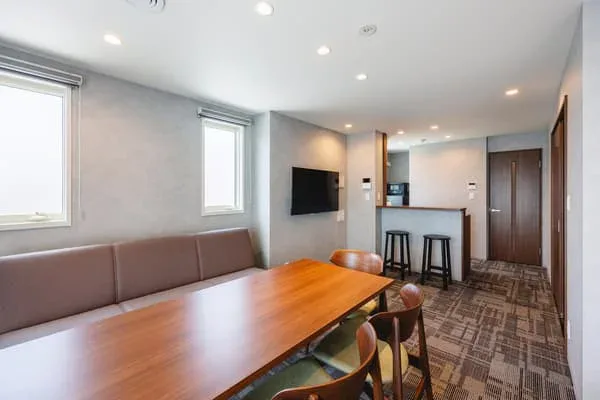
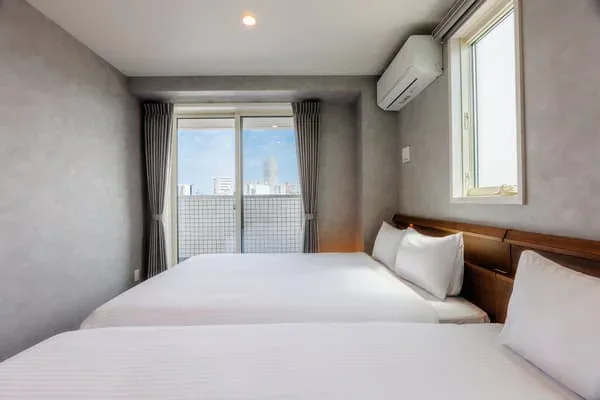
Floor areas by category
The smallest published category range is Comfort at 42.3–43.0 m². Standard spans 42.8–44.1 m²; Moderate is 45.1 m², Superior 54.1 m² and Deluxe 58.2 m². The property-wide range is therefore 42.3–58.2 m², but the category you select determines the actual sleeping and living arrangement.
In-room equipment
The main category descriptions list a kitchen, washing machine, microwave and IH hob. Confirm any indispensable appliance on your chosen room listing before payment, particularly if meals or laundry are central to why you chose this hotel.
Groups of six or seven
Superior and Deluxe are offered for up to seven guests. That is permission to book a stated configuration, not an assurance of seven separate conventional beds. Inspect the beds and sofa arrangement, child rules and final occupancy on the selected rate; compare with two rooms if the group needs more separation.
Direct trains from the airports
Some Narita trains continue to Oshiage without a change, and Haneda has through trains via Keikyu and the Toei Asakusa Line. A direct service depends on departure time and terminal. Choose the train first, then judge the hotel-to-station walk with the luggage your party will actually carry.
Cleaning during a longer stay
The published pattern is one standard room clean every three days, with an extra clean priced at ¥4,000 per day. Ask the hotel to confirm the current charge and timing if you intend to order extra cleaning. For a four-night stay, this policy may matter more than it would for a single night.
Arriving by car
The hotel does not provide its own parking and points drivers toward nearby paid coin parking. If a rental car is essential, calculate the parking cost and walking distance before you decide that the large room is the best base.
Seven site scores for a shared Oshiage room
Dimension | Site score | Reason for a family or group stay |
|---|---|---|
Location | Oshiage is a short walk and useful for east Tokyo and airport rail, though west-side sightseeing takes longer. | |
Room | The 42.3–58.2 m² apartments give groups a table, kitchen and sleeping layouts unavailable in typical compact doubles. | |
Cleanliness | Early guest categories are very high, but the post-opening review sample remains small. | |
Service | Early aggregated service marks are high; limited review volume makes a perfect score premature. | |
Facilities | In-room washing and cooking reduce daily chores, while this residence does not supply a large-hotel leisure complex. | |
Food | The kitchen and nearby groceries support self-prepared meals; food convenience here depends on the group using that equipment. | |
Value | Strong when one apartment replaces multiple rooms and the group uses laundry; compare the cleaning terms and exact bed plan. | |
Overall | A spacious east-Tokyo base for a group that needs shared living space more than on-site dining. |
These are site scores out of ten for a family or group using the apartment equipment. The young hotel has only a modest body of guest ratings, so the cleanliness and service marks remain cautious despite strong early categories.