
Hotel Resol Trinity Hakata earns its place when a Fukuoka evening finishes in Nakasu. The last walk from Nakasu-Kawabata Station Exit 1 is about a minute, and the guest bath on the fourteenth floor stays open until 02:00. A traveller can eat late, return without a long street or station transfer and still bathe before bed. That combination is useful for one or two nights focused on the district. It becomes less persuasive across five nights of early JR departures from Hakata, especially in a 16–19 m² room with two large cases.
The practical starting comparison for two adults is the 19 m² Standard Twin against the 24 m² Deluxe Twin, not the hotel's cheapest search result against its most attractive photograph. The Deluxe adds five square metres and wider beds; the gap repeats each time guests dress, open luggage or spend a rainy afternoon inside. A short, light-packing stay may not need it. Hakata versus Tenjin is the earlier decision if the party has not yet decided where its mornings and evenings happen; the hotel cannot make Nakasu the correct base for every Kyushu route.
↔ Scroll table left or right
| Actual itinerary | What the hotel adds | What could outweigh it |
|---|---|---|
| One or two Nakasu nights, late dinner and a bath | Short final walk and bath access until 02:00. | A room too small for the travellers' luggage. |
| Three to five nights with two full-size cases | Central rail access and laundry. | Repeated floor-space pressure; price the 24 m² Deluxe. |
| Several early JR or Shinkansen departures | Subway link to Hakata. | The station transfer repeats more than the late Nakasu return. |
| Little nightlife and no interest in communal bathing | General city location. | The two most distinctive benefits go unused. |
| Rental car with a late evening return | Possible hotel parking. | A pedestrian-only approach blocks the outdoor parking area 19:00–02:00. |
One minute is the last walk, not the whole airport journey
The hotel's published position is one minute on foot from Exit 1 of Nakasu-Kawabata. The Airport Line connects that station to Fukuoka Airport without a subway change. Those facts are useful with bags or rain, but they describe only parts of arrival. The route still includes baggage claim, finding the station, platform movement, the subway ride and getting out at the correct exit. Someone who would use a taxi from the airport should price that separately; the one-minute claim does not automatically benefit them.
The shorter surface walk can be more valuable after dinner than on arrival. Nakasu yatai, restaurants and nearby Tenjin activities can finish late. A guest who returns from those areas several times gets repeated use from the address; one Nakasu evening within a four-night stay may contribute little next to room space and morning transport. The Fukuoka yatai guide helps locate the actual evening, while a three-day Fukuoka plan tests whether most nights really belong in this corridor.
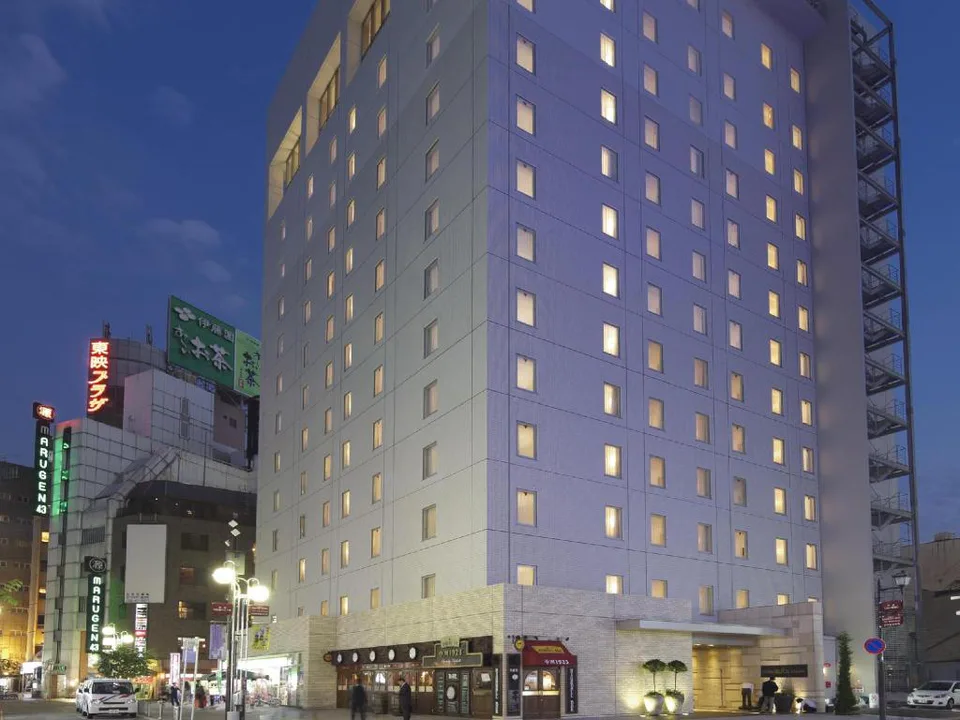
The exterior image shows a tall pale tower with lit guest windows above a city street at dusk. It gives a sense of the building's Nakasu setting, but neither the photograph nor “near the station” tells you which subway exit your luggage route uses. Save Exit 1 and the hotel's entrance before arrival. A family bringing a stroller should also check the lift route rather than assuming that the closest exit is step-free. The late-arrival hotel guide separates final-walk convenience from the full arrival chain.
Four room sizes, four different uses
↔ Scroll table left or right
| Named room | Published size and beds | Useful fit |
|---|---|---|
| Moderate | 16 m²; one 140 cm bed | Solo or very short couple stay with small bags. |
| Double | 18 m²; one 160 cm bed | Couple prioritising a wider shared bed. |
| Standard Twin | 19 m²; two 110 cm beds | Two people needing separate beds on a short stay. |
| Deluxe Twin | 24 m²; two 120 cm beds | More luggage, longer stay or more waking room time. |
| Triple / four-person categories | Specific 30 m² layouts with added or bunk-style beds | Verify each third or fourth sleeping surface rather than inferring it from area. |
The jump from Standard Twin to Deluxe Twin is five square metres, roughly 26% more published area. That percentage does not translate directly into clear suitcase floor: wardrobes, desk and bed arrangement matter. The hotel does not publish a measured guarantee that two particular 28-inch cases can stay open without blocking a path. Use room size as a comparison, then inspect the floor plan and photographs for where bags will go. If the Deluxe price is only modestly higher over a four-night stay, its extra area and 120 cm rather than 110 cm beds can earn the difference daily. For one sleep-only night with compact bags, the Standard Twin may be enough.
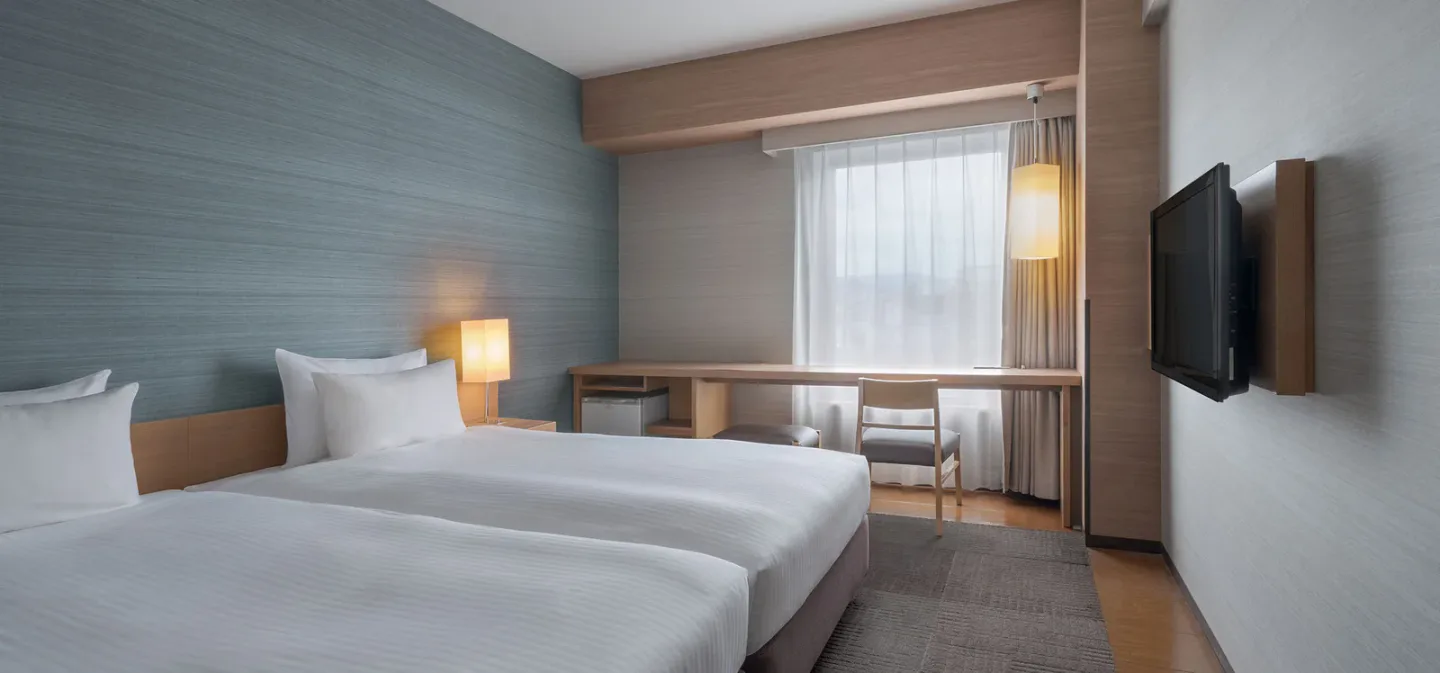
The Standard Twin photograph shows two beds close to a desk, a window and a wall-mounted screen. It describes the room's visible arrangement without pretending to measure open suitcase space. A couple sharing a bed should instead compare the 16 m² Moderate with the 18 m² Double: the latter adds a 160 cm bed and two square metres. If the hotel rate climbs too far while solving the room-size problem, widen the search rather than paying a large upgrade simply to keep the address. A smaller Nakasu alternative is a different trade-off, while Blossom Hakata Chuo changes the station priority.
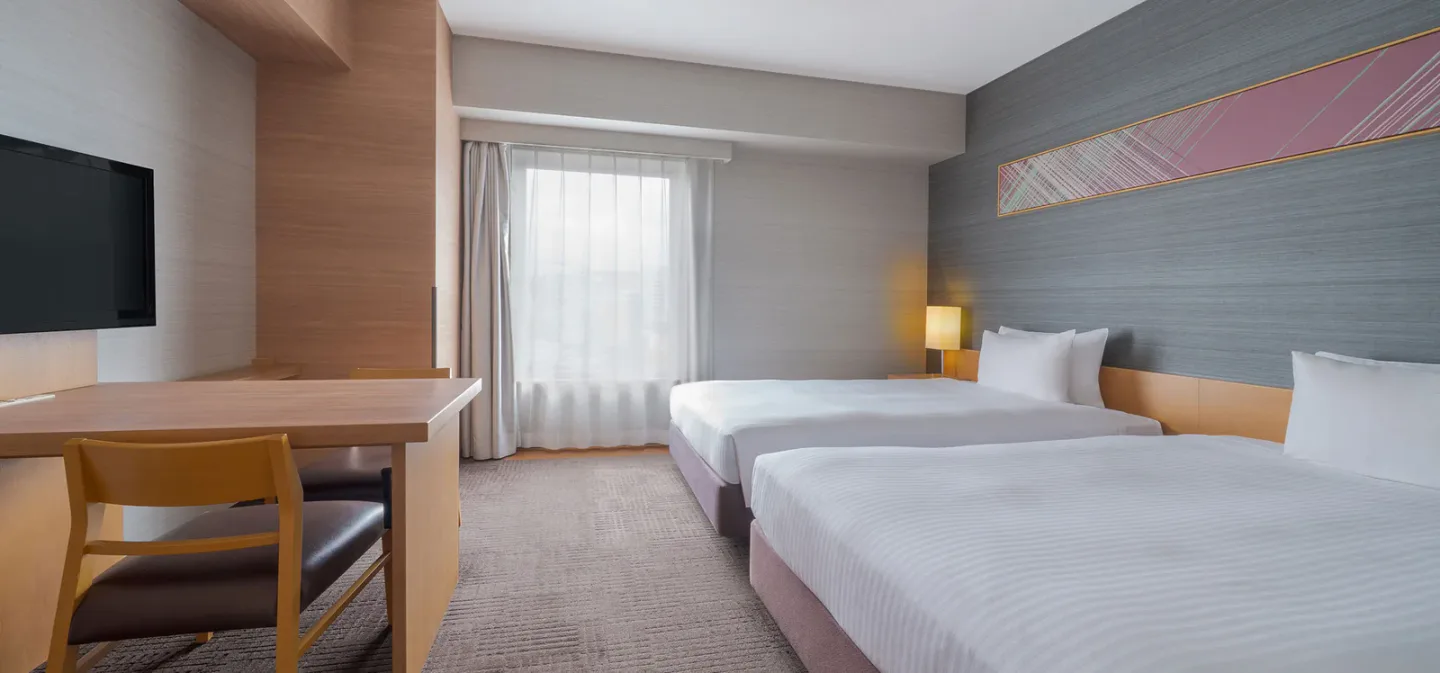
The Deluxe Twin image shows two beds with a table and clearer circulation around them. It supports the case for comparing categories but should not be read as an exact measurement of walking space. A three-person room uses an added bed, and the property's four-person designs have their own 30 m² bed patterns; they should be priced as separate products. The hotel's room page currently lists two 120 cm beds plus a 110 cm extra bed for the triple. If travelling with children, enter every age and decide whether bed-sharing is acceptable before selecting a room marked with a higher occupancy.
Late bathing fits the Nakasu clock
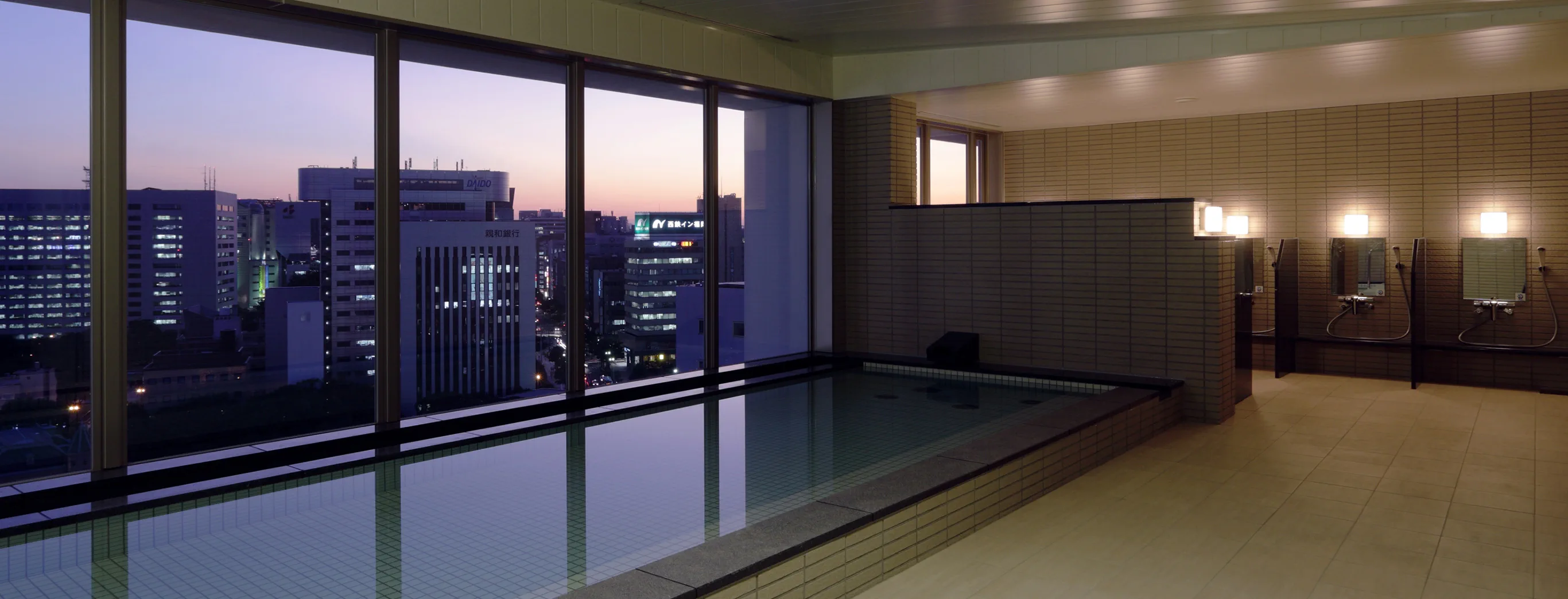
The fourteenth-floor guest public bath opens 15:00–02:00 and again 06:00–09:00 without a separate guest charge. A traveller arriving after a 23:00 dinner has a genuine later bathing window; a bath closing at 22:00 would be a different feature for this itinerary. The hero photograph shows the bath beside wide windows as the city darkens. That visual is the facility's setting, not a promise of an empty bath, a particular view from every position or private bathing.
The simple evening sequence is dinner in Nakasu, a short walk back, a bath after 23:00 and sleep. This is an example of how the hotel's features can overlap, not a first-hand account. A traveller who prefers the private in-room bath may get little value from the communal one. In that case the room and location must justify the rate by themselves. Other Tenjin and Nakasu hotels offer a better comparison if an in-room washer or different late-night amenity matters more.
↔ Scroll table left or right
| Possible time | Hotel use | Limit |
|---|---|---|
| 22:30 | Return from a Nakasu dinner with a short final walk. | This advantage disappears if dinner ends in another district. |
| 23:00–00:30 | Set down bags and bathe before the 02:00 close. | Only useful if the guest wants communal bathing. |
| After midnight | Use the second-floor washer-dryers if a machine is free. | Bath-area machines follow bath hours instead. |
| 06:00–09:00 | Optional morning bath before a flexible day. | An early Hakata train can rule it out. |
Morning bath hours can fit a leisurely start, but they compete with a timed JR departure. The hotel has no curfew; its first-floor automatic doors lock from 01:00 to 06:00, while already checked-in guests can use their card keys. That detail matters for a late return, though it is not a reason to build a nightlife plan around staying out until morning. A guest who will never bathe should not add an imaginary bath value to the nightly rate.
Laundry is useful when the stay is longer than the nightlife weekend
The hotel's current FAQ lists two washers and two dryers in each of the men's and women's bath areas on the fourteenth floor. Those machines follow the bath's 15:00–02:00 and 06:00–09:00 hours. Two washer-dryers on the second floor operate around the clock. This gives a late-running alternative if the bath-area machines are occupied, although it does not guarantee an empty machine at the hour you need. For one or two nights, laundry probably should not decide the booking; for four or five nights before another Kyushu base, it can make a lighter packing plan credible.
Washing clothes also does not enlarge a compact room. Fewer clothes may mean one smaller bag, but shopping, work equipment or a stroller still occupy floor. If the trip involves moving on to Yufuin, Kumamoto or Beppu, luggage forwarding may be more useful than paying for a larger room at every stop. Long-stay Fukuoka hotel comparisons show when shared machines become an everyday issue rather than a footnote.
Housekeeping on a multi-night stay is also a practical condition. The FAQ describes towel replacement and rubbish collection without entering for routine days, with room cleaning for hygiene on the fourth night; extra in-room cleaning can carry a charge. A traveller working in the room or carrying children may care more about that pattern than a late public bath. Compare it with the exact booked hotel's policy, not a generic expectation of daily full cleaning. The room should function over the whole stay, not only on check-in night.
Breakfast and Hakata departures compete for the same hour
Il Chianti on the first floor serves breakfast 07:00–10:00, with last admission at 09:30. The hotel lists ¥2,300 per adult when arranged by the previous day and ¥2,500 for same-day purchase; preschool children are free under its posted terms. It offers a buffet, but whether the price is useful depends on when the party must leave. Someone with a relaxed Fukuoka morning can eat before sightseeing. A traveller catching an early train from Hakata has to include the subway ride, platform navigation and a boarding margin. A room-only rate plus another breakfast may fit better.
Hakata becomes the stronger base when multiple mornings start on JR or Shinkansen services. One late Nakasu dinner should not dominate three early departures toward Yufuin, Beppu, Kumamoto or another Kyushu stop. The trip then reverses the hotel's best sequence: instead of dinner → short walk → late bath, it becomes early wake-up → subway to Hakata → navigate the JR station. Choose a Fukuoka area by repeated routes; Blossom Hakata Chuo is one station-focused hotel to compare. A traveller using Nakasu on two or three evenings may reasonably decide the opposite.
Test the whole morning, including any planned bath or breakfast. The bath's morning window ends at 09:00. Breakfast starts at 07:00. If a train requires leaving at 06:30, neither amenity works that day, and their presence should not justify a premium. A later departure may allow both. For a city stay, the Fukuoka days decision clarifies how many mornings are actually spent at the hotel versus away on side trips.
Driving into Nakasu has a time restriction rail guests never see
The hotel's parking is listed at ¥1,600 per night, first come and not reservable. Its mechanical parking holds 22 cars with vehicle-size limits; a small outdoor area has six spaces. The road immediately in front of the outdoor area becomes pedestrian-only from 19:00 to 02:00, preventing its entry and exit then. This is a concrete mismatch if the party expects to drive out for a late dinner or return by car during the restriction. The hotel says its mechanical car park operates around the clock, so distinguish which area or affiliated space the vehicle has actually been placed in.
If the property's spaces fill, staff may direct drivers to an affiliated lot, but that option can have different hours or availability; a paid public lot may ultimately be needed. A car-free traveller can ignore most of this. A self-driver should check dimensions, route, arrival time and where the vehicle will remain before counting “parking available” as a convenience. A Kyushu driving plan might favor a less restrictive hotel area when the car is used every evening.
Our seven Hotel Resol Trinity Hakata ratings
These marks assume evenings in Nakasu and only occasional early Hakata rail departures. The 16–19 m² rooms need separate luggage checks despite the same street address.
| Dimension | Our rating | The booking consequence |
|---|---|---|
| Location | Nakasu-Kawabata Exit 1 shortens the final evening walk; Hakata JR adds a subway leg. | |
| Room | A 16 m² room is less forgiving with two cases than the 19 m² twin. | |
| Cleanliness | Current room-upkeep results are positive across a large stay sample. | |
| Service | Front-desk assessments are steady, including late-night city arrivals. | |
| Facilities | The top-floor public bath is a useful return ritual; laundry matters on longer stays. | |
| Food | Breakfast has a good signal, although Nakasu and Hakata offer alternatives at different hours. | |
| Value | The small-room trade is most defensible when several evenings finish within this district. |
Our overall Nakasu-weekend read is 8.3/10 in a twin sized for the luggage. Repeated early JR starts make a Hakata Station room more competitive.
A seven-part room and route judgment
↔ Scroll table left or right
| Dimension | What supports this hotel | When it weakens |
|---|---|---|
| Night location | Repeated Nakasu/Tenjin evenings end near the room. | Most evenings finish elsewhere. |
| Morning route | Airport Line access works for city travel. | Several early JR departures add the Nakasu–Hakata segment. |
| Sleep and room | Four named sizes and bed patterns allow an exact match. | A 16–19 m² room does not meet luggage or shared-bed needs. |
| Bath time | 14F guest bathing continues until 02:00. | Communal bath is unwanted or the night is spent elsewhere. |
| Laundry | Bath-area machines plus 24-hour second-floor washer-dryers. | Short stay or shared machines already busy. |
| Food | 07:00 buffet can fit an unhurried morning. | Early train makes breakfast payment unusable. |
| Car logistics | On-site and affiliated options exist. | First-come capacity and outdoor access closure conflict with driving hours. |
The rating assumes the late return and the bath will both be used. The hotel is well matched to a short Nakasu stay when the late return and bath will both be used. For two travellers staying longer with full-size luggage, compare the 24 m² Deluxe Twin against the 19 m² Standard Twin before deciding the property wins. If most days begin at Hakata or the party never uses the bath, the one-minute walk alone is a weak reason to pay more. Compare the exact room, breakfast, parking and cancellation terms on the same dates. Check rooms near Resol Trinity Hakata only after choosing the bed and size your trip needs.
Hotel details
Related guides: THE LIVELY FUKUOKA HAKATA: Is Nakasu-Kawabata Worth a 12 m² Room? · Fukuoka Nakasu River Cruise: 30 Minutes or Hakata Bay — Which Is Worth It? · Miyako Hotel Hakata vs JR KYUSHU HOTEL Blossom Hakata Chuo: Is Direct Access Worth the Premium? · Hotel Sonia Otaru: Is a Canal-View Room and Rooftop Onsen Worth the 8-Minute Station Walk? · THE LUIGANS Spa & Resort Fukuoka: Is a 33m² Sea-View Room Worth Leaving Hakata for One Night? · Hotel Sosei Sapporo Review: Is a 39 m² Twin-Queen Room Worth a 15-Minute Walk from Sapporo Station? · Lotte Hotel Busan vs Arban Hotel: Is the Five-Star Premium Worth It in Seomyeon? · Nishitetsu Hotel Croom Hakata: Is 14.6 m² Worth a 1-Minute Bus Terminal and Late Onsen? · JR East Hotel Mets Premier Akihabara Review: Is a 17 m² Room Worth the 1-Minute Location? · HOTEL ANTEROOM NAHA: Is a 12-Minute Walk from Miebashi Worth Every-Room Harbour Views?
THE BLOSSOM HAKATA Premier: Is the 7-Minute Walk Worth a 30m² Twin and Public Bath?
Hotel Gracery Sapporo: Is a 1-Minute Station Walk Worth a 15 m² Room?
HOTEL FORZA Hakata Station Chikushi-Guchi I Review: 1-Minute Access and 18m² Rooms
Kinosaki Ryokan Dinner Included or Room Only: Which Is Worth It?
Hotel WBF Grande Asahikawa: Is a 2-Minute Station Walk Worth It for a Northern Hokkaido Base?
Hakata vs Tenjin hotels · Fukuoka yatai guide · Fukuoka three-day itinerary · JR KYUSHU HOTEL Blossom Hakata Chuo guide · Tokyu Stay Fukuoka Tenjin