
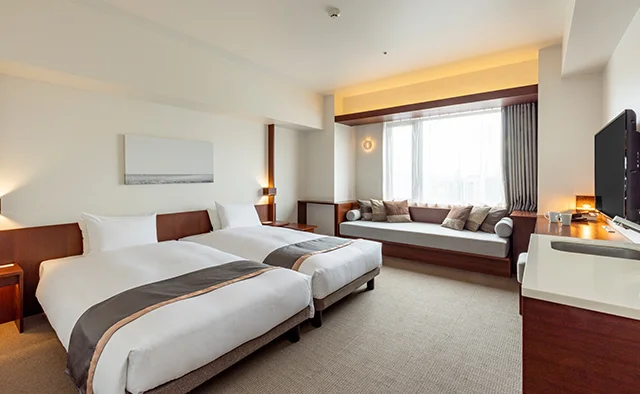
Tokyu Stay Fukuoka Tenjin becomes easier to judge once you count the nights on which you will actually use the room. A washer-dryer matters little if you land, sleep and leave for another city. Over four or five nights, washing clothes in the room can change what you pack and what happens after dinner. The hotel also puts a microwave in its principal room categories, while several larger or Residential rooms add a kitchenette. The question is whether those daily conveniences repay the extra trip to Hakata whenever you need JR trains.
The address is in Haruyoshi, between the Tenjin and Nakasu sides of central Fukuoka. The listed walk is about three minutes from Tenjin-minami Station Exit 6, seven from Tenjin Station Exit 16 and eight from Nakasu-Kawabata Station Exit 1. Those are three different arrivals, not three competing estimates for one station. Choose the route you expect to repeat. If the wider area decision remains open, start with our Hakata versus Tenjin hotel comparison before comparing individual rooms.
Start with your mornings, then your laundry
Four nights of shopping, city meals and one day trip favour Tenjin. Your evenings end near the hotel, and a load of washing can run while you prepare for tomorrow. Four mornings of early departures from Hakata are different: you will repeatedly walk to Tenjin-minami, take the Nanakuma Line and cross Hakata Station to your JR platform. That journey is workable, but a washer cannot shorten it. Our three-day Fukuoka itinerary is a useful way to mark where each day really begins and ends.
For one night, a room beside Hakata may be the simpler choice even if it has fewer appliances. On a two- or three-night visit, decide whether you expect to wash anything at all. On four or five nights, the in-room machine has enough opportunities to affect packing and the post-dinner routine. This is a question of expected use, not a claim that the hotel saves a fixed amount of time or money for everyone.
| Trip pattern | What the hotel solves | What you still need to allow for |
|---|---|---|
| One night before another train | A central room with laundry available | The Tenjin-minami to Hakata segment may matter more than the unused machine |
| Four or five city-focused nights | Repeatable laundry and microwave use after days around Tenjin or Nakasu | Choose a room with enough space for your bags as well as the appliances |
| Several early JR day trips | Evening access to the Tenjin side of Fukuoka | Repeat the subway and station transfer every departure morning |
| Family or three-person stay | Larger room tiers and in-room laundry | Compare actual occupancy, bedding and kitchenette by room category |
Arriving at Haruyoshi is easy; leaving by JR takes another step
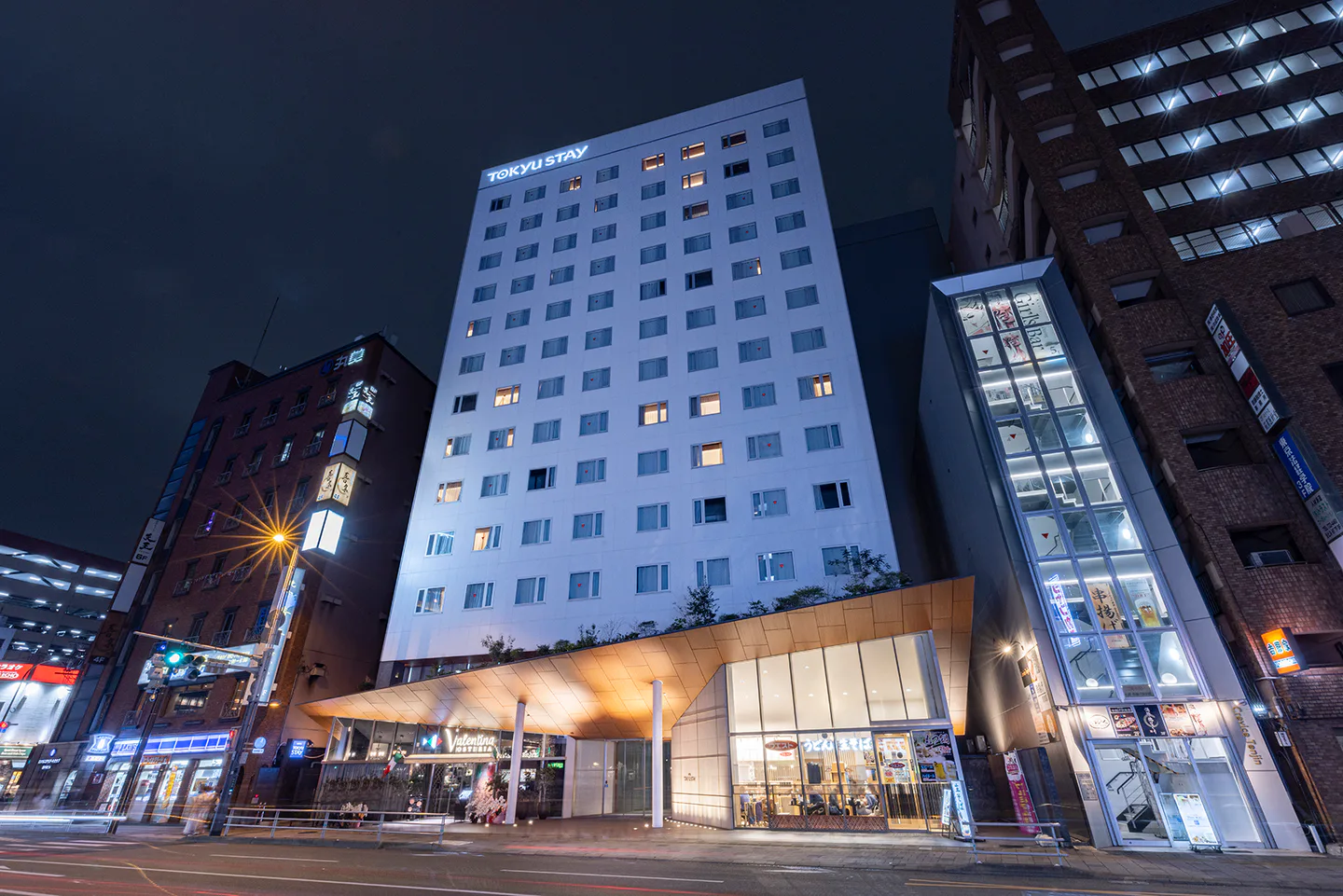
Fukuoka Airport connects to Tenjin on the Airport Line in roughly ten minutes. From Tenjin Exit 16, allow the hotel's listed seven-minute walk, plus whatever time you need inside the station and at street crossings. You do not need to go through Hakata merely to reach this hotel from the airport. Rain and large cases can make the final above-ground stretch more significant than its map distance suggests.
If you arrive at Hakata by Shinkansen, the Nanakuma Line brings you to Tenjin-minami; the listed walk from Exit 6 is about three minutes. That short final approach is why the hotel is viable even for a trip that includes a Hakata arrival. It does not turn it into a station-front Hakata hotel. Reverse the same sequence before every JR departure and the accumulated transfer becomes the price of sleeping near Tenjin. Travellers choosing a final night before an early flight can also read our Hakata or Tenjin last-night comparison.
Tenjin, Haruyoshi and Nakasu are also distinct hotel positions. Solaria Nishitetsu Hotel Fukuoka makes sense if being close to Tenjin Station is the priority. Hotel Mei puts more weight on the Haruyoshi side of the neighbourhood. Tokyu Stay's reason to choose this area is more practical: you return to a room that can handle washing, reheating and, in selected categories, basic food preparation.
Every principal room tier has laundry; pay extra for a different feature
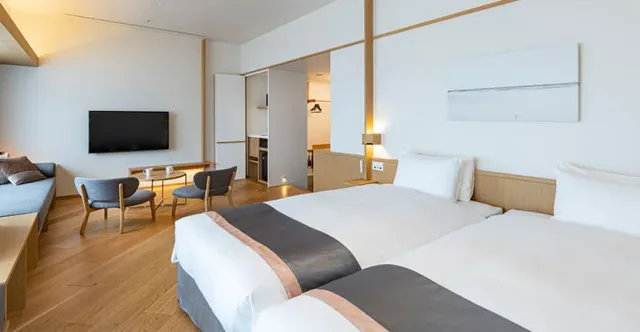
The room names can mislead. Moderate Double is 18 m² and already lists a washer-dryer and microwave. Residential Double is 19 m²: its important addition is a kitchenette, not a dramatic increase in floor space. Comfort Twin is 22 m² with two 110 × 200 cm beds, washer-dryer and microwave; a kitchenette is not listed for that tier. In other words, moving to a larger room does not automatically add cooking facilities. If you need a kitchenette, identify the category directly.
At 30 m², Residential Twin gives up to three guests twin beds, the washer-dryer, microwave, kitchenette and separate bath and toilet. Deluxe reaches 40 m² and up to five guests with the same useful long-stay functions. Connecting Room is listed at 40 m² for up to four and also includes a kitchenette. The 18 m² Moderate Single, intended for one guest, has the main laundry and microwave equipment too. Verify the exact booked category because a generic hotel listing will not tell you which functional difference your rate buys.
| Room | Published size / guests | Laundry and food equipment | Best reason to select it |
|---|---|---|---|
| Moderate Single | 18 m² / one | Washer-dryer, microwave | Solo stay that needs laundry, not a kitchen |
| Moderate Double | 18 m² / up to two | Washer-dryer, microwave | Two light packers seeking the core long-stay features |
| Residential Double | 19 m² / up to two | Washer-dryer, microwave, kitchenette | Simple food preparation matters more than extra floor area |
| Comfort Twin | 22 m² / up to two | Washer-dryer, microwave; no kitchenette listed | Separate beds without paying for a full residential room |
| Residential Twin | 30 m² / up to three | Washer-dryer, microwave, kitchenette; separate bath and toilet | Longer stay with more luggage or a third guest |
| Deluxe Room | 40 m² / up to five | Washer-dryer, microwave, kitchenette; separate bath and toilet | Family or group that will use the room space |
| Connecting Room | 40 m² / up to four | Washer-dryer, microwave, kitchenette | Four guests who want a connecting arrangement |
An 18 m² room can sleep two without being pleasant for two large suitcases left open across five nights. There is no published clearance measurement that would justify promising a particular luggage layout. If both travellers carry large cases or expect significant shopping, compare the 22 m² twin and 30 m² Residential Twin on the same dates. The latter buys more than a larger number: it separates bathing from the toilet and gives the kitchen option. If space outranks laundry, Hotel Great Morning's 27 m² rooms provide a useful counterpoint; The Blossom Hakata Premier places larger twins and a public bath on the Hakata side.
Do not buy a Deluxe room merely to secure a washer: the smallest categories already have one. A family can divide the 40 m² rate among more guests, but two people should have a specific reason to pay for that space. Likewise, the 19 m² Residential Double is a kitchen decision. This distinction also matters when a booking screen promotes a higher tier without showing the equipment matrix beside it.
What four or five nights of in-room laundry actually change
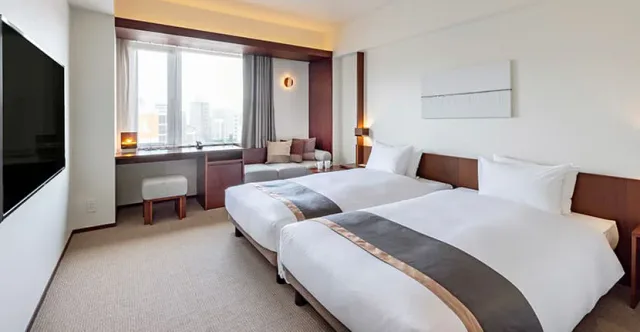
Consider a four-night stay after several days elsewhere in Japan. Washing a first load on night two can return shirts and small items to the usable pile before the suitcase fills with dirty clothes. Another load later in the stay may reduce what you carry into the next city. The hotel's guidance says detergent is provided in rooms equipped with a washer-dryer. You still have to start and finish each cycle; this is not a claim that washing becomes effortless or that every garment can safely go into a dryer.
The private machine is useful because the task stays inside the room. You can shower, sort purchases or prepare tomorrow's route while it runs. A shared laundry requires you to leave the room and may require checking availability. The benefit is especially concrete during humid summer weather, a rainy spell, family travel or a multi-city Kyushu itinerary. It is much smaller on the last night of a short trip, when you may simply carry the clothing home. For another hotel whose washer decision is genuinely room-specific, see our Mercure Tokyu Stay Osaka Namba room guide.
The washing machine does not compensate for an unsuitable room size. If bags occupy the remaining floor, or if your group wants daily full housekeeping, those problems will still be there after the laundry finishes. Compare the whole routine rather than awarding the machine a theoretical cash value. The most persuasive case here is a stay long enough to use it more than once without changing your preferred evening neighbourhood.
Cleaning, breakfast and the small decisions that recur daily
Check-in starts at 15:00 and checkout is by 11:00. On multi-night stays, simplified cleaning can be requested for towels, bathmat, sleepwear and rubbish; full room cleaning is scheduled weekly on stays of seven nights or more. That arrangement suits someone happy to keep belongings in place for four or five nights. If a thoroughly reset room each day matters to you, make it a real selection criterion rather than assuming all hotels use the same cleaning rhythm.
Breakfast is served at Osteria Valentina on the first floor, 06:30–10:00, with last order at 09:30; the listed price is ¥2,200 including tax. A 06:30 start can work before many city days. It is less helpful if you must also reach an early JR train at Hakata. Compare the breakfast-included rate with a room-only rate using your actual morning plan. The microwave in the principal rooms gives a lower-commitment option for a simple breakfast or late snack; the kitchenette in Residential and larger selected categories adds a way to prepare basic food without requiring every meal to be cooked indoors.
Fukuoka's food districts are part of the reason to stay here. On nights planned around Tenjin or Nakasu stalls, our Nakasu, Tenjin and Nagahama yatai guide helps distinguish a repeated evening plan from a single sightseeing meal. The kitchenette is most valuable as flexibility on a tired or wet evening, not as an argument to ignore the neighbourhood.
The front desk can hold luggage before check-in and on the same day after checkout, excluding valuables and fragile items. That can make a late flight day around Tenjin easier. It does not remove the need to plan your route back to the airport or to Hakata. If your final itinerary is dominated by the airport, weigh that trip separately from the preceding nights.
Choose the side of Fukuoka that absorbs the repeated journey
For a city-centred visit, the natural loop is breakfast, walking or shopping around Tenjin, a meal in Haruyoshi or Nakasu, then a short return to the room. Laundry and the microwave support the same pattern. For a regional route, reverse the direction: breakfast and checkout from the room, the walk to Tenjin-minami, the subway to Hakata and navigation to the train. Neither pattern is inherently better. The relevant count is how often you repeat each one.
| Where the day happens | Effect of this base | Room decision |
|---|---|---|
| Mostly Tenjin shopping, Haruyoshi meals and Nakasu evenings | Evening returns are short; room functions can be used after each day | Moderate is enough for light packers; Residential if you will use a kitchenette |
| One Yufuin, Aso or Kumamoto departure | One additional transfer to Hakata is manageable for many travellers | Keep the Tenjin base if the remaining days end nearby |
| Repeated early JR or Shinkansen departures | The same pre-train subway segment repeats | Compare a Hakata hotel on identical dates and room size |
| Two people with bulky bags or a small family | Laundry is useful, but 18 m² may feel constrained | Examine Residential Twin or Deluxe occupancy and bedding carefully |
A useful control is to compare a specific alternative, not an imaginary 'more convenient hotel.' Miyako Hakata versus Blossom Hakata Chuo shows what near-station access changes. Hotel Torifito Hakata Gion is another room-and-location trade. If a Fukuoka visit continues beyond the city, use the transport legs in your itinerary rather than deciding solely from the airport arrival.
Some alternatives solve a narrower requirement better. Hotel JAL City Fukuoka Tenjin is a useful check if your days begin around Akasaka rather than Tenjin-minami. Mitsui Garden Hotel Fukuoka Gion brings a three-adult room question into view. For one night deliberately spent at a waterfront resort rather than on a city schedule, The Luigans is a separate decision. None should be compared with Tokyu Stay solely by the first rate displayed.
Within Tenjin and Nakasu, priorities divide further. One Fukuoka Hotel is for a traveller planning to spend meaningful time in the hotel itself. Lamp Light Books Hotel draws value from its round-the-clock bookshop. Hotel Il Palazzo leans towards a different Nakasu evening experience, while Hotel Resol Trinity Hakata is a compact option with quick Nakasu access. These comparisons matter only if you would use their strengths more often than Tokyu Stay's washer and private-room equipment.
For a smaller, social-room approach, The Lively Fukuoka Hakata and lyf Tenjin Fukuoka frame the opposite choice: how much private space and equipment are you prepared to trade for shared facilities or a different atmosphere? Our Tenjin and Nakasu hotel comparison puts these features alongside one another. The point is not to rank every hotel by an arbitrary score; it is to match the feature to the days you have planned.
How this Tenjin stay rates over four or five nights
The score changes with the itinerary. A Tenjin-centred food and shopping stay uses this address and its in-room equipment differently from a string of early JR departures at Hakata.
| Dimension | Our rating | The booking consequence |
|---|---|---|
| Location | Three minutes from Tenjin-minami Exit 6 and easy evening returns from nearby food districts. | |
| Room | The ladder reaches 30 m² Residential Twin and 40 m² Deluxe, but the 18 m² Double is tight with two large cases. | |
| Cleanliness | Current cross-platform assessments are strong, while individual room experiences still vary. | |
| Service | Staff assessments are consistently positive and same-day luggage holding has useful conditions. | |
| Facilities | Every principal room tier has private laundry and a microwave; kitchenettes depend on category. | |
| Food | The ¥2,200 breakfast option starts at 06:30, but the food districts and room equipment give credible alternatives. | |
| Value | The machine saves a laundry trip over four or five nights, provided the room size suits the luggage. |
Our overall read is 8.3/10 for a Tenjin-led stay of at least four nights. A rail-heavy itinerary can make a Hakata hotel the better purchase despite the laundry advantage.
Before booking, compare a room category rather than a headline price
Fix the dates, number of guests, bedding, breakfast inclusion, taxes and cancellation deadline before comparing rates. Then confirm the room category. At this property, the 19 m² Residential Double has a kitchenette and the larger 22 m² Comfort Twin does not list one. A lower headline price may represent a different functional room, or a stricter cancellation condition. The same applies to the 30 m² Residential Twin versus a 40 m² room sold to a larger group.
For the area you are considering, compare available rooms around Tenjin and Haruyoshi after choosing the category that suits your party. Check the final booking page for current conditions. A map can help judge the walk between the hotel, your likely station exit and evening stops; it cannot tell you whether you will genuinely run the washer twice.
| Check on the final rate | Why it changes this decision |
|---|---|
| Exact room category and bedding | Kitchenette, twin beds and separate bathroom arrangement do not follow a simple size ladder |
| Guest count and occupancy | Residential Twin, Deluxe and Connecting Room serve different group sizes |
| Breakfast inclusion | An early Hakata departure can make a prepaid hotel breakfast impractical |
| Taxes and cancellation | Compare the payable total and flexibility, not the first displayed nightly figure |
| Cleaning expectation | Four or five nights use a different service rhythm from full daily cleaning |
The stay I would choose, and the one I would pass on
For two people staying five nights mainly around central Fukuoka, I would compare Moderate Double against Residential Twin first. Moderate holds down room cost while keeping the washer and microwave; Residential Twin addresses bags, separate beds and more time spent in the room. Residential Double becomes relevant if a kitchenette matters more than the extra space of a twin. The specific rate difference still decides whether the upgrade is sensible.
I would pass on this hotel for a short stay built around successive early departures from Hakata unless the Tenjin evenings are unusually important. A nearby JR base reduces the segment you repeat under time pressure. If only one morning needs Hakata, Tokyu Stay remains a strong candidate because the neighbourhood and laundry may serve the other days better. That is the genuine four-to-five-night decision: which inconvenience will you meet repeatedly, and which room feature will you actually use?
When your choice narrows to this hotel and a nightlife-oriented alternative, the Tokyu Stay versus Hotel Il Palazzo comparison tests that trade directly. If the decision is still between broader districts, return to the Hakata or Tenjin base guide and mark every night and departure on your route.
Questions to settle before choosing a rate
Would I upgrade from Moderate Double for a washer-dryer?
No. Moderate Double already lists both the washer-dryer and microwave, as does the single category. An upgrade needs another reason: separate beds, the Residential kitchenette, more floor area or a different bathroom arrangement. Two guests with large luggage can outgrow 18 m² without needing to cook. Conversely, a light-packing couple that wants to wash clothing may get the full practical benefit in the smaller category. Review bed size and the actual rate plan as well as the equipment description.
Does the 22 m² Comfort Twin include a kitchenette?
The published room matrix lists a washer-dryer and microwave for Comfort Twin, but does not list a kitchenette. Residential Double, Residential Twin, Deluxe and Connecting Room are the categories shown with one. That makes the comparison between 19 m² and 22 m² less obvious than the numbers suggest. Choose Comfort Twin if two separate beds and the extra area matter most; choose Residential Double if you share a bed and would use a cooking space. Do not assume the word “Comfort” or a larger area includes every feature of the smaller Residential room.
Can a third guest use Residential Twin?
Its published capacity is up to three, and Deluxe goes up to five. The connecting category is listed for up to four. Capacity alone does not describe the exact sleeping arrangement supplied with a particular booking, so confirm the bed configuration for three or more guests on the final rate page. A family should also compare bathroom separation and where open bags would go during the stay. The larger rooms earn their premium through living space and occupancy, not through exclusive access to the washing machine.
Is the hotel close enough to Hakata for repeated JR travel?
Tenjin-minami to Hakata on the Nanakuma Line makes the route feasible. “Feasible” still includes the walk from the hotel, the subway ride and the movement within Hakata Station. One departure rarely determines a multi-night hotel decision; several early ones can. Write the departure mornings onto your itinerary and compare them with your Tenjin or Nakasu evenings. If all your regional days start early, a Hakata base removes the trip segment you least want before a train. If most travel is within Fukuoka, Tokyu Stay's room features have more time to matter.
Does the four-night rate imply daily full cleaning?
Multi-night stays use a simplified service that can be requested for towels, bathmat, sleepwear and rubbish. Full cleaning is scheduled weekly for stays lasting seven nights or more. A four- or five-night booking should therefore be judged with that housekeeping pattern in mind. Guests who like a room left undisturbed may consider it a benefit; guests who rely on daily bed making and a full reset should compare another hotel. The washer-dryer and cleaning policy are both part of the longer-stay format, and one does not cancel out the other.
Should I prepay breakfast every day?
That depends on whether your mornings allow time to use it. Service begins at 06:30 and the current listed standalone price is ¥2,200 including tax. On city days, breakfast can fit neatly. Before an early Hakata train, it may compete with the subway and station buffer. Compare an included-breakfast rate with room-only for the same category and cancellation terms. Since the principal rooms contain a microwave, you retain a simple breakfast option on mornings when a restaurant meal does not match the schedule.
Can I leave my case after the 11:00 checkout?
Same-day luggage storage after checkout is available, as is storage before check-in; valuables and fragile items are excluded. It helps if your last day remains in central Fukuoka. You still need to return for the bag and travel onward, so a final afternoon in Tenjin has a different route from one spent beside Hakata Station. Do not let luggage storage alone decide the hotel without plotting that last journey.