
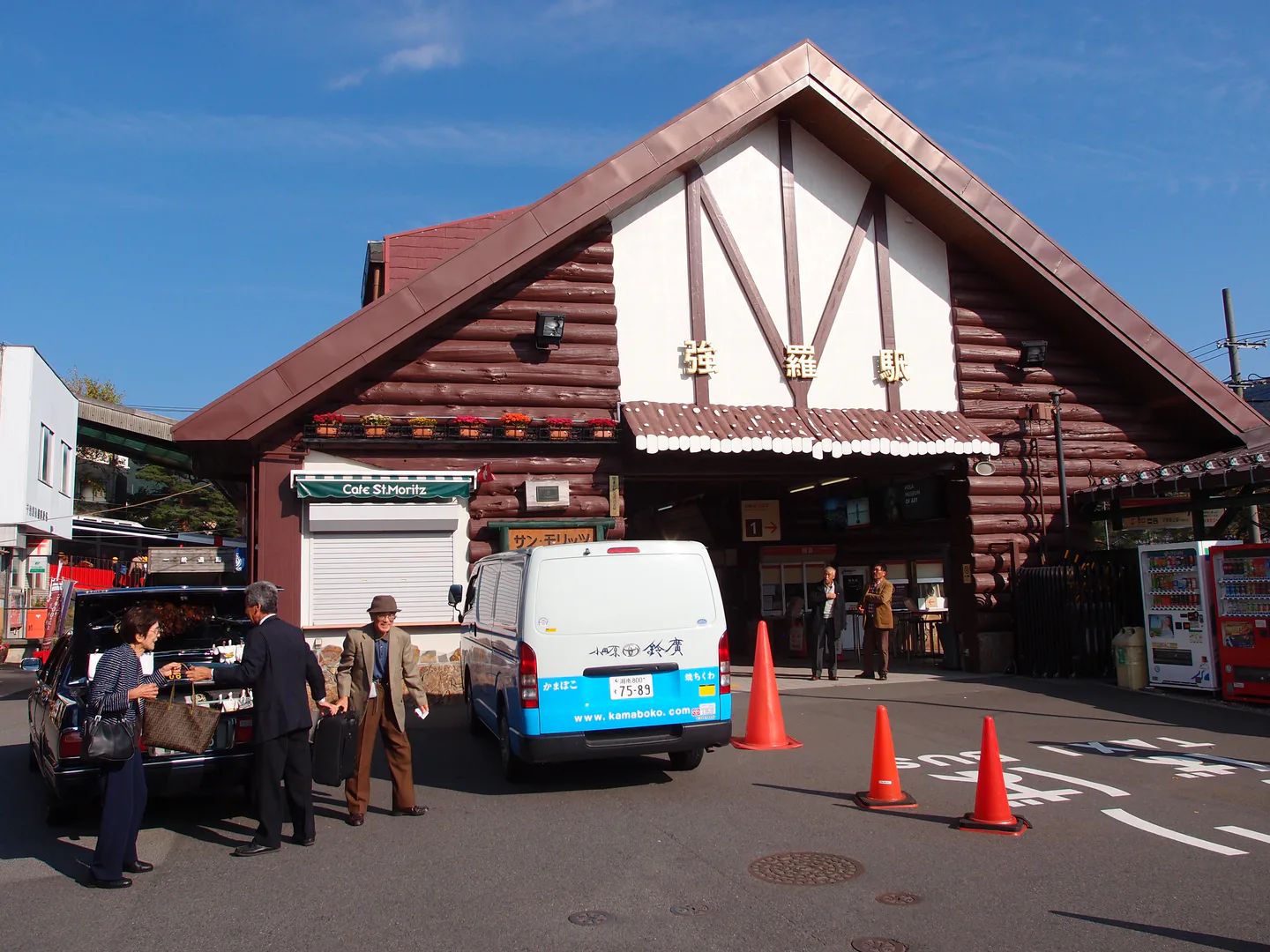
A one-night Hakone stay has two scarce stretches of daylight and one evening that may be fixed by ryokan dinner. The loop belongs on the side of that night with enough time to finish near your accommodation. An early train from Tokyo often makes sightseeing before check-in sensible; an afternoon arrival from Kansai usually makes dinner and the bath the better first-day plan. The hotel’s position can reverse either answer.
Before buying transport or committing to the complete circuit, place four points on the route: the station where you enter Hakone, where the main suitcase will be, the ryokan's latest dinner arrival, and the station you need after checkout. Yumoto, Gora and Lake Ashi hotels sit at different points in the network. Treating them as interchangeable is why a route that looks neat on a map can end with a rushed final bus.
Route direction matters before the morning-versus-afternoon question
↔ Scroll table left or right
| One-night route | Better first calculation | What would reverse it |
|---|---|---|
| Tokyo → Hakone → Tokyo | Arrive early and loop before the ryokan, leaving checkout day lighter | A late start, disrupted ropeway or a stay focused chiefly on the ryokan |
| Tokyo → Hakone → Kyoto or Osaka | Put the long loop on arrival day so the westbound journey has room after checkout | Arrival in Hakone too late to protect dinner |
| Kyoto or Osaka → Hakone → Tokyo | Settle at the ryokan after the intercity trip, then sightsee on checkout day | An unusually early Kansai departure that reaches Hakone before lunch |
| Gora or central-loop ryokan | End the mountain section close to the hotel | Early dinner or a start already slipping into mid-afternoon |
| Lake Ashi ryokan | Choose the loop direction that ends at the lake | The next day's onward transport works better in the opposite direction |
| Hakone-Yumoto ryokan | Allow a substantial descent and bus margin before dinner | Go to the hotel first and loop the next morning if arrival is late |
A Tokyo round trip can use a Romancecar or JR approach without a long westbound move after Hakone. The Tokyo–Hakone–Kyoto version has a different pressure: the next day still contains a Shinkansen journey, so a loop after checkout cannot run indefinitely. For travellers also considering Fuji, Hakone versus Kawaguchiko and the three-day combined route clarify whether this single ryokan night is doing too many jobs.
The Tokyo origin also determines the first useful hour. A hotel near the right departure station can simplify the early train; the Tokyo Station versus Shinjuku base decision is relevant before buying a train ticket. If Kawaguchiko precedes Hakone, the Fuji and Hakone rail-and-bus comparison makes the additional transfer visible. A six-night Tokyo-plus-Kyoto itinerary has little spare room for turning this one-night stop into two full sightseeing days.
The ropeway closes before the sightseeing day feels over
Hakone Ropeway posts a 09:00 start. Its seasonal timetable gives 17:00 as the broad February–November end, though individual station information lists 16:45 at some stations and 17:00 at Owakudani. December and January use 16:15 at all stations. Wind, lightning, typhoons or inspection can suspend service even within those hours. A 15:00 arrival in Hakone therefore does not leave a comfortable opening for the ropeway, Lake Ashi cruise, shrine and a ryokan meal, even if one gondola is still running.
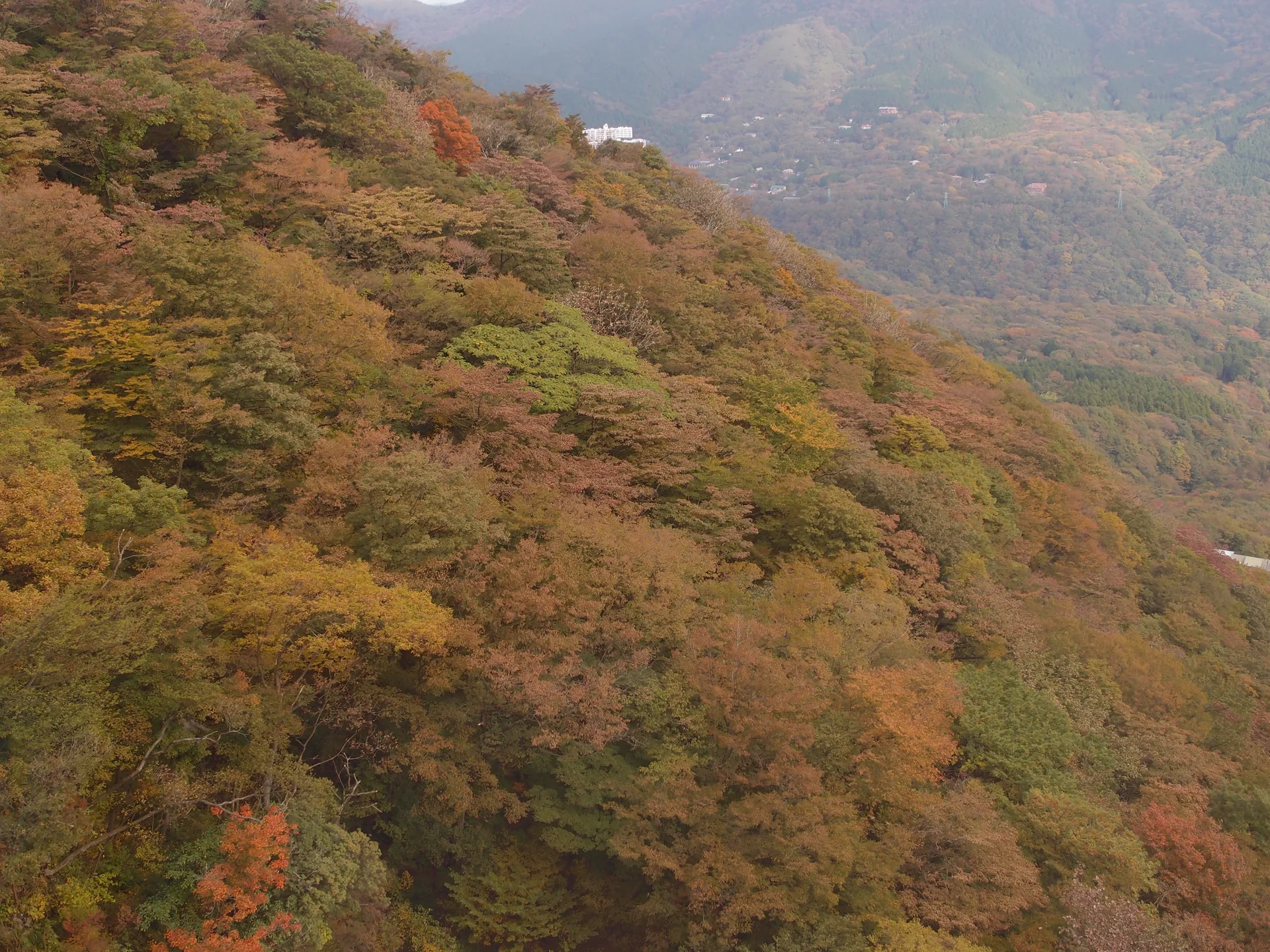
The hillside photograph shows autumn vegetation along the ropeway route, not a gondola or evidence that the service is running. Confirm current operation before committing to a route through Owakudani. If the mountain crossing is shut, a Gora museum visit or time at the ryokan may be a better use of the remaining day than attempting to trace the full circuit by substitutes. The autumn Gora-to-lake route is particularly sensitive to daylight and weather.
The ropeway is only one link. After Owakudani, the plan may still require travel toward Togendai, a ship across Lake Ashi, walking at Moto-Hakone or Hakone Shrine, then a bus or other transfer to the accommodation. A fixed dinner is less flexible than a casual city meal. On a ryokan night, the required hotel arrival time is the deadline; the time of the final attraction is only an intermediate point.
Work backward from dinner at the actual ryokan
Ask the property when guests must arrive for the reserved dinner, and whether check-in or room orientation happens before it. A practical planning allowance is roughly 60–90 minutes at the hotel before a fixed meal if you still need to retrieve bags, change or bathe. That is a buffer to test, not a universal policy: a hotel may specify a different last arrival. A ryokan with dinner and a private bath can be the main reason for paying for the night, making that time more valuable than the final loop stop.
The property itself can shape that buffer. Fujiya Hotel's building and room choice, for example, calls for a different on-property plan from a small ryokan with a fixed dining sequence. Confirm the booked meal plan and check-in window rather than applying one hotel's timetable to all Hakone stays.
↔ Scroll table left or right
| Final hotel area | Safer sightseeing finish | Margin that can be missed |
|---|---|---|
| Gora | Complete mountain sights early enough to end on the Gora side | One more lake stop can require a lengthy return before dinner |
| Hakone-Yumoto | Cut the lake or shrine section when the descent becomes tight | Bus travel down to Yumoto remains after the last photograph |
| Lake Ashi | Let the lake be the final sightseeing zone | A circuit ending back in Gora needlessly crosses the area again |
| Any area after a delayed arrival | Move the loop to checkout day or choose one smaller area | Trying to recover every attraction can cost the ryokan evening |
The published first-visit model day reaches Owakudani around 12:55, the sightseeing cruise around 14:20 and Hakone Shrine around 15:40. It allows roughly 40 minutes for the bus from Moto-Hakone toward Hakone-Yumoto and notes possible evening road congestion. That model is an illustration, not a guaranteed connection on your date. It shows why finishing the shrine at 15:40 is not the same as being checked into a Yumoto ryokan by 16:00.
Send the suitcase ahead only if the morning handover fits
The Hakone-Yumoto luggage transport counter currently accepts same-day deliveries to participating accommodation between 08:30 and 12:00, with hotel receipt after 15:00. That can turn a before-check-in circuit into a manageable day: give up the large case, carry a small day bag through the train, cable car, ropeway, boat and bus, then collect the case at the ryokan. It is not a walk-up solution for an afternoon arrival. The service also has size, weight and item restrictions, and its site warns that processing or area volume can end availability before noon.
After the noon handover, choose between station storage, going to the hotel first or postponing the circuit. Do not carry a full-size suitcase through every mode merely because the property appears near one section of the loop. A Fuji–Hakone luggage plan or the wider send, store or carry comparison can remove that friction before travel day. The Tokyo–Kansai delivery decision matters when the ryokan night is between two large-city bookings.
A checkout-day loop protects the evening but borrows from the next city
After-checkout sightseeing suits an arrival from Kyoto or Osaka, a late flight connection, a delayed train, or guests who booked Hakone mainly for dinner and onsen. Check in, settle down and let the hotel night stand on its own. The cost appears the following day: breakfast, checkout, luggage retrieval, the circuit and the onward train all share one timetable.
That burden is usually easier when the next hotel is Tokyo than when the same day must reach Kyoto or Osaka. For Tokyo-bound travellers, the one-night versus two-night Hakone choice helps decide whether a slower loop is worth paying for a second evening. For westbound travellers, price the full onward movement, not simply the train departure from Odawara. Missing the planned rail leg can shift hotel check-in and dinner in the next city.
The circuit also need not run only Yumoto → Gora → Owakudani → Togendai → Lake Ashi. Hakone Navi publishes a reverse-direction model. A Lake Ashi ryokan is a good reason to finish on the shore; a Gora hotel can favour a finish nearer the mountain rail. Reversing is useful when it aligns the last sightseeing zone with the hotel or next station, not as a novelty. If the room is beside the lake, the area comparison should lead the direction choice.
What to cut when one connection fails
Bad weather can remove the ropeway, while congestion can stretch the final bus. A one-night visit still has a valid shape with a smaller Gora or lakeside outing, a ryokan bath and an unhurried meal. The point at which the original loop risks dinner, an onward rail connection or an unwieldy luggage handover is the point to redraw it. The ship, Owakudani and the shrine are separate stops; none requires sacrificing the whole evening to claim a completed circle.
The common failures are practical: beginning at 15:00 because one published ropeway closing time says 17:00; aiming for hotel check-in without checking the meal's last arrival; assuming noon luggage delivery acceptance extends through the afternoon; and adding the shrine after the return margin has already disappeared. If any of those is true, choose the one or two places you most want to see. A full loop drawn against perfect connections is fragile in a network that includes mountain weather and road travel.
For an early Tokyo arrival and a Tokyo → Hakone → Kansai direction, put the main circuit before check-in only if the bag is handled and the hotel receives you comfortably ahead of dinner. For a late inbound journey or a ryokan-centred stay, enjoy the property first and use the checkout morning for sightseeing, with an onward-travel cutoff. Book the Hakone room that fits the route and meal timing after choosing where the loop will end.
Other one-night route reading
Hakone Ropeway operating hours · Hakone Navi first-trip one-day model route · Hakone Luggage Transport Service · Hakone Navi reverse-direction model route · Tokyo Disney Split Stay: Move the Night Before or After Your First Park Day? · Where to Stay in Kamakura or Fujisawa: The Best Base for Two Nights, With Enoshima as the Wild Card · Sapporo vs Chitose for the Last Night: Where to Stay in Hokkaido · Kagoshima or Ibusuki: Where to Stay for One Night Without a Car · Maidreamin Fukuoka Tenjin: ¥880 Entry vs ¥3,800 HYPER — Check the Night System Before You Go · THE LUIGANS Spa & Resort Fukuoka: Is a 33m² Sea-View Room Worth Leaving Hakata for One Night? · Osaka for Couples: A 7-Day Itinerary That Saves the Best Nights for Kyoto, Kobe and One Big View · Hiroshima or Miyajima: Where to Stay for One Night · La Vista Furano Hills: Is a Small Room Worth It for a One-Night Furano Stay? · Early Shinkansen from Osaka: Should You Stay in Shin-Osaka or Move Only for the Last Night? · Where to Stay in Osaka for Couples: Choose Your Evening Before the Hotel · Tokyo Honeymoon Hotels: Don’t Pay for the View Until You Pick the Night You’ll Stay In · Tokyu Stay Okinawa Naha: Is It the Right Final Night Before Your Flight? · Lake Biwa Otsu Prince Hotel: Is the 36.2m² Lake View Worth the Shuttle?