Six travellers, one booking: the beds and bathrooms decide the room count
A six-person reservation can be valid on a hotel website and still produce a difficult evening. A sofa or daybed may be assigned to the person least able to use it, the only bathroom may become a queue, and a child can be ready for bed while a grandparent still needs light. Before comparing square metres, write down who needs a fixed bed, who must be close enough to help whom, and whether different members of the party can keep their usual sleep routines behind one door. four adults and real beds.
The best room arrangement changes with the group. Five people who cook and wash clothes together may get considerable use from HIYORI Ocean Resort Okinawa’s Ocean Suite, provided three travellers genuinely accept its non-fixed sleeping places. A six-person Motobu stay needs at least two rooms at Ala Mahaina, however large its suites appear. In Naha, RIHGA Royal Gran makes a strong case when bus and monorail journeys dominate, while JR Kyushu Hotel Blossom Naha gives a group with divergent evenings a more useful set of separate bathrooms and sleep zones.
First decide whether the whole trip belongs in Naha, Chatan, Onna or Motobu. Once that geography is settled, the family hotel guide and Okinawa hotel area guide help narrow properties; the comparison below deals with the room allocation after the area decision. Okinawa Family Hotels. Okinawa hotel decision guide. Okinawa family hotel choices.
↔ Scroll table left or right
Travellers and routine | Room plan to price | What helps | What may rule it out |
Five people for three to five nights, similar sleep times | HIYORI Ocean Suite | Kitchen, washing machine and 56.4–60.87 m² shared interior | Three guests must use an extra bed or daybeds; only two beds are fixed |
Four adults wanting standard beds and more privacy | HIYORI Sky Luxury Suite | Two bedrooms hold four fixed beds; bath and shower are separate | The room admits four, even though its terrace and interior are much larger |
Six spending at least two nights around Motobu | A pair of Ala Mahaina rooms | Two sleep zones near Churaumi, with roomy kitchen-equipped accommodation | One short aquarium visit may not repay a hotel move for six |
Six travelling through Naha by bus or Yui Rail | Two eligible RIHGA rooms | Asahibashi and Naha Bus Terminal are a short walk away | Regular dinners around Kokusai-dori make the return walk less attractive |
Six with staggered sleep or a crowded shower hour | JR Blossom Family Room plus another suitable room | Parallel bathrooms, all-day laundry access and proximity to Kokusai-dori | The second booking costs more; essential adjacency needs a guarantee |
A ten-point way to expose the awkward nights
Start at ten and deduct two points for each serious recurring problem: an older adult needing a standard bed would sleep on a daybed, sofa or unsuitable extra bed; normal bedtimes differ by at least two hours; at least three people need the single shower or bathing area in one hour; or necessary nighttime help cannot be arranged with reliable proximity. Deduct one point if the kitchen, washer-dryer or living area will be used fewer than three meaningful times. Deduct another point when everyone would share one light and waking zone. These weights are a planning aid for the family, not a rating of hotel quality. Okinawa hotels with babies and toddlers.
↔ Scroll table left or right
Result | What it reveals | Next booking comparison |
8–10 | Few conflicts would repeat each day | One generous suite may usefully keep the party together |
5–7 | A specific weak point remains | Quote a suite and a room pair with matching conditions |
0–4 | The extra floor area leaves daily conflicts unresolved | Two rooms normally deserve first consideration |
Sleep and bathing receive the larger deductions because the same constraint can return every night or morning. An ocean-facing terrace may be pleasant; it cannot give an older guest a suitable mattress or create a second shower. Use the score to prompt the questions, then inspect the actual room plan and price both configurations.
HIYORI Ocean Suite: enough space for five, with unequal beds
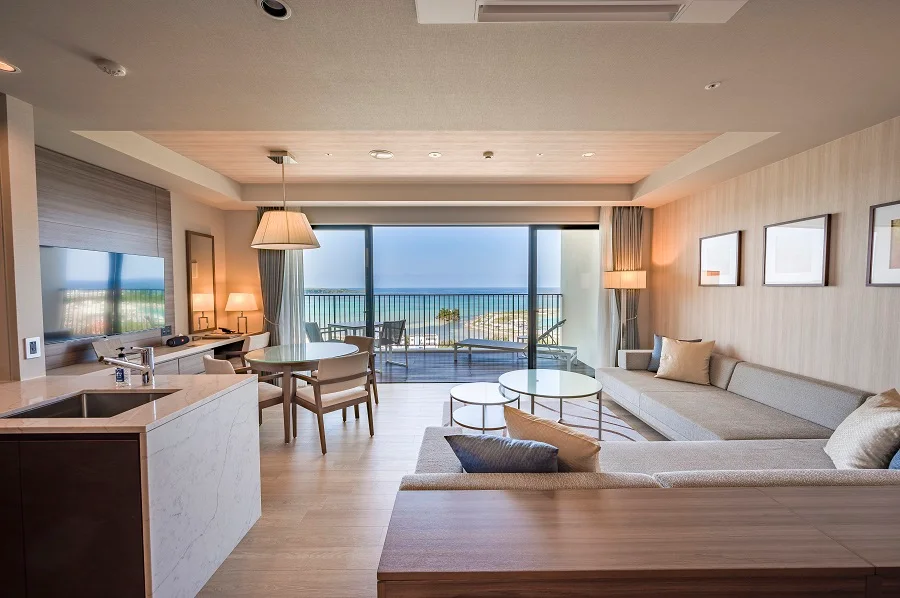
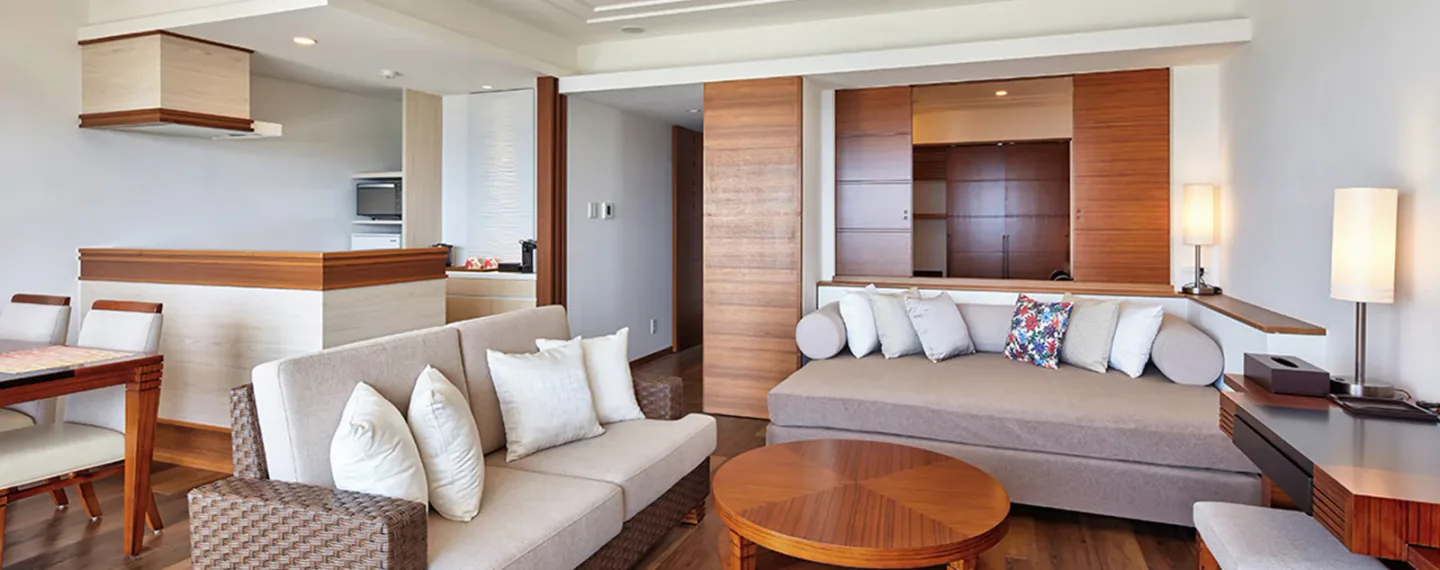
The Ocean Suite measures 56.4–60.87 square metres, with a further 14.4-square-metre terrace, and admits no more than five guests. Its five sleeping positions consist of two fixed beds 120 cm wide, an extra bed and two daybeds. That is the crucial distinction for a three-generation party: the published capacity is five, but only two people can take the permanent beds.
Allocate those two beds to the people who need them most before booking. Mattress support, bed height and the ease of standing or reaching the toilet at night can matter more for a grandparent than a child who routinely uses a daybed. If the older traveller cannot use the available alternative safely or comfortably, a larger floor area will not solve the allocation; compare a two-room booking. travel in Okinawa with parents.
The suite earns its price when the family actually uses its shared facilities. HIYORI equips rooms with washer-dryers, and the Ocean Suite has an IH cooking hob, a fridge-freezer, microwave, utensils and tableware. Over four nights, washing children’s clothes, preparing breakfasts or snacks and returning for a midday break can turn those facilities into daily tools. If every meal is outside and nobody plans to do laundry, much of the premium buys space the group may barely use. a family road trip with a nap break.
The same hotel illustrates why occupancy should not be confused with sleeping quality. The Sky Luxury Suite offers 90.46 square metres indoors and a 68.84-square-metre terrace, with four permanent 120 cm beds divided between two bedrooms. It also provides a bathroom and an additional shower room. Four adults who want real beds and more separation might prefer that arrangement to the Ocean Suite, even though the latter takes five. Sky Luxury still has a four-person maximum; its extra space does not permit a six-person reservation.
If all five guests require ordinary beds or their evenings diverge substantially, request two room quotes with the same dates and terms. The HIYORI suite review explores what repeated cooking, laundry and room returns contribute during an Onna stay. the HIYORI 56 m² suite guide. HIYORI Ocean Resort Okinawa | room sizes, occupancy and bedding. HIYORI Ocean Resort Okinawa | kitchen and washer-dryer information. the HIYORI Ocean Suite review.
Ala Mahaina: two rooms are the starting point for six in Motobu
Ala Mahaina’s room dimensions can lead the search in the wrong direction. A Superior Room spans 55.15 square metres but is limited to three people. The 63.88-square-metre Deluxe 4 Beds takes four, and even the two-bedroom Infinity Suite at 98.28 square metres is capped at four. For six, no amount of creative bed assignment makes one of those rooms eligible; begin with two suitable room types.
That split can give the family a better routine. One room might hold parents and children while grandparents have a second place to rest, or room allocation can follow who may need help at night. The group can still meet in a large kitchen-equipped room for part of the day. At bedtime, a second door brings another bathroom and lets the early sleepers turn off their light without ending everyone else’s evening.
A Motobu room split makes most sense when northern Okinawa is a genuine base rather than a single aquarium stop. The hotel is approximately five minutes by car from Okinawa Churaumi Aquarium. Two or more days around Motobu let the second booking reduce driving back and forth. If the only northern plan is half a day at the aquarium, moving six people and their luggage may create more work than a day trip from the central coast. an Okinawa four-day route.
Drivers should compare the car arrangement as well as the bedrooms. Ala Mahaina lists passenger-car parking at ¥1,000 a night, with the accommodation charge capped at ¥2,000 for a continuous stay, so a third night adds no further hotel parking fee. Spaces cannot be reserved. The facility’s first entry of the day has up to four free hours for facility users, but after a vehicle leaves and comes back, re-entry is charged at ¥200 per 60 minutes. Two cars double the vehicle count; an evening drive can change the bill even when the nightly cap looks simple.
Work out the parking cost in yen for the actual number of cars and departures. An exchange-rate conversion prepared months before the trip cannot make this booking decision reliably.
For two or three northern nights, the Ala Mahaina stay guide examines whether its location and kitchen facilities justify shifting the family’s base to Motobu. the Ala Mahaina long-stay guide. Ala Mahaina Condo Hotel | room occupancy, parking rules and room sizes. the Ala Mahaina stay analysis.
RIHGA Royal Gran: an Asahibashi base for a group without a car
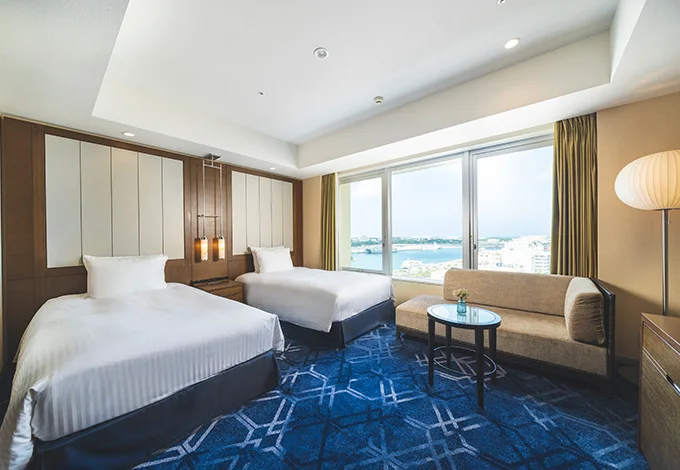
A City View Twin at RIHGA Royal Gran Okinawa occupies 35 square metres. It has two permanent 120 × 200 cm beds and can accommodate a third eligible guest using an added bed. Two rooms configured for three people apiece can therefore house six without hunting for a single rare six-person suite. Confirm ages and the extra-bed arrangement in both reservations; the room name alone does not establish that all six have conventional beds.
The address is the reason to consider it. Asahibashi Station and Naha Bus Terminal are about two minutes away on foot, and the Yui Rail journey to the airport is roughly ten minutes. For grandparents with tiring transfers, or a family making several bus excursions, repeatedly shortening the walk from transport to the hotel may outweigh an unusually large shared room elsewhere. Naha without a rental car.
Its advantage weakens when evenings repeatedly finish on Kokusai-dori. One half of the party may want to return early while the others continue dinner or shopping, making the final walk more important than the morning station transfer. Compare that pattern with JR Blossom’s street access. The RIHGA location review considers Asahibashi for arrival and departure nights in more detail. the Asahibashi location guide. the RIHGA vs JR Blossom comparison. RIHGA Royal Gran Okinawa | room information. RIHGA Royal Gran Okinawa | Asahibashi / transport access. the RIHGA Asahibashi review.
JR Blossom Naha: two bathing areas can shorten the whole evening
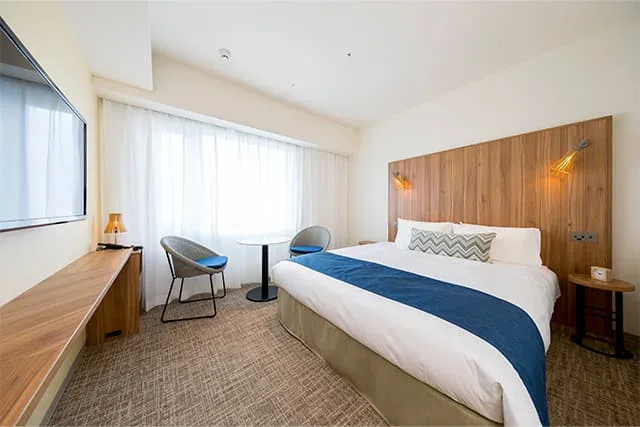
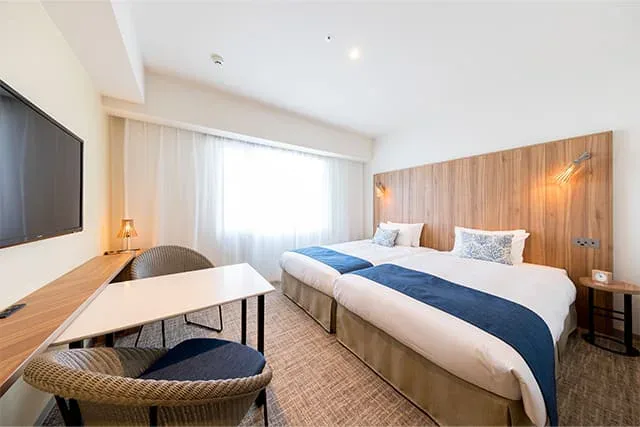
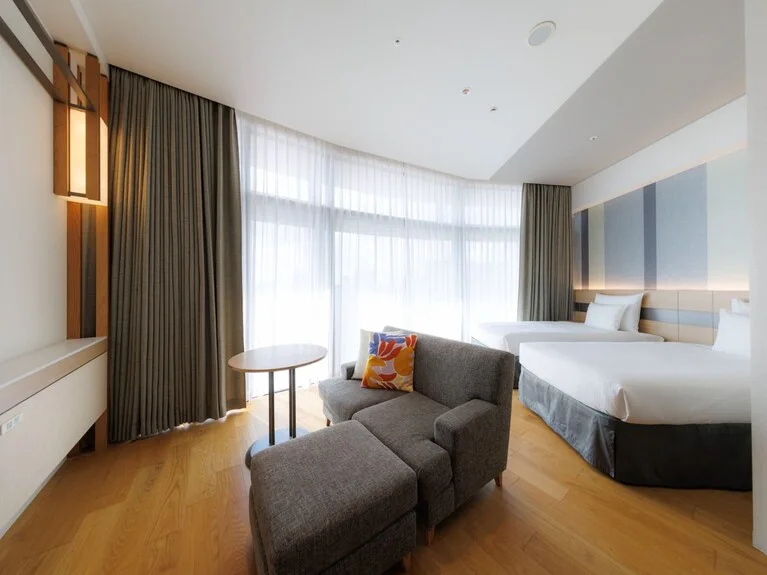
JR Blossom does not require the family to find one enormous room. Its 33-square-metre Family Room takes three or four people with two fixed 120 × 200 cm beds, a bunk and a sofa bed. A Superior Twin is 26 square metres for one or two, and a 33-square-metre Deluxe Twin can take three with an added bed. Six travellers could reserve a Family Room and another eligible room, or divide into two or three rooms to fit the actual care and sleeping relationships. Check the precise bedding of the pair being quoted.
Each room has a bathroom with a separate washing area. Two booked rooms therefore create two places to bathe at once. That can be more valuable than an open living area when grandparents and children both want a shower after dinner, or when departure preparations start in the same hour. Extra floor space in one room leaves the single bathroom queue intact.
The hotel’s 11th-floor coin-operated laundry runs around the clock, and the in-room VOD display shows the machines’ remaining time. A party of six may use that facility more often than a couple. Kokusai-dori is about one minute away on foot, while Miebashi Station is approximately five minutes away; part of the family can turn back toward the hotel without requiring everyone to leave the street at once. a car-free Okinawa itinerary.
There is also a Universal Twin room category. If an older guest needs an accessible layout, ask about that exact room, the bathing arrangement and the route through the property before deciding where the other five will sleep. The JR Blossom room and location review gives more detail on the standard room choices. the JR Blossom Naha location and room guide. the JR Blossom Naha room review.
The second door matters when schedules stop matching
Price an additional room promptly if grandparents and children usually go to sleep more than two hours apart, an older guest wakes repeatedly, or one person needs privacy for medication, dressing or care. The same applies when at least three people expect a shower in the same hour, or an adult needs light to work or pack after the others are asleep. Those are trip routines, not abstract preferences about spaciousness. the six-person room question in Osaka.
Adding twenty square metres to one open room does little for different lights-out times. Another door can create a quiet period and a second bathroom while everyone remains in the same hotel. The family can still spend sightseeing hours and meals together; the room plan only needs to make the hours spent asleep workable.
Ask for a guaranteed room relationship when care depends on it
A request for rooms near one another, a room pair that can sometimes be adjacent and an actual confirmed adjacent or connecting booking are three different outcomes. The first two may change at check-in. If a traveller could need help overnight, a vague note attached to two separate bookings is not an adequate proximity plan.
Ask whether the exact room types offered for your dates can share a corridor, whether there is an internal connecting door, and whether the hotel can guarantee the arrangement. If it can only record a preference, select a layout that remains safe when the rooms end up apart, or choose another property. A two-room saving does not compensate for a care arrangement that relies on luck.
An accessible route comes before a large room
The number on a floor plan does not tell you whether a wheelchair can turn, a bathroom threshold can be crossed, a shower has usable supports, or a guest can rise from the bed. A 63, 90 or 98-square-metre room may be spacious while still unsuitable for a particular mobility need.
Begin with the accessible or universal room’s exact layout and confirm the route between the entrance, lift, room, bathroom and transport pickup. Then place the remaining travellers around the guest who needs that configuration. Asking about access after choosing a dramatic suite may leave the most important person with the least suitable bed or bathroom. Okinawa hotels with older parents.
Find the busiest bathroom hour before comparing rates
Choose a real one-hour window from the family’s routine: perhaps 20:30–21:30 after dinner, or 07:00–08:00 before a tour. Count who needs the shower, toilet, sink, hair dryer or private changing space during that period. If five or six people converge on one bathing area, another room may return useful time every morning and night.
↔ Scroll table left or right
People converging on the bathroom | Planning implication |
Two or three, happy to take turns | One bathing area may be sufficient |
Four in the same 60 minutes | Expect a real queue or an earlier start |
Five or six, especially with different sleep times | A second bathroom may deliver more value than more lounge space |
A single suite can carry a lower room charge and a higher routine cost. When the queue delays departures or pushes young children’s bedtime later on four consecutive days, that lost flexibility is part of the comparison, even though there is no universal yen price for it.
A four-night comparison that counts repeated friction
Take the quoted difference between one suite and two rooms, then list what the second room would actually change: another shower, separate lights-out, a place to recover, or reliable access for care. Paying for a second room makes sense when those functions will be used repeatedly, rather than simply because two rooms appear more generous on a booking screen. a broader Okinawa trip budget.
A four-night stay gives a practical horizon. Work through the family’s expected routine rather than attaching an invented cash value to every minute:
↔ Scroll table left or right
Four-night family routine | Likely problem with one room | What a second room changes | How to decide |
Same sleep times, at most three bathing together, no care constraint | Only occasional waiting | Few repeated problems disappear | Avoid a large extra charge for space alone |
Grandparents sleep at least two hours before active children | Light and noise must be negotiated on all four nights | Each room can settle at its own hour | A separate door earns its price repeatedly |
Five or six must prepare in one morning hour | Everyone takes turns at one bathroom | Two groups can bathe in parallel | Value the four mornings of flexibility |
An older person might need overnight assistance | One room keeps help close but disrupts other sleepers | Adjacent or connecting rooms can balance proximity and rest | Use two only when the needed relationship is confirmed |
Kitchen, washer-dryer and living table used every day | One suite replaces several outside errands | Standard rooms may lose that common infrastructure | The suite can remain the better purchase |
Count occurrences rather than guessing time saved. An early-sleep conflict may recur on four nights and a morning bathroom queue on four days; together those make eight predictable events. Cooking and laundry may also recur. If the second room would remove only one speculative inconvenience, its premium largely purchases unused capacity. The calculation changes when it reliably prevents a problem every day.
Conversely, two separate standard rooms can lose the kitchen and shared table the family planned to use. The suite is the better purchase when meal preparation, washing and communal downtime occur more often than the need for independent bathing and sleep. Let the actual trip schedule establish which facilities are working. the Onna versus Naha last-night choice.
What each hotel layout actually gives the group
The table distinguishes bed types, parallel bathrooms and independent sleep. It describes physical arrangements, not a live rate comparison. A room category or quoted occupancy can change, so match the booking offered for your dates to the layout described here.
↔ Scroll table left or right
Reservation plan | Permanent beds | Simultaneous bathing | Independent bedtimes | Strongest use |
HIYORI Ocean Suite for five | Two fixed; remaining three use extra or daybeds | One principal bathroom route | Limited because the room remains shared | Children accept flexible beds and facilities are used often |
HIYORI Sky Luxury for four | Four fixed beds | Bath plus another shower area | Two bedrooms help separate sleepers | Four adults prize bed quality more than maximum capacity |
Two Ala Mahaina rooms for six | Depends on the particular pair booked | A bathroom in each booked room | Two doors create independent evenings | At least two nights in Motobu make the northern base useful |
Two eligible RIHGA City View Twins for six | Third occupants need eligible added bedding | Two bathrooms | Each room can settle separately | Car-free Naha journeys repeatedly use Asahibashi |
JR Blossom Family Room plus another room | Mix of fixed, bunk, sofa or added bed depends on rooms | Separate washing-area bath in each room | Two rooms can follow different dinner schedules | The party needs parallel bathrooms near Kokusai-dori |
Pick the hotel only after naming the feature that earns its price. At HIYORI it might be daily laundry and a kitchen; at RIHGA it may be repeated bus access; at JR Blossom it could be two bathrooms and an easy return from dinner. A larger number of square metres by itself does not identify the benefit to the six people travelling.
Compare like-for-like totals for all six guests
Enter every guest’s age, including children who share a bed, and specify where the extra bed or daybeds will be used. Then hold dates, breakfast, cancellation terms and room category constant while comparing one suite with two rooms. Breakfast pricing and child policies can vary by age or occupancy, and two rooms may be sold under different packages. A headline nightly rate hides those differences. family hotels near Naha Airport.
For nights beginning 1 February 2027, include Okinawa’s accommodation tax. The taxable room-only charge is allocated per guest per night; the base is rounded down to a ¥1,000 unit, then taxed at a combined 2%, subject to a ¥2,000 nightly cap for each person. The rules apply to qualifying stays from that date even if the room was reserved earlier. Where a municipality collects its share, it forms part of the combined rate rather than an additional 2%. Ask for the final six-person total so that a tax-inclusive two-room quote is not compared with a pre-tax suite price.
Add the associated transport and risk costs. Drivers need the parking bill for the actual cars and re-entries. A distant hotel may add taxis or tiring transfers for one part of the group. With six travellers and several generations, cancellation flexibility can matter if illness or flights change. Compare the conditions of the exact rate offered instead of treating the lowest non-refundable figure as the complete cost. Okinawa self-drive hotel logistics.
Choose the room count from the family’s nightly routine
Five guests with aligned bedtimes, children comfortable on daybeds and frequent use for cooking or laundry have a plausible one-suite plan at HIYORI. Four adults who all need permanent beds might favour its four-person Sky Luxury layout despite a lower capacity number. Both examples depend on actual bed assignment and the hotel’s occupancy limit.
Six in Motobu should start with two Ala Mahaina rooms. Six using buses and rail in Naha may gain more from RIHGA’s Asahibashi position. When the party splits after dinner or prepares for bed together, JR Blossom’s combination of rooms near Kokusai-dori offers stronger bathroom and bedtime separation. Request confirmation of adjacent rooms whenever nighttime assistance requires it.
The useful distinction is whether the group will use a shared kitchen and living area more often than it needs separate sleep, bathing and care zones. One room can work when those routines align. If people spend the day together but need different things for the following eight hours, two doors may make the stay calmer without reducing time together outside the rooms.
If the Naha choice has narrowed to Asahibashi or Kokusai-dori, compare RIHGA and JR Blossom directly. If the region is still unsettled, choose the Okinawa base first and only then price the rooms. For lodging quotes, use the relevant Onna, Motobu or Naha area so that the results fit the proposed itinerary. JR Kyushu Hotel Blossom Naha | room and Universal Twin information. JR Kyushu Hotel Blossom Naha | 24-hour laundry and facilities. Okinawa Prefecture | accommodation-tax rules and February 1, 2027 effective date. Osaka Hotels for 4–6 Friends: When One Big Room Stops Being the Better Deal. Southwest Grand Hotel Okinawa Review: Is a 45 m² Room and Pool Worth the Urban-Resort Premium?. Okinawa Girls’ Trip Hotels: Bathrooms, Luggage and Late Nights Matter More Than the Pool. Osaka for Couples: A 7-Day Itinerary That Saves the Best Nights for Kyoto, Kobe and One Big View. Where to Stay in Osaka for a Guys Trip: Beds, Two Bathrooms and the Late Ride Home Matter More Than Price Per Head. Okinawa With Parents: The Best Hotel Is the One That Removes the Last 10 Minutes. Nishitetsu Hotel Croom Hakata Gion: Can One 30.4 m² Room Work for Six?. Miyajima Food Guide: Oysters, Anago Rice and Momiji Manju. A 7-Day Osaka Premium Experiences Itinerary: USJ Express, Sumo, Samurai — and Only One Big Splurge. RIHGA versus JR Blossom in Naha. the Okinawa hotel area guide. Rooms in Onna. Rooms in Motobu. Rooms in Naha.
Related Okinawa room and itinerary decisions
Family hotels by bed sharing, laundry access and pool time
When HIYORI’s large Ocean Suite pays off over several nights
The Motobu case for Ala Mahaina’s kitchen suites
Room layouts, access and tax details
Confirm the exact room category, occupancy and any adjoining-room promise with the property for your travel dates. The linked room and facility pages give the current layouts and charges.
HIYORI room layouts and bed arrangements
HIYORI kitchen and washer-dryer facilities
Ala Mahaina room types and parking terms
RIHGA City View Twin layout
RIHGA access to Asahibashi and the bus terminal
JR Blossom Naha rooms and Universal Twin
JR Blossom Naha laundry and guest facilities
Okinawa accommodation tax and start date
For other group sizes and destinations, the linked guides compare rooms for four to six friends, family nights in Okinawa, and different ways to use a hotel base. Each addresses a separate trip pattern.
More Okinawa and group-stay guides