
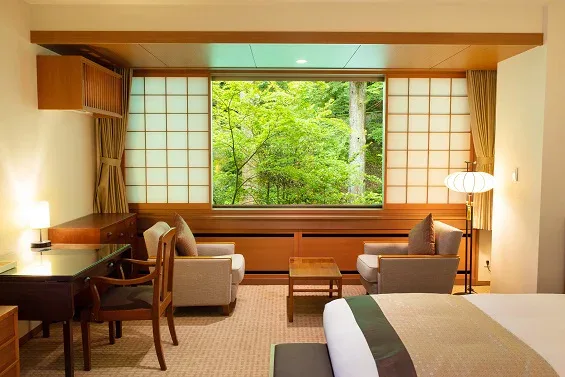
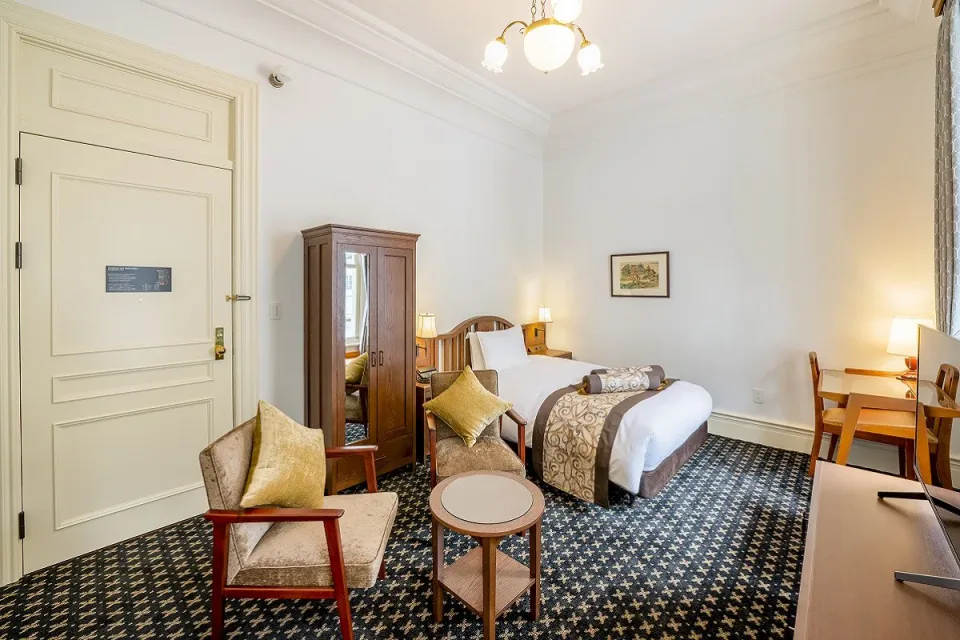
The room category matters unusually much at Fujiya Hotel. A 41 m² Forest Wing Twin, a 29–36 m² Main Building Historic Twin and a Flower Palace suite all share the Fujiya name, yet they buy different kinds of time in Hakone. Start with the room you will use: luggage and predictable circulation point towards Forest Wing; architecture can make the older buildings the reason for the stay; a larger Flower Palace room needs enough awake hours to justify its premium.
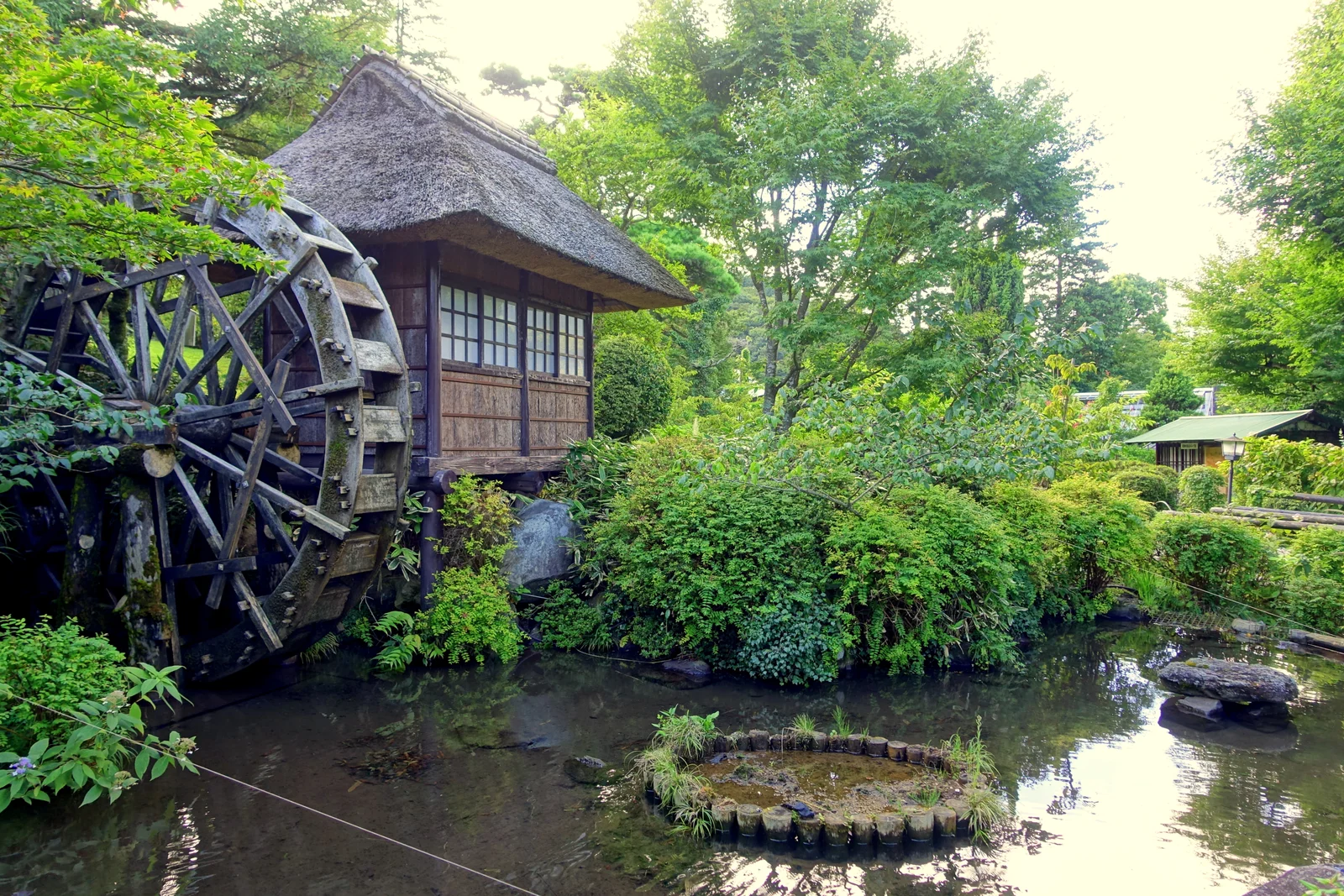
All 120 guest rooms receive natural Miyanoshita hot-spring water in their bathrooms. That changes the usual onsen-hotel calculation. You can bathe privately in any of the accommodation buildings; Forest Wing’s additional appeal is proximity to the shared guest spa. It does not hold a monopoly on hot-spring water.
The four buildings sell different room experiences
The hotel’s room inventory is spread over the Main Building, Western Building, Flower Palace and Forest Wing. The Main Building brings you into Fujiya’s older architectural core, built in 1891. Western Building historic categories add further room-size choices. Flower Palace makes the room and building part of a more elaborate heritage stay. Forest Wing favours a more regular modern layout and houses the shared spa. A booking screen that shows only “Fujiya Hotel” does not tell you which of those you are buying.
For a first Hakone visit with two substantial suitcases, begin with a Forest Wing Twin. Most standard Twin categories there are listed at 41 m², compared with a Main Building Historic Twin at 29–36 m². The area difference does not prove how two particular cases will open beside beds and furniture, but it provides a more comfortable starting range. Travellers with carry-ons who prize heritage may reasonably reverse that choice; they can spend the saved difference on the building they came to experience.
↔ Scroll table left or right
Building | Published room-size examples | Useful reason to book | Check before paying |
Main Building | Historic Twin 29–36 m²; Historic Double 28 m² | Sleeping in the original architectural core. | Individual layouts vary; area alone cannot establish clear luggage space. |
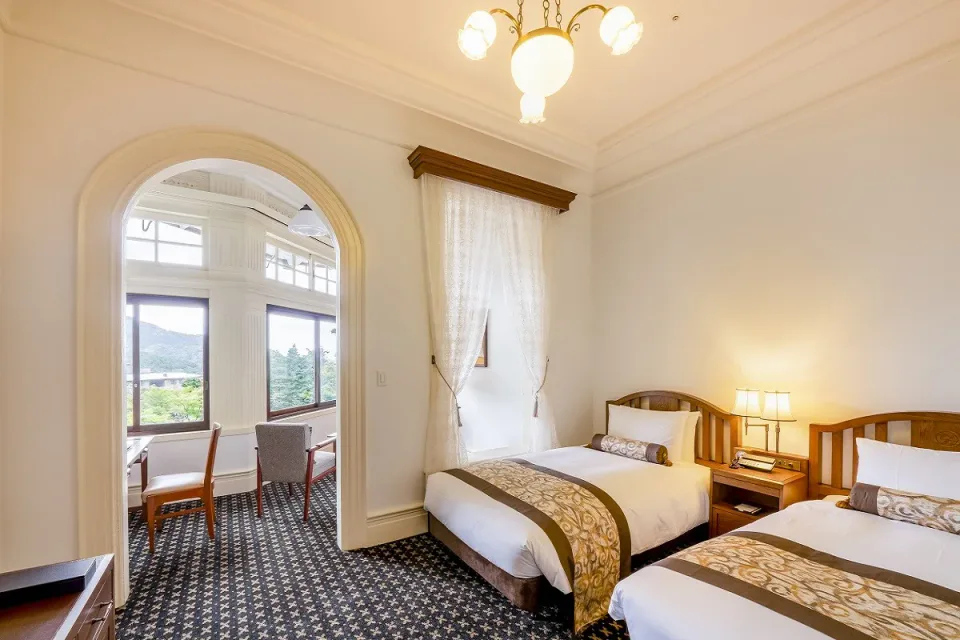
Western Building | Historic Twin 33–35 m²; Deluxe Twin 41–49 m²; Suite 60–64 m² | Historic surroundings with a wider size ladder. | Compare the named room, not a broad “historic” label. |
Flower Palace | Deluxe Twin 35–49 m²; Junior Suite 63–68 m²; Heritage 69–74 m² | Room time, architecture and a celebration stay. | Its larger categories cost more without helping a late sleep stop. |
Forest Wing | Most standard Twins 41 m²; Premier Suite 82 m² | Predictable Twin area and same-building spa access. | Less of the older-room atmosphere. |
The numbers identify a direction, not a floor plan. A Western Building Deluxe Twin may offer 41–49 m² and a different heritage setting from the 41 m² Forest Wing Twin. An anniversary booking in a Flower Palace Heritage category can be compelling when an afternoon and morning are reserved for the hotel. A family arriving after dinner to sleep before an early Lake Ashi departure is buying very little use of that large room. The one-night versus two-night Hakone comparison helps test whether a second hotel night gives you genuine use, or merely a higher bill.
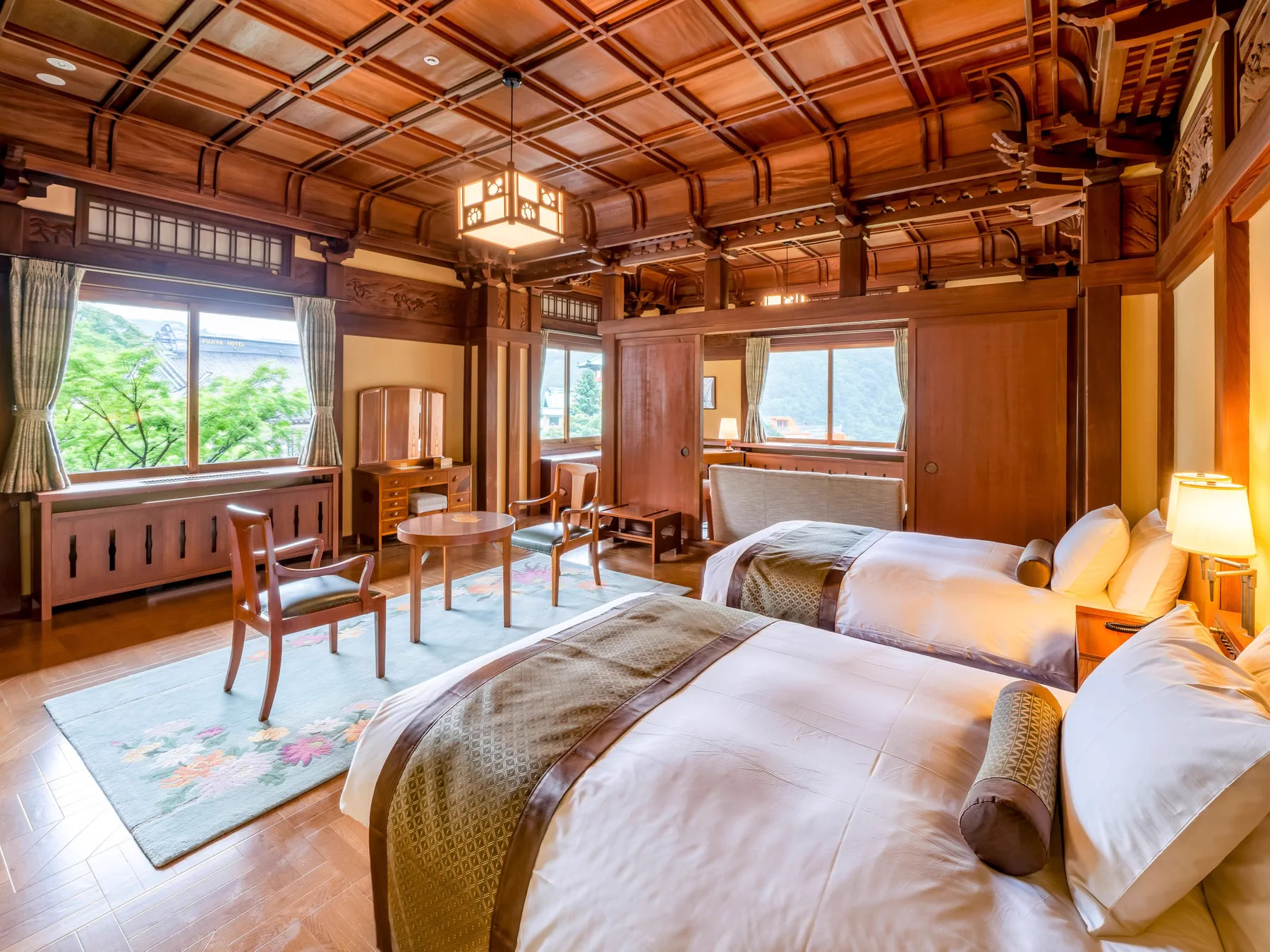
The photographs show the garden and particular historic rooms. They should not be taken as a promise that every room in the same building has identical woodwork, window orientation or furniture placement. Ask for the exact category if the architecture in a particular photo is the reason for booking. A garden view, forest view and historic interior are different purchasing motives, even though all appear within one property.
A private hot spring belongs to every guest room
The hotel’s bathing information confirms Miyanoshita hot-spring water reaches the bathrooms of all 120 rooms. Someone who avoids communal bathing can therefore choose Main, Western or Flower Palace without giving up a private hot-spring bath. Forest Wing’s sixth-floor guest spa adds indoor and semi-open-air bathing and a sauna. Its posted use periods are 14:00–25:00 and 05:00–11:00; the overnight break between those periods matters for very late or early arrivals.
Moving from another building to the Forest Wing spa takes more effort than stepping out of a Forest Wing room. That small difference may matter if you intend to bathe in the evening and again before checkout. If you expect to use only the private room bath, it has little value. The Hakone private-onsen comparison and ryokan booking guide explain how private baths, shared baths and meal plans differ at other properties. Fujiya’s in-room water is a clear feature, but the exact room design still matters.
A hotel-centred afternoon might include a garden walk, time in the room and a spa session before dinner. That itinerary uses facilities paid for through the room rate. If the day ends at the ropeway and you return after 21:00, the bath may be the only part you use before sleep. The Hakone loop order can keep the hotel afternoon intact when a one-night booking is already fixed.
The last transfer to Miyanoshita deserves planning
From Miyanoshita Station, the hotel quotes about seven minutes on foot. Its reference Odawara rail route takes roughly 47 minutes via Hakone-Yumoto and the Hakone Tozan Railway. For travellers carrying full-size cases, the hotel lists the Hotel-mae bus stop around two minutes away on foot. A bus or a short taxi may be more comfortable than a sloping walk in rain, particularly for a companion with limited mobility.
The hotel also gives approximate taxi fares of ¥3,100 from Hakone-Yumoto and ¥6,000 from Odawara. Those estimates can change with traffic or fare revisions; their dollar equivalents would drift with exchange rates. If luggage is the real obstacle, send a case ahead or read the Hakone and Kawaguchiko luggage plan before rejecting Miyanoshita solely for the station walk.
Rail and bus routes should be compared as full journeys, including the transfer at Hakone-Yumoto and the luggage you will have. The Tokyo-to-Hakone rail and pass guide is helpful when the hotel stay is part of a city-to-mountain move. Someone visiting both Hakone and Lake Kawaguchi faces a different onward-transfer problem; the two-area transport comparison and three-day Fuji-area route make that visible before an extra hotel night is committed.
Restaurant reservations put a limit on sightseeing
Main Dining Room The Fujiya and the Japanese restaurant Kikka-so currently list dinner from 17:30 to 20:30, with last orders at 19:30. Dinner is reservation-led. A late arrival after an Owakudani, ropeway or Lake Ashi day can collide with that schedule. If dinner is central to the heritage-hotel experience, reserve it and plan the afternoon backwards from the seating time. The hotel bakery operates in the daytime, roughly 08:00–17:00; it cannot stand in for an unplanned late meal.
For a room-only booking, identify an evening food plan before assuming Miyanoshita will function like a city dining district at 21:00. A meal-inclusive rate may be attractive when you are deliberately returning by late afternoon; it is a poor match if the route tends to slip. The Yumoto, Gora and Lake Ashi area comparison shows how evening food choices differ around the mountain. The meal-plan trade-off at Kinosaki ryokan is another example of why dining hours and a room-only rate must be evaluated together. Choose the room and the dining timetable together.
Breakfast and the hotel grounds also need awake time. Check-in is 15:00 and checkout is 11:00. Arriving at 15:00 leaves an afternoon to see the gardens or room and still make dinner. An 18:00 arrival can work with a booked meal and evening bath. At 21:00 followed by an 08:00 departure, you have paid for a historic property while using it mostly as a bed. A second night helps only if it removes a move or grants a separate hotel session; it does not automatically solve a trip spent entirely on the lake side.
↔ Scroll table left or right
Stay pattern | Fujiya fit | What the booking must allow |
15:00 arrival, sightseeing after checkout | Strong one-night option | Garden, historic spaces, dinner and bathing fit before the loop. |
18:00 arrival, normal departure | Can work | Book dinner and decide whether morning hotel time matters. |
After-21:00 arrival, early exit | Weak use of the premium | Little time remains for architecture, gardens or dining. |
Two nights with one Hakone outing | Strong if hotel time is protected | Reserve an evening or morning at the property, not just a second sleep. |
Miyanoshita may be central to the loop and wrong for your endpoint
Fujiya sits in the mountain route rather than on Lake Ashi or directly at Hakone-Yumoto Station. That position is useful for a loop with a deliberate hotel stop. A traveller seeking dawn lake scenery or an early lake-side departure may do better near Ashi. A traveller wanting the easiest arrival, departure and broader casual dinner choice can compare Hakone-Yumoto. Gora can be a better base for repeated cable-car and Owakudani movement. These choices concern where the days start and end, not a blanket ranking of hotel quality.
Autumn adds elevation differences: foliage near Yumoto, Miyanoshita, Gora and the lake does not peak on one identical day. Use the Hakone foliage route to decide which areas deserve the daylight, then check whether a Fujiya night follows that route naturally. The foliage and onsen hotel guide separates a scenic bath from an efficient leaf-viewing route. On a broader Tokyo–Fuji trip, the Hakone versus Kawaguchiko comparison helps avoid booking a heritage Hakone hotel for a Mount Fuji view the property does not promise.
Seven dimensions worth comparing on the same dates
↔ Scroll table left or right
The ratings below assume an afternoon arrival that leaves time for the grounds, bathing and a reserved dinner. An after-21:00 arrival would change the value judgement.
| Hotel dimension | Our score | Why |
|---|---|---|
| Location | Miyanoshita Station is about seven minutes away and Hotel-mae bus stop about two. The address suits a mid-loop pause, though Yumoto, Gora or Ashi can fit a different arrival or exit better. | |
| Room | Every room receives hot-spring water; historic Twin sizes vary below the Forest Wing standard Twin’s 41 m². The named building and layout matter more than a generic Fujiya room photo. | |
| Cleanliness | Recent guest cleanliness feedback is strong despite the historic buildings; compare the precise room category rather than assuming photos prove daily upkeep. | |
| Service | Recent staff feedback is strong. Restaurant reservations and special-room requests still need confirmation for the actual date and arrival time. | |
| Facilities | The guest spa, pools, gardens and heritage rooms make hotel time part of the trip; Forest Wing gives a closer spa approach. | |
| Food | Several distinct restaurants make dinner at the property viable, but reservations and serving hours can restrict a sightseeing-heavy day. | |
| Value | The premium buys a historic-property stay with hot-spring room water and time in the gardens. It is difficult to use fully with a late arrival and early departure. | |
| Overall | the property earns its premium when the day leaves time for the gardens, bathing and a booked meal; a bed-only stop wastes much of that purchase. |
For two full-size suitcases, price Forest Wing Twin beside a Main or Western historic category on the same date. Choose the older room when architecture is the real reason for staying and its layout works for your bags. Flower Palace is strongest when the room and hotel grounds are themselves part of a celebration. A late arrival, lake-first route or early departure changes the answer: a simpler base can serve the actual itinerary better, even if Fujiya is the more interesting building.
The booking link may earn JapanLayer a commission at no extra cost to you. Confirm the exact building and category, meal inclusion, taxes and cancellation terms before comparing prices. The Open-Air Museum timing guide may help schedule a nearby visit without letting it consume the planned hotel afternoon.
More travel reading
Fujiya transport directions · Main Dining Room hours · Tokyo immersive art museums · Hachinohe festival day choice · Fukuoka day trip choice · Hokkaido ski areas · Fukushima Waraji dates · MiraCosta room views · Aomori resort comparison · Aomori summer festivals · Tokyo National Museum tickets · Nada festival day selection · Takayama hotel room layouts · Busan hotel price comparison · Kochi Yosakoi schedule · Okinawa rental car firms