
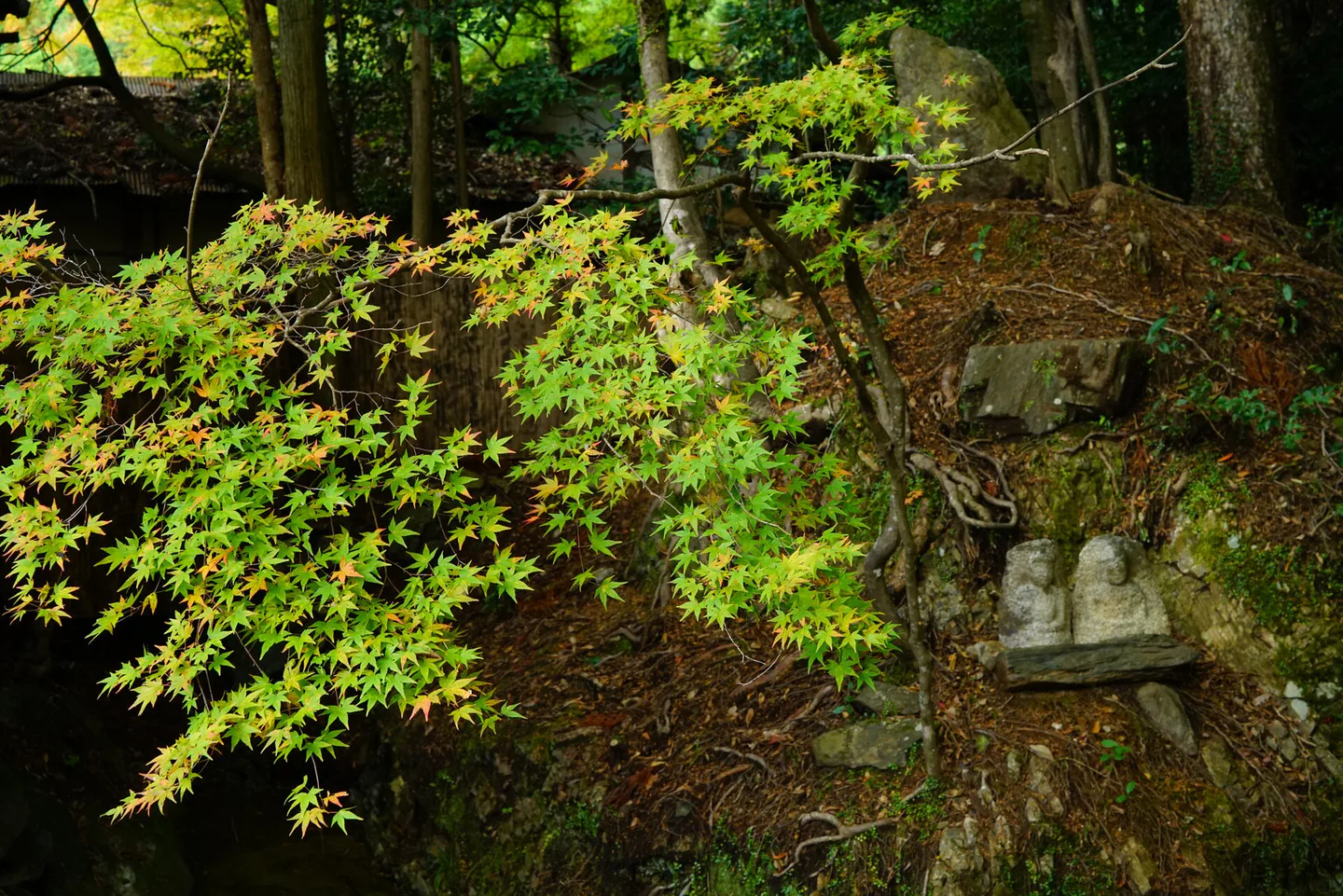
The useful question for a November Kyoto trip is which part of the city to visit on your actual dates. The hills around Takao, Ohara and Mt Hiei tend to colour ahead of lower gardens; western and eastern Kyoto then give you more choices; late in the month, Uji, Daigoji and city gardens can keep a day satisfying after a mountain valley has lost its leaves. A six-window plan gives you two plausible districts for each stretch of November, with one rail or bus corridor chosen the previous evening. It does not promise a peak on the date printed in your calendar.
Kyoto’s 2026 autumn-leaf calendar is scheduled to begin updating on 30 October. Until a dated location report exists, treat the following windows as planning ranges drawn from the city’s usual altitude sequence. The 2026 Kyoto autumn congestion map can then help you choose an hour as well as a district. A photo from last year, or a report from the other end of Arashiyama, is too broad to settle today’s walk. The Kyoto elevation guide explains why the same city can offer green lowland maples and finished mountain foliage on one afternoon.
November has six useful planning windows
| Travel dates | First district to inspect | Nearby or lower backup | What can go wrong |
|---|---|---|---|
| 1–5 Nov | Takao, Ohara, Mt Hiei or Kibune/Kurama | A temple and moss day in the same valley | Central Kyoto may still be green |
| 6–10 Nov | Mountain Kyoto; compare higher Arashiyama | Nishiyama or a single western rail route | A windy week can shorten the mountain season |
| 11–15 Nov | Arashiyama or northern Higashiyama | Remaining Takao/Ohara colour | Different slopes peak at different moments |
| 16–20 Nov | Arashiyama, Higashiyama or early Tofukuji | A second district on a separate day | Two famous areas can consume one another’s quiet hours |
| 21–25 Nov | Tofukuji, Kiyomizudera, Eikando or lower Arashiyama | Uji on a southern rail day | Temple queues and lodging pressure compound |
| 26–30 Nov | Higashiyama, Uji, Daigoji or city gardens | Architecture, tea and indoor time in the same corridor | Wind or rain can strip the remaining canopy |
The dates are a routing tool, not a leaf forecast. Pick an early or higher option and a later or lower one before you travel, then keep whichever has recent colour and a workable journey. Kyoto’s visitor information says that its hills, including Hiei, Ohara and Takao, change earlier than many central sites; it also stresses variation by year. The current calendar, when it opens, shows stages by district rather than one citywide “peak”. That distinction is especially useful for a two-night stay that cannot chase every valley. The early/mid/late nationwide foliage plan helps if Kyoto is one stop in a longer Japan trip.
Early November belongs to one mountain corridor
From 1 to 5 November, begin with the northern and higher areas rather than scheduling Kiyomizudera for its red-leaf photograph. Takao, Ohara, Kibune/Kurama and Mt Hiei are alternatives, not four stops on a loop. Takao works best when you commit to the western valley and accept its final bus segment. Jingoji has a considerable staircase; a group that cannot comfortably climb it can keep a shorter Kozanji or Saimyoji visit. The Takao and Kibune elevation comparison is useful here because the two places do not share a convenient final approach.
Ohara is a separate northern day: reach the Kokusaikaikan area by subway, finish by bus, then give Sanzenin and perhaps one other temple enough time. Kibune and Kurama instead have the Eizan Railway as the long-distance spine. Kibune needs its local onward bus, and walking over the mountain between Kurama and Kibune is a hike, not a casual shortcut between adjacent names on a map. Heavy rain or slippery ground can turn that traverse into the wrong plan. If the leaves are still green, a moss garden, temple buildings and a relaxed meal can justify the trip without a cross-city scramble for a red tree. The Kyoto weather-change itinerary gives a broader way to shorten the day.
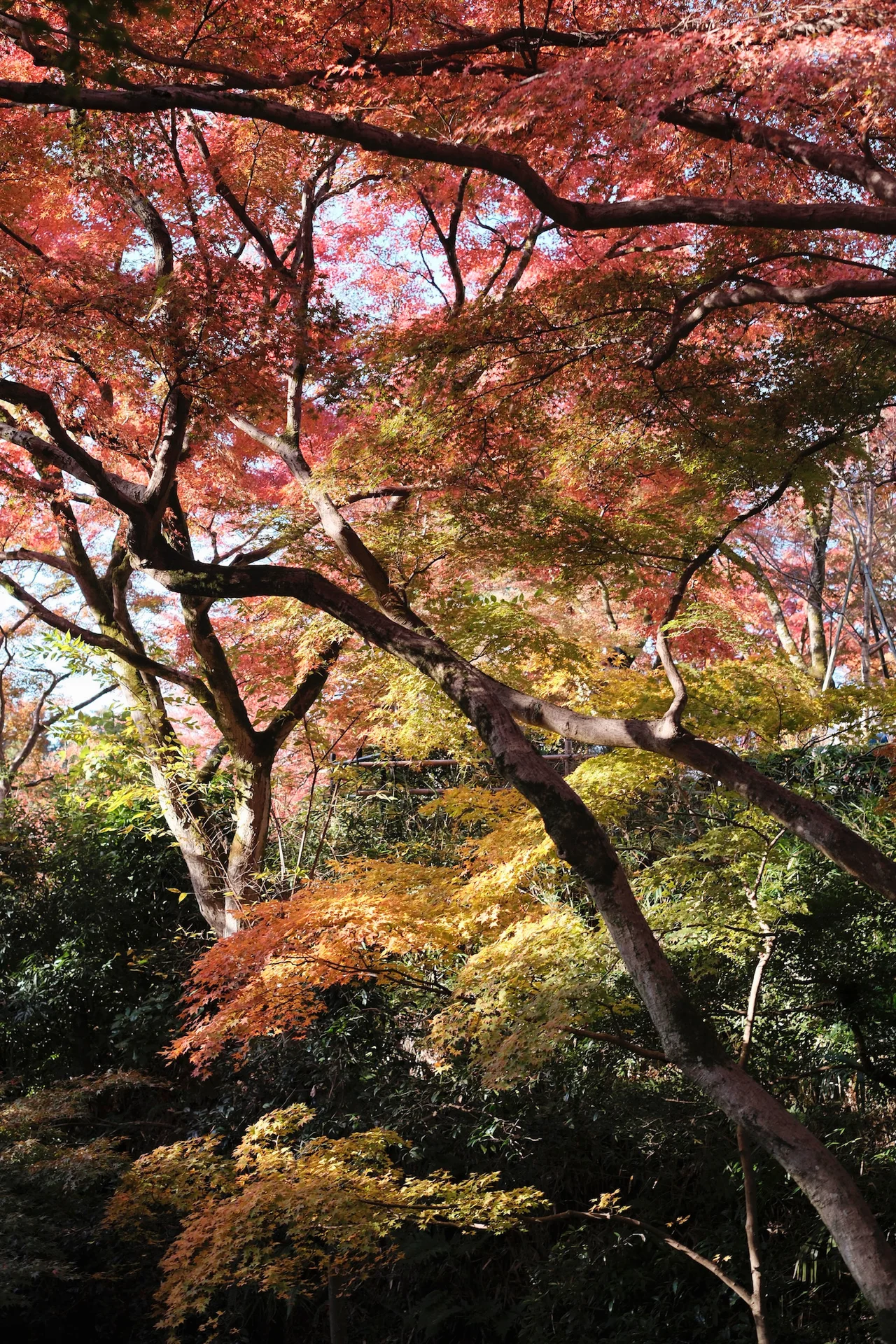
For 6–10 November, keep the mountain choice open but compare it with the higher parts of Arashiyama or Nishiyama. A still-colourful Ohara or Takao is a full day; return toward the city by mid-afternoon rather than building a late eastern temple onto a bus-dependent outing. When mountain reports show bare branches after wind, use the JR Sagano Line to enter Arashiyama early and continue beyond the Togetsukyo bridge core toward Tenryuji or Okusaga. The Arashiyama morning route gives that west-side day its own sequence. Takao in the morning, Arashiyama after lunch and an eastern illumination at night looks ambitious only until travel and daylight are counted.
The middle of the month is a hotel-base problem
Between 11 and 15 November, Arashiyama can offer a more convincing western landscape while northern Higashiyama begins to look promising. Keage subway station is a useful eastern entry for Nanzenji, Eikando and a manageable section of the Philosopher’s Path. Arashiyama’s main streets tend to fill before lunch, so an early rail arrival matters more than trying to fit every named temple into the visit. Takao and Ohara may still be strong, or they may already be fading. Keep one hotel base with a reasonable cancellation policy and choose the day’s direction using current images, not by shifting accommodation across Kyoto.
A 16–20 November stay has a different problem: several headline areas may look good at once. Give Arashiyama its own western day, northern or southern Higashiyama another, and Tofukuji or Uji a southeastern rail day. JR, Hankyu or Randen can get you near Arashiyama; the Tozai Subway is the useful spine for northern Higashiyama; JR Nara Line and Keihan serve Tofukuji, Fushimi and Uji. The Higashiyama sequence from Kiyomizu to Eikando shows why north and south of the district should not be treated as a single short temple hop.
If the group wants an illumination in this middle period, make the afternoon a genuine pause. Toji’s 2026 night programme begins on 31 October; Eikando begins on 20 November, so it does not solve a 12 November night despite the general daytime autumn exhibition. Murin-an’s limited-capacity twilight garden has specific 2026 dates of 14–15 and 21–23 November, with two sessions and a ¥4,500 ticket including café service and a short garden explanation. Each session holds 30 people and requires a reservation. This is a quieter, more structured product than a walk-up light-up, with a cancellation condition; it is worth comparing only if that is what your evening needs. The Kyoto night-viewing comparison details the other confirmed evening programmes.
Late November rewards a southern or eastern focus
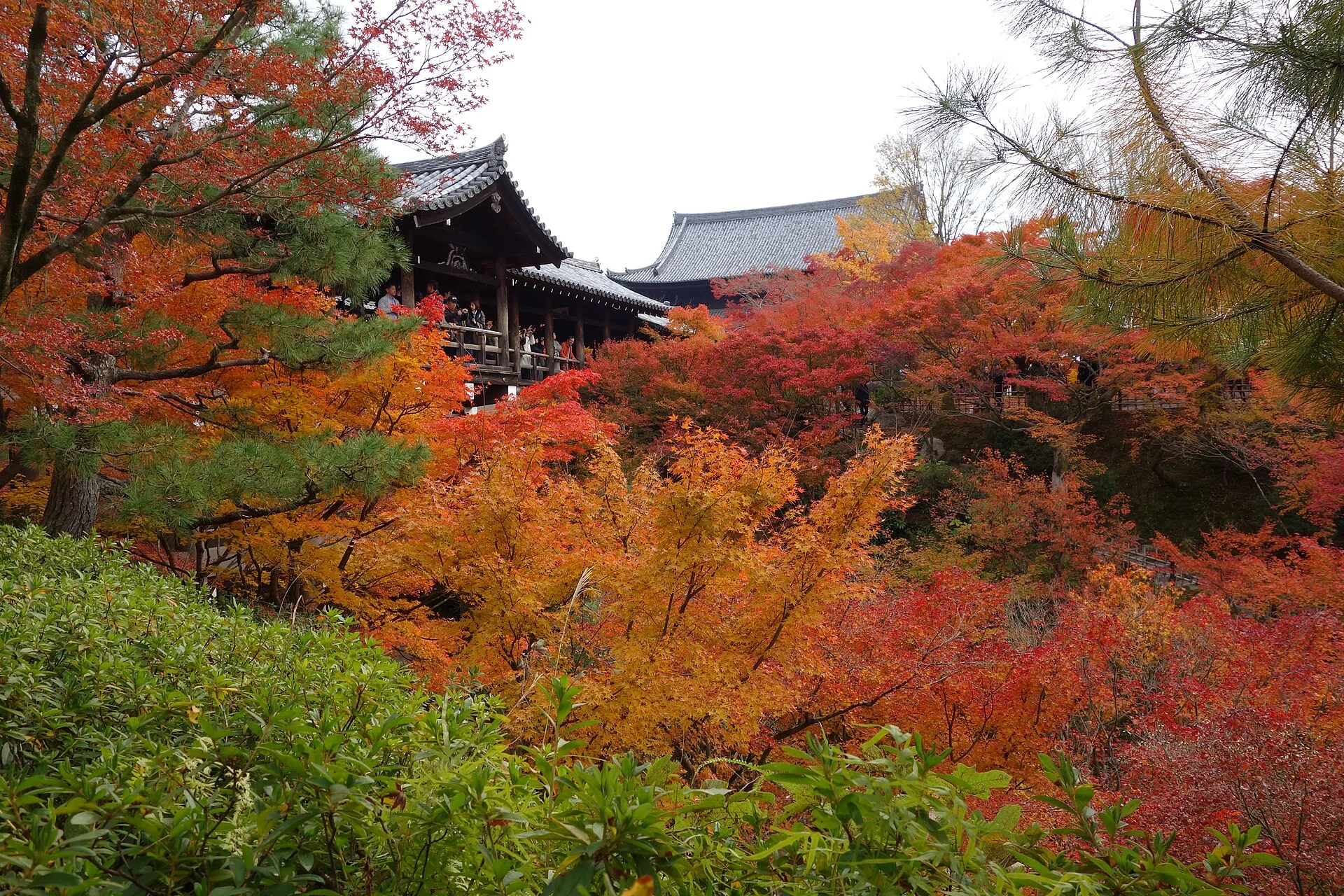
From 21 to 25 November, Tofukuji, Kiyomizudera, Eikando, lower Arashiyama and Uji are plausible headline areas, but this is also when hotel availability, train platforms, temple entrances and dinner reservations can all constrain a day. Put Tofukuji early. Fushimi Inari can follow as a short visit on the same southeastern rail direction, or Uji can take the afternoon; making both full attractions after Tofukuji is too much. A southern Higashiyama day can start with Kiyomizudera’s approach lanes, then move through the Kodaiji area toward Yasaka and Gion. The crowd and rail-corridor guide is a useful companion when the best photograph requires an opening-time arrival.
Kiyomizudera’s 2026 autumn night viewing runs 21–30 November, last entry 21:00 and closing 21:30; no reservation is required. Eikando’s dedicated programme gives 20 November–6 December, reception 17:30–20:30 and close 21:00. Toji continues until 13 December, 18:00–21:30 with last entry 21:00 and an adult night ticket of ¥1,000. These operating dates say when a night visit is possible; they do not say when each maple is at peak colour. A family that already walked Tofukuji and Fushimi Inari may get more from dinner and rest than from crossing Kyoto for another admission queue. The Eikando evening and hotel-area guide helps if the night itself is the anchor.
The right night depends on what you want from it. Opening-time daylight is still the better bet for a quieter photograph; an illumination buys atmosphere but adds an evening crowd and a second physical effort. Murin-an limits numbers but costs more and has advance booking and cancellation deadlines. For any ticketed night, check whether daytime visitors must leave and pay again, whether a reservation works with an overseas card, and when admission actually ends. A two-day first visit seldom needs an event every night. Leave at least one dinner and return journey without another timed gate.
For 26–30 November, lower Higashiyama, city gardens, Uji and Daigoji are more reliable directions to inspect than a mountain valley that has already finished in current reports. Tofukuji and Arashiyama can still work, but a storm can remove the canopy quickly. Uji offers tea, riverside walking and architecture when the leaves are patchy; Daigoji offers a temple-garden day even without every tree in full colour. Neither requires pretending that “late November” guarantees red leaves. If the trip continues into December, make food, museums, ginkgo or winter temple atmosphere a real part of the plan and accept any remaining maple colour as an addition. The late-November Japan foliage guide can help decide whether a different city is a better use of the next day.
Two, three and five days should feel different
With two days, choose two transport directions. Early in November, a mountain valley plus a city or Arashiyama day is enough; later, combine a western day with either Higashiyama or Tofukuji/Uji. Do not treat Arashiyama, Higashiyama and Uji as three short boxes to tick across two days. The cross-city transfer costs the quiet hours that make each place appealing. The three-day Kyoto foliage routes offer a fuller arrangement when you have an extra night.
A three-day trip can give the mountains, western Kyoto and the eastern or southern city separate mornings, with one night event selected for a date that actually operates. Five days add something different: one deliberately uncommitted day. A rain or wind shift can then move the best foliage corridor without forcing you to abandon a prepaid ticket or change hotels. Staying in one well-connected base also avoids repeated check-in, luggage storage and early departure work. Those practical hours are the reason a longer stay can feel flexible rather than just busier.
The tempting combinations that lose the day
| Pairing | Why it fits or fails | More usable sequence |
|---|---|---|
| Arashiyama + deep Higashiyama | Both reward early, quieter hours; the cross-city move consumes one of them | Give each a separate morning |
| Takao + Kiyomizudera night | A bus-dependent valley and a fixed eastern evening leave little recovery time | Return early or choose another night for Kiyomizu |
| Tofukuji + Fushimi Inari | Both use the southeastern JR/Keihan corridor | Foliage first, then make the shrine visit as short or long as energy allows |
| Tofukuji + Uji | A natural southbound rail sequence | Keep Uji as the afternoon rather than crossing central Kyoto |
| Nanzenji/Eikando + Kiyomizu night | Same general side, but a long walking day plus night climb is tiring | Stop for food and rest before the confirmed evening entry |
| Kibune + Ohara | Both sound northern but use different final transport spines | Choose one valley and use its nearby attractions |
A map can make two red dots look adjacent even when the useful rail lines, final bus stops and entrance slopes diverge. The aim is not to ban combinations: Tofukuji plus Uji is sensible, for example. It is to protect the best daylight and a realistic meal. If you have older parents or children, one staircase-heavy temple may be enough for the morning; the gentler foliage routes for mixed-age groups can help adjust walking demands.
A ¥230 bus ride can cost the best hour
Kyoto City Bus’s central flat fare is ¥230 for an adult. That price is easy to compare with a ¥1,100 Subway & Bus 1-Day Pass or an ¥800 Subway 1-Day Pass, both current in 2026. In autumn, however, a full bus or a road queue can be more expensive to the itinerary than the fare. Kyoto’s transport guidance recommends using rail closer to the destination and saving the bus for the last segment. For Arashiyama, start with JR, Hankyu or Randen as appropriate; use the Tozai Subway or Keihan for eastern routes, JR Nara Line or Keihan for Tofukuji and Uji, and Eizan Railway for Kurama/Kibune. Takao and Ohara still need a bus at the end.
Buy a pass after choosing the corridor. The city pass does not automatically make a day on JR or private rail cheaper, and outer routes can have coverage exceptions. The 2026 Kyoto/Arashiyama digital one-day pass is ¥1,400 during its autumn sale period, while a Keihan/Eizan product for the Kurama/Kibune area is ¥2,100 and has short-term-visitor conditions. Neither belongs in a Uji-and-Tofukuji plan just because it says Kyoto. An IC card can be simpler for mixed operators. The Kyoto transport and pass list gives the current product boundaries; compare the actual trip legs before paying.
Large suitcases make crowded platforms, temple slopes and mountain buses worse. Leave the case at one hotel, use a station locker where appropriate, or arrange delivery to the next stay with enough lead time. The Japan luggage-forwarding guide covers the send-versus-carry choice. Regional rail passes rarely solve the last bus to a valley temple, and a rented car inherits the road congestion. Kyoto City is adding measures for its 2026 autumn bus season, but a timetable is still less useful if a full vehicle passes the stop.
| The hidden cost | How it changes the route | Practical limit |
|---|---|---|
| Full bus or roadside queue | A small map distance becomes an uncertain arrival | Use rail first and board nearer the bus origin when possible |
| Temple stairs | The second or third stop may become physically unrealistic | Choose one demanding climb for a mixed-age group |
| Illumination | A second paid visit adds travel, queue and 2–3 evening hours | Use one confirmed event after a meal and pause |
| Cross-city transfer | Quiet morning light is lost while changing districts | Move the far-side site to a different day |
| Prepaid night ticket | Less freedom to follow better colour or weather | Book it because the programme is worthwhile on its own |
Your bed determines which switch is easy
Kyoto Station works for JR access to Uji, Tofukuji and Arashiyama, Shinkansen arrivals, luggage and an early onward train. Kawaramachi or Gion suits an eastern evening, dining and Keihan or Hankyu connections. Karasuma Oike has the most flexible subway position for a longer trip that may alternate west and east. Demachiyanagi shortens the start for Kibune and Kurama, and can help an Ohara day, but the hotel choice and late dining range are narrower. The Kyoto autumn hotel-area comparison weighs these against an Osaka base.
Otsu can be a reasonable response to a Kyoto sell-out, but a late illumination then needs a protected return train. The same applies to an Osaka hotel used for several Kyoto days: the room may cost less, but an early temple start and late evening both incur the intercity trip. The Kyoto sold-out backup-base guide lays out those trade-offs. For an international departure or long Shinkansen leg, keep the final night near the required departure corridor instead of depending on a rural bus that morning.
Compare Kyoto stays for your chosen rail corridor. Search after you have selected the two or three directions you will actually travel. A hotel a little farther from a famous garden can be better when it removes an awkward return from the evening you care about most.
Rain and leaf fall should change the stop, not the whole city
Check recent photographs for the exact district, then compare wind and rainfall from the previous two days. If a northern valley remains green, a temple and moss visit there can still be worthwhile, or you can move to a more developed western or eastern corridor. If the mountain maples have already dropped, stop chasing last week’s image and choose Higashiyama, Uji, Daigoji or a city garden. Rain makes the Kurama traverse, Jingoji stairs and a long Philosopher’s Path walk poor bets; a rail-accessible temple, museum and meal in the same district are easier to shorten.
Night viewing adds a second clock. Eikando’s reception ends 20:30, while Kiyomizudera and Toji have 21:00 last entries on their current 2026 programmes. A printed cutoff is not a good target arrival time when an entrance queue or uphill walk precedes it. One night is enough for many two- or three-day stays, particularly after a full foliage walk. If an event is sold out or your group is tired, dinner, a Gion stroll or an early start next morning can be a better replacement than another paid event across town. The free Kyoto autumn paths give a lower-commitment daytime option too.
The city’s autumn-leaf calendar is scheduled to start its 2026 updates on 30 October; its previous-season photographs are useful for orientation, not as a 2026 condition report. The Kyoto transport guide and current autumn congestion guidance help set realistic arrival and exit choices. For dates and ticket rules, use the actual Kiyomizudera night programme, Eikando autumn programme, Toji autumn programme or Murin-an twilight event for the night you select.
Other route ideas: Nov 16–20: Arashiyama, Higashiyama and the, Japan Autumn Leaves in Mid-November: Kyoto,, 5- or 7-Day Kyushu Autumn Leaves, Okutama Autumn Leaves Guide: Mitake Gorge,, Japan Autumn Leaves in September: Hokkaido,.
Other route ideas: Hokkaido Autumn Leaves 2026: Daisetsuzan, Sapporo, Hakodate and Onuma Autumn Leaves: Late, Japan Autumn Leaves Late October: Tohoku,, Unzen Nita Pass Autumn Leaves Guide:, Japan Autumn Leaves December: Tokyo, Kyoto,.