
September changes Japan's foliage map by elevation before it changes the familiar city parks. At the start of the month, look at the upper Daisetsuzan slopes in Hokkaido. Later, a trip may reach Ginsendai, Tateyama's alpine zones or the grass colour of Oze. Tokyo, Kyoto and Osaka can still be excellent city stops, but their temple and street-tree foliage should not be promised as a September spectacle.
September 2026 has now ended. This is a planning framework for future September trips, using the operators' typical seasonal pattern rather than presenting August 2026 monitoring notes as a live forecast. The sequence changes with temperature, wind and first snow; any dated colour report is useful only for the location and day it describes. For the broader progression, see the regional autumn calendar and the dated foliage updates.
↔ Scroll table left or right
| September dates | Landscape to consider first | What may go wrong | Better response |
|---|---|---|---|
| 1–10 | Asahidake and Kurodake upper slopes | Colour has not developed at your chosen elevation; wind or cloud blocks the view. | Keep an Asahikawa or Sounkyo fallback day instead of promising a peak. |
| 11–20 | Daisetsuzan, with Ginsendai only if its access works | Road controls, bus seats, hiking conditions or return times. | Make the trail day conditional on both colour and transport. |
| 21–30 | Lower Daisetsuzan bands, Tateyama, Oze marsh grass | First snow, fog, seasonal transport or short daylight. | Buy a weather window and protect the route back. |
| Any September city-only route | Urban sightseeing rather than mature maple colour | Expecting November-like Kyoto or Tokyo leaves. | Travel for the city itself or change dates for tree foliage. |
Asahidake and Kurodake offer different first attempts
Asahidake gives a broad volcanic plateau, Sugatami Pond and fumaroles. The ropeway deposits visitors around 1,600 metres, where the Sugatami circuit is approximately 1.7 km and one hour in benign conditions. That is a reference time, not a guarantee: exposed wind, uneven footing and fast weather shifts can stretch it. A ropeway ticket does not convert an alpine walk into a sheltered city stroll. Our Asahidake–Kurodake comparison covers the contrasting approaches.
Kurodake is more modular. Its ropeway rises from Sounkyo to the fifth station in about seven minutes, where some visitors can take in the view without a summit hike. The summer chairlift continues to the seventh station when operating; its usual published season extends to mid-October, but future-year dates and wind closures must be checked for the travel day. The operator describes a common sequence from upper summit colour in early September through seventh-station slopes in mid-month and fifth-station colour later. Those are typical elevation bands, not reserved peak dates. The Hokkaido autumn base guide compares nights that support either side.
The two mountains sit in different access valleys. Putting both in one day because both turn early gives away the weather margin that makes September viable. Asahikawa can support a car-free Asahidake attempt and other low-risk activities. Sounkyo better positions a second Kurodake morning, with its gorge and onsen when the summit is hidden. The wider Hokkaido route can help place a single alpine day within the full holiday.
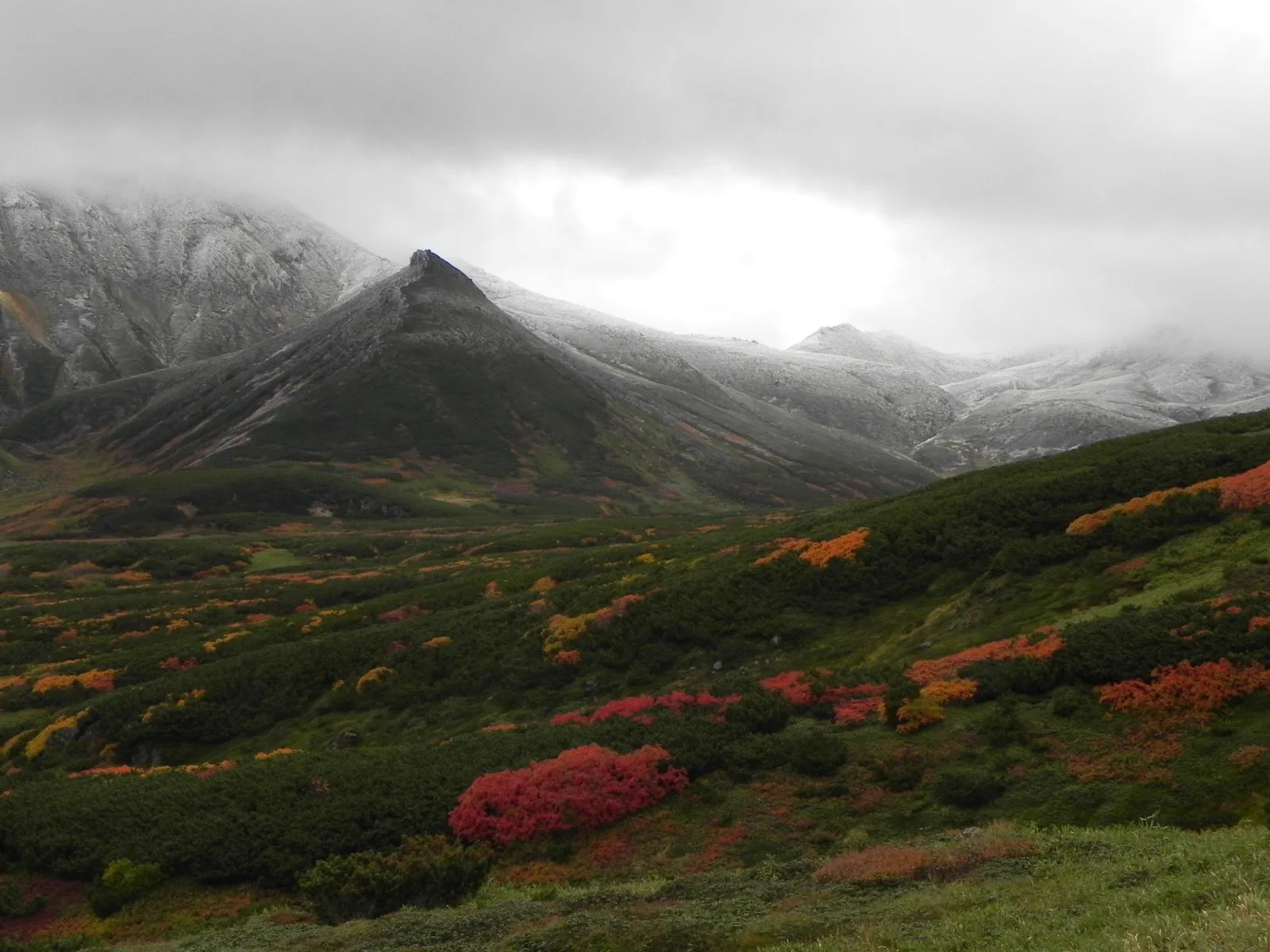
The photograph above depicts Daisetsuzan slopes with red vegetation below mist and a dusting of pale colour high on the ridge. It illustrates why visibility and elevation matter; it is not a current-season colour report.
Ginsendai needs a transport plan as much as a colour report
Ginsendai is a road-end trail access point, not a ropeway observation deck. A striking mid-September image is therefore insufficient reason to go. Road restrictions, parking arrangements, bus capacity and the final return have to work on the same day as the weather and walking plan. Check the specific season's access rules before reserving a Sounkyo night around it. The Ginsendai access guide goes into the shuttle and trail questions.
For a group starting from Asahikawa, a Sounkyo pre-night can put the first attempt nearer the mountain and leave an early second window. It is still a hike: waterproof warmth, suitable shoes, food, water, offline navigation and bear awareness belong in the plan. First snow or ice changes the route for anyone without mountain experience and equipment. If transport or weather fails, stay with Kurodake, the gorge or an onsen rather than improvising a road-end return. A historical “mid-September peak” cannot override an unsafe or unworkable trip.
Three questions should be answered separately before moving a hotel booking: Is there a recent location-level colour report? Is the ropeway, trail or bus operating for the dates? Is the weather and return journey usable? Good colour alone does not fix the other two. For families or slower walkers, the distinction between a viewpoint and a long trail is particularly important.
Why an overnight can rescue the mountain day
September foliage at Daisetsuzan is a narrow target because the attractive elevation changes during the month. Staying near an access valley gives a traveller a first attempt and, if wind or cloud blocks it, a second morning before leaving the region. That is a different benefit from simply reaching the trailhead early. A single day trip from Sapporo may be possible for some sights, but a cancelled ropeway or restricted road can consume most of that day before an alternative is found.
The overnight still needs to be placed on the correct side of the mountains. Sounkyo supports Kurodake and the Ginsendai approach; Asahikawa is a more flexible base for the Asahidake side and city options. Moving between those bases just to chase a dated peak report can be counterproductive if the group loses the next clear morning in transit. Decide which access point is the main objective, then choose a second activity that is worthwhile without leaf colour. A gorge walk, town visit or onsen is a real fallback; a second high-altitude ticket subject to the same wind may not be.
Late September opens an alpine route and a marshland alternative
Murodo sits around 2,450 metres on the Tateyama Kurobe Alpine Route; Midagahara is lower, around 1,930 metres. They do not need to be at the same stage of autumn on the same date. A west-side stay in Toyama can allow a Murodo return on the better weather day, while a full Toyama-to-Ogizawa crossing is a different itinerary with several timed non-JR segments. The route's 2026 operating season was scheduled through 30 November, but that does not promise clear September mountain weather or the same timetable in a future year. Compare the traverse with an out-and-back before attaching it to a flight or non-refundable evening plan.
Two nights in Toyama can be useful if one day is reserved for the clearest mountain forecast and the other can absorb Toyama, Kanazawa or another safer outing. One night followed by a compulsory crossing leaves little room for fog or a delayed transport segment. Forward the main suitcase between city hotels where practical and take a small mountain bag. A Hokuriku itinerary comparison can help determine whether the rest of the region merits those nights.
On the Alpine Route, distinguish a west-side return from a traverse before buying the next night's hotel. A Murodo out-and-back can bring the traveler to Toyama again; a traverse ends toward Nagano and changes where luggage and onward rail travel should go. Visibility also changes the value of the long crossing. If cloud closes the high section, a visitor with two Toyama nights can use the city day first and try the mountain the next morning. A visitor committed to a one-way crossing has to decide whether the transport journey itself remains worthwhile without the panorama.
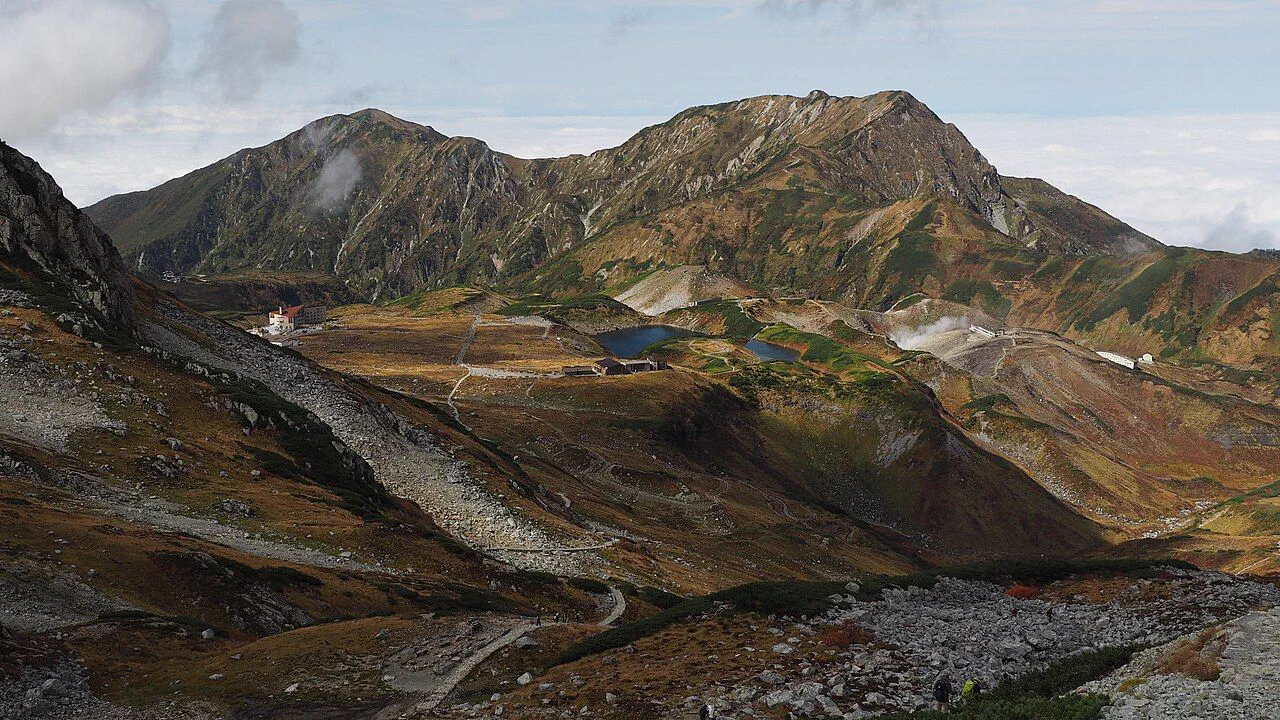
The Tateyama photograph shows exposed rocky ridges and only patchy colour. It should not be read as evidence that a future late-September day will have the same appearance.
Oze provides another kind of September autumn. Its kusamomiji is grass and marsh vegetation turning orange, ochre and gold while many trees remain green. Boardwalks and wetland views, rather than red temple maple canopies, are the reason to go. The Oze Preservation Foundation places grass colour in September and fuller tree colour later. A Katashina or Tokura pre-night is often easier than racing out and back from Tokyo for a long boardwalk day. Access from Tokura uses a bus or shared taxi toward the trailhead; car restrictions make the last leg a separate planning task. Tokyo's later tree-colour options serve a different visual goal.
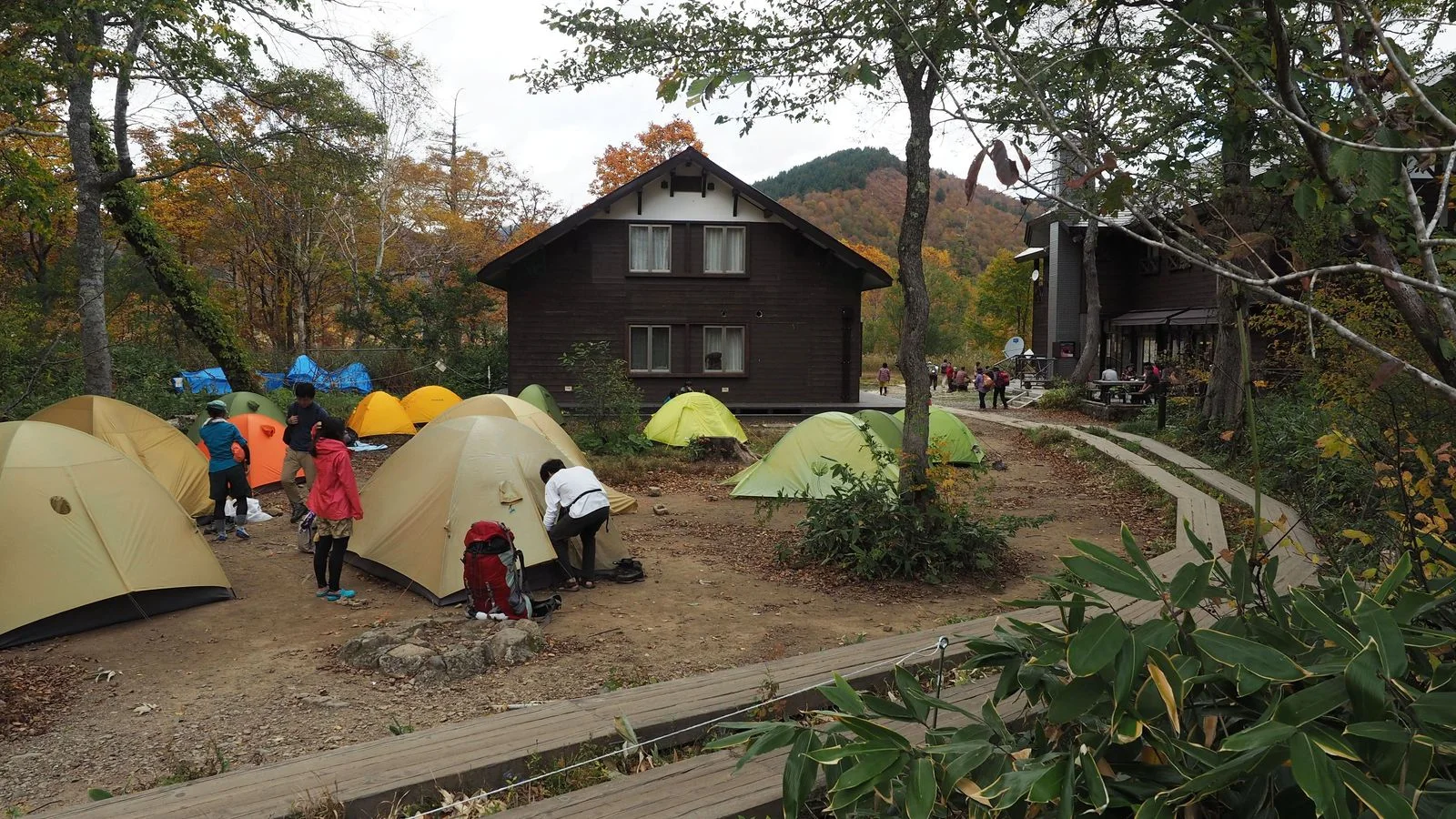
The Oze image shows a campsite and hikers near wooden lodges, with some autumn tones around the trees. It does not show a sweeping marsh boardwalk, so use it for an overnight-stay context rather than proof of peak kusamomiji.
A flexible base is worth more than a rigid peak prediction
Asahikawa helps an early-September Daisetsuzan plan: airport and rail access, Asahidake, Biei and city alternatives can share a base. Sounkyo better serves Kurodake, Ginsendai and an onsen fallback. Toyama is the western gateway to a late-September Tateyama attempt. Tokura or Katashina shortens an Oze approach. Move hotels when the change buys a second useful weather window or an enjoyable non-mountain evening, not solely because an old foliage chart marks a location red. Airport choice also follows the elevation and regional sequence. Once the route is settled, compare Asahikawa stays for Daisetsuzan or Toyama station-area stays for Tateyama using the same dates and cancellation conditions.
A rail pass can pay for part of the intercity spine without solving a Daisetsuzan local bus, ropeway, Ginsendai shuttle, Oze trailhead transfer or the Alpine Route's non-JR vehicles. Price and reserve the final approach separately. Luggage is part of that decision: a missed rural connection is more costly with a full suitcase. An onsen stay may earn its place when it also gives the group an enjoyable low-visibility day.
In wind or cloud at Asahidake and Kurodake, Asahikawa, Biei, Higashikawa or Sounkyo remain usable. A closed Ginsendai road calls for a planned Kurodake or gorge alternative. At Tateyama, a second Toyama night permits a mountain-day swap; at Oze, persistent rain may justify shortening or cancelling a boardwalk outing. These are actual itinerary branches, not guaranteed substitutes for foliage. A longer autumn itinerary has more room to follow the season than a fixed one-day detour.
For the first third of September, begin with Daisetsuzan's upper slopes. In the middle third, consider Ginsendai only if access and return conditions permit. Later in the month, compare Tateyama's altitude and Oze's grass colour instead of promising Kyoto-like maples. Travellers beginning in the final days can use the month-by-month comparison to test whether delaying the trip would better fit the desired colour; a ten-day route gives more room to shift between areas. If the real aim is red trees around buildings, a November Kyoto plan is a more honest fit. A September trip succeeds when the route, weather option and expected type of colour agree.
Related seasonal routes and operating pages
Asahidake vs Kurodake · tenki.jp foliage service status · Weathernews foliage service status · Asahidake Ropeway live operation and seasonal · Kurodake Ropeway live operation · Kurodake ropeway/chairlift operating periods · Tateyama Kurobe notices · Hakone Autumn Leaves Guide: Foliage Timing · Free Autumn Leaves in Kyoto 2026: · Hakodate and Onuma Autumn Leaves: Late · 5- or 7-Day Kyushu Autumn Leaves · Unzen Nita Pass Autumn Leaves Guide: · Okutama Autumn Leaves Guide: Mitake Gorge,