
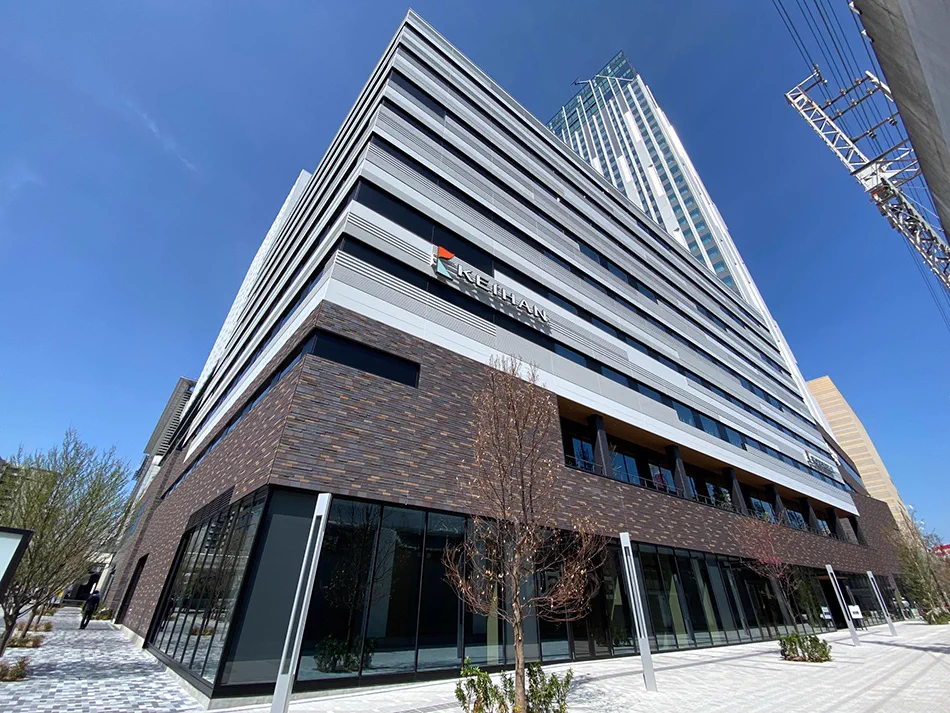
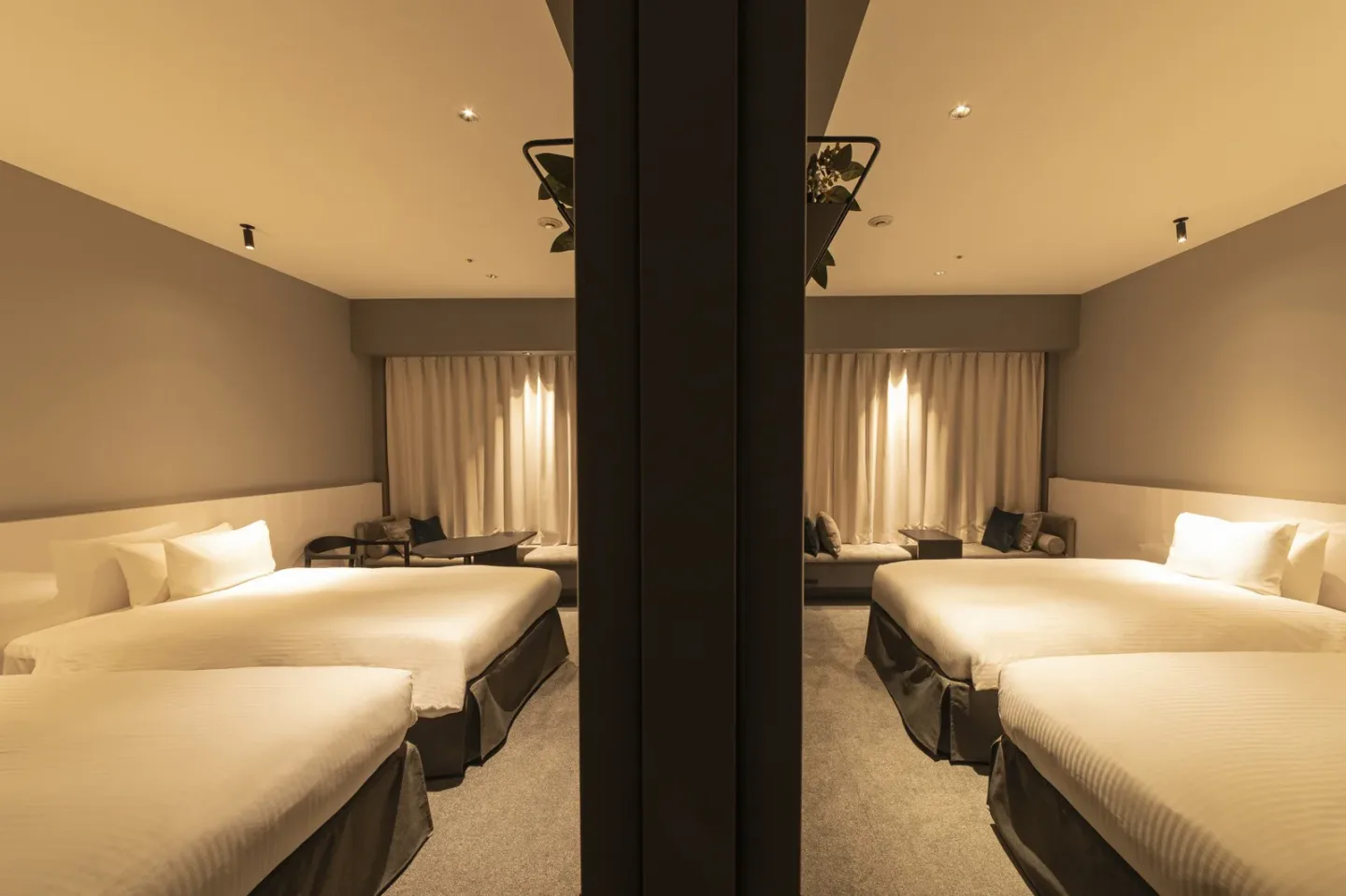
Four adults can fit in Hotel Keihan Namba Grande's 44 m² Family Room or its pair of Connecting Rooms. The difference shows up at 07:00. The Family Room has four permanent 110 cm beds, two washbasins and one bathroom; its washer-dryer and small kitchen support a longer shared stay. The Connecting Rooms are two internally joined 20 m² twins, with two separate bathrooms and washbasins. If four people need showers before an early departure, that second bathroom may be more useful than the Family Room's extra four nominal square metres.
For parents with younger children and several nights of laundry, the result can reverse. One shared Family Room keeps the party together and adds a drum washer-dryer, IH hob, oven-microwave and 90-litre refrigerator-freezer. A Twin Room with Japanese Room gives a different 42 m² solution for guests willing to use futons. First select the sleeping arrangement and morning routine, then compare the complete room rates. “Sleeps five” alone does not tell you whether the fifth person receives a permanent bed, extra bed or futon.
Which morning problem repeats throughout the stay?
| Party routine | Room to price first | Limitation to check |
|---|---|---|
| Four adults, several early train or tour departures | Connecting Rooms | Confirm the internally connected product, not two adjacent requests |
| Four sharing meals, washing clothes and staying three to five nights | 44 m² Family Room | One shower despite two basins |
| Three to five comfortable with floor bedding | 42 m² Twin plus Japanese Room | Futons take the third to fifth sleeping positions |
| One or two nights with little cooking or laundry | Any eligible simpler room | A Concept Room premium may buy unused equipment |
The published Connecting Room is a real internal-door product: two standard twin rooms, each around 20 m², paired for a total of 40 m². For four, it supplies four existing 110 × 195 cm beds. With five or six, the hotel adds one or two 100 × 185 cm extra beds. Each side has a washing-area bathroom and separate washbasin. That gives two groups some privacy while allowing the door to be used between them. A generic booking for two separate rooms does not guarantee this layout; confirm that “Connecting Room” is the sold room type.
Four people showering sequentially in one bathroom create a queue even when the shared room feels spacious. If each person hypothetically takes 15 minutes, the shower sequence occupies around 60 minutes. Two bathrooms can make it around 30 minutes if the party splits evenly. This is a planning illustration, not a claim about real guest shower lengths, housekeeping flow or guaranteed departure time. The practical point is that parallel capacity can matter more than 44 versus 40 m² on a fixed early morning.
| Illustrative preparation step | One Family Room | Two Connecting Rooms |
|---|---|---|
| Four people at 15 minutes per shower | About 60 minutes through one bathroom | About 30 minutes if split evenly across two bathrooms |
| Teeth, face and makeup | Two basins in one shared zone | One basin in each separate room |
| Different bedtimes | All four share one sleeping space | Two rooms can keep separate sleep schedules |
The same two-bath layout can help at bedtime when children and adults keep different schedules, or when two pairs want distinct sleeping zones. The Family Room has its own advantage: everyone remains in one shared space and can use the laundry and kitchenette without dividing supplies. The larger-friends-room decision explores when separation overtakes the appeal of one big room.
Family Room equipment can repay a multi-night stay
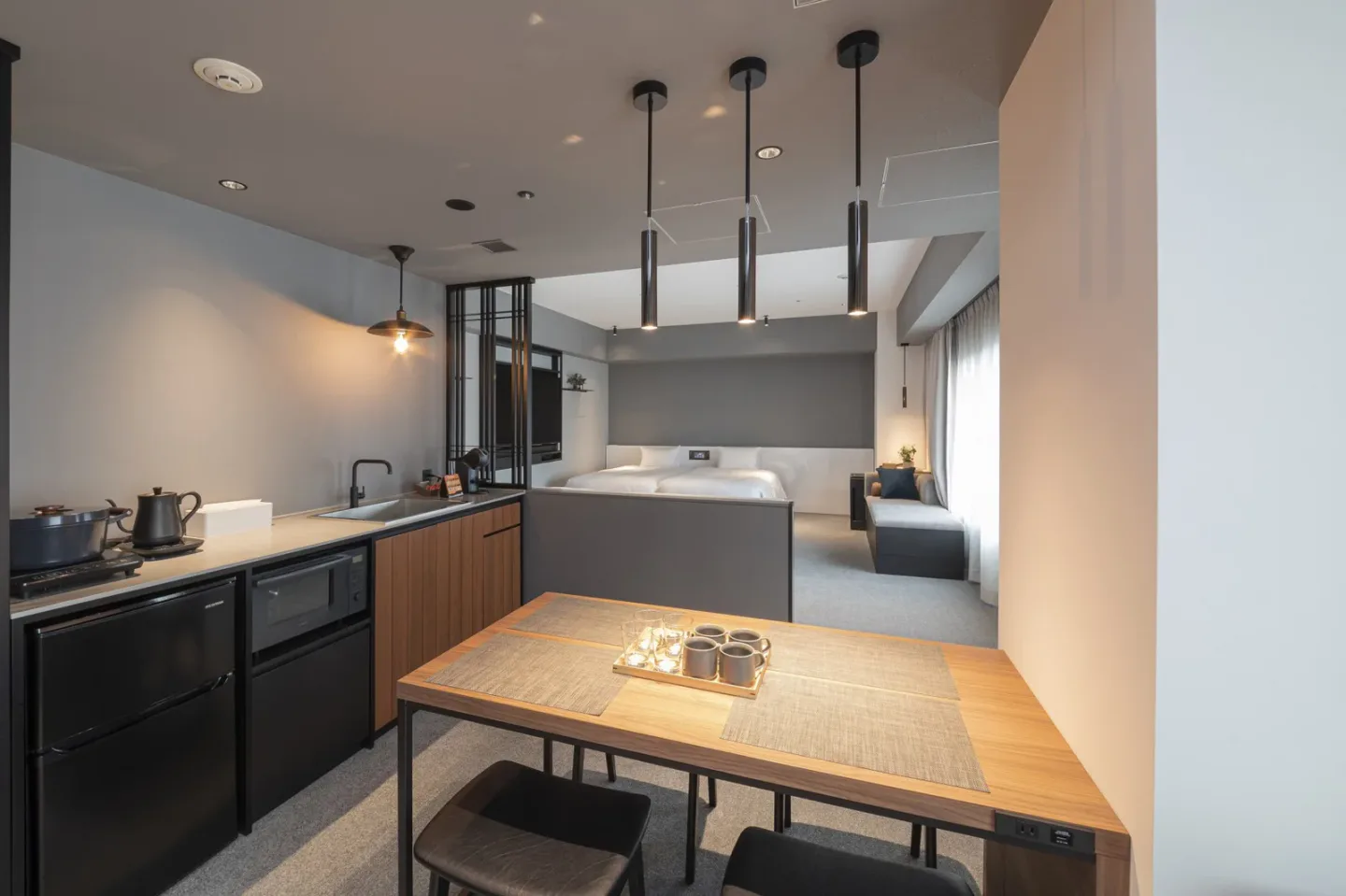
The hotel's Family Room page specifies 44 m² and capacity for five. Four occupants receive four 110 × 195 cm existing beds; a fifth uses a 100 × 185 cm extra bed. It also lists a drum washer-dryer, IH cooking hob, oven-microwave, 90-litre freezer-refrigerator, double basin and separate washing-area bath. Those features make it unusually self-sufficient for a hotel room, but they solve different tasks. The double basin allows two people to brush teeth or prepare in parallel; the shower remains one.
A family returning with damp clothes after a park day can start a load without waiting for shared machines. A parent can make a simple breakfast while another person rests; the larger refrigerator can hold more than a small minibar. These advantages repeat on a four-night stay that uses the equipment. A one-night stay ending with an early checkout may leave the hob and washer untouched. If the room rate is meaningfully above a valid twin arrangement, price only the functions your group expects to use.
The photograph of the Family Room shows its kitchen counter and table in the same view as the sleeping area. It helps explain how people can work on separate tasks without leaving the room. It does not prove there is infinite case-opening space. Four beds, the table and an extra fifth bed occupy area. Ask where large suitcases can lie open before treating 44 m² as automatically spacious for every five-person group. The Swissôtel-versus-MIMARU four-adult comparison uses the same luggage and shared-space test nearby.
Futons change the 42 m² Japanese-room option
The Twin Room with Japanese Room covers 42 m² and accepts up to five. The first two guests use two 110 × 195 cm beds. For three through five people, the hotel lays out one to three 100 × 195 cm futons in the Japanese-style portion. This is not the same sleep experience as a Family Room's four fixed beds or Connecting Rooms' two pairings of twins. A group that enjoys a tatami zone may find the arrangement flexible; an adult who dislikes rising from floor bedding should not be persuaded by the small two-square-metre gap to the Family Room.
Like the Family Room, the Japanese option belongs to the hotel's Concept Room group with washer-dryer, IH hob, oven-microwave, 90-litre freezer-refrigerator and two washbasins. The equipment can make it a practical long stay even though the bedding is fundamentally different. Compare it on bedding preference first and area second. The fifth traveller's body size and mobility may also matter more than the fact that five names fit into the listing.
The hotel also publishes Superior Family and other larger room labels. Do not substitute one name for another without opening the exact bed plan and in-room equipment list. A Fukuoka one-room-versus-two-room comparison shows why occupancy alone is a weak shortcut across cities.
Shared laundry changes the price of the Family Room
In February 2026, Hotel Keihan Namba Grande added first-floor Smart Laundry for staying guests. The chain's April 2026 notice lists three washers and three dryers, operating 24 hours, with online cashless payment. The posted tariff in that notice is ¥600 per wash and ¥100 per ten minutes of drying. Those yen figures are recent but still need checking for the dates of travel. The key planning change is that a guest in Connecting Rooms or a smaller room can wash clothes without an in-room machine.
Suppose a load requires forty minutes in a shared dryer. Four ten-minute units cost ¥400, giving a ¥1,000 wash-and-dry example. Three identical loads would cost ¥3,000. The dryer requirement is an assumption for comparing room premiums, not a promise that all clothes dry in forty minutes. The original article converted the example to US dollars using the 26 August 2026 exchange rate; that conversion is no longer a useful current booking figure. Keep the yen tariff and check it at the machine or current hotel notice.
| Example laundry use | Shared-machine cost at the published tariff | What in-room laundry may still save |
|---|---|---|
| No load | ¥0 | Nothing from the washer alone |
| One wash plus assumed 40-minute dry | ¥1,000 | A trip downstairs and possible machine wait |
| Three identical loads | ¥3,000 | Several collection and scheduling trips |
Even repeated coin-laundry charges may be small beside a multi-night room-rate gap. In-room laundry must earn a higher premium through convenience and control as well as fee avoidance. Shared machines can be occupied when several guests return from a rainy day. A private machine can run while the family eats, but its cycle and noise may have their own practical costs. Compare the actual refundable price difference over the entire stay; do not assign an invented financial value to avoiding a lift ride.
A five-night Osaka visit with a mid-trip clothing reset is a stronger case for the Concept Family Room than a one-night stop. The washer-dryer room distinction at Mercure Tokyu Stay Namba is worth reading if a private machine is the priority and the group can fit its room categories.
Breakfast can make the kitchenette useful without saving money
Hotel Keihan currently lists a breakfast buffet from 07:00 to 10:00, with last entry at 09:30 and about sixty seats. The posted charge is ¥2,200 including tax. A group leaving early for a train or park entrance may not have time to sit together at 07:00 and eat at its preferred pace. The Family and Japanese-style rooms allow someone to make a simple meal independently while another traveller sleeps or packs. That is a scheduling advantage, not evidence that self-catering will always be cheaper.
When comparing breakfast-inclusive rates, check how many guests and children the plan covers. A family of five may pay a different total from the apparent base room price. The shared room's 90-litre freezer-refrigerator can help if the group actually stocks food, but there is little value in it when every meal is eaten outside. The Osaka five-day itinerary helps reveal which mornings start early enough for the kitchen to matter.
Namba is close to some arrivals and longer from others
The hotel gives an approximately six-minute walk from Nankai Namba's south gate and around ten minutes from Osaka Metro Namba Exit 3. A Kansai Airport arrival using Nankai rail therefore finishes near the more useful side of the station complex. A morning route to Shin-Osaka via the Metro begins with a different station approach. Do not treat “near Namba Station” as one uniform minute count when mapping a group with several cases.
For a stay whose evenings cluster around Namba, Shinsaibashi or Nipponbashi, this position can keep the last return leg short. A trip dominated by Osaka Station or northbound day trips may spend more travel time reaching its first train. Namba versus Umeda decides the broad base. Kansai Airport arrival routes matter before assuming the quickest train also delivers the shortest case haul to the hotel.
Families planning Universal Studios Japan should count how many park days repeat the Namba-to-Universal City journey. One park day within a food-focused Osaka visit can leave Namba as a useful base. Two very early starts may favour a closer hotel. The one-versus-two-day USJ hotel test handles that separate decision before the group chooses Family Room or Connecting Rooms within Namba.
Our seven Hotel Keihan Namba Grande ratings for a family
The marks assume four or five people and a room with the actual number of beds they need. The 44 m² Family Room and a two-bath connecting pair solve different morning queues.
| Dimension | Our rating | The booking consequence |
|---|---|---|
| Location | Nankai arrival and southern Namba plans fit better than repeated JR Osaka mornings. | |
| Room | A four-bed Family Room supplies one bath; connecting twins supply two baths and more privacy. | |
| Cleanliness | A broad international stay sample rates upkeep much higher than a smaller local set. | |
| Service | Current cross-market staff feedback is strong, while arrival instructions need attention in a group. | |
| Facilities | The Family Room washer-dryer and kitchen equipment materially help a multi-night family stay. | |
| Food | Breakfast is optional when a kitchenette and Namba dining choices are already on hand. | |
| Value | Two bathrooms can beat free laundry for a group with four simultaneous morning routines. |
Our overall group-stay read is 8.5/10 with the bed plan confirmed. A nominal five-person room without five workable sleeping places should be rejected.
Seven room and itinerary checks after the hotel ratings
| Dimension | Family or Japanese Concept Room | Connecting Rooms |
|---|---|---|
| Occupancy and beds | Family: four fixed beds plus one extra; Japanese: two beds plus futons | Four fixed beds plus up to two extras |
| Morning parallelism | Two basins but one shower | Two bathrooms and two basins |
| Arrival with luggage | One 44 or 42 m² shared layout | Two 20 m² rooms and a dividing doorway |
| Self-sufficiency | Washer-dryer, hob, oven-microwave and large refrigerator | Use the first-floor shared laundry for washing |
| Itinerary fit | Best when the group uses room equipment across several nights | Best when simultaneous preparation or separate sleep repeats |
| Bath and privacy | One washing-area bath in a shared room | Two separate bath and sleeping zones |
| Price and utilisation | Value depends on repeated equipment use | Value depends on time saved and privacy desired |
The old story gave the Family Room 9.0/10 in one four-night scenario, Connecting Rooms 9.2/10 for early-start adults, a Japanese room 8.6/10 for willing futon users and a two-person short Family stay 7.1/10. Those figures were editorial scenario scores, not measured hotel quality. The practical dimensions and the four scenarios remain above, but a universal numerical ranking would imply evidence we do not have. The group's real bottleneck decides which room earns any premium.
Another way to test a more expensive Connecting Room is to divide its entire-stay premium over the estimated morning queue hours it removes. The result is personal: an hour before a fixed early train can be worth much more than an hour on a relaxed holiday morning. The arithmetic is useful only after the party estimates its actual shower overlaps and confirms the rate difference. It should not become a published “acceptable yen per hour” standard for all travellers.
| Order of booking checks | Evidence to confirm | If it fails |
|---|---|---|
| 1. Guest count and bedding | Four fixed beds, fifth extra bed or Japanese futon as applicable | Discard that room before price comparison |
| 2. Morning overlap | Whether the party truly needs two simultaneous showers | A single room can remain viable |
| 3. Laundry and simple food | How often the private machine, hob or refrigerator will be used | Do not credit unused Concept Room equipment |
| 4. Length of stay | Repeated uses over several nights or one short sleep stop | Compare smaller eligible rooms |
| 5. Complete rate | Internally connected booking, breakfast, tax and cancellation | Reprice the actual valid product |
Compare Keihan Namba Grande room configurations for the actual four- or five-person party. The confirmation should say Family Room, Twin Room with Japanese Room or Connecting Room, state the bedding and match the expected number of internally linked rooms. Check breakfast, tax, cancellation and any fifth-bed terms. For a longer family stay, the private laundry and kitchen may justify one shared room. For early-start adults, two bathrooms may solve more daily friction than those appliances. A short stay that uses neither should return to simpler valid rooms before buying the largest label.
Room and service details: Family Room equipment · internally joined rooms · Twin Room with Japanese Room · full room list · Smart Laundry tariff and machines · breakfast hours and charge · station exits and walking routes.
Other group-room decisions
Centara Grand Osaka vs Hotel Keihan Namba Grande · Centara Grand Osaka vs Hotel Keihan Namba Grande · Tokyu Stay Osaka Hommachi: five-night stay · Where to stay for USJ · Centara Grand Hotel Osaka: Is the 40m² Family Room Worth It for Four? · MIMARU Osaka Namba Station: Is One 35 m² Apartment Better Than Two Rooms for Four? · Zentis Osaka vs voco Osaka Central: Laundry or a 30m² Room for 4+ Nights? · Tokyo Family Hotels: “Sleeps Four” Is Not the Same as “Works for Four” · THE LUIGANS Spa & Resort Fukuoka: Is a 33m² Sea-View Room Worth Leaving Hakata for One Night? · Where to Stay for Kishiwada Danjiri: Kishiwada, Rinku or Namba · Hotel WBF Grande Asahikawa: Is a 2-Minute Station Walk Worth It for a Northern Hokkaido Base? · OMO7 Osaka vs Centara Grand Hotel Osaka: USJ Shuttle or 40m² Family Room? · Hilton Tokyo Bay Happy Magic vs Family Happy Magic: Which Room? · Lake Biwa Otsu Prince Hotel: Is the 36.2m² Lake View Worth the Shuttle? · Osaka Solo Travel Hotels: Pay for Less Friction, Not a Bigger Room · HOTEL STRATA NAHA: For Two Nights, Is a Twin Room Worth More Than a Compact Room?