
Hiroshima earns a place on a first Japan itinerary when the Peace Memorial Museum or Miyajima is a real reason for making the journey. A westbound route can make the stop economical in travel time; a return from Osaka solely to fit Hiroshima into a standard checklist can consume a day that the trip needs elsewhere. Decide what the city contributes before assigning it a night. For most visitors who want both the museum and a substantial island visit, one night is a workable starting point. Two nights need a further purpose, such as a slower museum day, Mt. Misen or an evening on Miyajima.
On a ten-day Tokyo–Kyoto–Osaka trip, I would usually leave Hiroshima out unless its history or island landscape ranks above another planned stop. At roughly twelve days, a one-night addition can work well when the train continues toward Fukuoka. With fourteen days or more, there is more space, but duration alone still does not make a second Hiroshima night valuable. These are allocations, not universal city rankings. A first-visit Japan route should establish the days already committed to Tokyo and Kansai before adding a western detour.
↔ Scroll table left or right
| Current trip | Hiroshima allocation to test | Reason |
|---|---|---|
| Ten days, Tokyo and Kansai still short of time | Usually none | Another hotel change can take a scarce full day from a higher priority |
| Twelve days, museum personally important | One night or a focused day | The stop has a defined purpose instead of being added for completeness |
| Kansai → Hiroshima → Fukuoka or Kyushu | One night is often efficient | The city lies on the onward direction of travel |
| Kansai → Hiroshima → Kansai | Selective day or overnight | Most long-distance movement exists only for the detour |
| Museum plus a slow Miyajima visit | One or two nights | Separate the experiences and decide where the quiet hours should fall |
A westbound stop costs less travel time than a return excursion
Hiroshima is not far from Kansai in Shinkansen terms, but the train journey is only part of the cost. A published Shin-Osaka–Hiroshima estimate is about one hour and twenty minutes. A return from Osaka repeats that long-distance leg, producing roughly two hours and forty minutes on the Shinkansen before hotel access, station navigation, waiting or local sightseeing transport. Travelling on to Hakata takes roughly another hour and ten minutes by fast train, but it moves the visitor toward Kyushu rather than back to the same Kansai base.
That difference is route credit. Osaka → Hiroshima → Fukuoka allows Hiroshima to divide an existing westbound journey. Osaka → Hiroshima → Osaka makes almost the entire intercity round trip an expense incurred for this stop. A traveller ending the Japan trip in western Japan may also avoid reversing direction. Conversely, someone whose flights and reserved Kyoto hotel bring them back east must count the return honestly. Hiroshima versus Fukuoka for extra nights is the useful next decision once the direction is fixed.
Luggage increases the friction of a one-night stop. Large cases require finding storage or moving through a new station, checking in, repacking and leaving again. A linear itinerary lets travellers consider forwarding the main bags to the next long-stay base while carrying an overnight bag. That does not justify every short stop, but it can remove some physical cost. Japan luggage forwarding choices explain when sending, storing or carrying each case is sensible. A backtrack with all cases can be much less attractive than the same museum visit on a through-route.
The Peace Memorial Museum needs attention, not just a time slot
The museum can be the sole reason to choose Hiroshima, particularly for visitors with a serious interest in the city's history. It presents personal belongings, accounts and material about the atomic bombing and its aftermath. Treat it as a high-attention visit rather than an item squeezed between two trains. The museum's extended schedule offers flexibility, yet a late closing time does not guarantee a relaxed visit if admission, exhibits, the park and the onward train all occupy the same afternoon.
City visitor information currently lists 07:30–19:00 from March to July and September to November, 07:30–20:00 in August and 07:30–18:00 from December to February, with special arrangements on 5–6 August. The earlier and later extended periods require designated advance web tickets; on-site ticket queues can also be long at busy times. The practical move is to choose a museum entry window and then protect time after it, rather than relying on the building's last closing hour. Specific reservation periods can change, so make the entry decision against the visit date.
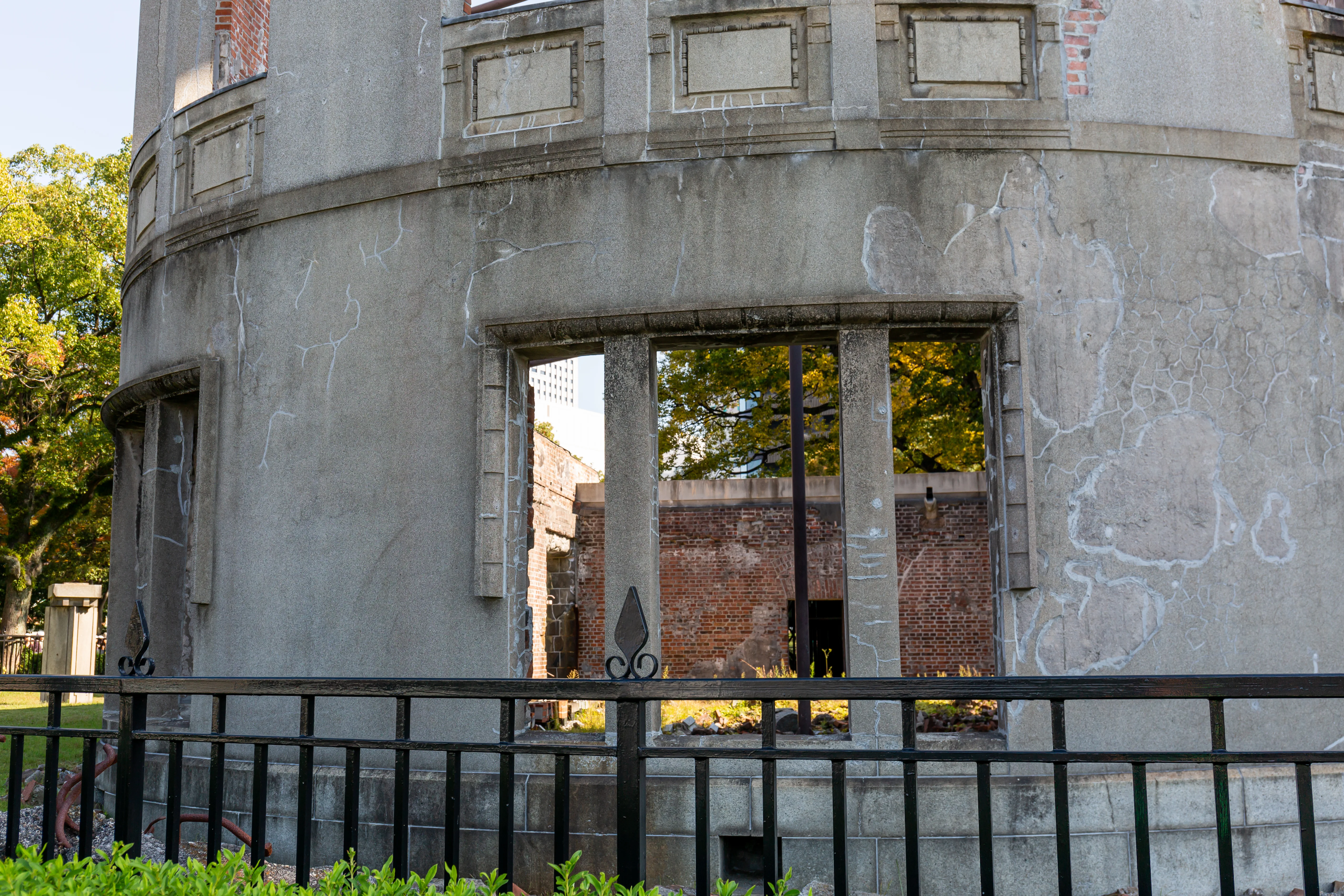
The Peace Memorial Park and Atomic Bomb Dome belong in the same historical area, but neither converts the museum into a quick photo stop. The dome image here is a close view of its scarred concrete and exposed brick; it does not show the full walk from the museum. A visitor can take a pause in the park after reading the exhibits before adding another major attraction. A one-day Hiroshima route helps plan a city-focused day; a two-day city-and-island route helps when both anchors are firm.
There is no need to manufacture a second anchor if the museum is enough for this trip. A visitor arriving from Kansai could take a focused day trip and return, while another may prefer one overnight to avoid a hard train deadline after the exhibits. The answer depends on the value placed on the museum and the opportunity cost of moving accommodation. If the stop is personally significant, removing a lower-priority Osaka shopping day or secondary Tokyo activity is more honest than compressing Hiroshima until it merely fits on paper.
Miyajima adds a transport chain and a different tempo
Reaching Miyajima from Hiroshima Station involves the JR Sanyo Line to Miyajimaguchi, a short walk to the ferry pier, a ferry crossing of about ten minutes and then the island walk. A common rail estimate is about thirty minutes to Miyajimaguchi and another five minutes on foot to the pier. None of these legs is difficult alone. Together, and then repeated on the return, they make the island a substantial programme rather than an incidental Hiroshima afternoon.
The current Japanese JR West Miyajima Ferry fare page lists ¥200 one way for an adult; the older English fare page still shows ¥180. Miyajima additionally collects a ¥100 visitor tax on entry, with its stated exemptions for young children. The difference in money is small beside hotel and rail costs, but separating ferry fare from tax prevents a misleading single “ticket price.” The regular ferry timetable lists a 22:14 departure from Miyajima, so an overnight on the island is not needed simply to get back across the water. Check the actual day's service, especially around disruption or special dates.
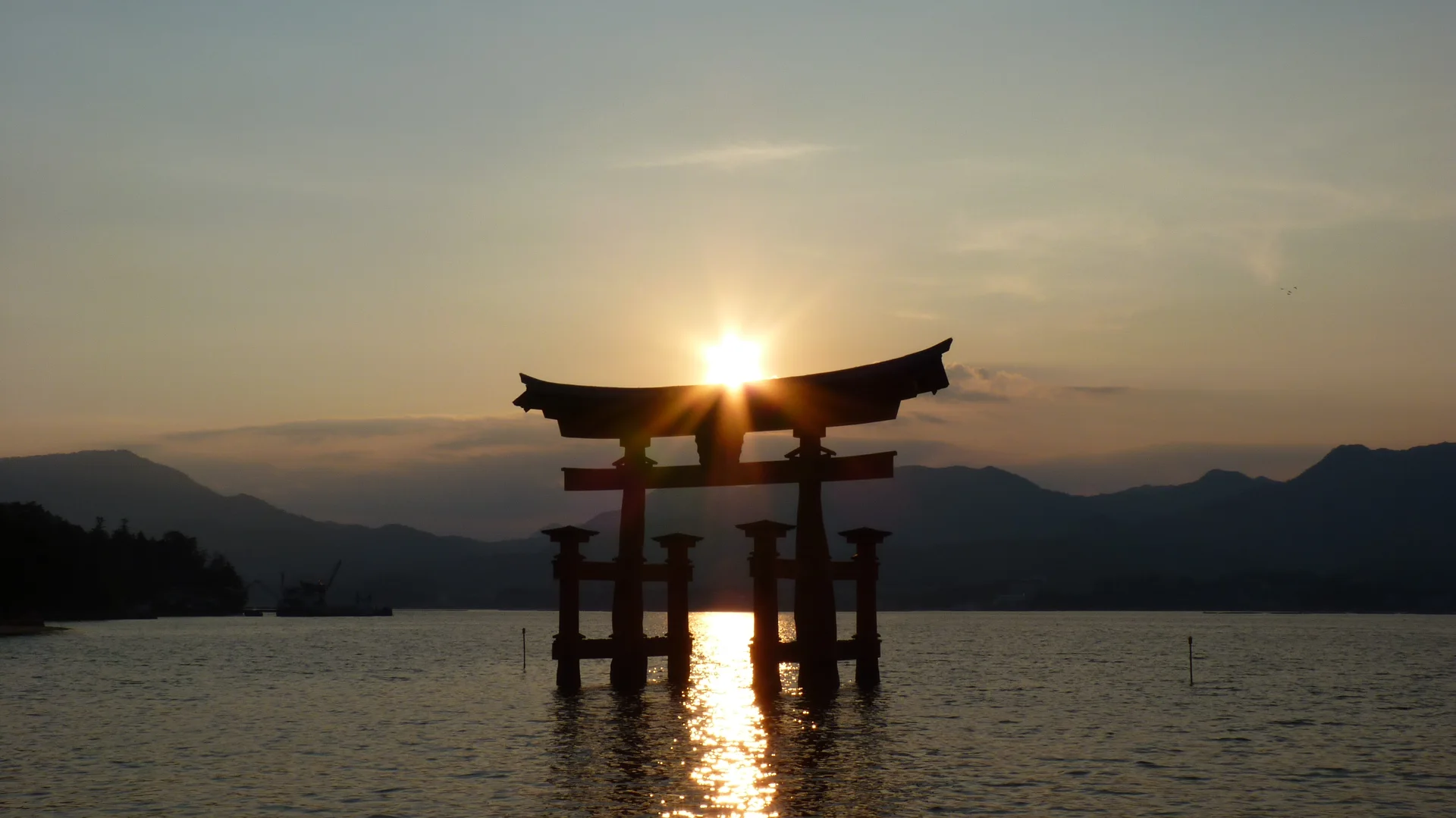
A fast visit to Itsukushima Shrine and the sea torii differs from a day that includes Mt. Misen, Momijidani, a leisurely lunch or sunset. The torii photograph captures the gate as the sun sinks behind it, which is the kind of time-specific scene a short midday stop may miss. Staying on Miyajima can buy early or late island hours with fewer day visitors and an island lodging experience; it also creates more ferry and baggage dependence. The Hiroshima-versus-Miyajima overnight choice should be made after deciding whether the museum or island deserves the less crowded hours.
For a first visit with both anchors, a city hotel for one night is often the more resilient default: luggage can stay nearer the Shinkansen and museum, while the island receives its own day. An island night becomes persuasive when the island's evening or morning is the central goal. One-night logistics are tighter if the guest arrives late, wants an unhurried museum and also wants a long island hike; that combination is a credible reason for two nights. If all the traveller wants on Miyajima is the shrine and a brief street walk, it may be possible without a second hotel night.
Hiroshima Castle no longer fills an extra indoor half-day
Hiroshima Castle's reconstructed main keep closed to visitors on 22 March 2026 because of deterioration and safety concerns. Its exterior remains visible, and the Ninomaru reconstructed buildings and Sannomaru facilities continue to operate. This changes older plans that treated “Peace Park + castle museum + Shukkeien” as a reliable full city day. The grounds and exterior can still fit a walk, but the closed keep should not be counted as the same indoor history attraction.
That distinction matters when deciding whether a second urban half-day justifies the hotel move. A visitor with a separate interest in Shukkeien, baseball, a Setouchi continuation or another specific activity may still want the time. Someone using the castle only as a third line on an itinerary should reconsider. Onomichi as a side trip is a different, time-consuming reason to stay longer; it should be priced in calendar days rather than added to a crowded museum-and-island visit.
The number of real anchors determines the number of nights
With one anchor, a focused day or a single night may suffice. With both the museum and Miyajima, one night usually allows the city on one side of the sleep and the island on the other. Two nights earn their keep when one anchor deliberately expands: a Misen walk, time on Miyajima after day visitors leave, a museum visit without a same-day departure, or a third substantive regional purpose. A second night that exists only because Hiroshima is famous is a weak use of limited first-trip time.
At ten days, compare the proposed Hiroshima block with what it removes. Kyoto cut to one usable day, Tokyo divided into fragments around Disney or Fuji, and several consecutive one-night hotels can make the whole route tiring. If the museum has personal importance, it can still outrank a routine Osaka day; the point is to make that trade explicit. Fukuoka on a first trip poses a similar westbound allocation question, while Hakone versus Kawaguchiko shows how another overnight can compete for the same calendar space.
At twelve days, route shape matters more than the number itself. A westbound stop between Osaka and Fukuoka uses travel already pointing onward; an Osaka return demands a stronger anchor. Replacing a low-priority Osaka afternoon may be a fair exchange, whereas removing the only full Kyoto day often is not. At fourteen days or more, the city and island can breathe, but two nights still need jobs. One efficient night can cover the museum, sleep in the city, then spend the next day on Miyajima before travelling farther west.
↔ Scroll table left or right
| Number of nights | What the allocation can do | When it is weak |
|---|---|---|
| No night | One defined city or island anchor on a focused day | Both major anchors are forced into a rushed return |
| One night | Separate museum and Miyajima across two days | A late arrival and early onward train erase both usable blocks |
| Two nights | Slow one anchor or add a real third regional purpose | The second day consists of filler after a quick museum and shrine visit |
Other potential third anchors include an event, a baseball game, Okunoshima or onward time in Onomichi. Each has its own transport demand. Listing several possibilities does not mean they all fit into one extra day. Naoshima's full-day calculation is an example of how island travel can consume more time than a map suggests; the same discipline applies before stacking Setouchi destinations on Hiroshima.
City or island: give the quiet hours to the main purpose
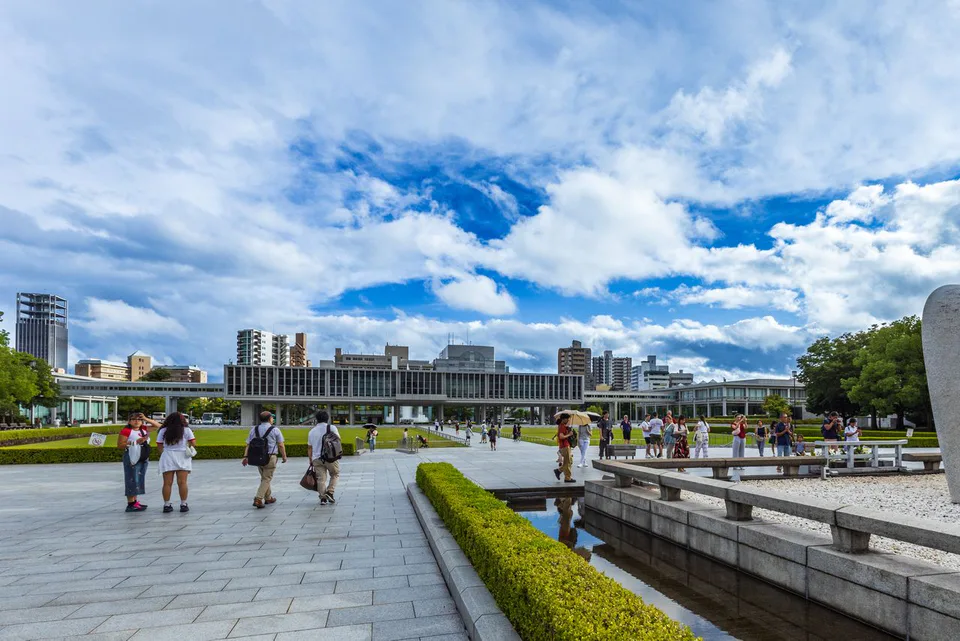
Stay in Hiroshima city if the Peace Memorial Museum is the central commitment, luggage is heavy or the next morning uses a Shinkansen. City lodging gives more transport flexibility after the exhibits and makes a train departure less dependent on ferry timing. The image of people crossing the museum plaza shows an open park on a clear day; actual visitor volume and weather will vary. A city overnight can allow a museum visit without an immediate long-distance return.
Stay on Miyajima if the late island atmosphere or early shrine approach is the reason for making the trip. That choice moves the quiet hours to the island but requires ferry travel with whatever luggage was brought. A ryokan dinner plan also sets an arrival deadline, so a museum visit immediately before it may create pressure. The lodging-base comparison examines the overnight in more detail; an Otaru day-versus-night case illustrates the same general principle of paying for the hours day visitors miss.
For families or travellers with mobility constraints, count each transfer rather than simply total rail minutes. A large station, a pier walk, ferry boarding and another hotel check-in can turn a nominally short detour into a demanding day. Forwarding main cases or using one stable city base may be more useful than selecting the cheapest room. A history-focused party could reasonably spend its entire Hiroshima time in the city and skip Miyajima on this trip; an island-focused party could do the reverse.
Taxes belong in the budget, not in the decision's centre
Hiroshima Prefecture began charging an accommodation tax on 1 April 2026. It is ¥200 per guest per night when the pre-tax room-only accommodation charge reaches ¥6,000 per person; stays below that threshold are exempt. Miyajima's entry tax is a separate ¥100. A family should include the applicable amounts in a hotel comparison, but neither sum explains whether a museum visit and island day are worth another hotel move. That question is mostly about time, energy and the experiences displaced elsewhere.
Hotel prices, train fares and cancellation rules vary by date. Fix the route and number of nights first, then compare actual room offers, baggage handling and the next day's transport. The western stop can be a highlight of a first Japan trip when the museum or Miyajima has genuine priority and the journey fits; it can be a poor detour when it exists solely to satisfy a sample itinerary. Compare Hiroshima-area rooms once the city-versus-island night has been chosen.
Place details
Related guides: Is Fukuoka Worth Visiting on a First Japan Trip? When to Add It—and When to Skip It · Onomichi Day Trip from Hiroshima: Is It Worth Adding in 3 Days? · Itoshima Day Trip or Overnight? Is One Coastal Night Worth It? · Naoshima Day Trip from Takamatsu: Is It Worth a Full Day? · Fukuoka Guys’ Trip Hotels: Four Adults, Real Beds, Late Nights and Whether a Sauna Is Worth It · Otaru Day Trip or Overnight? When Is One Night Worth It? · RIHGA Royal Gran Okinawa: Is Asahibashi Worth It for Your First or Last Night? · Nara Day Trip or Overnight? When Is One Night Worth It? · Mt Fuji Day Trip or Overnight: When an Extra Night Is Worth It · 35 Best Things to Do in Osaka 2026: What’s Worth Your Time by Area, Budget and Trip Style
Biei Day Trip or Overnight? When Staying One Night Is Worth It
teamLab Borderless Tokyo Review: Is It Worth 2–3 Hours of Your Tokyo Trip?
Hakone vs Kawaguchiko: Which Is Better for Your First Japan Trip?
Nara Ikimono Museum Is Great With Kids — But It Can Hijack a First-Time Nara Day Trip
Hiroshima or Miyajima for One Night · Hiroshima tourism — access · Hiroshima Peace Memorial Museum visitor information · Hiroshima Castle — current closure and remaining facilities · JR West Miyajima Ferry — timetable · JR West Miyajima Ferry — fares and visitor tax · Hiroshima Prefecture — accommodation tax · Fukuoka City tourism — Shinkansen access