
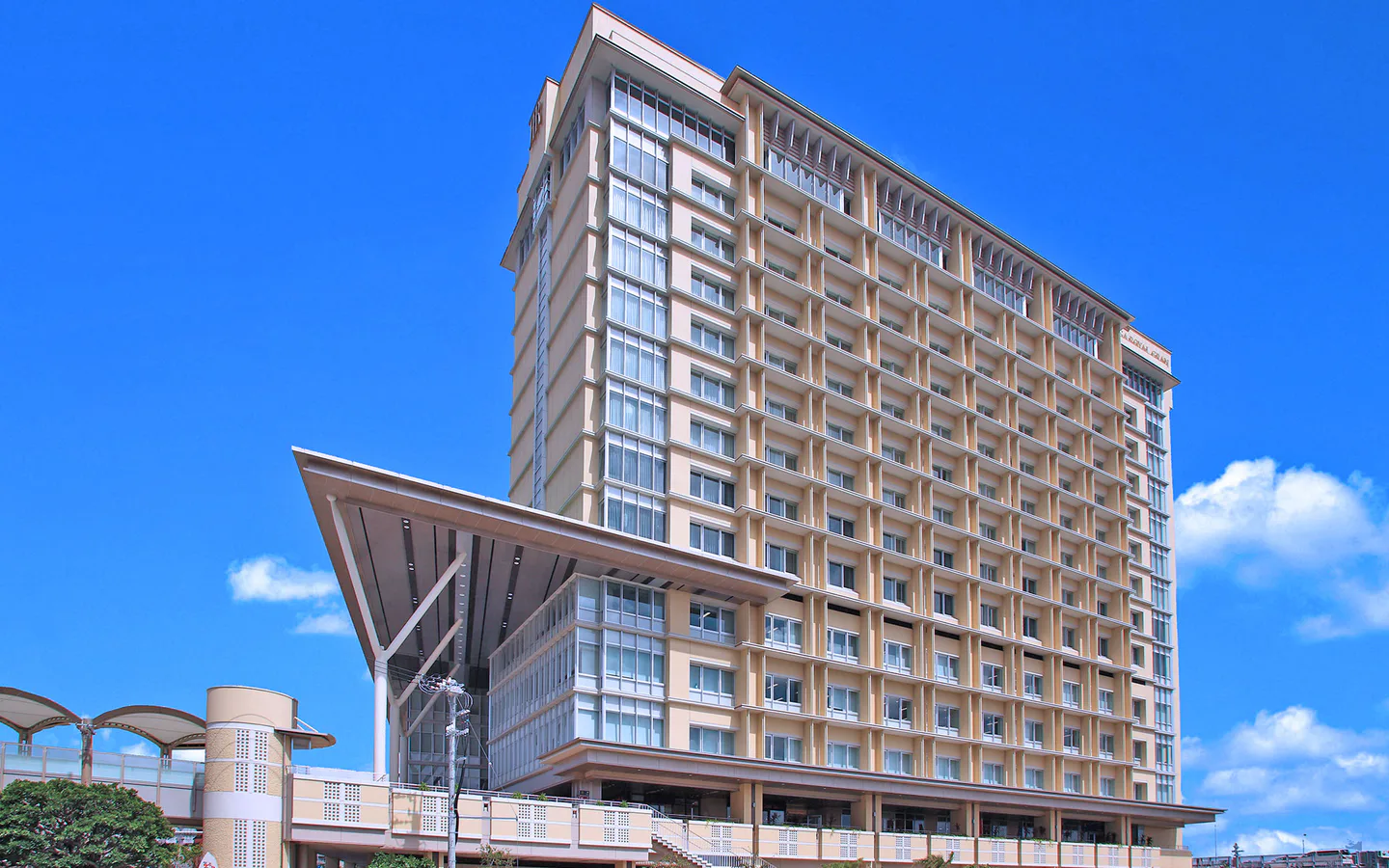
RIHGA Royal Gran Okinawa works best at the edge of a trip. Yui Rail lists the Naha Airport–Asahibashi ride at ¥290 per adult and about 11 minutes. From the station, a covered pedestrian connection leads toward the hotel and Naha Bus Terminal. That combination is useful on a first night before collecting a rental car, on the final night after returning one, or during a short stay without a car.
Keep a car for every Naha day and the calculation changes. The standard rooms still begin at 35 m², but hotel valet parking adds ¥1,500 per vehicle each night and the station connection may rarely be used. The decision depends on the actual airport, bus and rail journeys in your itinerary; a linked station is valuable only when one of those journeys takes advantage of it.
Room and meal packages vary by date. Use the listed amounts below, then compare the complete offer for the actual party and travel nights. Yen amounts are sufficient to judge whether parking or breakfast is worth paying for.
If the wider route is undecided, resolve where to base an Okinawa trip and whether the island days need a rental car first. An Asahibashi room becomes much easier to judge once you know how many days are in Naha and when the driving segment begins.
How often will the Asahibashi connection be used?
List the movements during the particular hotel stay. Airport arrival, airport departure, a Naha Bus Terminal departure, a car-free day on Yui Rail, delayed rental pickup and early rental return each use this location in a different way. Count only movements that will actually occur rather than assuming the hotel saves time on a self-drive beach day.
↔ Scroll table left or right
Trip movement | What Asahibashi changes |
Airport arrival | ¥290 adult Yui Rail ride and a connected approach to the first room. |
Airport departure | Final morning can use rail without retaining a car just for the airport. |
Naha Bus Terminal | The terminal is near the hotel for a car-free island bus departure. |
Naha monorail day | The station helps again during the stay, not only on flight day. |
Car collection after the city segment | A Naha night need not create an unused rental and parking day. |
Car returned before the last Naha night | Departure can begin by rail after the driving days are over. |
For one or two nights, two of those movements can make the connected approach especially useful. Across four days of self-driving, one airport rail ride may have little weight against four parking charges and daily valet handovers. These are itinerary judgments, not a numerical score supplied by the hotel; use the table as a checklist for your own route.
The key distinction is between a station that sounds close on a listing and a station your party will use with bags or on the morning of a fixed departure. A person travelling with only a backpack may value the pedestrian connection less than a family navigating the same route with suitcases.
Arrival, departure and everyday patterns
↔ Scroll table left or right
Actual stay pattern | Initial fit | Main reason or limit |
First night before collecting a car | Strong | Rail and linked luggage route support a simple arrival. |
Final night after returning a car | Strong | Avoids another rental and parking day for an airport morning. |
Two car-free Naha nights | Strong | Both bus and Yui Rail may be used repeatedly. |
Four self-drive nights | Compare | ¥1,500 nightly valet cost and underused station access. |
Repeated late Kokusai Street evenings | Compare another area | Restaurant doorstep may matter more than the station. |
Beach-resort stay | Weak | An urban transport hotel does not supply an Onna resort setting. |
Delay a rental-car pickup if Naha comes first
A car in the hotel lot costs ¥1,500 per night, while Yui Rail charges ¥290 per adult for a one-way airport–Asahibashi trip. Two adults therefore pay ¥580 for that rail leg. A parked car and an airport rail ticket do different jobs, but the price difference highlights a wasted car night when the first evening contains only a Naha meal and sleep.
Picking up the car at the airport can still be sensible when the party drives north immediately. If the vehicle instead sits with the valet until the next afternoon, the bill includes parking before counting the extra rental day, fuel or collection time. Compare the timing and return locations of rental agencies; moving pickup to the first real driving day can make the first night simpler as well as cheaper.
One workable sequence is flight, monorail to Asahibashi, hotel drop and a Naha evening, followed by car collection when the route heads north. Reverse it at the end: finish the coastal drive, return the vehicle, then take the last Naha room and rail to the airport. This avoids keeping a car solely for a short final airport run when the schedule permits.
Okinawa rental company choices and a five-day Naha–Onna–Churaumi route help place those driving days. The return-office hours matter as much as the first day's collection time.
The connected station route still has a walk and lifts
After leaving the Asahibashi gate, head toward the bus-terminal side, cross the pedestrian bridge and enter the hotel at level two. Reception is on floor fourteen, reached by lift. The route cuts street-level wayfinding and has a covered section, but it is not a platform-to-bedroom doorway. The hotel places the bus terminal about two minutes away on foot.
That route can remove uncertainty when it rains or a group has rolling cases. It still needs time for station gates, the footbridge, elevators and check-in. Anyone with mobility needs should assess those actual steps and lift access rather than relying on the word 'connected' alone.
For the two ends of a flight itinerary, compare late-arrival and early-flight Naha hotels and a two-day car-free Naha route. An airport-side hotel may still be a stronger fit for an exceptionally early departure.
What 35 m² means in the room categories
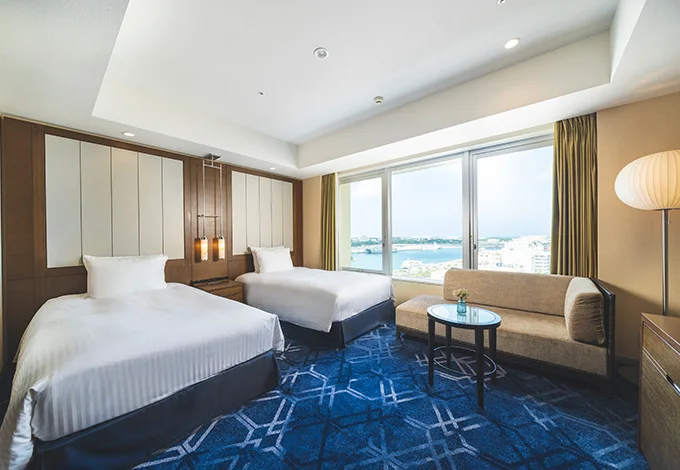
Bayside Twin and City View Twin are both listed at 35 m²; the City View version can be set up for a third guest. Premier City View Twin is also 35 m² on floors 11–13, with a possible extra bed and Premier benefits. Several names in this range describe floor, outlook, bath arrangement or services rather than additional floor area.
Two adults wanting a roomy Naha overnight can begin with the named standard twin that fits their beds and view preference. Pay more for Premier only if breakfast, a higher floor, 14:00 arrival, noon checkout or its other services will be used. The View Bath label changes the bathroom outlook; it does not by itself establish a larger bedroom.
↔ Scroll table left or right
Named room | Published area and occupancy | Reason to choose |
Bayside Twin | 35 m²; two guests | Two-person room baseline with its named outlook. |
City View Twin | 35 m²; can take three | Extra-bed possibility without a larger floor area. |
Bayside View Bath Twin | 35 m² | Bathroom outlook rather than a space increase. |
Premier City View Twin | 35 m²; higher floor | Premier meal and timing benefits with similar area. |
A 35 m² specification is a useful baseline but cannot guarantee that two particular 28- or 29-inch cases fit open in every layout. Look at the room plan and actual bed positions for the chosen category, especially if a third guest needs an extra bed. Maximum occupancy and generous area are separate pieces of information.
The Naha Terrace's 35 m² rooms show how the same area can serve a different trip: that hotel's longer walk to a station changes its airport-night value. Choose by the full route, not only the room size.
Premier breakfast and time benefits in yen
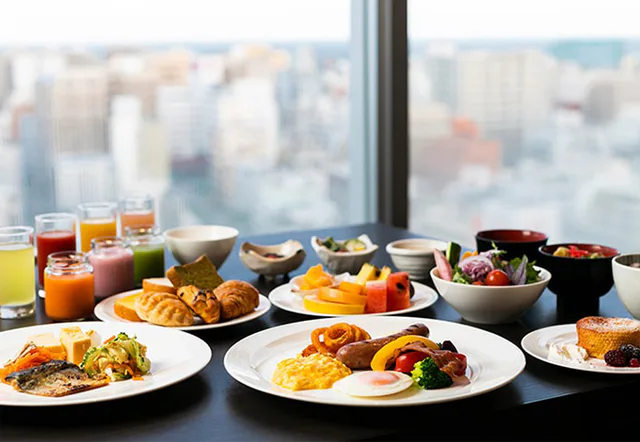
Dining19's published breakfast price is ¥3,300 per adult and ¥1,870 for a child aged six to eleven. Premier Floor includes breakfast and normally moves check-in from 15:00 to 14:00 and checkout from 11:00 to 12:00; Premier rooms occupy the higher floors. The one-hour extensions and other included services should be valued only when the day's arrival and departure use them.
Breakfast gives a concrete starting point for comparing an otherwise like-for-like standard and Premier offer. The party total is easier to use than a vague promise of an 'upgraded experience':
↔ Scroll table left or right
Breakfast party | Published separate-purchase total | How it informs a Premier comparison |
One adult | ¥3,300 | Only count it when the guest can eat after 07:00. |
Two adults | ¥6,600 | Useful meal-only reference against the package premium. |
Two adults and one child aged 6–11 | ¥8,470 | Family meal value matters if all three use the buffet. |
If a two-adult Premier quote costs ¥6,000 more than an otherwise comparable standard twin and both guests will eat the ¥3,300 breakfast, the meal alone accounts for ¥6,600 of the comparison. At a ¥12,000 premium, breakfast leaves a larger gap that must be justified by floor, view, early access and later checkout. Hold the date, bed arrangement, taxes and cancellation rules constant before making either calculation.
Dining19 opens for breakfast at 07:00 and ends at 10:00. An early flight, dive boat or fixed pickup can erase much of that value. Even a noon Premier checkout does not help a traveller leaving at sunrise. The guest count and actual morning sequence decide whether paying for the package is sensible.
First and last nights make different use of the hotel
↔ Scroll table left or right
When RIHGA is booked | Job for this night | Risk to count |
Arrival night | Reach Naha with bags, then begin the driving trip later. | An airport rental parked immediately wastes a car day. |
Middle no-car nights | Reuse rail and bus access from the same room. | Repeated Kokusai Street evenings may favour another doorstep. |
Final night | Return the car, repack and reach the airport by rail. | The previous day still needs the road journey back from the north. |
A first night can absorb flight arrival before the road trip begins; a final night can replace an early drive from the north with a short Naha airport transfer. A two-night car-free stop may use both Yui Rail and the bus terminal repeatedly. A long self-drive stay can still enjoy the room, but pays for a transport position it rarely uses.
The trade-offs beyond the room rate
RIHGA does not put the busiest Kokusai-dori blocks immediately outside its entrance. If most evenings end with late shopping, bars or repeated meals there, a hotel nearer that activity may shorten each return. Asahibashi is a transport choice; do not mistake it for a Kokusai Street doorstep.
Daily self-driving also involves a valet handover. The hotel publishes the parking price but no universal retrieval wait, so schedule a little practical margin without inventing a fixed delay. Four parking nights add ¥6,000 at the published rate, before considering the car days themselves.
A Premier or View Bath label may sound like more space even when the listed area remains 35 m². Anyone paying mainly to spread out luggage should verify the category's floor plan. Those room names can still have value, but it comes from the particular view, bath position, services or hours rather than an automatic size increase.
Five ways the plan can go wrong
An airport rental collected on arrival can spend the first night parked while the party eats and sleeps in Naha. Unless the car has an actual journey that day, the vehicle and hotel parking are costs without much use.
A covered link to Asahibashi can be mistaken for no movement at all. Passengers still cross the station, follow the footbridge, enter on level two and ride a lift to floor fourteen for reception.
Premier Twin does not mean more square metres than a standard Twin. Compare identical bed and view categories before assigning the upgrade value to breakfast, floor placement and the extra check-in and checkout hour.
Breakfast cannot repay a Premier premium when the traveller leaves before the 07:00 opening. A fixed marine pickup or very early airline check-in can make a meal-inclusive rate poor value.
Nightly Kokusai-dori activity points toward a different neighbourhood. Repeated late returns from the shopping and restaurant area can matter more than a smooth airport arrival once the trip is underway.
When another Naha hotel fits better
↔ Scroll table left or right
Situation | Starting choice | What can overturn it |
Two adults, first night, no car yet | RIHGA | A much lower equivalent airport-route rate or very late arrival. |
Last night after car return | RIHGA | An exceptionally early flight better served nearer the airport. |
Two no-car Naha nights | RIHGA | Every activity and dinner concentrated around Makishi or Miebashi. |
Four self-drive nights | Compare | Room size and amenities might still justify recurring parking. |
Premier for two adults | Test against ¥6,600 breakfast | If the buffet is unusable, assess floor and timing alone. |
For a Kokusai Street doorstep, compare HOTEL COLLECTIVE Naha. RIHGA versus JR Kyushu Hotel Blossom Naha puts Asahibashi rail access beside a more shopping-oriented room location.
Hold the room terms steady before paying
Use the same date, party size, named room, breakfast inclusion, tax and cancellation deadline for every quote. Standard, Premier, City View, Bayside and View Bath can all refer to roughly 35 m² while changing a different benefit. If a breakfast-inclusive Premier package is compared with a room-only standard price, the visible difference is not a pure room upgrade.
Compare RIHGA rooms for the arrival night
A third-person setup needs the exact extra-bed terms rather than an assumption that every twin accepts three. Look for the named City View category and the booking engine's actual occupancy. A family needing four separate beds may need a different room or hotel entirely.
A view or bathroom upgrade earns its cost only if the party will be in the room long enough to use it. An arrival near midnight and departure at dawn is mainly a transport and sleep purchase; a late-afternoon check-in can make a higher-floor view more relevant.
The final twelve hours: RIHGA beside Tokyu Stay
↔ Scroll table left or right
Departure-night task | RIHGA Royal Gran Okinawa | Tokyu Stay Okinawa Naha |
|---|---|---|
Station approach | Asahibashi covered link; bus terminal nearby | Tsubogawa, hotel-listed three-minute walk |
Common twin area | 35 m² standard baseline | 23 m² Residential Twin |
Laundry | Hotel service, with turnaround to confirm | Washer/dryer in residential rooms |
Breakfast opening | 07:00 | 06:30 |
Car retained | ¥1,500 per night; valet re-entry | ¥1,500 per day; affiliated deck without re-entry |
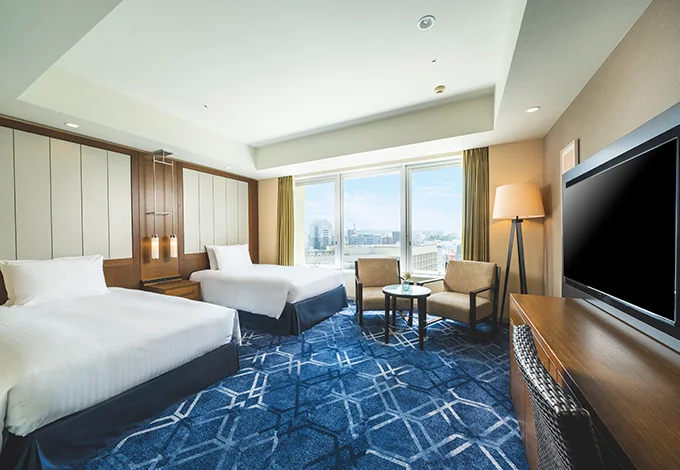
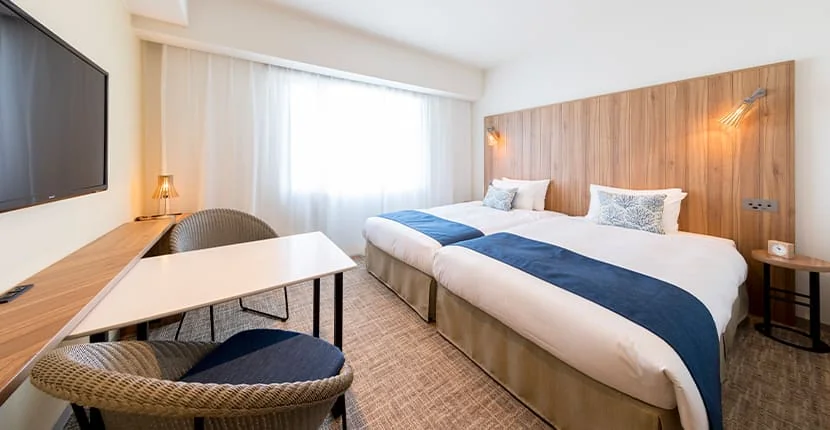
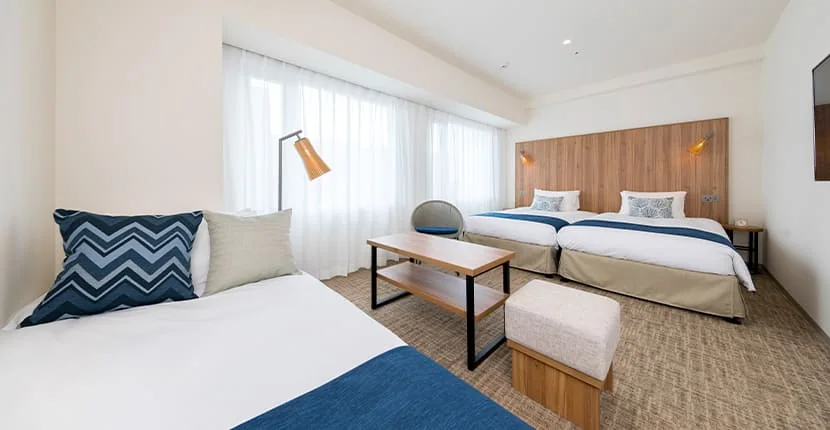
For a last night with cases already packed, RIHGA's 35 m² standard-room baseline and Asahibashi link can make leaving simpler. Tokyu Stay Okinawa Naha has a different strength: residential rooms with an in-room washer/dryer and a kitchenette. Clothes from beach or diving days can be cleaned during the final evening if there is enough time for a complete cycle. Compare the actual flight, party and room type before choosing either.
↔ Scroll table left or right
Final-night question |
RIHGA Royal Gran Okinawa |
Tokyu Stay Okinawa Naha |
|---|---|---|
Rail and luggage |
Asahibashi pedestrian link and nearby bus terminal |
Tsubogawa about three minutes on foot |
Room use |
Standard 35 m² twins and larger bathroom |
Residential Double 21 m², Twin 23 m²; laundry and microwave |
Morning buffet |
Dining19 07:00–10:00 |
06:30–10:30; last order 10:00 |
Overnight car |
¥1,500 valet; re-entry; no advance booking |
¥1,500 deck; no re-entry or guaranteed space |
Clearest benefit |
Straightforward rail/bus exit with more room |
Wash, dry and repack inside the room |
A final-night hotel should be chosen from the flight backward
For an 08:00 departure, neither hotel's buffet is likely to be usable without a very rushed morning. The monorail ride itself is short, but checkout, the station approach, train wait, airport walk and airline queue all require time. RIHGA's airport-to-Asahibashi rail leg is listed around eleven minutes; Tokyu Stay is a three-minute walk from Tsubogawa. Neither number is a door-to-gate promise. Check the airline's deadline for the actual domestic or international flight.
With a later departure, food enters the comparison. Tokyu Stay opens its buffet at 06:30 and currently lists ¥2,300 per adult; RIHGA Dining19 begins at 07:00 and lists ¥3,300. A thirty-minute earlier start helps only when the group can still finish, check out and reach the airport with margin. Premier RIHGA packages include breakfast, while a standard room does not automatically include it. Okinawa hotel breakfast timing is useful before paying for either buffet.
A Naha last night can replace a long departure-morning drive from Onna or Motobu, but neither RIHGA nor Tokyu Stay removes the drive on the previous evening. A five-day Naha–Onna–Churaumi route shows one return point. Onna versus Naha for the final night weighs packing against the shorter airport leg, while the Okinawa hotel-split test helps avoid moving merely for a small time saving.
Asahibashi also serves the bus terminal
The station connection is especially relevant to someone reaching Naha by bus after the driving part of a trip. Naha Bus Terminal is close to RIHGA, and the station-to-hotel approach is more organised than a generic 'near rail' claim. Even so, the traveller crosses a footbridge and takes a lift to the fourteenth-floor reception; a bus arrival with heavy cases still needs some walking and checkout time on departure morning.
Tokyu Stay's Tsubogawa stop sits nearer the airport along the same rail line and its hotel advertises a three-minute station walk. That does not make it the better option for a traveller arriving at Naha Bus Terminal, whose last approach may be shorter from Asahibashi. A car returned near Tsubogawa or a load of laundry could shift the answer toward Tokyu. Okinawa without a rental car covers the wider network; a no-car split stay matters if this final night is part of a longer rail-and-bus route.
Laundry versus floor space on the last night
Tokyu Stay lists a washer/dryer, microwave and kitchenette in its residential rooms. Its Residential Double is 21 m², Residential Twin 23 m² and Residential Family Room 31 m²; the family room can be configured for more guests. These layouts solve a sandy-clothes or child-laundry problem that a larger empty floor cannot. RIHGA's common 35 m² twin gives considerably more room to lay out cases, but it does not put a washing machine beside the bed.
A wash-and-dry cycle must actually finish before repacking. Start it early enough to cool, check for any still-damp garments and avoid relying on a machine after a late-night arrival and dawn departure. Okinawa hotels with in-room laundry looks at longer stays, while rooms for families with babies and toddlers covers the equipment that can make laundry disproportionately useful.
RIHGA offers hotel laundry service instead of a washer/dryer in its guest rooms. Service turnaround and cost may not suit a single final night, particularly if the only goal is drying swimwear before a flight. Its advantage is the 35 m² room baseline and larger bathing and circulation space. For three guests, reserve a named category that permits an extra bed, such as City View Twin; do not assume that every same-size twin has three sleeping places.
↔ Scroll table left or right
Last evening's actual need |
First room to price |
Reason |
|---|---|---|
Wet clothing and a later checkout |
Tokyu residential category |
Laundry can run during dinner and packing. |
Early flight and cases already packed |
RIHGA standard twin |
Room area and Asahibashi exit serve a simple stay. |
Bus arrival at Naha Bus Terminal |
RIHGA |
The bus and rail hub are closest to its linked approach. |
Family of four with a full laundry load |
Tokyu Family or larger category |
Occupancy and in-room machine address two tasks. |
Two adults planning one hotel dinner |
Compare rates, including RIHGA |
Dining19 and the larger room have value only if used. |
Parking rules if the rental car stays overnight
RIHGA charges ¥1,500 per car per night for valet parking, permits re-entry and does not accept advance parking reservations. Tokyu Stay's affiliated deck is also ¥1,500 per day, but its current terms prohibit in-and-out use, cannot reserve a space and direct overflow cars to another paid lot. Those equal headline amounts buy different driving flexibility. If the last dinner requires the car, the two parking arrangements deserve more attention than a small room-rate difference.
Returning the rental car before hotel check-in may remove a rental day, fuel stop and parking bill. That makes sense when the final evening is a Naha meal and the airport departure uses the monorail. Keep the keys if a real last journey or luggage load needs them. Okinawa rental-car providers and returns and the hotel-and-car day calculation help check where the car can be returned without a long detour.
On a late arrival rather than an early departure, Tokyu Stay's laundry may have little immediate use. RIHGA's linked station approach and 35 m² room can matter more when tired travellers simply need a direct check-in. Compare Naha airport timing hotels, RIHGA against its shopping-area alternatives and Tokyu Stay's final-night room trade for the specific trip edge.
Where the final dinner will happen
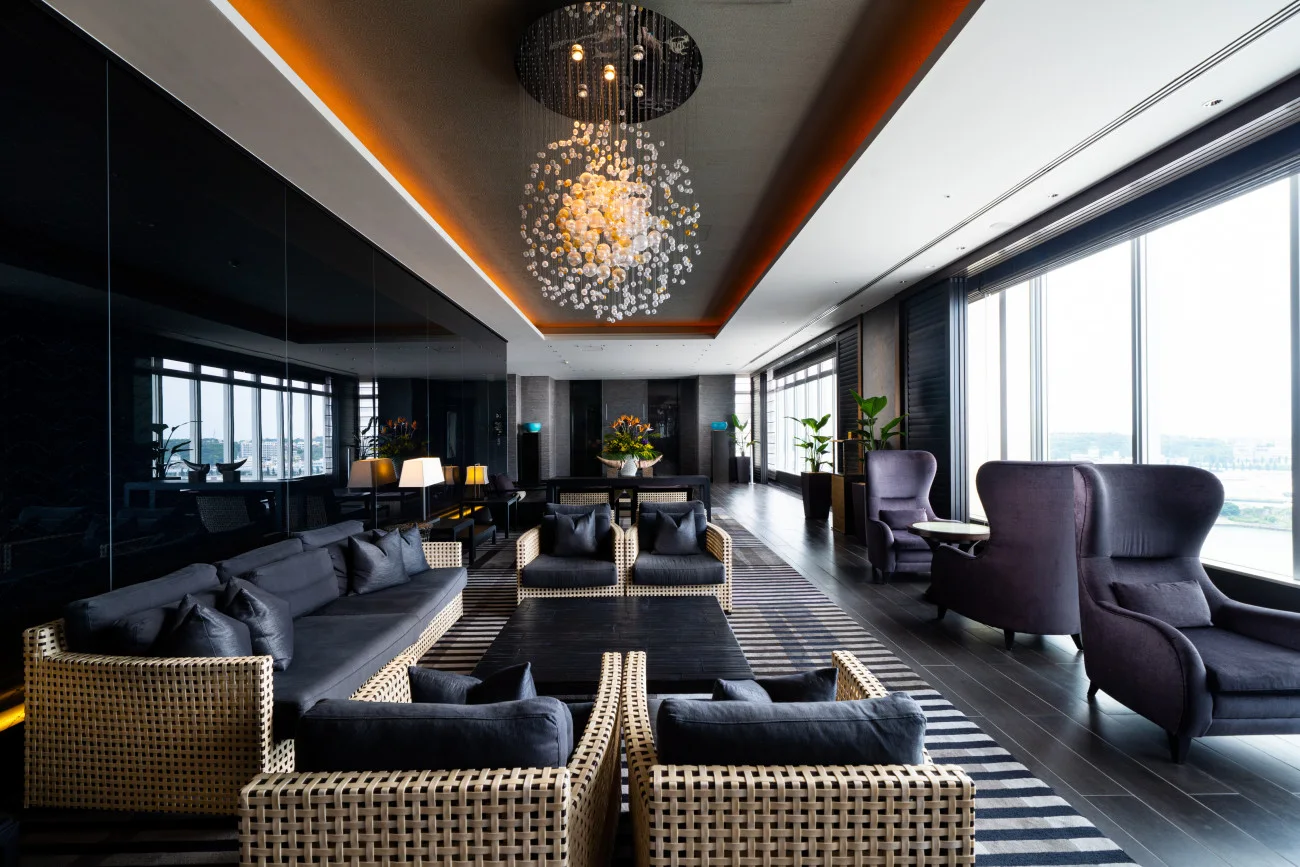
RIHGA's top-floor Dining19 and lounge can make a self-contained last evening after a flight or road trip, with Naha visible from the windows. If that dinner motivates the booking, check its opening day, menu and reservation availability before locking a non-refundable room. Local Asahibashi restaurants are another possibility, though the district is a different evening from the busiest Kokusai Street section.
Tokyu Stay's residential kitchenette and microwave serve a simpler plan: pick up food, run a wash cycle and repack in the room. The property sits above retail space, which may help with basics. Someone who wants the final evening on Kokusai Street should calculate the walk or monorail return from either hotel. Naha without a car, Okinawa area choices and shopping-focused last-night bases give a wider area comparison.
An included breakfast is still wasted if the flight or sleeping schedule keeps the party away from the buffet. RIHGA's 07:00 top-floor service suits a relaxed morning; Tokyu Stay's 06:30 start can fit a somewhat earlier departure. Neither guarantees a comfortable international check-in. For a genuinely early flight, compare other airport-side hotels and the actual taxi or rail options rather than assuming either Naha buffet can be squeezed in.
Three reservations details that matter on a departure night
First, compare a room that solves the job. At RIHGA, separate breakfast and Premier benefits from the basic 35 m² twin and confirm the beds. At Tokyu Stay, confirm that the chosen residential category has the washer/dryer and enough beds. The room list ranges from a 21 m² double and 23 m² twin to a 31 m² family layout and 59 m² Premier Riverside Twin; the word 'Tokyu' alone says little about the room you will occupy.
Second, put the flight's check-in deadline on the calendar before buying a buffet or late checkout. A 10:30 domestic departure might leave room for breakfast and a measured rail trip, while an 08:00 flight probably does not. Those are examples, not transferable departure times. A four-day Okinawa plan and first-visit transport decisions locate the final transfer within the week; the airline's own deadline controls the last morning.
Third, decide whether the car is returned before this night. If so, remove both hotels' parking lines from the comparison. If not, RIHGA's valet re-entry and Tokyu Stay's no-re-entry deck lead to different dinner plans. A drive from the north also needs traffic and refuelling time before check-in. A five-day self-drive sequence and Okinawa trip cost components help keep that final transport decision in scale.
For dry, already-packed luggage, RIHGA can be the more direct final-night choice when the rate fits: Asahibashi, the bus terminal and 35 m² room all serve the exit. If the party arrives with wet clothes, a Tokyu residential room can clear that task during the evening, provided the cycle finishes before departure. Compare the exact bed count, meal, cancellation deadline and total price rather than a bare hotel name.
Compare RIHGA rooms for the final night
Compare Tokyu Stay residential rooms
Published fares, meal prices and parking rules can change before a future booking. Apply the current offer to the actual date and party; the trip pattern above is the more durable part of the choice.
A useful first or final Naha night
RIHGA Royal Gran Okinawa has its clearest role on arrival before a car rental, on departure after a car return, or during a compact car-free Naha stop. Those patterns reuse Asahibashi rail and bus access while giving the party a 35 m² twin baseline. The location is less persuasive when a car is driven and parked every day.
For a longer driving stay, add the recurring valet charge to the room quote and decide whether the space alone still warrants it. For repeated Kokusai-dori evenings, place a more central alternative in the same comparison. The best Naha address depends on the number of airport and bus movements as well as the places visited after dark.
A practical booking test is to imagine the Asahibashi connection did not exist. If the room would still be your choice at the same total, judge RIHGA against other spacious Naha hotels. If the link is the deciding feature, identify the airport, rail or bus legs that will actually use it. A listing's transport advantage should appear in the itinerary, not only in the description.
RIHGA as a first or final Naha night: seven marks
| Dimension | JapanLayer score | What matters for this booking |
|---|---|---|
| Location | Asahibashi links the airport rail, covered approach and nearby bus terminal. | |
| Room | Several named twin categories start at 35 m², with an extra-bed option only in specified rooms. | |
| Cleanliness | Room upkeep has a consistently strong record across recent stays. | |
| Service | Front-desk and room-service consistency is a marked strength of this hotel. | |
| Facilities | The room bath is generous, while laundry is a service rather than an in-room machine. | |
| Food | The Premier breakfast adds real meal value only when the 07:00 start fits the flight. | |
| Value | The room and transport link earn their cost when the extra rental and parking day is avoided. |
JapanLayer score: 8.6/10 for a first or final Naha night without a rental car. The Asahibashi connection and 35 m² room carry that verdict; a guest who needs in-room laundry or an airport hotel for a very early flight should follow a different branch of the comparison.
Questions about access and room terms
What does the monorail cost from Naha Airport?
Yui Rail lists the adult airport–Asahibashi fare at ¥290 and the scheduled station-to-station ride at about eleven minutes. Add airport walking, platform wait and the hotel bridge route when planning arrival or departure. The last train and first train matter for unusual flight times.
Does the station link remove every walk?
No. Exit Asahibashi toward Naha Bus Terminal, use the footbridge, enter the hotel on level two and take a lift to reception on floor fourteen. The approach is clearer and partly sheltered, but still includes the station and building transfer with bags.
Are Premier Twins larger than standard Twins?
Common Bayside and City View Twins are 35 m², and Premier City View Twin is also listed at 35 m². Premier changes floor placement and services rather than automatically adding area. Check a specific category and bedding if there are three guests.
How much is guest parking?
RIHGA lists ¥1,500 per car per night. Valet staff park and retrieve the vehicle; re-entry is allowed, though advance parking reservations are not. Confirm the rate for the booked night and account for any rental day that could be avoided.
What are Dining19 breakfast hours and prices?
The published buffet runs 07:00–10:00. It costs ¥3,300 per adult and ¥1,870 for children aged six to eleven; younger-child terms depend on the current hotel information. Compare breakfast value with the actual departure time before buying a Premier package.
Other Naha hotels for the same trip edge
RIHGA versus JR Kyushu Hotel Blossom Naha compares transport and shopping streets; The Naha Terrace offers another 35 m² room with a longer station approach; HOTEL COLLECTIVE Naha is a Kokusai Street alternative.
Okinawa route decisions
Okinawa hotel areas, rental car or public transport and a five-day cost plan should be settled before committing to every Naha night.
Hotel, rail and breakfast details
RIHGA access and parking describe the linked Asahibashi approach, Naha Bus Terminal and valet arrangements.
RIHGA room categories give sizes, occupancy and differences between standard and Premier floors.
Dining19 breakfast sets the opening hours and adult and child prices used in the comparison.
Yui Rail Asahibashi fare table gives the airport fare and station-to-station time.
Check the selected room's breakfast, parking and cancellation conditions against its final booking total. The value of a Premier package or a final-night laundry room changes when the party or morning schedule changes.
Related hotel and airport-night decisions include HIYORI Ocean Resort on a three-night Onna stay, Onna versus Naha for the last night, RIHGA versus JR Kyushu Hotel Blossom, a Tokyo Disney hotel switch, Hakata or Tenjin before a flight, a KIX departure-night move, Shin-Osaka before an early Shinkansen and Hakone versus Kawaguchiko.