
Fukuoka earns a place on a first Japan trip when it helps the route move west, opens Kyushu or puts the departure airport where the journey already ends. A return trip from Osaka just to spend two nights there asks the city to repay roughly five hours of long-distance rail travel, before hotel changes and station transfers. That can still be right for a traveller whose main interests are Fukuoka food or Kyushu. It is a weaker default for someone with only a week or ten days to cover Tokyo, Kyoto and Osaka.
Begin with the itinerary, not a list of local attractions. A city can be enjoyable and still be a poor addition to a particular route. Equally, Fukuoka may be an unusually efficient final stop after Hiroshima because the westbound journey is already underway. This guide uses nights, rail direction, flight airport and onward plans to decide. A one-night stop may do useful transport work; two nights let Fukuoka behave like a destination.
↔ Scroll table left or right
| First-trip situation | Working decision | Reason | What could change it |
|---|---|---|---|
| Seven to ten days, Tokyo–Kyoto–Osaka core still compressed | Usually leave Fukuoka out | A western move consumes time needed in the original cities | Fukuoka or Kyushu is a main trip purpose, or a flight removes a large return |
| Eleven or twelve days and Hiroshima already planned | Consider a westbound extension | Hiroshima to Hakata is approximately 70 minutes by Shinkansen | Protect the minimum useful Tokyo and Kyoto time first |
| Eleven or twelve days, out and back from Kansai | Usually stay closer | Shin-Osaka to Hakata is around two and a half hours each way | A Fukuoka flight or Kyushu continuation removes the return |
| Thirteen or fourteen-plus days with a westbound sequence | Two nights often fit | Fukuoka can be both city stay and airport or regional gateway | A string of other one-night stops may still make the route too rushed |
| Only one Fukuoka night | Use it for positioning | Arrival evening plus onward departure gives the hotel two jobs | Make it two nights if the city itself is the reason to come |
The real expense is the journey you add
On a Kyoto or Osaka itinerary, a Fukuoka detour is measured in more than the Shinkansen timetable. You must reach the departure station, board with luggage, travel west, get to a different hotel, then do those steps again on the return. A rail pass or prepaid fare does not return the lost hours. The useful comparison is between the itinerary with Fukuoka and the same itinerary without it: which movements disappear, and which remain?
Hakata is roughly an hour and ten minutes from Hiroshima by Shinkansen, so a traveller already sleeping in Hiroshima pays a smaller extra rail leg to move west. From Shin-Osaka, the train leg is about two hours and thirty minutes. An Osaka–Hakata–Osaka excursion therefore uses about five hours on the trains alone. These are line-haul estimates, not a promise of door-to-door arrival. Even an efficient station hotel adds checkout and local movement. The Hiroshima versus Fukuoka decision is particularly useful when the same two or three western nights are being contested.
Think of three different reasons for the city. As an endpoint, Fukuoka is the final hotel before a flight home. As a gateway, Hakata leads onward to an actual Kyushu plan: Fukuoka versus a Yufuin night, Beppu, Nagasaki, Kumamoto or another named stop. As a detour, Fukuoka sends you back to the corridor you just left. The endpoint and gateway cases receive value from transport as well as city time. A detour has to justify nearly all of the westbound and eastbound movement on its own.
The direction need not be Tokyo first. A flight into Fukuoka followed by Kyushu, Hiroshima, Kansai and Tokyo can be coherent if fares and dates work. The test is whether the hotel nights and train rides form a line. A first-trip route across ten, twelve or fourteen days lets you judge the national sequence before treating Fukuoka as an isolated weekend break.
How the airport changes the calculation
Fukuoka Airport is close to the urban core. Fukuoka City Subway currently gives five minutes between Hakata and Fukuoka Airport Station, and eleven minutes between Tenjin and that station. Those are valuable rail times, especially compared with a remote airport transfer. They refer to the station at the Domestic Terminal. The International Terminal is a separate building; the airport offers a free inter-terminal shuttle, with the airport indicating approximately ten minutes between buildings and warning that traffic can lengthen it.
For an international arrival, the actual sequence includes immigration, bags, getting landside, any terminal change and then the city journey. A departure likewise needs to reach the International Terminal, not simply the subway platform. Some hotel locations may favour a direct bus or taxi, so the shuttle is not mandatory for every traveller. The important distinction is that a five-minute subway ride is not a five-minute journey from aircraft door to Hakata hotel. The early-flight hotel-base comparison applies this distinction to the departure morning.
An open-jaw ticket can improve the whole route. Arrive through Tokyo or Kansai, work west through Hiroshima, and depart from Fukuoka, or reverse the direction. If the fare and connection are sensible, this avoids a return toward the starting airport. It is a conditional benefit, not a claim that a multi-city ticket is always cheap. Compare the real fare, checked-bag rules, onward connection and arrival hour before giving the flight any itinerary credit. A poor connection can erase the apparent savings in rail time.
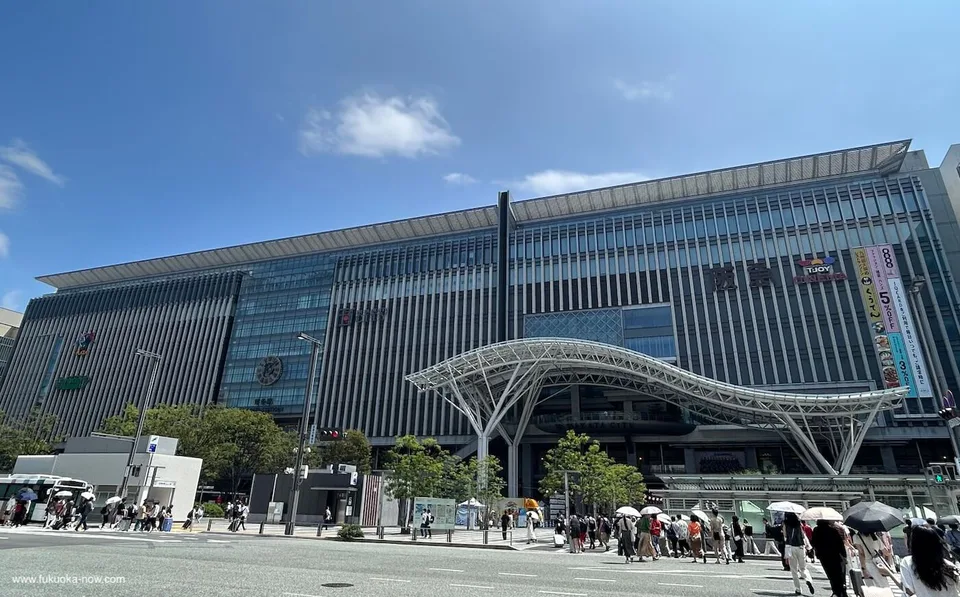
Where the Fukuoka hotel sits matters less to the airport train than to the stay itself. Hakata is the obvious first base for Shinkansen arrival, a Kyushu train the next day or a morning airport departure. Tenjin can better serve shopping, nightlife and repeated evenings in the city. The six-minute subway difference from those stations to the domestic-side airport platform is usually smaller than the repeated trip back to a hotel in the wrong district. Hakata versus Tenjin should be answered after the city’s role is set.
One night solves a transfer; two nights let you meet the city
A single night can be a smart route device. You might arrive from Hiroshima in the afternoon, eat near the hotel, sleep and depart to Kyushu or the airport the next morning. This is not an inadequate Fukuoka visit; it is a useful overnight stop with an evening. It is inadequate only if the itinerary then claims the city has received a full day. Check-in, a late arrival and early checkout can shrink the visit to dinner and sleep.
For a first visit that is genuinely about Fukuoka, two nights offer a better frame: arrival evening, one complete day and a departure morning that is not just a sprint. The Fukuoka length guide can help decide whether two, three or four days have distinct jobs. A third hotel night should be attached to a plan: Dazaifu or Itoshima, another city day, food exploration or time before a Kyushu departure. Without that job, it competes with Hiroshima, Kyoto or an onsen stay.
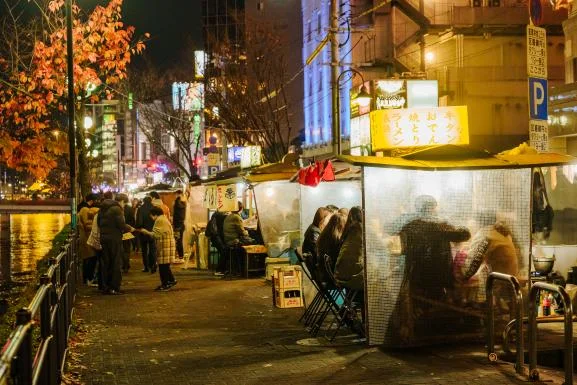
A Fukuoka evening is one reason the positioning night can feel more useful than a generic airport hotel. Yatai and late dining belong to the city’s appeal, but their existence does not rescue an arrival at 22:00 followed by a 07:00 train. Protect the hours that make food part of the plan. Breakfast choices can then fit the following departure rather than create a queue hazard. For an unhurried city programme, a three-day Fukuoka route is a more honest reference than a one-night stop.
Arrival time determines which of the two-night patterns is useful. A first evening with time for a neighbourhood walk and dinner, a full next day and an onward morning can justify the hotel moves. Two nights that both begin after dark because of long transfers provide far less city time. Write the arrival and departure hours beside the dates before booking, especially when flights involve the International Terminal transfer.
Where Fukuoka belongs in a first-trip ranking
Tokyo, Kyoto and Osaka offer enough material for a short first visit without another domestic move. If the only way to add Fukuoka is to leave Kyoto with one usable day, split Tokyo into fragments around Disney or day trips, or stack consecutive one-night stays, the itinerary is paying too much. A ten-day Tokyo–Kyoto–Osaka route shows why staying within that corridor often works better than a western extension.
Hiroshima is frequently the first western addition for travellers who have never been to either city and have only two spare nights. Peace Memorial Park and Museum and Miyajima give the stay different purposes, while Fukuoka’s strongest value can be its onward reach. That is a routing judgement, not a universal league table of cities. Once Hiroshima is already planned, Fukuoka is much closer and may be the sensible next step. A Hiroshima city day and Miyajima sights and Mount Misen reveal the time those two Hiroshima nights can consume.
Fukuoka’s own case is not that it offers a longer checklist than those cities. It changes the pace: a compact urban stay with food, late evenings, a short airport rail leg and access into Kyushu. A food-focused traveller may reasonably rank it higher. A traveller eager for the major first-trip temples and city landmarks may reasonably leave it for a second journey. a three-day Fukuoka itinerary help determine whether your interest is a city day or just the idea of adding another pin to the map.
Do a deletion test: remove Fukuoka from the draft itinerary. If the route still goes west for Hiroshima or Kyushu, a stop may add little friction. If removing it makes the whole long detour vanish, the city is paying the full transport cost. Then identify the exact night being displaced. Trading a low-priority extra Osaka night for a westbound airport endpoint is different from sacrificing the only quiet Kyoto morning and returning east immediately afterward.
Three itineraries, three different answers
Ten days with Tokyo, Kyoto and Osaka. Treat Fukuoka as an exception. The established cities already require hotel moves and choices among day trips. Adding Fukuoka as an isolated return journey usually spends the scarce margin on transport. The answer can change if Fukuoka or Kyushu is a primary reason for visiting Japan, or if a flight structure makes it the natural endpoint. Do not let a generic “best Japan cities” list override the trip’s own priority.
Twelve days with Hiroshima. Fukuoka becomes a conditional extension. A Hiroshima–Hakata ride is shorter than starting from Kansai, so a flight out of Fukuoka or onward Kyushu journey can support one positioning night or two destination nights. If the following leg simply returns to Osaka or Tokyo, compare the long return with another night in the places already on the route. The western-night comparison is the right decision at this point.
Fourteen days with a westbound itinerary. Fukuoka can be a strong two-night addition after Kansai and Hiroshima, particularly when it leads to Kyushu or a departure flight. A third night still needs its own day: perhaps the Itoshima coast, an Aso route or simply a slower city day that the traveller actually wants. More total days do not make a run of one-night hotels comfortable; the Kyushu five- or seven-day plan shows how quickly regional stops can consume the extra time.
For a route that already includes Fukuoka, the next decision is the hotel district. Choose a Fukuoka hotel by trip shape instead of an overall property ranking. If an overnight stop positions an early Shinkansen, the most attractive nightlife district may cause another morning transfer. If two nights are for central evenings, a station-adjacent room may be less important.
A booking decision that respects the timetable
Fukuoka belongs on the first trip when the city’s own hours and its transport role both make sense. A one-night positioning stop is honest if it has a useful evening and smooth onward leg. Give a destination stay at least two nights when the schedule permits. Skip a western out-and-back that cuts the core cities below the time you chose for them. These are conditional itinerary decisions, not a claim that Fukuoka is inferior to Tokyo, Kyoto, Osaka or Hiroshima.
Before committing, check the precise train and flight dates, the terminal of a Fukuoka arrival or departure, and the actual hotel-to-station journey. The subway’s five- and eleven-minute city links and the airport’s free terminal shuttle describe different pieces of the journey. If your trip ends here, compare stays in the Fukuoka area once the arrival and departure sequence is fixed.