
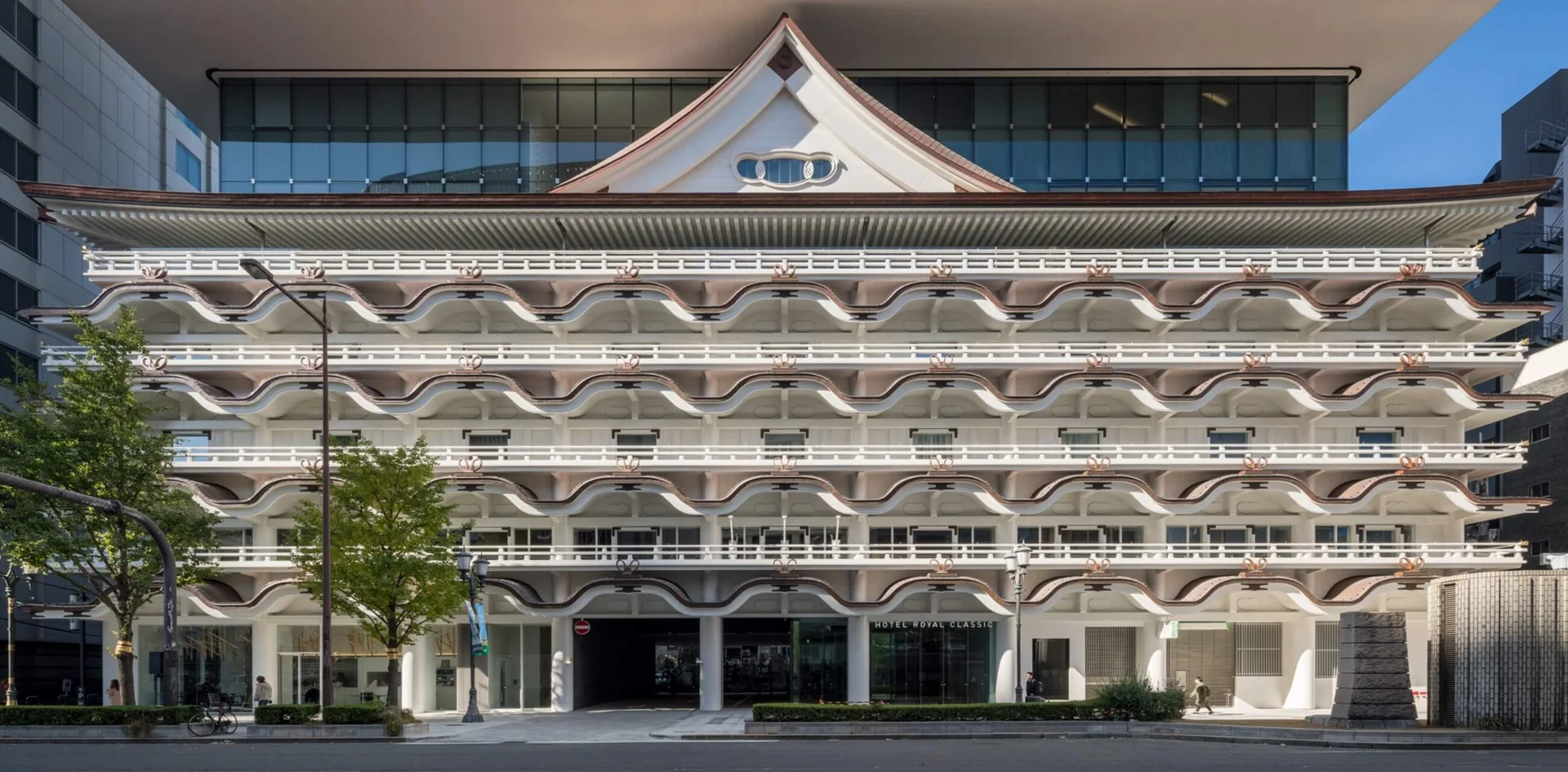
Hotel Royal Classic Osaka makes the most sense when Namba is more than the place where your airport train terminates. Osaka Metro Namba connects to the hotel near Exit 12, while Nankai Namba is around four minutes away on foot and JR Namba around ten minutes through Namba Walk. That distinction matters on arrival with cases. It matters even more over several days: a room close to the Metro and Dotonbori is useful each time you return to drop purchases or go out again after dinner.
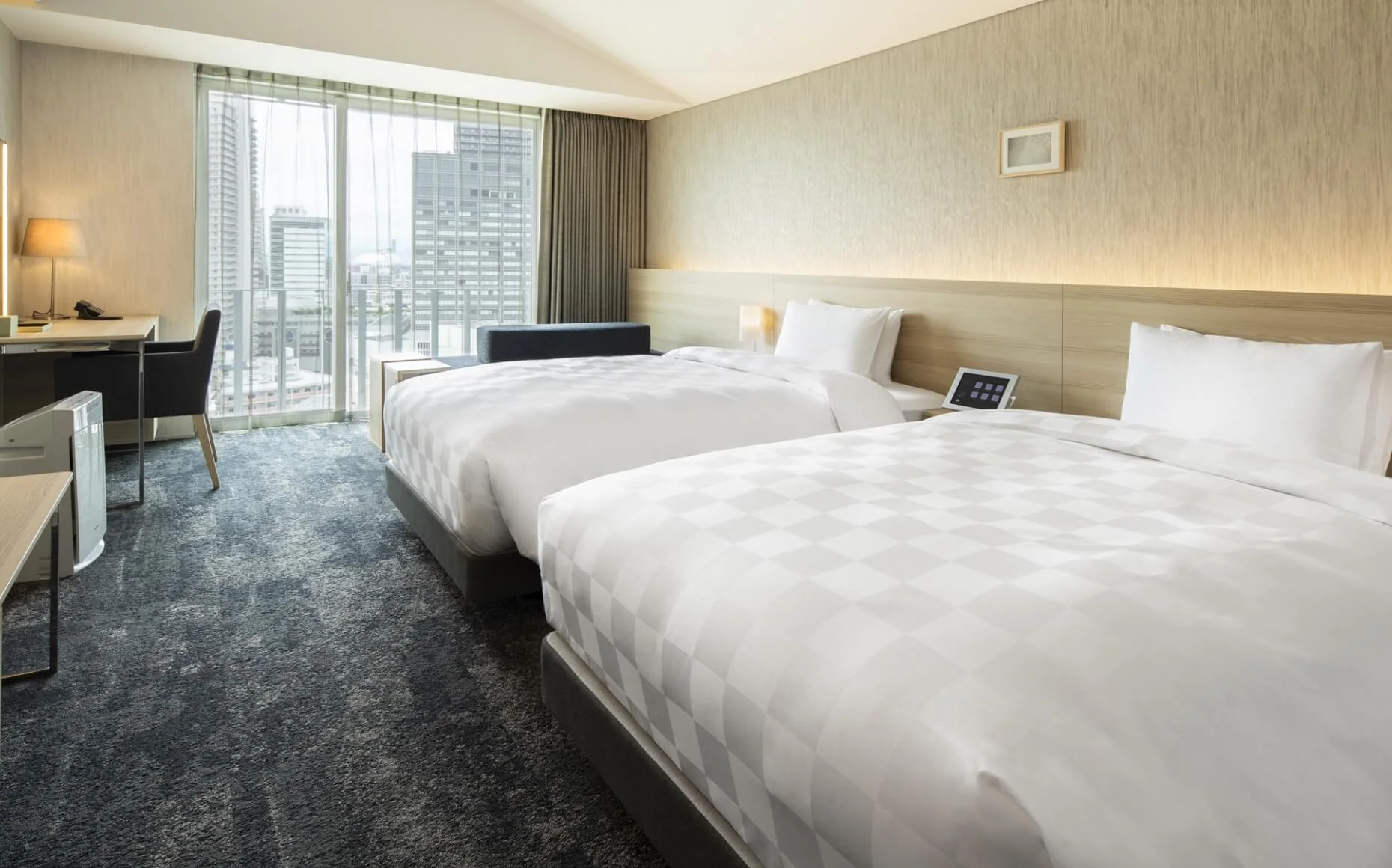
For a three- or four-night trip centred on Namba, Shinsaibashi and south Osaka, I would compare this hotel’s Standard Twin before paying for a smaller room elsewhere. If most days begin at JR Osaka Station or Shin-Osaka, I would first price an Umeda base. The station label alone cannot settle the booking; the routes you repeat during the stay can.
Three Namba arrivals, three different final walks
The hotel’s access directions place its direct connection at the Osaka Metro Namba Exit 12 passage. The Nankai station, including trains from Kansai International Airport, is a separate walk of roughly four minutes. JR Namba is about ten minutes away through Namba Walk. Platform-to-room time also includes finding the right exit, using lifts if needed, checking in and reaching the room. Treat those station figures as the last route segment, not a promise that a train deposits you at reception.
Nankai services are a natural airport route for a Namba stay, with roughly 45 minutes often quoted for the rail portion. That is a scale estimate, not a door-to-door journey. A late flight, an older companion, a stroller or two large suitcases makes the final four-minute walk more consequential. Travellers who chiefly want the shortest Nankai arrival should also compare Swissôtel’s station connection against Royal Classic. The wider Namba hotel comparison separates that choice from Metro access and apartment-style space.
↔ Scroll table left or right
Arrival or outing | Published access | What to allow for |
Osaka Metro Namba | Connected near Exit 12 | The strongest repeated-use station advantage. |
Nankai Namba | About four minutes on foot | An airport-train arrival still has a final walk with luggage. |
JR Namba | About ten minutes via Namba Walk | A materially different station distance. |
Dotonbori | About seven minutes on foot | An evening return need not become another rail trip. |
Kuromon Market | About ten minutes on foot | Useful for a market morning, though proximity does not determine whether a guided tasting is good value. |
The Metro passage is especially useful after check-in. A day around Osaka Castle can end with shopping in Shinsaibashi, a stop at the room and another short outing for dinner. The room’s location then helps twice in one day. A traveller who leaves early for Kyoto and comes back only to sleep may use the same advantage far less. An Osaka attractions map can expose those return patterns before the hotel decision.
Room area helps, but the bed layout decides more
The hotel lists its Standard Twin at 30–31 m², with two 120 × 195 cm beds. Standard Double A is 31 m² with a single 180 × 195 cm bed. Standard Double B keeps that 180 × 195 cm bed but occupies 25.6–27.7 m². A couple with two large cases over several nights should compare the Twin and Double A as actual layouts, not assume every standard room offers the same floor space. If one bed is preferred and the rate is close, Double A preserves the larger published area.
↔ Scroll table left or right
Room category | Space and beds | Reason to choose it |
Standard Twin | 30–31 m²; two 120 × 195 cm beds | Two adults with separate beds and large cases over three or four nights. |
Standard Double A | 31 m²; one 180 × 195 cm bed | A shared bed without stepping down in listed area. |
Standard Double B | 25.6–27.7 m²; one 180 × 195 cm bed | A lighter-luggage or one-night stay when its rate saving is meaningful. |
No published room area tells you precisely where two 28-inch suitcases can lie open around the furniture. The larger Twin gives more total margin for packing than Double B, but it is not a guarantee of two clear suitcase footprints. Over a single night, a couple may prefer the cheaper Double B and leave the luggage closed. Over four nights of shopping, unpacking and repacking become part of daily room use. Compare the real rate gap for those particular dates.
The bathing area and toilet are separated, with a full glass partition door described in the hotel’s guest information. Two people may find it easier to stagger morning routines, although the published layout says nothing about sound isolation or the feel of a particular room. The CANDEO Osaka Tower room comparison addresses a different trade: smaller standard rooms with a rooftop public bath. Hotel Vischio Osaka offers another way to compare compact and larger room tiers near a different station.
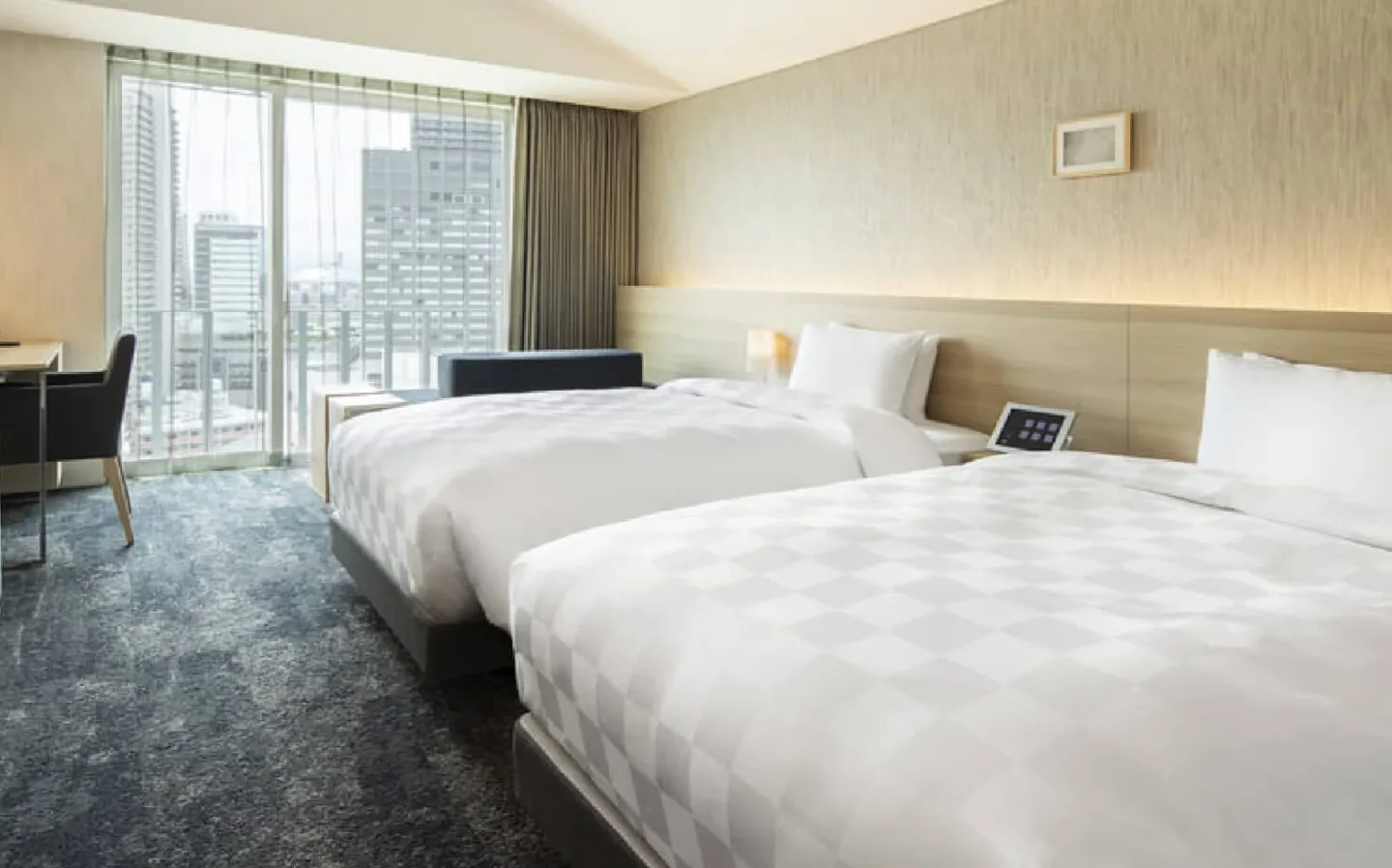
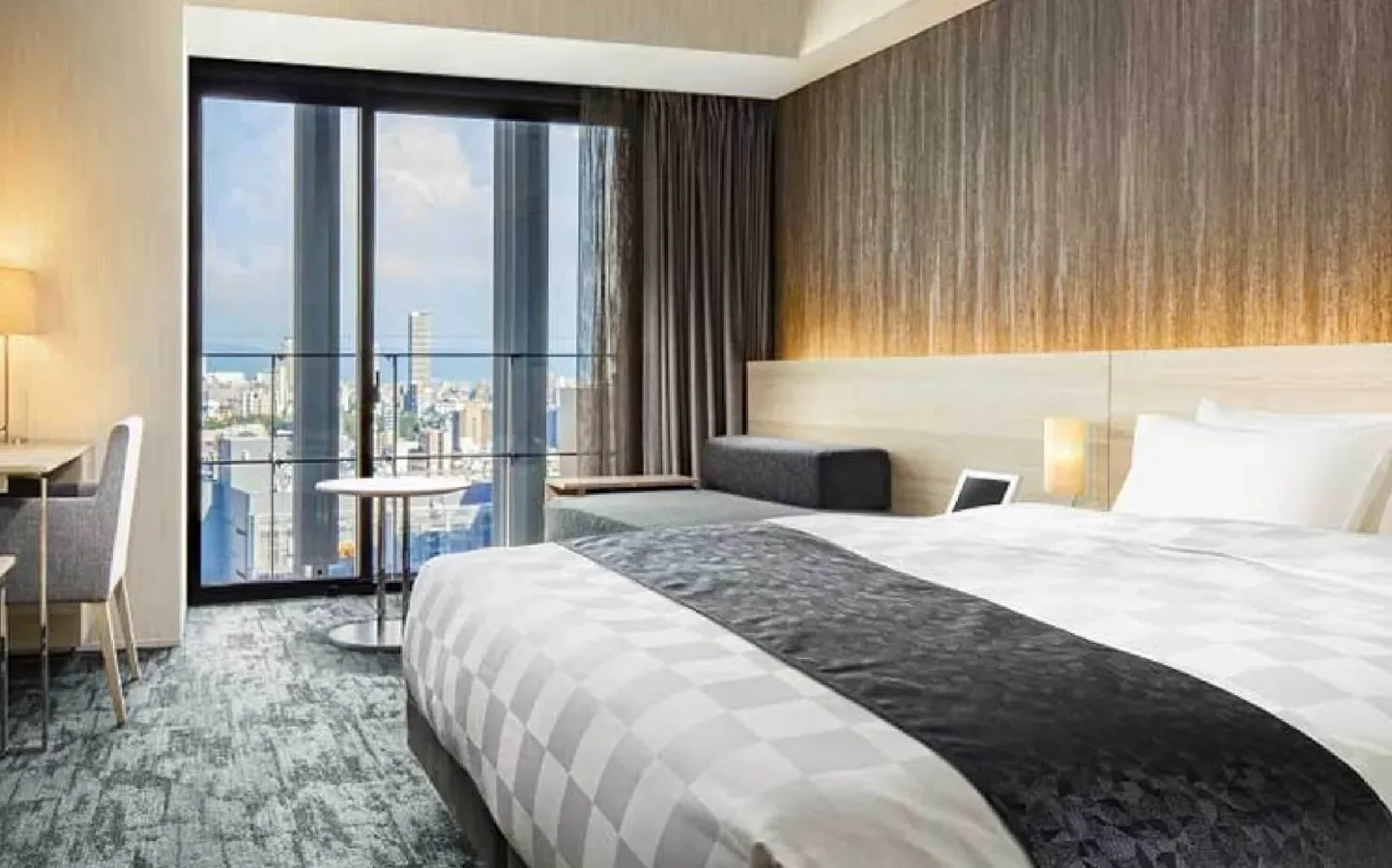
The photo set shows the exterior, a twin room and a king-bed room. It helps you see the design differences, while the named room category and bedding on the reservation screen control what you buy. A balcony or window angle shown in one image should not be assumed for every room.
Namba evenings can repay the location premium
Consider an arrival at Kansai Airport that puts you in Namba around 20:30. A roughly four-minute walk from Nankai, a bag drop, and dinner near Dotonbori are a coherent first evening. On the following day, Metro travel and a return to the hotel between shopping and dinner make the location useful again. This is a planning example, not a record of a stay or a fixed travel-time promise. It shows why an arrival-only comparison underrates a hotel that you can revisit during the day.
For a three-night south-Osaka visit, Dotonbori, Shinsaibashi, Kuromon and the Metro connection are close enough to support those returns. The five-day Osaka itinerary helps reveal whether your time actually clusters there. A family choosing between Namba, USJ and Osaka Station has a further question: room occupancy and sleeping arrangement can outrank a short walk to dinner.
Now change the trip. Two mornings start with regional JR trains, another heads to Shin-Osaka for a Shinkansen, and the evenings end around Umeda. You would retain Royal Classic’s easy arrival from KIX but repeatedly travel north to use the city. Compare Hotel Intergate Osaka Umeda, Hotel Granvia Osaka or the Osaka Station hotel comparison before booking all nights in Namba. A Kyoto or Kobe day trip can make a few saved station minutes recur in both directions, as the rail day-trip hotel guide explains.
For five nights split fairly evenly between north and south Osaka, a central compromise such as Tokyu Stay Osaka Hommachi may be worth checking. It makes the room’s washer-dryer category part of the decision. A four-person party might instead compare two hotel rooms with an apartment-style unit at MIMARU Osaka Namba Station. The meaningful question is whether the group needs individual privacy, a shared living space, or the quickest station access.
Laundry operates on a service timetable
The hotel’s laundry is a staffed service rather than a self-service room of coin machines. Items handed in before 10:00 can be collected after 18:00 the same day; the service is closed on Sundays. That model can work when you can leave clothes in the morning and collect them after dinner. It is poorly matched to someone who expects to start a load at 23:00 or needs Sunday washing to travel light.
A booking filter labelled “laundry” may not distinguish those arrangements. Zentis Osaka’s Room 001 has 24-hour shared laundry, while washer-dryers at Tokyu Stay Hommachi depend on the room tier. Mercure Tokyu Stay Osaka Namba also requires checking the exact category for a machine inside the room. Those alternatives solve different problems; do not price a Royal Classic stay as though its service were an anytime washer you operate yourself.
HAFU breakfast has a late enough finish for a slow morning
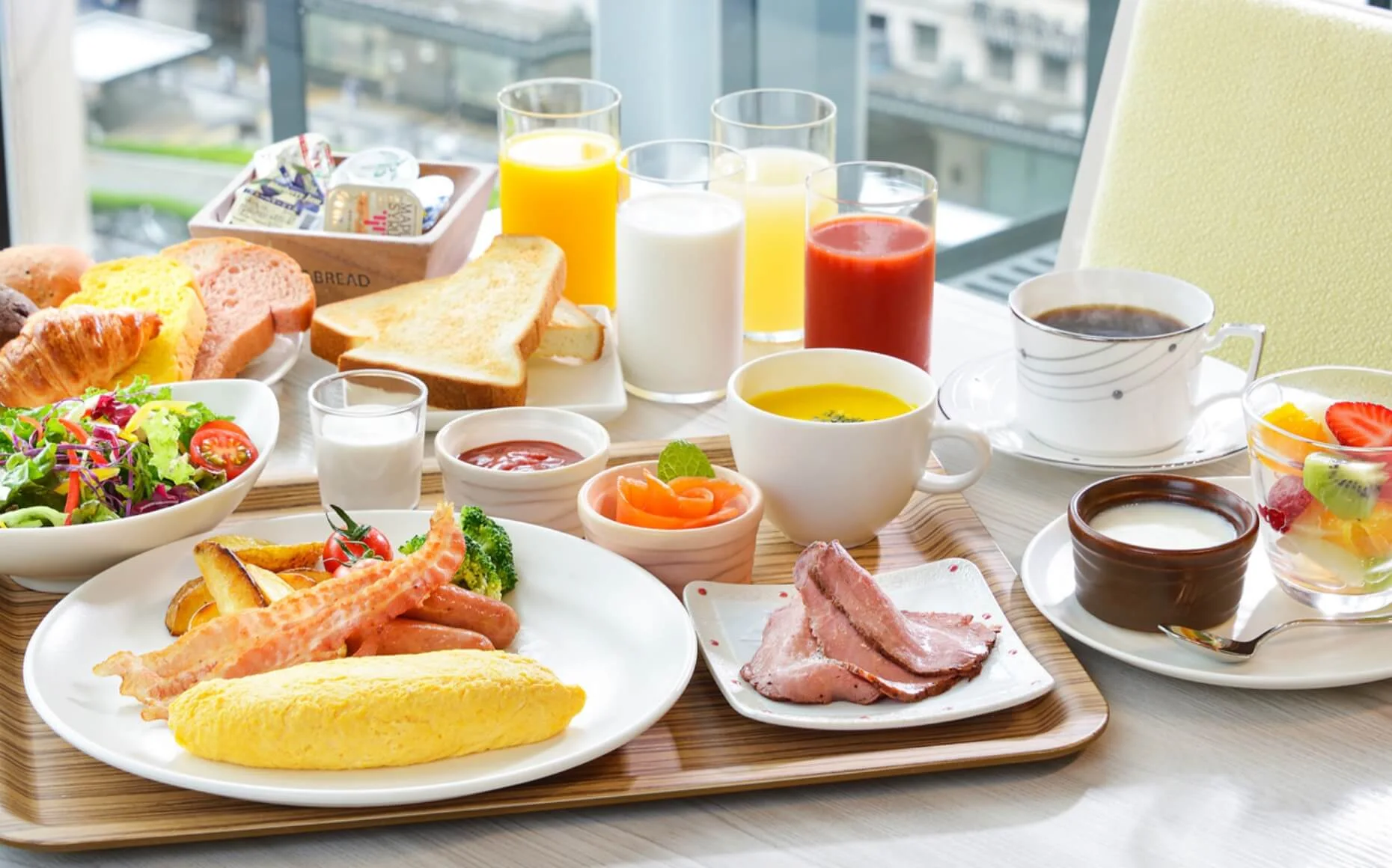
Restaurant HAFU is on the 11th floor. Its breakfast period runs from 07:00 to 10:30, with last admission at 10:00. The hotel’s breakfast page lists ¥4,500 for an adult and states that consumption tax and a 10% service charge apply. Check the final charged amount on the booking or dining screen; the printed base figure should not be presented as tax-inclusive. A room-only guest may add breakfast on the day, while advance breakfast reservations are not accepted.
That flexibility is helpful for a mixed itinerary. A relaxed Namba morning or noon-checkout day may leave ample time for the buffet. An early USJ start, a Kyoto appointment or a Shinkansen departure may make it hard to use. Check whether the room-and-breakfast plan adds value on the mornings you will actually eat there, keeping cancellation rules and taxes the same when comparing it with room-only. The breakfast plate photo shows one meal rather than a guarantee of a fixed menu.
Standard check-in is 15:00 and checkout is 12:00. Noon checkout can make a departure morning less rushed, especially if you want breakfast and a final pack. Early check-in depends on availability and can carry a fee; an early flight does not automatically grant morning room access. If the main reason for choosing Royal Classic is a smooth airport arrival, plan luggage storage or a first outing until the room is ready.
Where the extra room area changes a four-night stay
The Twin’s 30–31 m² specification becomes more useful when the room is visited repeatedly, not merely when two guests sleep there. Imagine a pair arriving with one large case each, buying food and small purchases in Namba, and repacking before a later city change. Separate beds make it possible to use one side of the room for a case while the other person still reaches their bed; that is a planning advantage of the layout rather than a measured claim about clear floor space. With Double B, both people share one 180 cm bed and have less total listed area for the same bags. If the journey is a single arrival night and both cases remain closed, the saving on Double B may be more valuable than unused area.
Room size also has to be judged against the rest of the group’s booking. Four adults in two Twins obtain two bathrooms and two private spaces, though the combined price can exceed a family apartment. One apartment at MIMARU can make shared meals and group planning easier, but people on different sleep schedules may prefer the privacy of two hotel rooms. A family with children should check the hotel’s actual occupancy and bed rules for each category instead of reasoning from floor area alone. A 31 m² room does not automatically permit four sleepers. The Namba family hotel comparison puts bedding and occupancy beside access when a group choice is less straightforward than the room photographs suggest.
The bathroom arrangement is another reason to compare actual categories. With a bathing or shower area separated from the toilet, one guest can be getting ready while the other uses the toilet, although the glass partition limits visual privacy. A couple comfortable with that layout may value it more than decorative space elsewhere. Travellers who require a solid opaque bathroom door should look carefully at the property images or ask the hotel about the exact booked room rather than infer privacy from the phrase “separate bath.” Neither room dimensions nor promotional imagery can establish how quiet the corridor is, how a mattress feels, or whether a given floor is interrupted by street noise.
Two trip shapes produce different hotel answers
A south-focused four-night example might begin with a Nankai arrival, then devote separate days to Namba and Shinsaibashi, Osaka Castle and central Osaka, and a larger outing such as USJ. In that pattern the hotel may be visited at breakfast, after shopping, and again after dinner. The Metro connection supports the across-city day; Dotonbori and Kuromon do not require adding a rail ride for a short local visit. USJ remains a cross-city journey, so a park day alone should not be allowed to decide the whole base. If the park is the point of the trip and several nights end late near it, compare a Universal City location instead of repeatedly returning to Namba.
A north-focused four-night example can look similar on a map but behaves differently in use. Suppose the party takes a Kyoto day trip, visits Kobe, departs by Shinkansen from Shin-Osaka and meets friends near Umeda in the evenings. The first Nankai arrival still favours Namba. The repeated journeys thereafter favour quick access to Osaka Station or Shin-Osaka. One extra transfer or station walk on both the outbound and return legs can be more cumbersome than the initial four-minute airport-arrival walk. If Namba dinner is only one night, Royal Classic’s proximity to Dotonbori is a pleasant feature rather than the organising benefit of the hotel stay.
A mixed trip should be evaluated by counting nights as well as daytime attractions. A traveller may spend the day in Kyoto but return to Namba for dinner every evening; that can keep this location attractive despite northbound departures. Another traveller may visit an attraction near Namba in daylight but eat and socialise in Umeda each night; in that case a northern base may still fit better. Try writing down the final stop each evening and the first train each morning. That simple pair of points tells you more about repeated transport than a generic “central Osaka” label. If several of those trips involve heavy luggage, consider forwarding a case to the next hotel and carrying a smaller overnight bag; the luggage-forwarding guide explains when that changes the transport calculation.
A late arrival and a noon departure need different planning
Airport trains and flight arrival times rarely align neatly with a 15:00 room check-in. On an early arrival, the hotel’s central position is useful for leaving luggage and spending the waiting hours near Namba, but luggage acceptance and early room access are separate services. Check the relevant conditions for the booking date. Arriving after 20:00 creates almost the opposite issue: there may be little time to use the room beyond sleep, while the ability to find dinner within walking distance becomes valuable. When a first Osaka night is followed by an immediate Kyoto hotel move, the larger room has far less opportunity to pay back its cost than on a multi-night Namba stay.
On departure day, the 12:00 checkout can give time for breakfast, packing and a short neighbourhood walk. It is less useful if the train or flight forces a dawn departure. If you plan a late-afternoon train, noon checkout still leaves a gap to manage: decide whether to store bags, spend the afternoon nearby, or book a later departure that uses the hotel’s location well. Do not turn the noon checkout into a claim of room access all afternoon. Breakfast added on the day can support a relaxed morning, though a room-only rate with food elsewhere may better suit a firm early start.
These differences should be reflected in the rate comparison. A refundable room-only Twin may be more appropriate for a flight-dependent journey than an apparently cheaper non-refundable breakfast package. A fixed schedule and leisurely mornings might justify a package if its true total is favourable. Compare the final amount after taxes and service charges, then ask which part of the package you will actually use. A room upgrade, breakfast and cancellation flexibility each solve a different problem; their values should not be collapsed into the lowest headline price.
Our seven Hotel Royal Classic Osaka ratings
A Namba-centred Osaka trip uses the connected approach on arrival and late returns. The rating still depends on the room category, not just the lift from the station.
| Dimension | Our rating | The booking consequence |
|---|---|---|
| Location | The Namba station connection removes a wet street leg; JR-heavy mornings still point north. | |
| Room | The larger rooms offer a meaningful contrast with compact Namba doubles. | |
| Cleanliness | Room upkeep remains strong in recent multi-category stay feedback. | |
| Service | Current staff response is a strength on arrival and luggage days. | |
| Facilities | The connected building and shared hotel services help, though it is not an onsen stay. | |
| Food | Breakfast is consistently well assessed, with abundant Namba alternatives for room-only stays. | |
| Value | The premium earns more with frequent airport and late Namba returns than a single overnight. |
Our overall Namba-base read is 8.9/10. Check the specific station entrance and total room price before paying for the word “connected”.
Seven practical dimensions for this hotel
Floor plans and operating hours can explain several parts of a stay, but cannot establish a numerical score for cleaning or staff responsiveness. The comparison below separates documented features from points that need recent, date-specific guest evidence.
↔ Scroll table left or right
Dimension | Evidence and booking implication |
Access | Metro Exit 12 connection; Nankai about four minutes and JR Namba about ten. Choose by the line you actually repeat. |
Space | Twin and Double A around 30–31 m²; Double B smaller. Bed layout and bags matter beyond the headline area. |
Comfort | Separate bath and toilet arrangement; check the glass partition and the selected room category for personal fit. |
Cleanliness | Photographs and specifications do not show day-to-day consistency. Look for recent stays in your category. |
Neighbourhood | Dotonbori and Kuromon are walkable; a JR-heavy itinerary adds repeated northbound movement. |
Service | Laundry has a before-10:00 deadline, after-18:00 collection and Sunday closure; early check-in may cost extra. |
Value | Compare like-for-like room, breakfast, tax, payment and cancellation terms, then decide how often you will use Namba. |
The hotel is an especially coherent choice when you arrive by Nankai, carry substantial luggage, spend three or four nights in the south of the city, and expect several room returns between outings. It deserves a closer price comparison when Namba is only the arrival point or a single evening stop. For a strict budget sleep base or a trip requiring 24-hour self-service laundry, its principal advantages may go unused.
Price the same room, then make the base decision
Standard Twin, Double A and Double B are different products. Hold travel dates, guest count, bed type, breakfast, taxes, payment timing and free-cancellation deadline constant across platforms. A cheaper Double B rate cannot establish that one platform beats a Twin quote elsewhere. A non-refundable offer may also be unsuitable while flight or rail plans are moving.
These booking links may earn JapanLayer a commission without raising the price you pay. Their order is not a rate ranking. For a south-Osaka trip, start with the Twin or Double A price and the repeated value of the Metro and Namba location. If the northbound journeys dominate, put an Osaka Station room into the same comparison. The decision comes from your route and room use, rather than the broad promise of being “connected to Namba.”
There is no useful universal price threshold for this hotel. One traveller may take the least expensive Double B and spend every day out; another may pay for a Twin because a parent and two large bags need room to move. Write down the alternative hotel and the journey it would add each day. If the cheaper option requires repeated transfers after dinner or a long final walk with shopping, compare that cost in time and effort against the room-rate difference. If the alternative is beside the station used for every day trip, Royal Classic’s short Dotonbori walk may be the less valuable convenience. A booking decision becomes much clearer when these are the two actual routes under comparison.
More Osaka and Japan reading
Hotel Intergate Osaka Umeda · Hotel Granvia Osaka · Swissôtel Nankai Osaka · Swissôtel Nankai Osaka · Namba Hotel Comparison · MIMARU Osaka Namba Station · Zentis Osaka · Zentis Osaka · Tokyu Stay Osaka Hommachi · Swissôtel Nankai Osaka vs MIMARU Osaka Namba Station guide · Hotel Royal Classic Osaka access information · Hotel Royal Classic Osaka standard rooms · Hotel Royal Classic Osaka guest information · Hotel Royal Classic Osaka hotel overview · Best Day Trips from Osaka: Kyoto, Nara, Kobe or Himeji — When Does a Tour Actually Sav · JR Inn Asahikawa: Is a Station-Connected Hotel Worth a Smaller Room? · Osaka Shinsekai Food Tour 2026: Which Guided Dinner Is Actually Worth It? · Things to Do in Kawaguchiko: What Is Actually Worth Your Time? · Obon Shinkansen 2026: What the Reserved-Only Nozomi Rule Actually Changed · Osaka and Kyoto in 7 Days: 3 Nights Each — When One Hotel Move Is Actually Worth It · Sanrio Puroland Tickets 2026: Save on the 2 PM Pass Only If You Know What You’ll Skip · Kumagaya Fireworks Seats vs Free Viewing: What 2026 Prices Actually Bought