
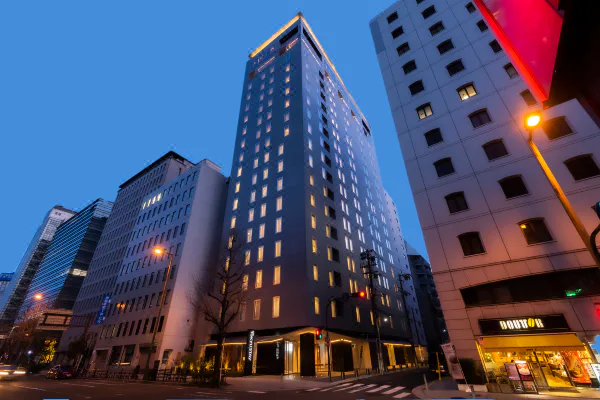
Tokyu Stay Osaka Hommachi makes most sense once Osaka becomes a base rather than a one-night stop. The useful distinction is at room level: two 16 m² doubles can look similar in a price list, yet only one has the washer-dryer that makes a five-night stay easier. The hotel also sits between two Metro stations with different lines. Pick the room first, then check which station you will actually use each day.
The booking decision turns on the 16 m² room name
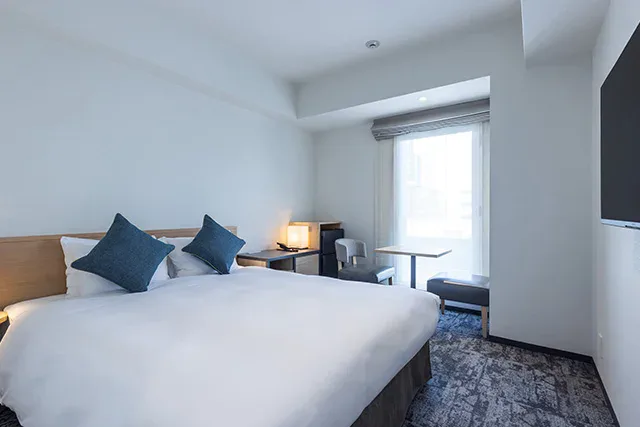
A Smart Double has a microwave but no listed in-room washer-dryer. An Economy Double occupies the same 16 m² and adds the washer-dryer. That is a substantial difference for a longer trip, even though the floor area has not changed. Smart Single follows the same no-washer side of the divide. If a search result says only “Tokyu Stay Osaka Hommachi”, it has not told you whether the main long-stay feature is included.
For two people bringing large cases, I would also compare the 19 m² Standard Double and Standard Twin before buying the cheapest laundry-equipped rate. Three extra square metres cannot guarantee two fully opened suitcases, but the difference matters more over five nights than it does for a single sleep. The 21 m² Superior Twin adds a kitchenette. At 28 m², the Deluxe Twin accommodates two or three guests and separates the bathroom and toilet while retaining laundry, microwave and kitchenette. Those are different ways to spend money; a kitchenette has little value if every meal is outside, while a separate bathroom can matter to three people getting ready together.
| Room | Area and equipment | When I would pay for it |
|---|---|---|
| Smart Single / Smart Double | Smart Double 16 m²; microwave; no washer-dryer listed | A short stay, or a long stay with laundry arranged elsewhere |
| Economy Double | 16 m²; washer-dryer and microwave | The lowest-area route to laundry in the room |
| Standard Double / Twin | 19 m²; washer-dryer and microwave | Two guests who want some luggage space without paying for a kitchen |
| Superior Twin | 21 m²; washer-dryer, microwave and kitchenette | Five nights with some meals assembled in the room |
| Deluxe Twin | 28 m²; the long-stay equipment, separate bath and toilet; two to three guests | Extra space and a more workable morning routine for a small group |
Room names on booking screens sometimes shorten or translate these categories. Check the equipment attached to the exact refundable or prepaid rate, not a hotel-wide amenity list. The wider Osaka long-stay hotel comparison helps if you are unsure whether in-room laundry is worth prioritising at all. If space is the real constraint, MIMARU Osaka Shinsaibashi Central is a more useful comparison than another compact double.
Where the “one-minute walk” applies
Sakaisuji-Hommachi Exit 11 is about one minute on foot. Hommachi Exit 12 is about five minutes. These are not interchangeable entrances to the same travel pattern: Sakaisuji-Hommachi serves the Sakaisuji and Chuo lines, while Hommachi serves the Midosuji, Chuo and Yotsubashi lines. A guest spending most days around Umeda, Namba or Shin-Osaka will probably use the Midosuji Line often. For that guest, the five-minute Hommachi approach is the honest planning number.
The Chuo Line is helpful for east-west travel, including Osaka Castle area days. The Sakaisuji Line gives a different set of central connections. Neither station puts Dotonbori nightlife outside the hotel door. If the last stop most evenings is Namba, compare Namba and other Osaka evening bases before committing to Hommachi. A trip built around Umeda or an early onward train may fit Osaka Station hotels or the Shin-Osaka last-night decision better.
For arrival from Kansai Airport, the most tiring part can be the interchange and the final Metro platform, not the walk from Exit 11. Compare the whole route you plan to take, including luggage and the line used after the airport train. If the stay includes Kobe and Koyasan, the Osaka, Kobe and Koyasan itinerary shows when one central base remains practical. Spending the night on Koyasan changes the luggage calculation; the Koyasan temple-stay guide covers that overnight separately.
Five nights are long enough to use laundry, but not weekly housekeeping
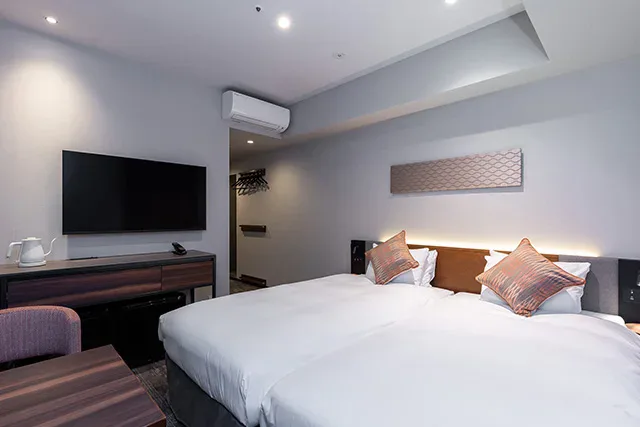
An in-room washer-dryer frees you from carrying clothes to a shared laundry and waiting for an empty machine. You can start a load while showering, sorting purchases or planning the next day. That overlap is the real advantage. I would not promise a particular wash-and-dry cycle length: the published room details do not establish one duration for every load and setting.
The appliance may let you pack fewer changes of clothes during humid weather, a rainy trip or a schedule with long walking days. It is less useful if you leave early and return after midnight every day, because you still need a moment to load and unload it. A five-night guest should decide when laundry will fit, perhaps on an early return evening, before paying a room premium. For a trip with several regional day trips, the autumn route-planning guide illustrates how the same base can save repeated packing. The Osaka foliage routes help distinguish east-west days from trips that end back near Namba.
Housekeeping follows a different rhythm. On multi-night bookings, simplified cleaning can be requested; a separate full-room clean is scheduled weekly for stays of at least seven nights. Five nights do not automatically bring daily full housekeeping. If you want a freshly remade room every afternoon, that may matter more than the laundry machine. Check the cleaning request process when you arrive, especially if you plan to keep laundry drying or luggage spread out.
| Five-night situation | What this hotel changes | What it does not solve |
|---|---|---|
| One mid-trip wash | You can run it during room time rather than make a separate laundry trip | A 16 m² room still has limited space for two large cases |
| Several simple breakfasts | Microwave in selected rooms; kitchenette from Superior Twin tier | Appliances do not replace buying food or checking the room's exact equipment |
| Daily trips across Osaka | Two station choices and several Metro lines | Umeda and Namba nights still require the ride back |
| Housekeeping expectations | Simplified cleaning can be requested | No automatic daily full-room reset on a five-night booking |
Breakfast is a separate five-day expense
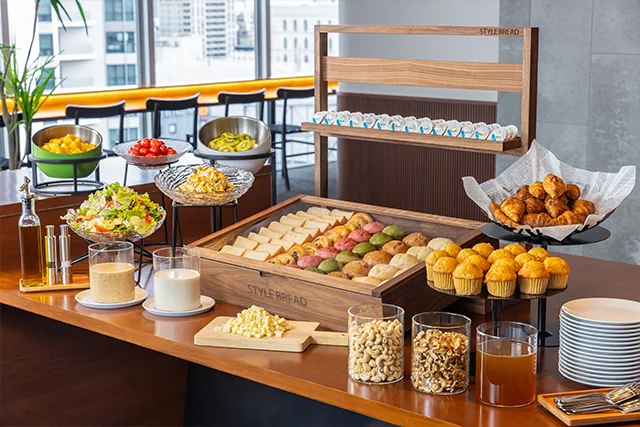
Breakfast is on the 18th floor, currently 06:30–10:00 with last order at 09:30, at ¥2,750 including tax. Prices and service details can change. For five mornings the listed price would total ¥13,750 per person if bought every day, so I would match breakfast to the actual plan rather than add it reflexively. The available breakfast information includes egg dishes such as omelets or scrambled eggs and a salmon meunière option, but the selection can vary.
A relaxed first morning may justify it. A very early park or train day may not. If the room has a microwave or kitchenette, a supermarket breakfast could make better use of the feature you paid for. The USJ one-day plan and ticket and Express Pass guide help you estimate whether there is time to sit down before leaving. Food plans need not be identical on all five mornings.
Test the base against your last stop, not the first train
Hommachi works best when your days point in different directions and you would otherwise keep changing hotels. A day around Osaka Castle or Minoh, another near Namba, and an intercity departure put different lines to work. If you are staying for a USJ event, the route home after the park closes deserves more attention than the easy morning departure. Compare Universal City, Umeda and Namba bases and the last-train options. A hotel right at Universal City, such as THE SINGULARI, solves a different problem.
The same logic applies beyond Osaka. Taking the overnight ferry to Beppu means checking the port transfer and what happens to luggage after checkout. For a short multi-city plan, a room washer may be less important than leaving bags at a convenient rail hub. If you rely on maps while moving among Tokyo, Osaka and Kyoto, the Japan eSIM comparison addresses a separate practical need; it should not decide the hotel location.
Think through a realistic evening: back at the hotel at 18:30, clothes in the machine, shower, then dinner elsewhere. If your actual pattern is out until 00:30, the example falls apart. Use your own schedule rather than treating an appliance list as proof that the room will pay for itself.
There is also a difference between using Osaka as one base and sleeping in the city every night. A Kobe day trip returns to the same suitcase and benefits from a room set up for several days. A Koyasan temple night or an overnight ferry creates a real checkout. In that case, check whether the hotel will hold a bag between separate bookings, and compare the cost of two reservations with a single continuous stay. Do not assume that paying for a room you will not sleep in is the simplest luggage solution.
Seven ratings for a five-night Hommachi booking
The hotel is most useful as a stable Osaka base when the exact room includes the features you will use. Its Smart and Economy doubles should not share one score for room equipment.
| Dimension | Our rating | The booking consequence |
|---|---|---|
| Location | Sakaisuji-Hommachi Exit 11 is close, while Hommachi Exit 12 is the longer route for Midosuji Line days. | |
| Room | A 16 m² Double can work lightly packed; the 19 m² Standard and larger twins improve a longer stay. | |
| Cleanliness | Large recent aggregates are positive, with some recent reports of bathroom cleaning lapses. | |
| Service | Luggage help and front-desk interaction rate well across recent stays. | |
| Facilities | In-room washer-dryer and microwave are strong for five nights, but Smart rooms lack the washer. | |
| Food | The ¥2,750 breakfast buffet can work on a slow morning; five prepaid breakfasts are harder to defend. | |
| Value | The value depends on using laundry and avoiding a room whose luggage space is too tight. |
Our overall five-night read is 8.0/10 for a mixed-direction Osaka itinerary. The score falls for trips ending repeatedly in Namba or beginning at JR Osaka Station.
Which booking would I reject?
I would reject a cheap Smart rate if the trip depends on in-room laundry. I would also hesitate over an Economy Double for two large suitcases if the Standard category costs only a little more for the same dates. A Superior Twin premium needs to be supported by actual kitchenette use; a Deluxe Twin premium should reflect its space, third-guest capacity or separate bathroom arrangement. If none of those needs exists, a more convenient Namba or Umeda hotel could be the better buy.
| Plan | Most useful room or alternative | Check before payment |
|---|---|---|
| Four to six nights, one or two laundry loads | Economy Double or Standard Double/Twin | Washer-dryer listed for the exact rate, bed layout, suitcase space |
| Five nights with simple meals in the room | Superior Twin or Deluxe Twin | Kitchenette inclusion and total price against eating out |
| Three guests sharing the room | Deluxe Twin, if the bed arrangement suits the group | Occupancy and sleeping arrangement for the booked dates |
| One or two nights, late Namba evenings | Compare a Namba hotel before paying for long-stay equipment | Last train or taxi route and actual final-night location |
Use the same dates, guest count, cancellation terms, taxes, breakfast choice and room category when comparing booking options. A lower headline price is meaningless if it quietly moves you from Economy to Smart. For the Hommachi area, compare available rooms around Hommachi on a map; open the hotel listing and verify the washer-dryer against the selected room before paying. The OMO7 Osaka location decision gives a contrasting southern base, while Mitsui Garden Hotel Osaka Premier is worth a look if a quieter Nakanoshima setting is the priority.
My five-night call
For a mixed Osaka itinerary with at least one planned laundry load, I would shortlist Tokyu Stay Osaka Hommachi from Economy Double upward. Standard room space may be a sensible upgrade for two people; the kitchenette tiers should earn their price through actual use. The hotel is less compelling when every night ends in the same entertainment district, when a fully serviced room each day is important, or when the stay is too short to use the facilities. Its value comes from the specific room and repeated daily route, not the brand name alone.
If the trip is for a couple, compare the seven-day Osaka-based itinerary and where those evenings finish. If it is a group trip, the beds and bathrooms comparison may outweigh a washer. Other laundry-led city hotels, including Tokyu Stay Shinjuku Eastside and Tokyu Stay Sapporo Odori, show how differently room categories can work within the same chain.
Questions that matter before booking
Does every room have laundry?
No. Smart Single and Smart Double do not list an in-room washer-dryer. Economy Double and the relevant higher room categories do. Recheck the equipment attached to your exact room rate.
Is it one minute or five minutes from the subway?
About one minute from Sakaisuji-Hommachi Exit 11, or about five minutes from Hommachi Exit 12. Use the station corresponding to your Metro line when estimating each journey.
Does a five-night booking include full daily cleaning?
No. Simplified cleaning is requested on multi-night stays; full-room cleaning follows the separate weekly rule for stays of seven nights or more.
Where does the kitchenette start?
The 21 m² Superior Twin lists a kitchenette along with its washer-dryer and microwave. The 28 m² Deluxe Twin retains those facilities and adds a separate bathroom and toilet.
When is breakfast?
The current listing is 06:30–10:00 on the 18th floor, with last order at 09:30 and a ¥2,750 tax-inclusive price. Check the terms for your travel dates.