
Hita's bamboo lanterns return November 13–15, 2026, with lighting planned around 16:30–21:00 in Mameda, Maruyama and along the Kagetsu River. The adjoining Hita Tenryo Festival takes place only on Saturday and Sunday, November 14–15, from 10:00–16:30. Friday therefore suits a lantern-led evening; the weekend offers a daytime historical programme before the river and streets light up. The city's September update also changes the old travel calculation: the Fukuoka-bound highway bus now leaves Hita Bus Terminal as late as 20:10 on weekdays and 20:00 on weekends, one hour later than the schedule used in the earlier version of this guide.
That extra hour makes a short Fukuoka day trip more plausible, but it does not cover the whole display. Give yourself time to walk from the river or Mameda to the terminal, and remember that the highway bus is unreserved and can fill. A hotel in Hita remains the straightforward choice if full darkness, night photographs and a meal without a departure alarm are the point. The Fukuoka–Hita–Yufuin–Beppu sequence shows when that overnight also advances the next day.
The three dates have different daytime plans
↔ Scroll table left or right
| Travel plan | Best fit | What it buys | Constraint |
|---|---|---|---|
| Lanterns and photographs are the main aim | Friday, November 13 | A focused evening without the Saturday/Sunday Tenryo daytime programme | Last regular Fukuoka bus is currently 20:10 |
| Historical Hita by day, bamboo lights at night | November 14 or 15 | Tenryo programme 10:00–16:30, then lights about 16:30–21:00 | More walking, traffic pressure and a 20:00 weekend bus |
| Early lantern sample from a Fukuoka hotel | Any of the three days | No change of room or luggage | Leave before the final hour of lighting and allow for the walk to the terminal |
| Full evening and a slow morning | Hita overnight | Dark-sky photo time and Mameda without a last-bus clock | Room cost and a next-morning onward plan |
On Sunday the period-costume procession is scheduled 13:00–16:00, so that date has a distinct daytime draw. The city lists the Tenryo market, craft programme and food stalls on both weekend days; the bamboo lights themselves begin on Friday. Do not assume every exhibition or procession occurs all three days. The historic district is worth seeing before dusk so the shopfronts and street layout make sense when the lanterns take over. Dazaifu's procession-and-candlelight event is a different Kyushu evening, and Karatsu Kunchi has its own night-versus-return trade-off.
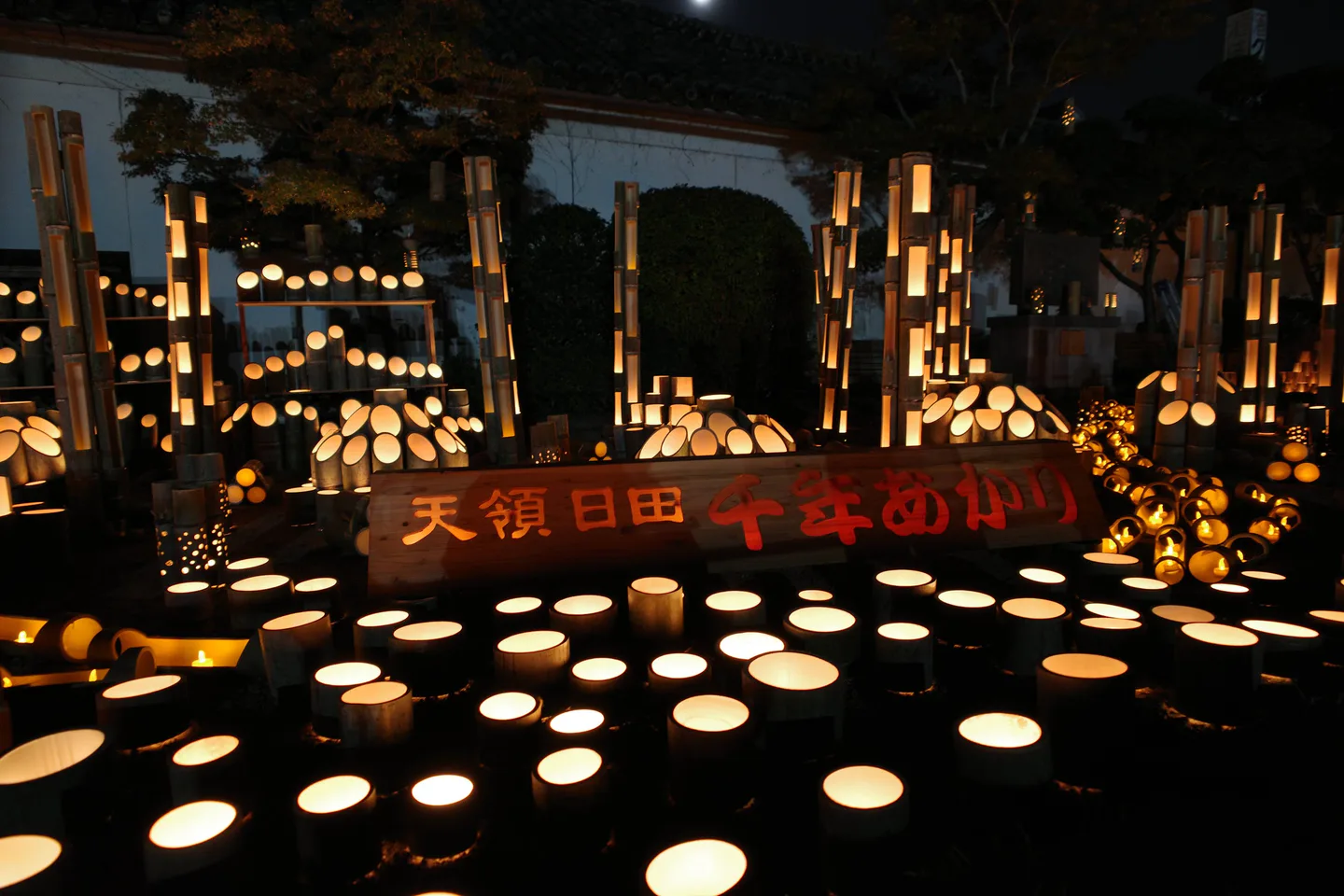
The first photograph shows a wooden Tenryo Hita Sennen Akari sign among lit bamboo pieces, not the Kagetsu River. The festival grew from local bamboo-cutting efforts connected with protecting Hita's cedar and cypress from bamboo spread; the town's historic setting and the river are part of the display, rather than merely a backdrop for anonymous candles. The event has run since 2005 and sits alongside Oita's Usuki and Taketa bamboo-light traditions.
The revised last bus changes the day-trip calculation
The Fukuoka–Hita highway bus takes about 95 minutes between Tenjin and Hita Bus Terminal in the route information and does not require advance reservation. It is still a finite-capacity service. The October 1, 2026 timetable moved the last Hita departure toward Fukuoka from 19:10 to 20:10 on weekdays and 19:00 to 20:00 on weekends and holidays. Friday November 13 uses the weekday pattern; November 14 and 15 use the weekend pattern. Recheck the dated service if the operator announces an event variation. The new times let you see more early darkness than the old timetable, but a 21:00 festival finish remains beyond the regular bus. Fukuoka's city transport choices solve the journey to Tenjin, while the Hita highway departure controls the return.
A sensible day-trip version reaches Hita before sunset, walks Mameda in daylight, moves through Maruyama toward the Kagetsu River as lanterns light, then uses a fixed time to turn back toward the terminal. You can see the shift from old streets to candlelight without pretending to stay for the entire night. The roughly 95-minute outbound ride should not be mistaken for a same-night return that is available at any hour. The Fukuoka trip-length plan can reserve a full day for Hita instead of squeezing it between unrelated city stops.
Rail offers another set of choices, but it has to be searched for November 13, 14 or 15, not inferred from one named train. A previously published Yufuin no Mori itinerary listed a Hita departure at 18:12 and Hakata arrival at 19:27; that particular sightseeing train is not a late-festival solution. Later ordinary or limited-express services may be available, and seat calendars are date-dependent. Check the actual JR Kyushu journey after the festival programme and return time are settled. A Northern Kyushu Rail Pass is justified by the combined journeys that it covers, not by the fact that Hita lies in Oita Prefecture. For a next-day Yufuin leg, compare the rail and bus choices as a separate route decision.
Mameda, Maruyama and the river form one walk
Mameda-machi gives close views of lanterns against old wooden and plaster façades. The Maruyama area links those lanes to the broader Kagetsu River display. Along the water, bridges, embankments and reflections let the installation read as a city landscape. Start in Mameda while there is still enough light to orient yourself; visit the river when the sky darkens; return through a different street only if your bus or hotel timing permits. Treating each area as a separate taxi stop would lose the transition that makes the festival coherent.
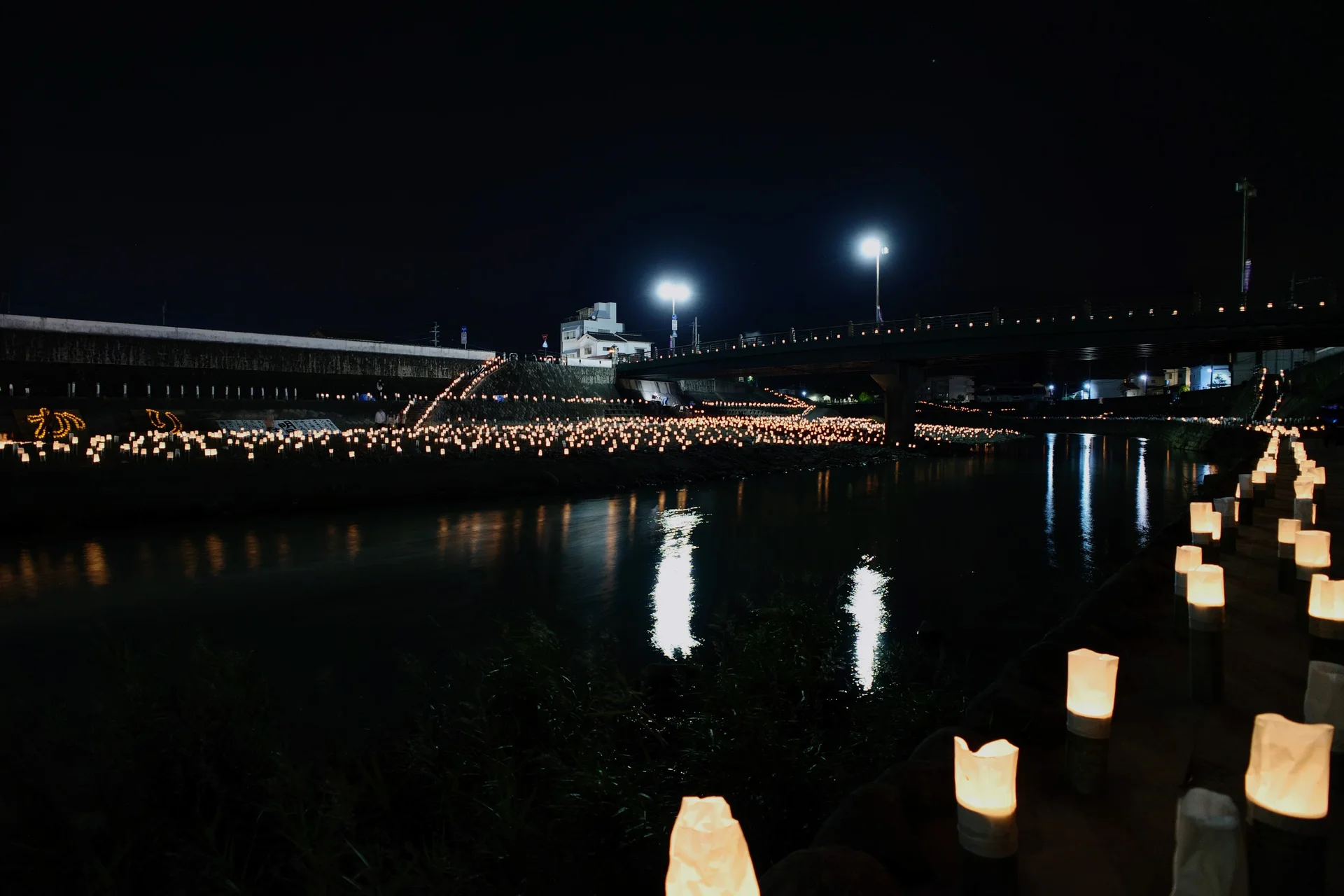
The river image shows lantern rows beneath a bridge and their limited reflections, with streetlights also visible. It is not a perfectly mirrored river scene. Wind and water level can change those reflections, and a crowded bank can make a planned viewpoint impractical. Walk until a safe clear view opens instead of insisting on one precise camera position. The Kawaguchiko illumination guide is useful only as a comparison of night-event access; its autumn trees and transport are unrelated to Hita's bamboo programme.
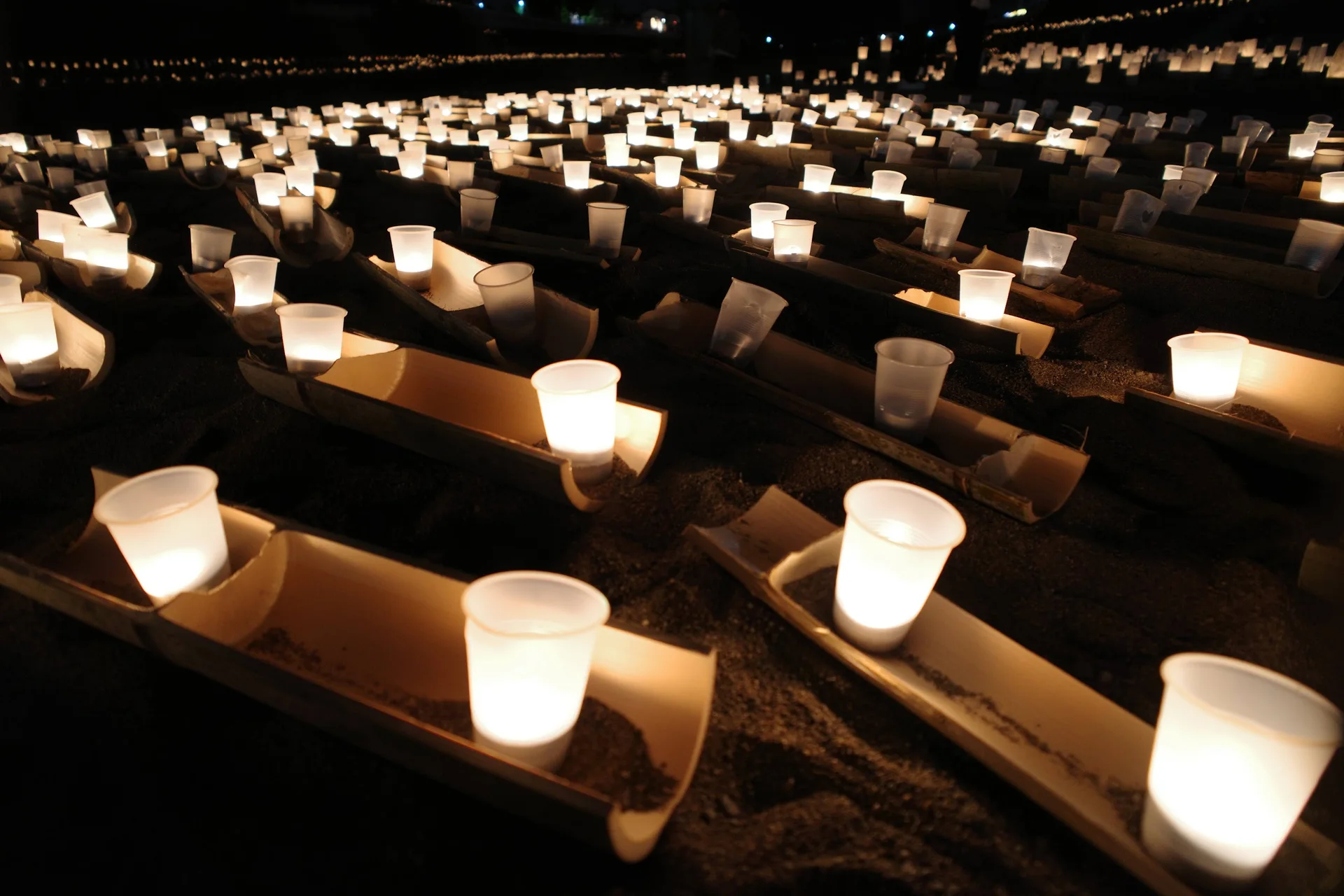
The close-up shows small lights in cups set into split bamboo. A slight underexposure can protect the bright flame detail while keeping the surrounding riverbank readable. Include a bridge, waterline, stone wall or distinctive street in a wider frame so the picture still identifies Hita. A small tripod can help in low light if it does not block a narrow public path. Make a few shorter exposures when wind moves the flame or weakens reflections rather than staking the evening on one long shot.
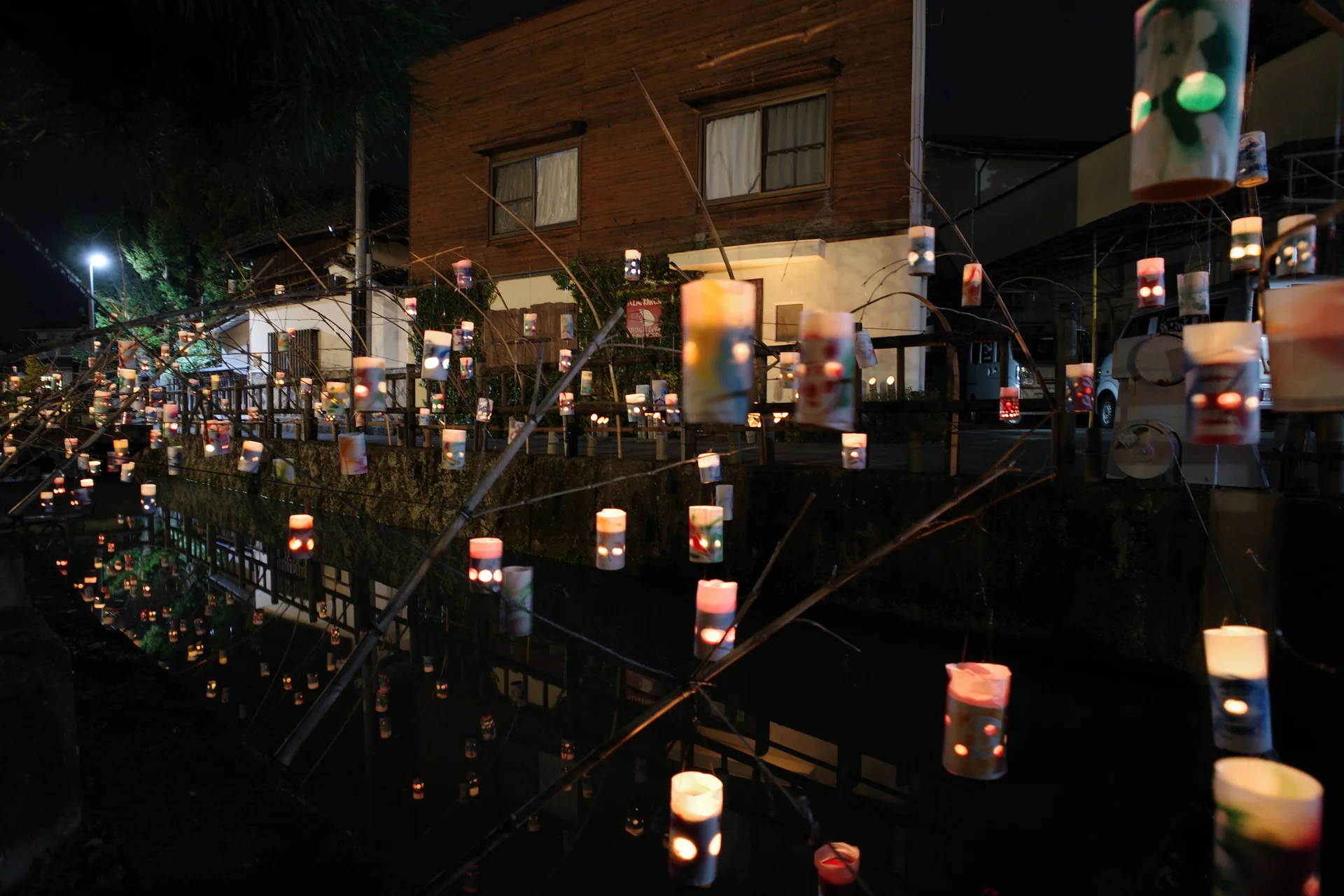
Suspended painted lanterns beside Mameda buildings offer a tighter composition than the river panorama. Arrive before the busiest dark period to see where the hanging pieces sit, then return after sunset if time allows. Children and older companions may prefer this shorter district walk to a repeated riverbank traverse; a family should set the return turn-around point before everyone becomes tired. The Fukuoka-with-parents hotel guide considers the same walking and late-return limits at the base.
An overnight should buy the last hour and the next morning
If a bus departure would pull you away around 19:15–19:40, a Hita room buys the deeper dark period up to the planned 21:00 finish, a meal break and another look at Mameda after river crowds shift. It can also give you the historic streets the next morning without festival traffic. A station-side hotel, such as Hotel Route-Inn Hita Ekimae, is practical when an early bus or train matters. A riverside or onsen-style property has a stronger case when the room, bath and breakfast are themselves part of the night. Compare the actual distance from your final lantern area to the hotel door, then the next morning's departure; a cheap remote room can give back the time you thought you bought.
Compare Hita stays for the festival nights using the 13, 14 or 15 November date that fits your programme. If the next leg is Yufuin or Beppu, the Hita–Yufuin continuation and the Beppu–Yufuin choice determine whether Hita is a genuine route stop. The Fukuoka-versus-Yufuin extra-night choice may matter if this festival adds a third competing base. Luggage forwarding options matter when you carry camera equipment or travel beyond Hita. A night in Fukuoka can still be the right choice for a short candlelight sample; the last Fukuoka hotel base should fit your departure rather than the festival alone.
Weather and parking can shorten the programme
These are outdoor bamboo installations with real candlelight. Rain, wind or river conditions can affect individual displays, walking routes and reflections even while the festival date remains on the calendar. Check the city's event notice on the travel day; carry weather protection that leaves your hands free on river steps. If a scene is roped off or a narrow path is crowded, change angle rather than blocking the flow for a photograph.
The city is introducing reserved, paid parking near the 2026 event as a congestion measure. General vehicle spaces are listed for public sale from October 28 at ¥1,500 per time slot; a city-resident advance sale runs October 21–27 at ¥1,000 per slot. Bus spaces have separate rates. Anyone driving should confirm the designated lot and reserved period rather than assume an old free-festival parking arrangement. That does not make a rental car necessary for a Fukuoka day trip. The Fukuoka car-day plan helps keep a vehicle only for routes that warrant it.
Friday is the better fit when lanterns alone are the reason to travel. Saturday or Sunday earns the additional daytime Tenryo events but uses more of the day and can raise crowd and hotel pressure. The October 2026 later last bus makes an early dark-sky sample possible from Fukuoka; staying in Hita remains useful for the final hour, night photography and an unhurried next morning. Choose the return or room before adding other Kyushu stops, and let the actual weather and service on the date shape the final walking route.
Other evening routes
Hita Tourism Association — corrected 2026 Sennen Akari and Tenryo Festival dates · Nishitetsu — Fukuoka–Hita highway bus, April 1, 2026 timetable · JR Kyushu — current Yufuin no Mori schedule and operating-calendar notices · Lake Biwa Fireworks 2026: Free Viewing, Closures and Otsu Access · Koyasan Autumn Leaves Guide: Temple Lodging, Morning Prayers and Access from Osaka · Lake Kawaguchi vs Lake Yamanaka for Autumn Leaves: Views, Access and Hotels · Tomamu Private Ski Lessons: 2, 3 or 6 Hours? Compare Group, Private and Photo Lessons · Hakkoda Autumn Leaves Guide: Ropeway, Sukayu Onsen, Access and Weather Plans · Yamagata Hanagasa Festival Reserved Seats 2026: Is the ¥4,000 Seat Worth It? Paid vs Free Viewing · Kamikochi Day Trip: Matsumoto Access and Walking Routes · Akita Kanto Festival 2026 Guide: Dates, Seats, Day Contest and Hotels · HOTEL FORZA Hakata Station Chikushi-Guchi I Review: 1-Minute Access and 18m² Rooms · Osaka Castle Cherry Blossoms: Nishinomaru, Castle Tickets and Night Viewing · Yamaga Lantern Festival 2026: What Was Cancelled and How Refunds Work · Yamaga Lantern Festival 2026 Seats: Refund Deadline, Ticket Types and What You Get Back