
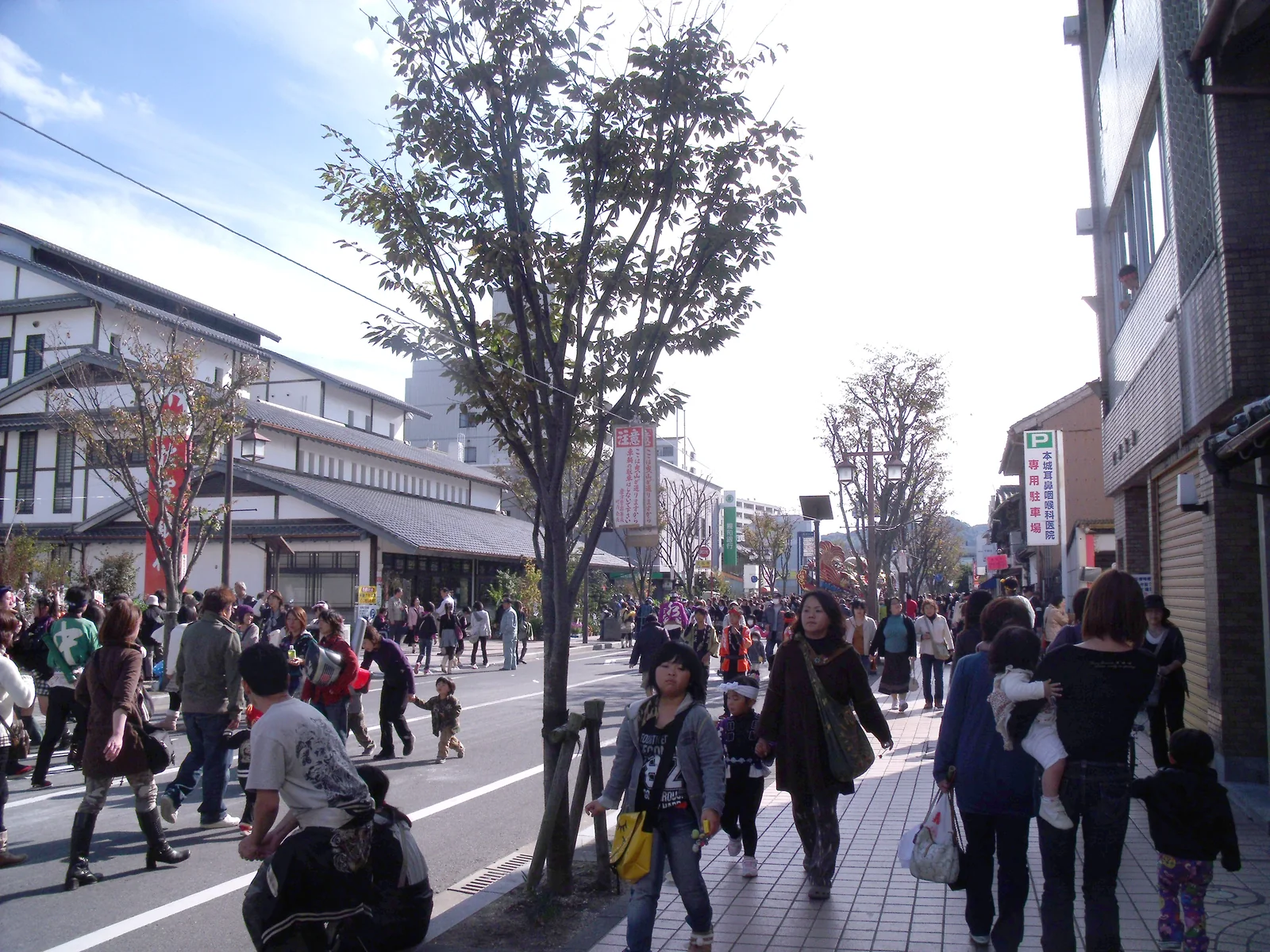
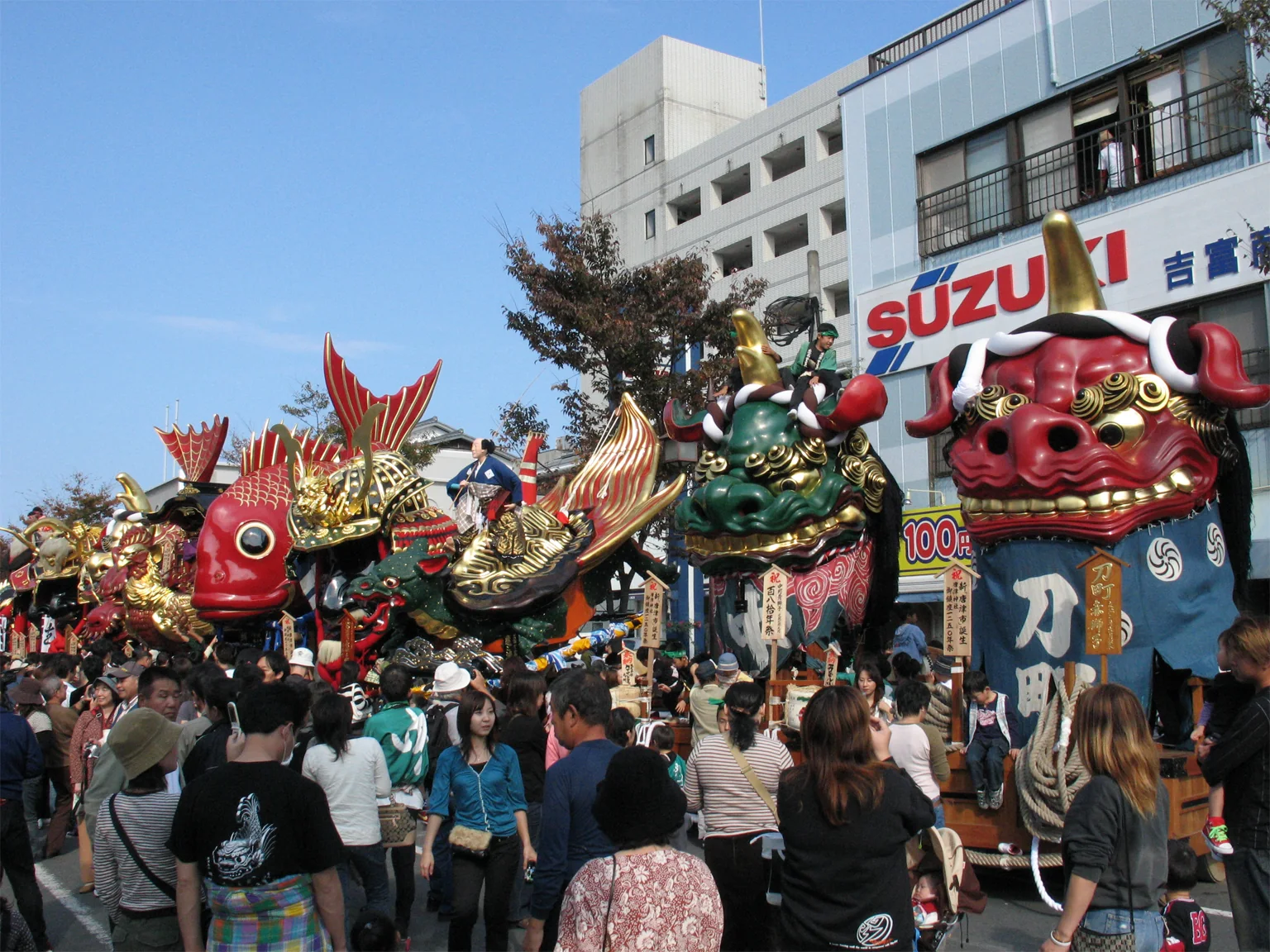
Karatsu Kunchi is a three-day festival, but its nights and mornings create different hotel problems. The annual programme runs 2–4 November. On the evening of the 2nd, lantern-lit hikiyama floats move through the old town. The following day centres on the shrine procession and the route to the ceremonial grounds; the 4th has another town circuit. If your image of the festival is the floats after dark, a hotel search for “Karatsu, November 3” misses the night you need. If you want the long daytime route, a room on the 2nd can also spare an early transfer from Fukuoka. Neither choice requires a three-night festival package by default.
The decision is whether to make Karatsu your base for the part of the procession that matters, or use Fukuoka as a larger trip base and return by rail. Fukuoka offers more rooms and dinner options. Karatsu makes the late streets and next-morning viewing much easier to manage. The Fukuoka hotel hub is useful for a general city stay; this article looks at the festival's particular sequence and the final walk from the route to bed.
Swipe through earlier event photographs
First choose a festival date, then choose a room
The Karatsu Tourism Association describes the festival as an annual 2–4 November event. It identifies the lantern-lit night procession on the 2nd and the larger daytime route on the 3rd. The organisation's English introduction is useful for the festival's shape; the Japanese festival page should be checked again for any 2026 route notices. Some maps and timing sheets online are from older years. They help explain the streets, but they are not a promise that a 2026 float will reach the same corner at the same minute. I would book the night against the annual dates, then confirm the current route and transport notices nearer departure.
The 2nd favours a Karatsu overnight if you want to stay until the floats have passed and still enjoy the town afterwards. A Fukuoka return is possible only if the actual train service and your walking route back to Karatsu Station fit your plan. A crowded street can make a nominal short walk longer than a map suggests. On 3 November, an early arrival from Fukuoka may be enough if you only want a defined daytime section and plan to leave before evening. If you want to see the morning assembly, a first train that reaches the station after the route starts will not be rescued by a fast walk.
| What you want to see | Best night to protect | Why the hotel location matters |
|---|---|---|
| Lantern-lit floats on the 2nd | 2 November | A central room removes the need to race from the route to a late train |
| Main procession on the 3rd | 2 November, if you want an early start | You can walk from the station district before visitors arriving from Fukuoka |
| A shorter daytime look on the 4th | 3 November, if you want a relaxed morning | Overnight in town is useful, but a day trip may be enough |
| A festival stop inside a Fukuoka holiday | Only if it serves another purpose | Confirm your exact train and viewing window before paying a festival rate |
The table is a planning tool, not a fixed route announcement. The 2026 programme may adjust procession arrangements or crowd controls. Children, wheelchairs and anyone who cannot stand for long periods also need to choose a realistic viewing interval. The longest possible festival day is not automatically the best one. A shorter route section with a comfortable return may leave more time to appreciate the floats than hours spent chasing them through crowded streets.
The Karatsu hotel should be in the old-town rail district
For a festival-first stay, search central Karatsu before a general coastal resort. HOTEL KARAE is a real property near the north exit of Karatsu Station; its hotel access page says roughly two minutes on foot. That is a useful example because a station-side room also puts the historic town close enough to explore on foot. Karatsu Daiichi Hotel is another central address: its access page says five minutes from JR Karatsu Station and two minutes from Oteguchi Bus Center. Neither fact guarantees a particular viewing point or an open route to the hotel door during procession controls. Compare the exact entrance, the streets likely to be restricted and the date-specific room terms before paying.
Karatsu Seaside Hotel can be attractive for a different trip, but its official access information places it near Higashi-Karatsu Station, with onward transport into central Karatsu. It is not a simple replacement for a festival room beside Karatsu Station. A sea view, spa or larger room may justify that extra leg if the hotel stay itself is the centre of the holiday. It is a poor way to save a small amount if you intend to follow the lantern procession until late and then need a taxi at a moment many other visitors also want one. Read “Karatsu” in a search result as a city label, not proof that the route is outside the lobby.
Festival inventory can disappear or change price early. If the central rooms you want are sold out, widen the search carefully. Check whether a candidate is near Karatsu Station, Higashi-Karatsu, Nishi-Karatsu or a road-only location. Those are not identical after a night procession. Ask whether the property has a late check-in cutoff and how luggage storage works before and after the stay. A station locker may be full on a busy festival day, so a hotel that will hold a bag has practical value. If two rooms cost the same, the one with a dependable walk back from the route may be worth more than a larger one across the river.
The check-in hour itself can change how much of the 2nd you see. If your train reaches Karatsu before the room is ready, leave the bag rather than carrying it into a viewing crowd. If you arrive after the hotel's usual check-in window, tell the desk in advance that you expect to enter after the procession. A locked lobby or an unstaffed entrance can undo the advantage of a central address. Check whether the named guest needs to present identification at the desk, and keep the reservation details available offline in case mobile data is slow among spectators. These small arrangements are worth settling before festival day; they are much harder to resolve while a float is moving past your hotel street.
The Fukuoka return is a real alternative, with a hard end time
Fukuoka works well when Karatsu rooms are unavailable or when you are already using the city for several nights. The rail link to Karatsu involves the subway and JR Chikuhi Line; the hotel page for HOTEL KARAE describes an approximately 90-minute journey from Hakata, Tenjin or the airport to Karatsu Station. That is an orientation, not a live timetable. Service pattern, departure station, through-running and the last return have to be checked for your exact festival night. The Fukuoka transport guide is useful for understanding why “one line” on a tourist map can still require attention to operators and train destinations.
If you return to Fukuoka after the 2 November procession, decide your departure threshold before the floats arrive. Keep a current rail option on the phone, but also know how long it takes to leave the viewing street and reach Karatsu Station in a crowd. A train that departs soon after the advertised procession end may be a poor target. The festival is not a show that everyone leaves through one gate at once, yet streets can still move slowly. Give your group a meeting point and do not choose a route that depends on being able to cross a closed street. The Fukuoka late-arrival hotel guide can help you decide whether the room at the other end remains comfortable after a late train.
Where in Fukuoka should you sleep? For an early outward departure or late inward train, a Hakata or Tenjin room close to the platform you will actually use is more valuable than a vague central address. Hakata suits people with a Shinkansen or airport leg; Tenjin can suit dining and a subway-first trip. The Hakata versus Tenjin hotel comparison illustrates how different neighbourhoods change the last walk. The Hakata Station hotel comparison is more useful if the festival is followed by an early intercity departure. The Fukuoka two-night short-stay guide can show whether keeping one Fukuoka base avoids a costly and tiring hotel change.
| Booking choice | What it buys | What it asks of you | I would choose it when |
|---|---|---|---|
| Central Karatsu, night of 2 November | Night floats and next morning without an intercity transfer | Higher festival demand; fewer rooms | The festival is the purpose of the trip |
| Central Karatsu, night of 3 November | Full main day and a calmer next morning | You may still need an early arrival on the 3rd | The procession matters more than the 2nd's night scene |
| Fukuoka base for every night | More room choice; no packing move | Fixed return threshold and longer travel | You want a selected short festival interval |
| Coastal Karatsu resort | A hotel stay with spa or sea view | Extra transport to the old-town route | The resort is as important as the festival |
Notice that “Fukuoka base” is not a compromise to be justified by price alone. It can be the right choice if your Karatsu visit is one part of a longer city itinerary. But book it honestly as a day or evening trip with a planned exit. The Fukuoka three-day itinerary and Dazaifu versus Itoshima day trip are useful contrasts: a festival with moving floats and temporary traffic controls is less forgiving than an ordinary flexible sightseeing day.
A route plan for people who do not want to chase every float
Choose one or two viewing areas after the 2026 route is released. Arrive early enough to understand which side of the street the floats will pass and where the nearest open crossing lies. If photography matters, avoid assuming that the first clear position will remain clear as the crowd changes. Respect staff directions, private entrances and the space needed for float teams. The photographs in this article show previous years; they are evidence of the event's appearance, not a map of 2026 positions.
A family may be happier viewing one early segment on the 2nd, eating before the busiest period and returning to a nearby room. A solo visitor who can wait comfortably may prefer a later stretch but still needs the return train deadline. Someone with limited mobility should seek a reachable location and verify any temporary access arrangements; a central hotel helps only if the streets between it and the viewing place remain passable. An afternoon arrival from Fukuoka with suitcases makes all of these decisions harder. Store bags first or book a room that can accept them.
Food is another reason to keep the evening plan modest. Restaurants and shops are part of the festival experience, but opening hours and queues can differ from an ordinary weekday. Eat before the point at which you cannot comfortably step away from a viewing spot. If you return to Fukuoka hungry, the Hakata Station dinner guide may help, but check late service for 2 or 3 November rather than assuming a usual timetable. The Fukuoka yatai district guide is an option only when your return time leaves room for it; it is not a reason to cut the procession short unless you value that meal more.
The morning after a Karatsu overnight can be used for the town itself, not merely for checkout. If the 3rd is your main festival day, keep breakfast and luggage simple. If you are leaving after a night on the 3rd, check whether the Hikiyama Exhibition Hall is open: the tourism association notes festival-day closures in its own listings, so do not use a generic museum itinerary without looking at the date. A later Kyushu leg might favour a Fukuoka four-day route or a Hita–Yufuin–Beppu hotel sequence, but neither should force you to leave Karatsu during the float procession you came to see.
What I would book
For a visitor whose priority is the lantern-lit floats on 2 November, I would first look for a walkable Karatsu Station hotel for that night, with 3 November available for the morning route or departure. HOTEL KARAE is a location-specific search starting point, not a claim that rooms remain or that any rate is good. For a visitor interested in only a defined daytime section, I would compare a Fukuoka base against a Karatsu room using the exact train service and luggage plan. I would not buy a distant resort room to solve a central-street festival problem unless its own facilities are part of the trip.
Before departure, check the 2026 route notices, railway services and any street access restrictions. Keep one exit route that does not depend on crossing the procession. The festival's annual dates are established; your exact evening and the practical way back to the hotel still need date-specific confirmation. If Karatsu is part of a wider Fukuoka stay, the Fukuoka day-trip base guide, Fukuoka family hotels and Fukuoka with parents hotels can help choose the surrounding nights without taking attention away from this one.