
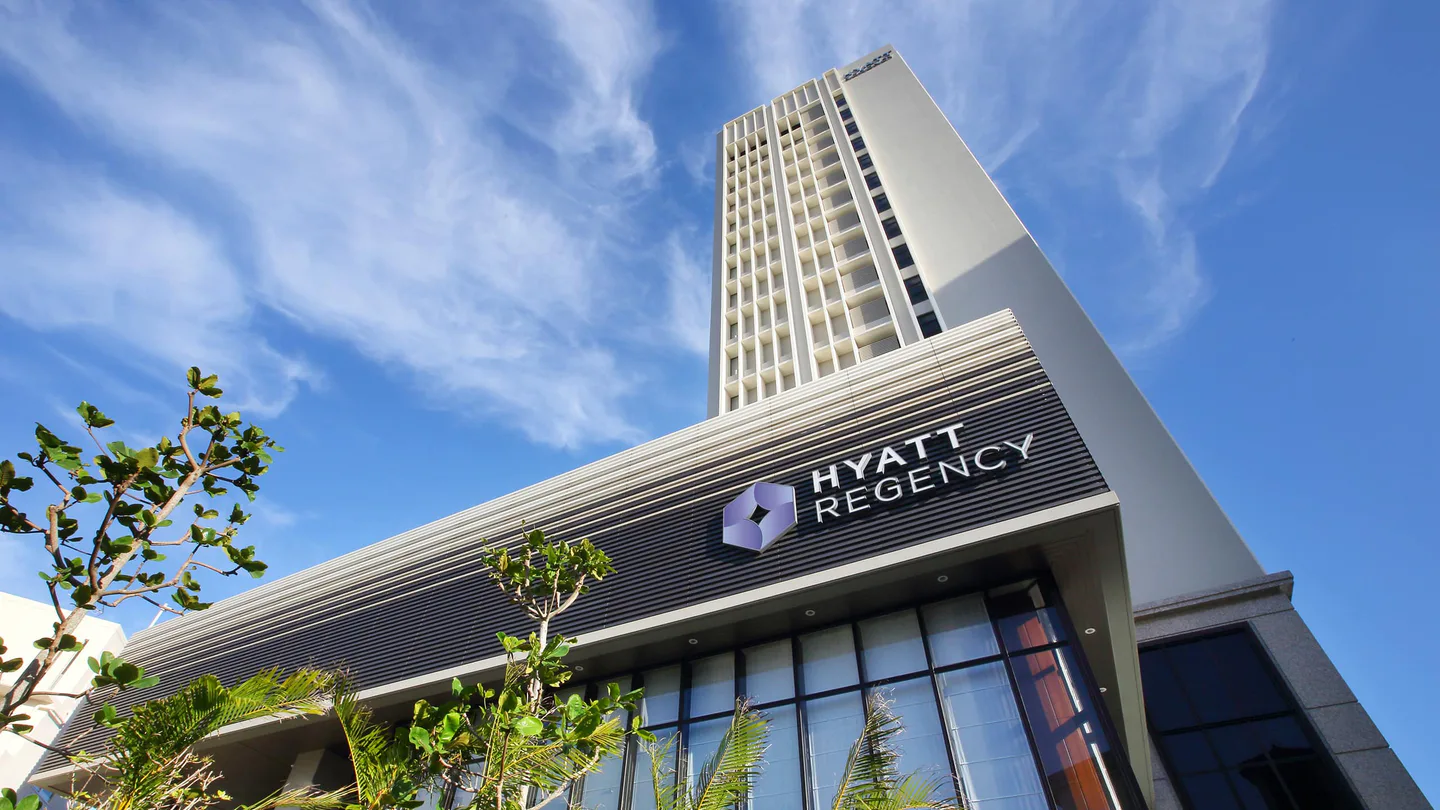
Hyatt Regency Naha works best when Naha itself is part of the holiday. The hotel stands on the Makishi–Sakurazaka side of the centre, close to the public market and Tsuboya’s pottery streets. That puts several pleasant evening walks near your room, but Makishi monorail station is farther away than the name “central Naha” might suggest. For a two-night stay after an Okinawa road trip, that trade can be excellent. For repeated airport and rail journeys with heavy bags, it deserves a closer calculation.
Hyatt puts Kokusai Street roughly three minutes away on foot, Tsuboya Yachimun Street about one minute away and Makishi Public Market about four minutes away. Its own Makishi Station estimate is eight minutes. These are useful orientation figures, not promises of a timed walk in summer heat, rain or with a stroller. A room in the centre of a map does not tell you whether the trip will be spent near the hotel or repeatedly travelling beyond it. The two-day Naha walking and rail route is a good way to count the movements before comparing hotels.
Where the Makishi address helps, and where it costs time
The strongest case for Hyatt is an itinerary that returns to the Makishi market, Sakurazaka restaurants and Tsuboya more than once. You can come back to the room after shopping, change before dinner and leave again without crossing the length of Kokusai Street. On a hot afternoon, a short return can also make a room or pool break realistic. The hotel is set back from the main shopping frontage, although that does not guarantee a quiet room: floor, orientation and activity nearby still influence the experience. The Naha and Chatan shopping-base comparison helps if the last evenings, rather than morning transport, drive the booking.
Now count station journeys. Arrival and departure by Yui Rail mean two hotel-to-station walks. Add one rail outing and the total becomes four; at the hotel’s eight-minute estimate, those walking legs alone add up to about 32 minutes. Three rail sightseeing days between arrival and departure would make eight walks, or roughly 64 minutes. Those totals are arithmetic based on the advertised walk, not measurements of your actual route. They omit crossing waits, lifts, platform access, bags and weather. Someone making rail trips to Shuri or Omoromachi every morning may prefer a station-side address even if the market is farther away.
A taxi on airport days changes that comparison. Hyatt gives an approximate 20-minute drive from Naha Airport in ordinary traffic and lists no airport shuttle. If two people share a taxi and have large cases, the Makishi station walk may disappear from the two most awkward journeys. It then matters only on days when the monorail is part of the plan. A traveller protecting a small budget may still choose rail both ways; the Okinawa car-versus-public-transport guide puts these city choices in the context of the entire trip.
↔ Scroll table left or right
| Stay pattern | Hyatt’s likely advantage | Main thing to check |
|---|---|---|
| Two or three nights around Makishi, Tsuboya and Kokusai Street | Repeated neighbourhood walks are short. | Whether the quoted room and breakfast suit the party. |
| Monorail departures every sightseeing day | The city location still works for evenings. | Eight-minute station legs multiply; compare a station-side room. |
| Last two nights after returning a rental car | Central Naha can be explored without keeping the car. | Car return point and transfer to the hotel. |
| One late arrival before collecting a car | Little beyond a comfortable room may be used. | Airport transfer, arrival hour and a simpler first-night rate. |
| Club booking during full-day excursions | High-floor room remains. | Breakfast and evening lounge sessions may be missed. |
That distinction is particularly useful at the beginning and end of a self-drive route. A one-night airport bookend leaves little time for the surrounding streets or facilities. The late-arrival hotel comparison may produce a better first night. After you return the car, however, a Makishi hotel can provide two easy car-free evenings. The five-day car-free Okinawa plan shows which days can stay in Naha and which are better handled from a different base.
Choose a room by the third traveller and the lounge schedule
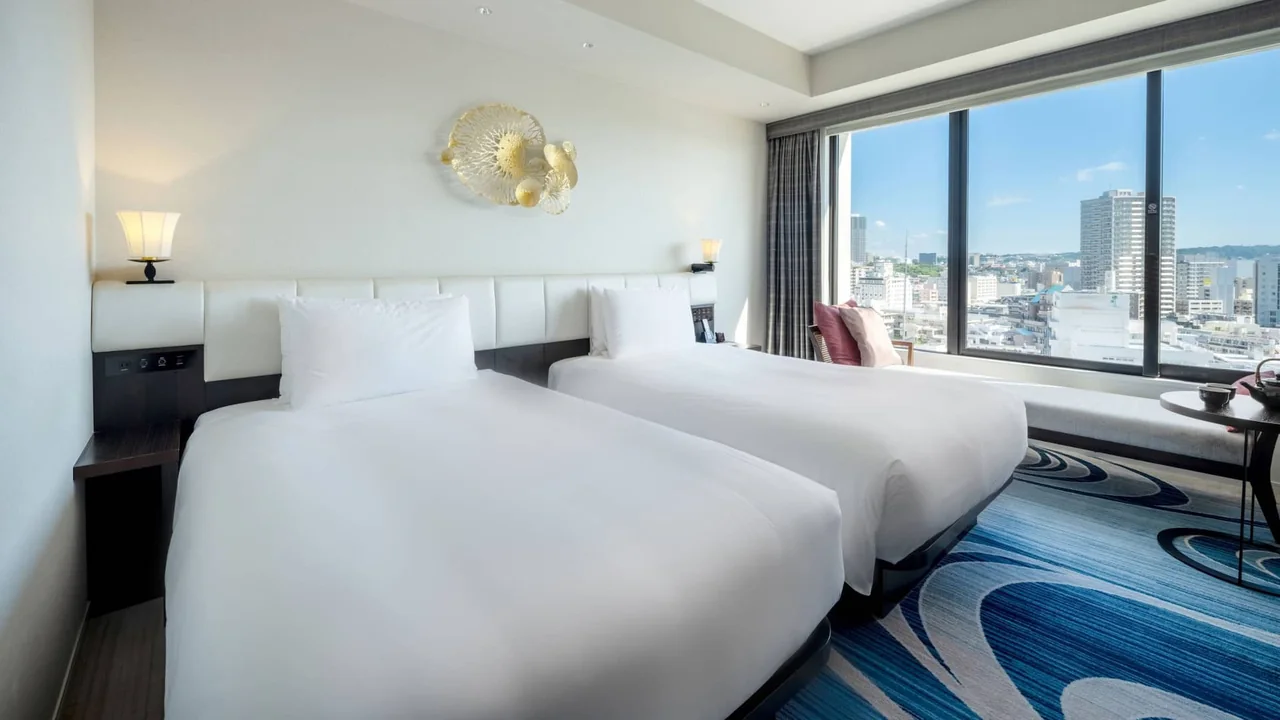
Hyatt’s standard two-twin room is 28 m². That is a sensible baseline for two adults who will spend much of the day outside. The Deluxe Twin is 32 m² and is offered in a distinct two-twin-plus-extra-bed configuration for a maximum of three guests. A capacity statement does not mean there are three fixed beds. Before paying for a group, locate that precise room product, confirm its extra bed and compare the final rate for all occupants. The Okinawa room-capacity guide explains why maximum occupancy alone can mislead.
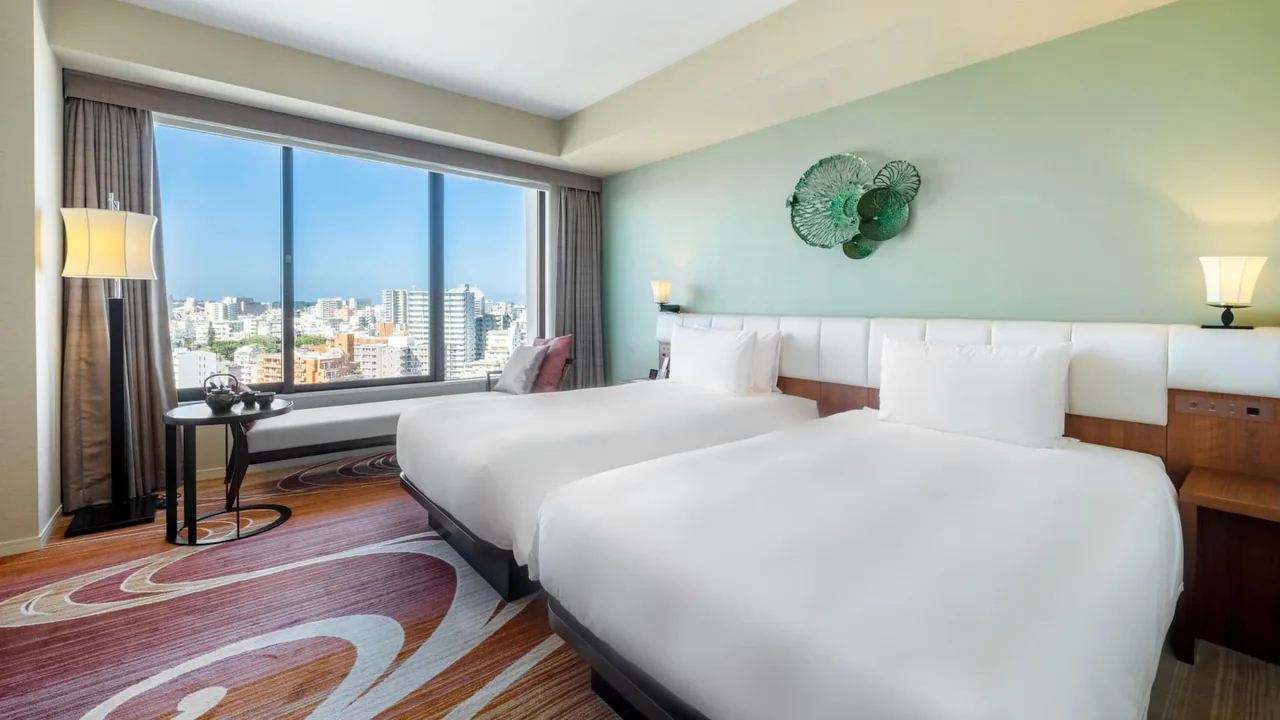
A Club Twin also measures 28 m². Its premium changes the floor and grants Regency Club access; it does not buy the four extra square metres of the standard Deluxe Twin. Hyatt additionally lists a 32 m² Deluxe Club Twin, so “Club” and “Deluxe” need not be treated as mutually exclusive. A couple wanting more open space should price the Deluxe room before assuming a Club upgrade solves it. A couple planning an afternoon at the hotel may value the Club more, especially when breakfast and the evening drinks replace spending elsewhere.
The 18th-floor Regency Club is reserved for guests in Club Rooms and Suites. Hyatt currently lists a 07:00–21:00 operating day, breakfast 07:00–10:00, a tea period 10:00–17:00 and again 19:00–21:00, and evening cocktails 17:00–19:00. These windows are useful only when your plans bring you back. A city morning followed by a mid-afternoon rest and a Kokusai dinner can use more than one session. A Motobu or Onna day starting early and ending late may use none. An included lounge breakfast also has less value if your first outing requires a very early departure. Match the actual room rate, the food inclusion and your return hours; do not assign a cash value to lounge access that you will not consume.
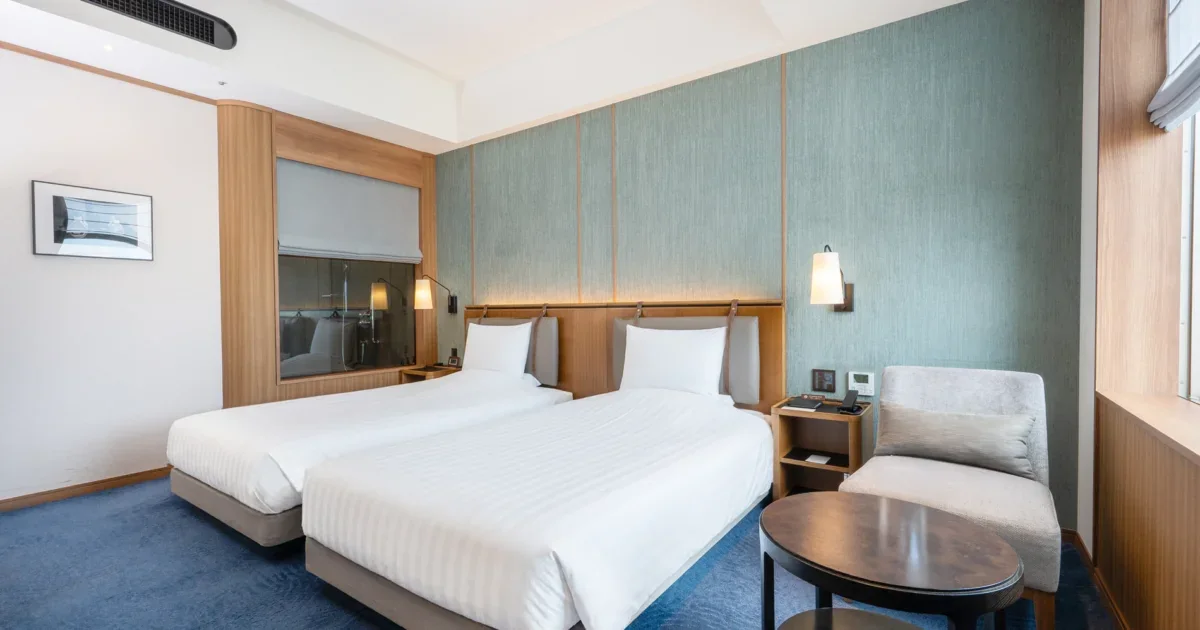
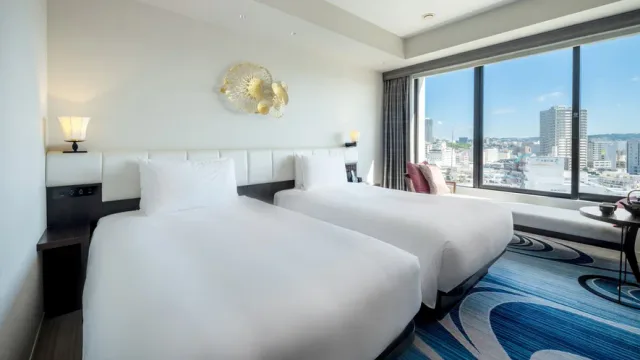
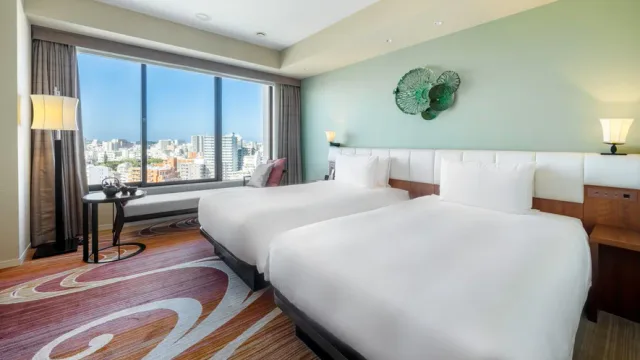
Hyatt’s room descriptions list a Japanese-style bath, but the exact configuration and clear floor space should be checked for the category offered on your dates. The wide-angle photographs show bedding, furniture and window placement in particular rooms; they are not measurements of suitcase clearance. Someone working from the hotel needs to inspect the desk and daylight of that exact category, not just a generic 28 m² figure. Guests needing a specific accessible layout should request it directly. The Okinawa hotel decision guide helps compare room utility with access rather than treating a room photo as the whole booking.
↔ Scroll table left or right
| Room question | Hyatt detail | Booking implication |
|---|---|---|
| Two adults, regular twin | Standard Twin is 28 m². | Start here if beds and bathroom meet your needs. |
| Three travellers | 32 m² Deluxe Twin can be sold with an extra bed. | Confirm the specific three-person plan and bed arrangement. |
| More space for two | Deluxe Twin adds four square metres over the standard room. | Compare its rate with Club only after deciding whether lounge access matters. |
| Club access | Club Twin remains 28 m²; a Deluxe Club category is also listed. | Use the exact category and your likely lounge hours. |
| Bathroom or desk needs | Product photos and amenity lists differ by category. | Inspect the offered room layout rather than a property-wide gallery. |
The room decision becomes more complicated when comparing Hotel Collective. Collective’s Superior Twin baseline is about 30 m², only two square metres beyond Hyatt’s standard Twin. That headline difference is too small to settle a booking by itself. A third traveller, bathroom layout, bed widths, a cancellation deadline or included breakfast may change the better value. The Collective Premium Twin and other larger categories should be priced by their names; a photograph of one category should never stand in for a cheaper one. The Hotel Collective room and location guide is useful for the parallel comparison.
A city pool with a daytime deadline
Hyatt’s outdoor pool currently runs from March 1 through November 30, 09:00–20:00, with last entry at 19:00. The jet bath runs throughout the year, 07:00–20:00, again with last entry at 19:00. Staying guests do not face a separate admission charge. A 20:30 return from a northern sightseeing day therefore cannot turn into a pool evening. If the family wants to swim, reserve time before dinner or make a hotel afternoon part of the route. For December through February, remove the outdoor pool from the value calculation; the jet bath is a different facility.
The current pool rules also matter to families: children aged 12 or younger need an adult guardian, and infants and toddlers need swim diapers or water-play pants under their swimwear. The jet bath is mixed-gender and requires swimwear. Pool equipment restrictions and weather can affect use. Those are more concrete planning facts than a hotel listing that merely says “pool.” The Okinawa hotel-pool decision guide helps compare a short city swim with a genuine resort afternoon. If rain or a storm closes outdoor plans, use the rainy-day Naha options rather than treating the pool as a weatherproof fallback.
A city hotel should also not be mistaken for a beach base. Hyatt lets you walk to market food, pottery and the central streets, not step from the lobby onto a swimming beach. Hotel Collective also has seasonal outdoor pool facilities, plus indoor bath and sauna amenities, but its facilities have their own operating rules. Both are useful city bases when the day ends in Naha; neither removes the transport time to Onna or the aquarium. If the itinerary needs a beach or northern attraction on several days, the split-stay calculation may matter more than the difference between these two lobbies.
Airport, parking and Sunday access
The airport-to-hotel question has three practical answers: Yui Rail plus the final walk, a direct taxi, or a route-specific bus if its stop and luggage terms actually fit. Rail is predictable when bags are light and arrival is during service hours. A taxi can spare a family the last walk, but road time varies. The hotel does not provide an airport shuttle. Write down the first and final segments separately rather than treating “Naha Airport to central Naha” as a complete route. For a departure at an awkward hour, the Asahibashi hotel alternative is a useful comparison.
Hyatt has tower parking, but spaces are first-come, first-served. A full facility or a vehicle that does not fit can require nearby paid parking, so ask about the current rate and dimensions before building a week of self-drive days around it. The address gains its greatest advantage when you return the rental car before the Naha portion. If driving continues each day, the cost and friction of parking should sit beside room price. The five-day Okinawa route helps decide when to collect or return a car rather than automatically renting one for every night.
Part of Kokusai Street becomes pedestrian-priority on Sundays from noon to 18:00. Hotel Collective publishes a special car approach for that period; Hyatt’s approach is on the Makishi–Sakurazaka side rather than through Collective’s frontage. Anyone arriving by taxi or arranging a tour pickup should confirm the actual vehicle stop for that day. A hotel address on a booking confirmation is not always the bus door. The four-day city and coast route makes repeated pickups visible before a location is chosen.
↔ Scroll table left or right
| Movement | Hyatt side | Collective side | Check before leaving |
|---|---|---|---|
| Yui Rail arrival | Makishi area, then an eight-minute hotel walk by Hyatt’s estimate. | Kenchomae, then about seven minutes on foot. | Lift or exit, weather and suitcase size. |
| Taxi from airport | Access the Sakurazaka-side hotel entrance. | Kokusai Street address; Sunday approach may change. | Traffic and correct drop-off. |
| Local bus or day tour | Use the stop named by that service. | Street-front stop may help only when the route serves it. | Pickup point and last return. |
| Early departure | Allow for the Makishi walk or book a taxi. | Work back from Kenchomae or the actual bus service. | First departure, luggage and check-out. |
| Rental car | Tower parking has capacity and vehicle limits. | Check its own parking and Sunday approach. | Daily fee, car size and return location. |
Do not rely on an old fare screenshot while making that choice. Room rates, taxi fares, bus prices and access arrangements can move independently. Price the journey for the actual date and party, then compare it with the room-rate difference. The Okinawa five-day cost guide keeps transfers, parking and hotel spend together. A slightly dearer room near the activities you will repeat can be cheaper in total; a premium hotel that requires extra taxis can also go the other way.
Hyatt or Hotel Collective for two car-free nights?
These hotels serve different walking loops. From Hyatt, Makishi Market, Tsuboya and Sakurazaka can become one connected day with a mid-afternoon room stop. Collective sits directly on central Kokusai Street. That makes shopping returns, nearby bus stops and street-side dining easier when those are the repeated tasks. Its Kenchomae walk is shorter by the published station estimates, but the relevant departure may be another stop altogether. Neither hotel is automatically better for every bus or tour. The car-free base-split guide helps decide whether Naha should hold every night.
Collective’s rooms begin around 30 m² and its Superior Twin is a sensible initial quote. Hyatt’s 28 m² Twin may still have the preferred layout or rate; its 32 m² Deluxe category may suit an extra bed. Compare the same guest count, breakfast inclusion and cancellation terms. If one rate includes a Club category, remove the lounge from your mental comparison until you have counted the sessions you can use. The property with the larger photograph or grander lobby should not win a room comparison that is really about three people, a tub or suitcase placement. The Okinawa toddler hotel guide adds nap, bathroom and stroller requirements for families.
Consider three car-free nights: airport arrival, a Naha city day and one northbound bus or booked tour. If the tour meets at a named stop by Collective and the evenings are central Kokusai shopping, Collective may remove more repeated friction. If the tour pickup is near Makishi and both evenings are centred on the market and pottery quarter, Hyatt may save walking even with its longer station approach. If two of the three days start with long buses to the north, neither hotel solves the itinerary. The Naha–Onna–Churaumi plan shows when changing base may remove those backtracks.
↔ Scroll table left or right
| Your principal day | First room to price | Unsettled point |
|---|---|---|
| Makishi meals, Tsuboya workshops, Sakurazaka dinner | Hyatt Regency Naha | Last luggage walk from Makishi. |
| Central Kokusai shopping and a named bus stop | Hotel Collective | Does your particular bus use that stop? |
| Early flight with little city time | Compare both with Asahibashi or an airport-side room. | First train or taxi and total rate. |
| Two northbound excursion days | Price a split stay. | Return bus time versus cost of moving bags. |
| Three adults in one room | Price the confirmed triple configuration at each hotel. | Actual third bed and breakfast for all guests. |
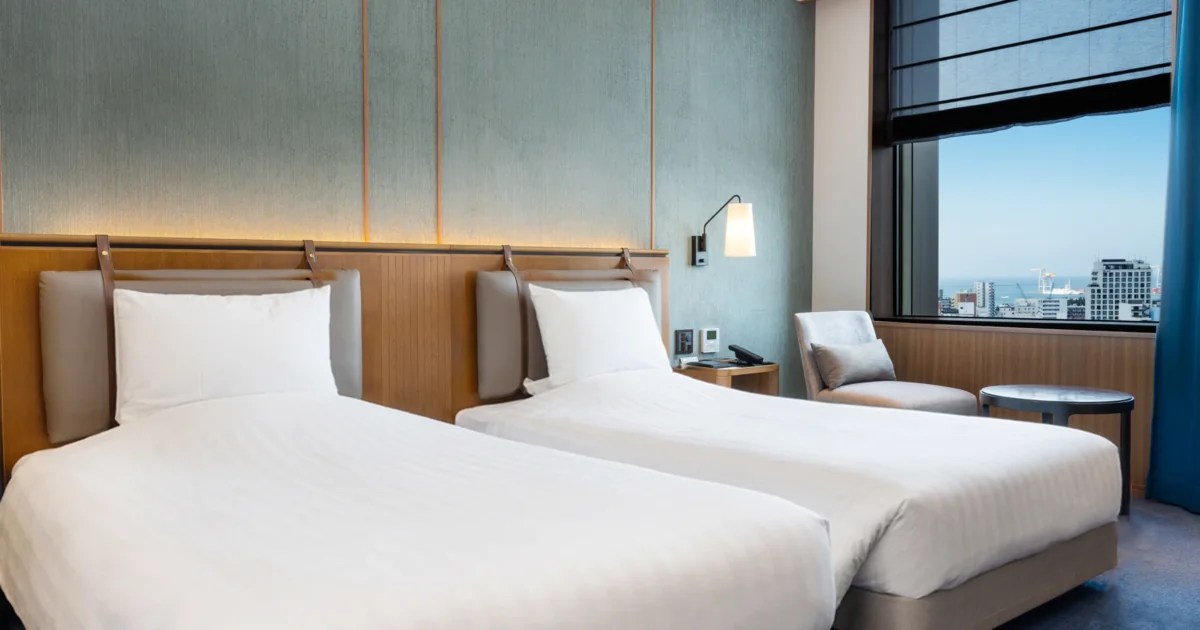
The hotel photographs below show particular categories, not interchangeable versions of a standard room. The small Hyatt Twin view and Deluxe Twin view reproduce the same two categories in smaller formats; they do not add another bookable type. Pool, city view and lobby photography should likewise be read as facilities or scenes, never as a guarantee attached to every rate. If Hotel Collective’s street frontage is the attraction, check whether your chosen room faces that street and whether street activity suits the way you sleep. If Hyatt’s quieter side-street position is the attraction, request the actual room orientation rather than assuming every room shares it.
Our seven Hyatt Regency Naha ratings
These scores assume two Naha nights with market, Tsuboya and Sakurazaka time. An airport taxi can remove the repeated Makishi Station walk, but the hotel has no airport shuttle.
| Dimension | Our rating | The booking consequence |
|---|---|---|
| Location | Kokusai Street and the market are close; Makishi Station is an eight-minute published walk. | |
| Room | A third traveller needs a real sleeping plan, while Club access depends on the exact booked tier. | |
| Cleanliness | Current room-upkeep feedback is strong across a sizeable Naha stay sample. | |
| Service | Staff assessments are consistently good, especially for a city-centre hotel. | |
| Facilities | Pool and lounge time are useful when daylight remains; this is not a beach-resort base. | |
| Food | Breakfast scores well; market-area eating can make a room-only plan equally sensible. | |
| Value | The room premium works when Naha evenings and at least one hotel facility are actually used. |
Our overall two-night Naha read is 8.5/10. A car-led Okinawa trip may pay less for a base with simpler parking.
Seven aspects to compare before paying
A property-wide numerical mark would hide the fact that the deciding feature changes by itinerary. The published room and facility details support these seven concrete checks; cleaning consistency and individual service experiences require current guest evidence for the room and dates you are considering.
↔ Scroll table left or right
| Aspect | What the current details establish | What remains personal or date-specific |
|---|---|---|
| Access | About eight minutes to Makishi Station; market, Tsuboya and Kokusai are closer. | Which route you repeat, luggage and summer walking tolerance. |
| Room space | Standard and Club Twin 28 m²; Deluxe Twin 32 m². | Bed layout, extra-bed plan and clear space in the sold category. |
| Comfort | In-room bath, outdoor pool season and year-round jet bath are described. | Room orientation, noise, temperature and actual facility time. |
| Cleanliness | Photos and specifications cannot establish day-to-day cleaning. | Use recent room-specific accounts and raise needs with the hotel. |
| Neighbourhood | Makishi Market, Sakurazaka and pottery streets are walkable. | Whether those are your evenings rather than distant excursion days. |
| Service | Club has defined breakfast, tea and cocktail periods. | Whether service hours align with your plans; individual responses vary. |
| Value | Room type, facility hours and transport pattern can be compared. | Same-date final price, meals, taxes and cancellation conditions. |
A two-night city break with a market morning, Tsuboya walk, afternoon swim and Kokusai dinner puts several of Hyatt’s advantages to work. A late-flight sleep stop before collecting a rental car uses few of them. A three-night stay built around long northbound buses needs a transport or second-base decision before a more expensive city hotel can improve it. The first-time Okinawa itinerary is useful for deciding which days truly belong in Naha, and the Onna versus Naha final-night comparison addresses the last transfer directly.
For a hotel-centred afternoon, choose the room type first and place the pool or Club session on the calendar. For a walking-centred city stay, trace the two streets you will use most. Then compare Hyatt, Collective and a station-side hotel with the same number of guests and cancellation terms. This is a more useful purchase than paying for every possible perk when your hours make most of them inaccessible. The Okinawa family-hotel comparison adds bed-sharing and laundry when those change the decision; the group-hotel guide focuses on bathroom and late-night movement.
Compare rooms at Hyatt Regency Naha for the dates and guest count you will actually book. If direct Kokusai Street frontage better fits the walking plan, compare Hotel Collective on the same terms. Check the named category, occupancy, included meals and cancellation deadline before treating either headline rate as comparable.
Other routes and hotel comparisons
late-arrival hotels near Naha Airport · Hyatt Regency Naha property guide · Hyatt Regency Naha — transport and parking · Nearby attractions and walking · Pool and Regency Club information · Hilton Okinawa Chatan Resort Review: Are the Pool and 37m² Ocean-View Rooms · Hyatt Regency Seragaki Island Okinawa: Should You Keep an Afternoon Free on · Southwest Grand Hotel Okinawa Review: Is a 45 m² Room and Pool Worth the Ur · JR Kyushu Hotel Blossom Naha Review: Is Kokusai-dori Access Worth Giving Up · Oriental Hotel Okinawa Resort & Spa Review: Is the 170m Pool Worth a 7-Minu · Okinawa Private Boat Charter 2026: Naha, Chatan or Onna? Start With the Gro · CANDEO HOTELS Osaka The Tower Review: SkySpa, Rooms and Access · Vessel Hotel Campana Nagoya Review: Rooms, Bath and Station Walk · Lequ Okinawa Chatan Spa & Resort: Is the Paid Rooftop Pool Worth a Chatan S · Vessel Hotel Campana Okinawa Review: Does Free Bed-Sharing Work for 2 Adult · Lake Biwa Otsu Prince Hotel: Is the 36.2m² Lake View Worth the Shuttle?