
Vessel Hotel Campana Nagoya charges a walking cost that a hotel inside the station does not. The property lists about nine minutes from JR Nagoya Station's Sakura-dori Exit. A hotel brochure also identifies a roughly four-minute approach from Subway Nagoya Exit 1, so the useful comparison depends on the train line actually used. A one-night stay before an early Shinkansen makes the longer JR walk conspicuous. Over two or three nights, the second-floor public bath, room choice, family policy and laundry may be used enough times to justify it.
For two adults carrying large cases, the 20.9 m² Standard Twin is the starting room, not the cheapest 15 m² Standard Double. The hotel's two twin beds and extra published area can reduce a recurring room problem. Yet an early train can also cancel the value of breakfast and a morning bath. Set the rail itinerary and room category first; the hotel is neither automatically convenient nor automatically too far. Station-connected Nagoya hotels form the direct transport alternative when the Shinkansen is the main purpose of the night.
↔ Scroll table left or right
| Actual stay | Vessel case | When the walk dominates |
|---|---|---|
| One night, early Shinkansen and two heavy cases | Only if rate or a late bath has clear value | Arrival and departure both make the JR walk costly |
| Two or three nights with bath sessions | Bath can be used repeatedly while arrival occurs once | Night returns fall after bath last entry |
| Family sharing existing beds | 18-and-under policy may reduce room charges | Bed width, cot fit and floor area are still limiting |
| Several subway-led city days | Exit 1 route can be shorter than the JR headline | Shinkansen or Meitetsu approaches use another station path |
JR Sakura-dori and subway Exit 1 create two different hotel walks
The hotel's access page gives nine minutes from JR Nagoya Station Sakura-dori Exit. Its brochure gives about four minutes from Subway Nagoya Exit 1. Neither number is a platform-to-room guarantee: a guest may still cross the station, find the correct exit, wait at road crossings and use the hotel lift. A Shinkansen passenger should plan with the JR-side approach. A city traveller using the subway can have a different pattern. Arrival from Chubu Centrair on Meitetsu also entails movement within the station area before the hotel walk begins.
Count how often that distance recurs. Arrival and departure create two station-facing legs. Three rail day trips can create six more. If a connected hotel would save about six minutes on each of eight legs, the illustrative extra walk becomes almost fifty minutes across the stay; on a city plan centred on nearby subway exits, the real gap can be smaller. The calculation is a planning example, not a measured hotel-to-platform claim. A Takayama trip from Nagoya adds a rail morning; a Korankei bus day creates a different transport pattern.
A hotel should not win because one website displays a shorter walk while the guest repeatedly uses another entrance. JR Gate Tower and Marriott Associa are relevant when an early reserved train makes covered station access valuable. If the main purpose is exploring Nagoya by subway, Vessel's bath and room offer deserve a same-date quote rather than immediate rejection. A Sakae activity can illustrate a city day whose useful movement is not another Shinkansen.
The bath has a deadline on both sides of midnight
The second-floor guest public bath opens 06:00–10:00, with last entry at 09:30, then 15:00–01:00, with last entry at 00:30. Overnight guests pay no separate admission. The men's side has a dry sauna and the women's side a mist sauna. Those are real, repeatable facilities if the traveller wants shared bathing and reaches the hotel while entry remains open. The extra JR walk can be a fair exchange after a long day if a bath session follows it; the same walk is harder to justify when the guest arrives after the 00:30 cutoff.
Suppose two nights permit an evening soak after arrival, another after a city day and perhaps a morning visit before a relaxed departure. That is more utility than a public-bath icon used once. A 07:00 Shinkansen, however, may rule out the morning bath entirely; a late dinner can eliminate the evening window. Judge the bath by the sessions that fit the itinerary, not by the existence of a sauna in a facilities list. A Hakata hotel with a similar bath-versus-station trade-off is a useful comparison of the same decision pattern.
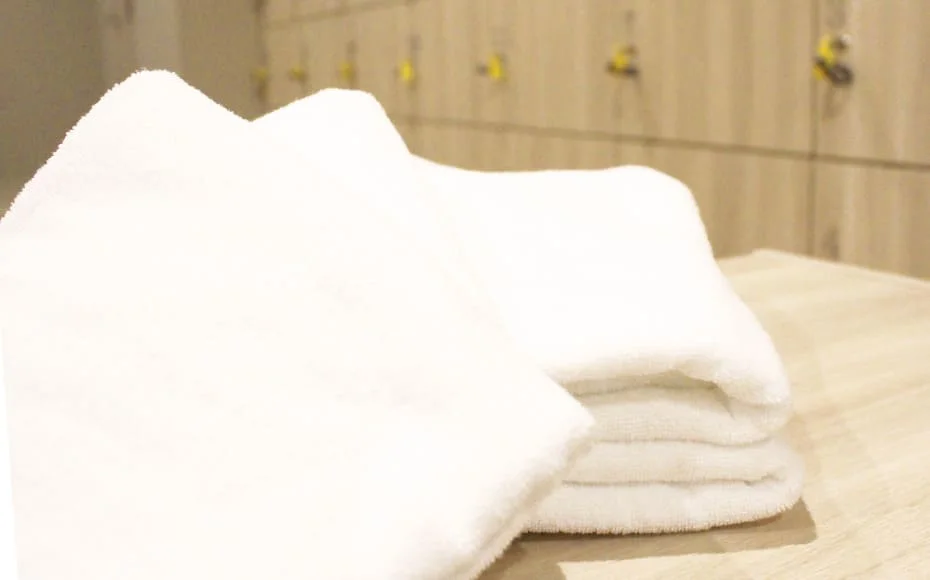
The photograph shows folded white towels beside hooks. It depicts bath-area amenities, not the size or vacancy of the bathing pool. The hotel provides face towels in the bath area, while guests bring their bath and wash towels from their room. That detail can shorten what needs carrying upstairs, but does not change the central question of whether the bath will be used. Vessel Campana Susukino is another case where a 01:00 close has value only before its last-entry time.
There are specific entry limits. Tattoos must be fully concealed by two 8 × 10 cm cover stickers supplied at the desk; a larger design that cannot be covered does not qualify. A child who uses diapers may enter the public-bath facility, but may not enter the bathing area while wearing a diaper. For mixed-gender parent-child bathing, the hotel's posted age limit is five. These conditions matter more than a generic “family bath” label when deciding whether the amenity is usable for the booked party.
Room size changes the luggage baseline
↔ Scroll table left or right
| Room category | Published area and beds | What it can solve | Limit to check |
|---|---|---|---|
| Standard Double | 15.0 m²; one 140 cm bed | Solo or short shared-bed stay with compact bags | No loan baby cot; little margin for two large cases |
| Standard Twin | 20.9 m²; two 120 cm beds | Two adults, separate beds and more luggage room | Floor plan still decides open-case circulation |
| Comfort Twin | 21.4 m²; two 120 cm beds | Higher-floor positioning and Airweave mattress | Only 0.5 m² beyond Standard Twin |
| Superior Twin | 27.0 m²; two 140 cm beds | More room or a three-adult booking | Guest count does not show suitcase floor |
| Superior Triple | 27.0 m²; added 90 cm bed | Different group bed pattern | Five-adult maximum is not a comfort guarantee |
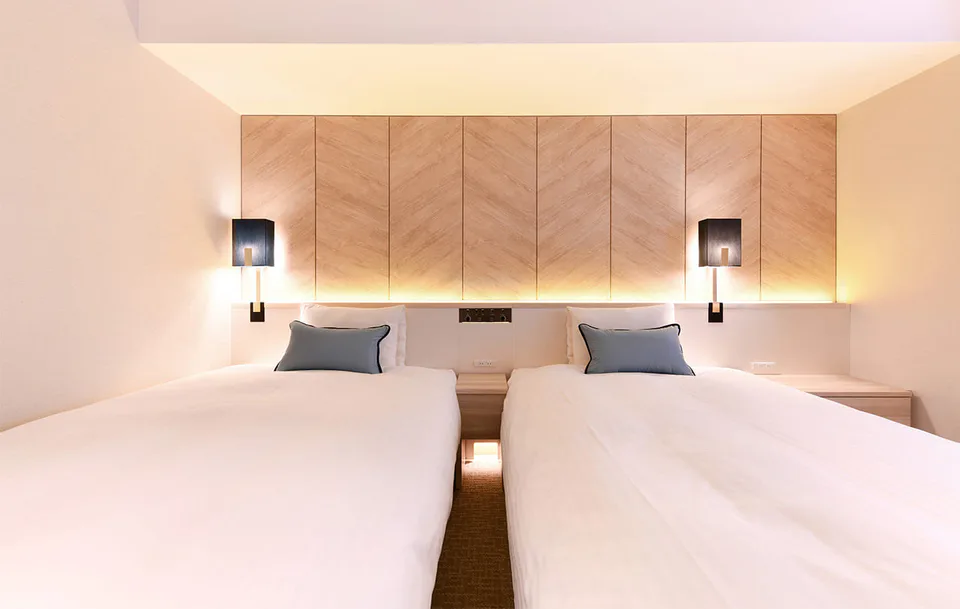
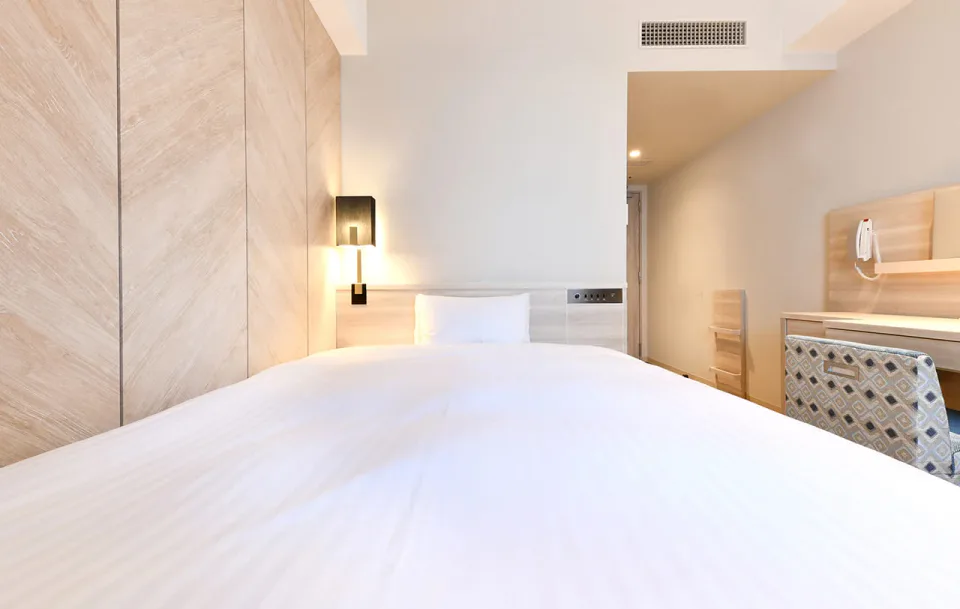
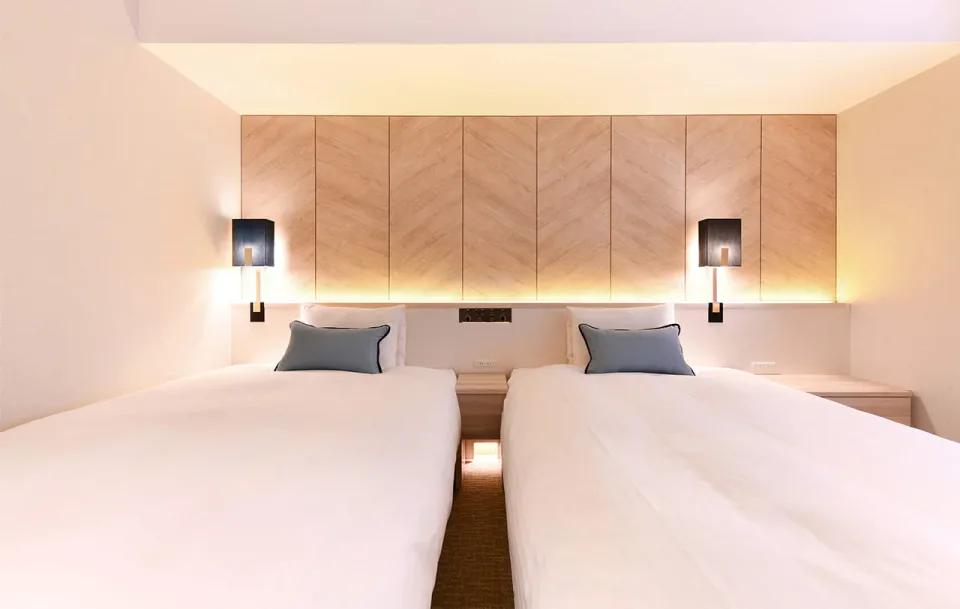
The Standard Twin adds 5.9 m² to the Standard Double, about 39% of the smaller published area. That is a meaningful category change. It still does not prove two particular 29-inch cases will lie open without blocking the room. The hero image shows two white beds against a wood-panel headboard; it cannot show the complete floor. The double image shows one bed and a compact desk. Use both as visual context, then check the actual room floor plan and named reservation.
Comfort Twin's extra half-square-metre is modest; its value should come from the higher-floor location or Airweave mattress rather than an imagined large jump in open floor. The Superior Twin and Superior Triple both publish 27 m² but have different beds and occupancy. A room permitted for three or five adults may still feel crowded with everyone else's luggage. For a family, count sleeping surfaces and cases before treating capacity as comfort. A larger hotel room away from a station is another example of why area and transfer should be priced together.
Free bed-sharing does not create another bed
The hotel's family policy allows children aged eighteen or younger to share existing beds free with a parent or grandparent. That can change the total cost for a family, but the booking still needs enough bed width and usable floor. The family page also states that one adult and one child using a twin can be priced as two adults. Enter the actual ages and occupancy in the rate search instead of assuming every child is free in every configuration. Another Vessel family's bed-sharing decision shows why the policy and the physical room must be assessed separately.
The Standard Double cannot accommodate the hotel's loan baby cot; the Standard Twin can. A family needing the cot should therefore exclude the cheapest room before comparing prices. Children sharing the 120 cm twin beds also change how comfortably two adults can sleep. Add stroller, nappies and day bags to the luggage picture. If a larger Superior room is needed, its higher rate may erase some of the nominal bed-sharing saving. The policy is a useful conditional advantage rather than a substitute for room planning.
Bath use with children has its own rules, and a family arriving late may not get the anticipated public-bath session. The hotel's family facilities include children's bathing items and a second-floor microwave, while its posted child-bath conditions still apply. A one-night family booking that uses neither bath nor breakfast may be better judged by room fit and station route. A larger family-capable city room with a station walk is a relevant way to think about the same trade-off.
Breakfast and laundry depend on the night's position in the trip
The guest breakfast buffet runs 06:30–09:30, with the room closing at 10:00. Current hotel pricing lists ¥1,700 for a staying adult, ¥900 for ages six to twelve and no charge for children five or younger. The food includes Nagoya dishes; the image shows savoury rice preparations in bowls, not a promise of an identical spread every morning. Before an ordinary day of sightseeing, the meal may simplify a family start. Before a 06:30–07:00 train, there is no useful buffet window.
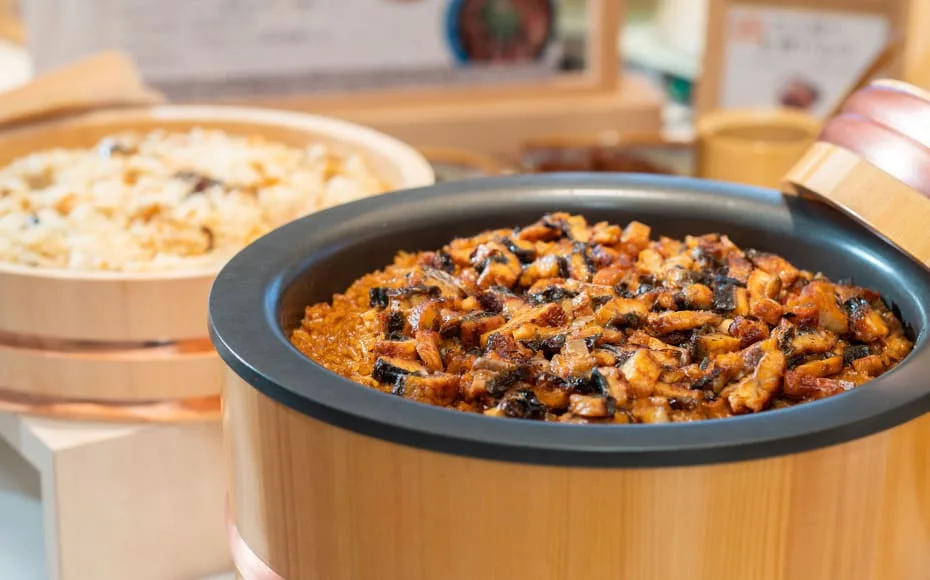
Do not add breakfast value simply because it starts earlier than many restaurants. Include eating, packing and the nine-minute JR walk plus station circulation before the train. The guest price should also be compared with the breakfast-inclusive room premium rather than multiplied mechanically; packages can have their own rate. A Hakodate hotel with 05:30 breakfast illustrates how the morning meal can genuinely change an early-departure decision when the schedule is different.
The second-floor laundry corner operates twenty-four hours. On a one-night stop it is unlikely to matter; on night three of a longer Japan journey, it can let travellers wash before heading toward Kyoto or the Japanese Alps. Washing does not remove the need for drying time or an available machine, so it should not be scheduled tightly against checkout. A multi-stop Chubu route is a concrete context where a Nagoya laundry reset might reduce packing. The hotel also has a microwave, useful for some families without becoming a room feature.
Our seven Vessel Campana Nagoya ratings
The score assumes a 20.9 m² Standard Twin and time for the bath. The nine-minute JR Sakura-dori walk differs from the shorter subway Exit 1 approach.
| Dimension | Our rating | The booking consequence |
|---|---|---|
| Location | The station is walkable but not connected; repeated JR starts expose the outdoor segment. | |
| Room | Two adults with cases gain more from the 20.9 m² twin than the 15 m² Standard Double. | |
| Cleanliness | Room and public-area upkeep show a strong current large-sample signal. | |
| Service | Staff scores are steady, while family bedding terms require a bed-width check. | |
| Facilities | The public bath and sauna can repay the longer station walk on several nights. | |
| Food | Nagoya breakfast dishes are a strength; an early train may erase that morning benefit. | |
| Value | The bath and larger twin make the rate work when the guest accepts repeated outdoor walks. |
Our overall Nagoya rail-stay read is 8.5/10 with bath time and the larger twin. A station-connected room gains ground when the first train is a daily constraint.
When the connected station hotel earns its own premium
JR Gate Tower Hotel is directly connected to Nagoya Station, with its property information giving about five minutes from its front desk to the Shinkansen gate. It solves arrival and early-departure friction that Vessel's public bath cannot erase. Choose the connected option when the booked train is early enough to lose breakfast and bath, when rain or limited mobility magnifies the outdoor walk, or when the necessary Vessel room has risen close to the connected hotel's price. The Nagoya station hotel comparison treats that transport priority in detail.
Vessel becomes stronger when at least two of its other benefits will be used repeatedly: bath, workable twin, family bed-sharing, breakfast or laundry. The seven factors below do not carry the same weight for every stay. A two-night city break can make bath time and laundry useful, whereas a single night before an early train puts the JR walk first.
↔ Scroll table left or right
| Decision dimension | Evidence for this hotel | When the evidence weakens |
|---|---|---|
| JR/Shinkansen route | Nine-minute Sakura-dori walk | Multiple early rail departures or heavy cases |
| Subway/city route | Brochure gives four minutes from Subway Exit 1 | Most travel uses JR or Meitetsu instead |
| Two-person room | 20.9 m² Standard Twin versus 15.0 m² Double | The booked room is the small Double or has poor bag circulation |
| Bath/recovery | Guest bath and saunas into the evening | Party cannot enter or returns after 00:30 last admission |
| Repeat utility | Breakfast and 24-hour laundry alongside bath | Short stay or timetable prevents use |
| Family fit | 18-and-under sharing policy and cot-compatible twin | Beds and room floor remain too small |
| Early departure | 06:00 bath and 06:30 breakfast when timing permits | Very early Shinkansen cancels both and amplifies the walk |
One night before a train demands a clear reason to accept the walk. Two nights can give bath, breakfast and room space time to contribute. Three or more nights increase the usefulness of laundry and floor space, while also multiplying any repeated JR walk. Compare the named room, breakfast inclusion, cancellation and full stay price on the actual dates. Compare rooms near Vessel Campana Nagoya after deciding which station entrance and bath sessions the trip will really use.
Hotel details
Related guides: Hotel Torifito Hakata Gion Review: Is a 23 m² Twin and Public Bath Worth Leaving Hakata Station? · Vessel Hotel Campana Okinawa Review: Does Free Bed-Sharing Work for 2 Adults and 2 Kids? · Lake Biwa Otsu Prince Hotel: Is the 36.2m² Lake View Worth the Shuttle? · Vessel Inn Sapporo Nakajima Park Review: Is a 1-Minute Subway Walk Better Than Sapporo Station in Winter? · HOTEL COLLECTIVE Naha Review: Kokusai Street, 30m² Rooms and a 7-Minute Monorail Walk · HOTEL FORZA Hakata Station Chikushi-Guchi I Review: 1-Minute Access and 18m² Rooms · The Naha Terrace: Are 35m² Rooms and 12:00 Check-Out Worth a 15–20 Minute Station Walk? · Vessel Hotel Campana Susukino: Is the 25:00 Public Bath Worth a 4-Minute Walk? · CANDEO HOTELS Osaka The Tower Review: SkySpa, Rooms and Access · THE BLOSSOM HAKATA Premier: Is the 7-Minute Walk Worth a 30m² Twin and Public Bath?