
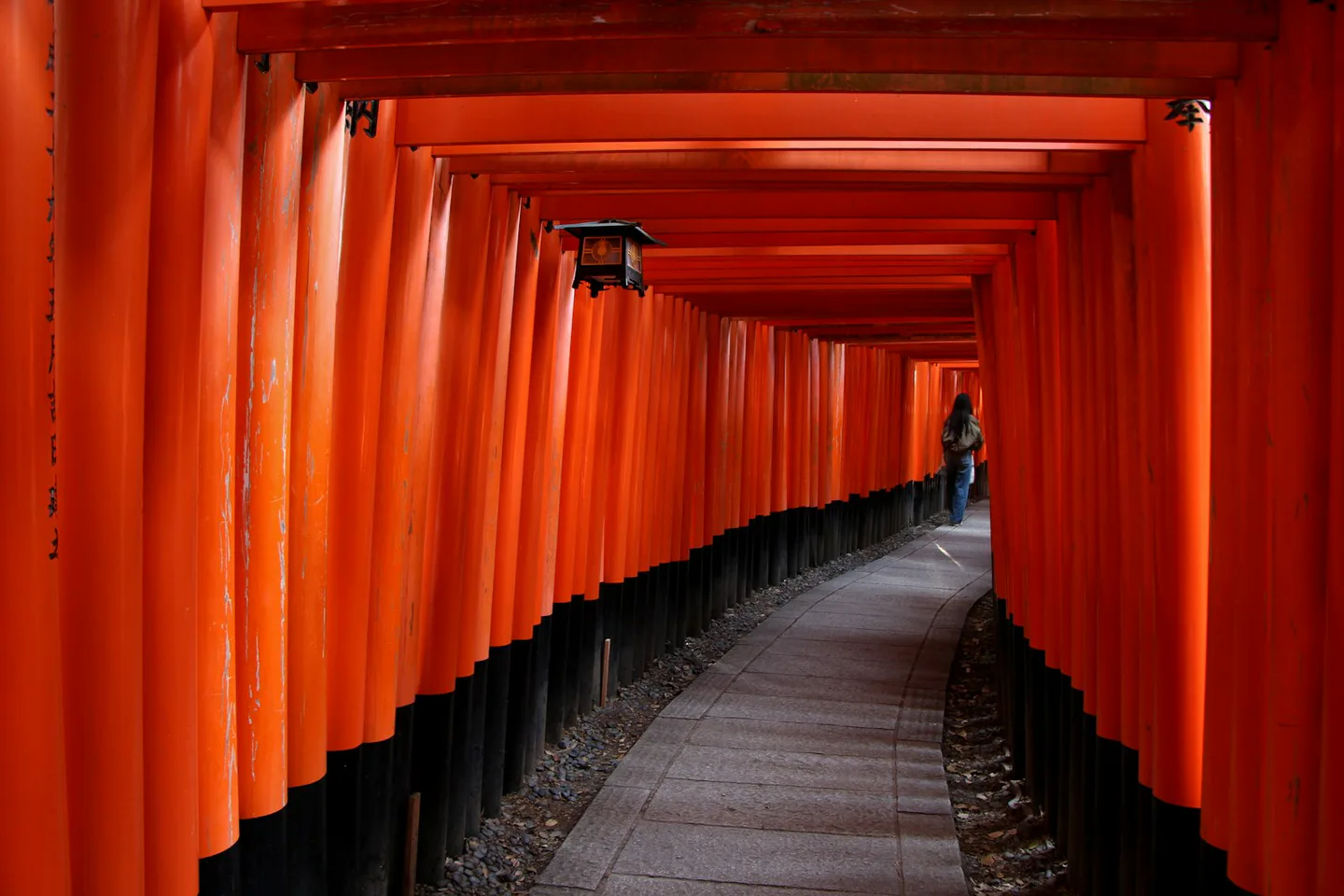
Fushimi Inari can be a compact shrine visit, a substantial mountain walk or a brief encounter with the torii after dark. Decide which one belongs in your Kyoto day before choosing an arrival hour. For many first-time visitors, the main shrine, Senbon Torii and Okusha area provide the scene they came for. Walking on toward Yotsutsuji makes sense when the climb itself is enjoyable. The full Inariyama circuit has a different purpose: Kyoto City's benchmark is about four kilometres and two hours, before generous rests or photography.
The summit is not an observation-deck reward promised at the end of the gates. Ichinomine is the highest sacred peak, at 233 metres, where Suehiro Okami is worshipped. Shrine descriptions frame the mountain around worship sites, torii and otsuka stones. A visitor who mainly wants the famous lower corridor can turn back without having missed a superior panorama. A hiker or repeat visitor who values the entire sacred route may reasonably give it the morning.
↔ Scroll table left or right
| Turnaround | Allow as a practical plan | Why stop or continue there |
|---|---|---|
| Main shrine, Senbon Torii and Okusha | About 45–75 minutes for a short first visit | The iconic lower experience is complete; a Nara or Kyoto follow-on remains viable |
| Climb toward Yotsutsuji | Roughly 90–120 minutes with pauses | The mountain walk now contributes meaningfully; reassess energy and the next commitment |
| Full Inariyama circuit via Ichinomine | City benchmark: about 4 km and two hours, often longer with rests | Choose it for the sacred mountain route rather than an assumed summit view |
| Lower route after dark | Set a short return point before entering | Atmosphere is the aim; avoid improvising a mountain hike at night |
The shorter time bands are planning allowances rather than a shrine timetable. Walking speed, steps, temperature and stops can change them substantially. Set a latest turnaround based on the next fixed reservation, not a target photograph. A one-day Kyoto plan especially needs that boundary because both Fushimi Inari and Arashiyama compete for the quietest morning.
The lower route is a complete visit
The main precinct and Senbon Torii concentrate the image most people associate with the shrine. Continue to Okusha, then decide whether the next hour would be better spent climbing or at the day's second place. This is a useful default on a two- or three-day first visit. The torii continue uphill, but the existence of more gates is not an instruction to follow all of them. A family with limited stamina can share the lower route and still visit a significant place of worship rather than treating a summit as the only success condition.
The hero photograph shows a quiet passage through closely spaced red gates. It captures the lower-route appeal, although the actual crowd at a future hour may differ. This corridor is also where stopping to stage a perfectly empty photograph can obstruct worshippers. The shrine asks visitors to keep narrow paths passable, avoid prohibited or commercial photography and respect the site as a place of prayer. Arriving early can help with the atmosphere; it does not confer a right to hold the walkway for a photo session.
A short version pairs particularly well with Nara because the JR Nara Line serves Inari Station and continues south. It works only while the shrine stays a defined morning block. The Nara day-trip transport choice is geographically sound, yet Todaiji, Kasuga Taisha and Naramachi still have their own daylight and opening hours. A real Nara day gets squeezed if the Fushimi stop becomes a full mountain circuit without changing the rest of the plan.
Yotsutsuji is where the day can change direction
After the busiest lower gates, the route becomes more of a climb. Yotsutsuji provides a natural point to decide whether the mountain has become the attraction. Ask whether everyone still wants the stairs, whether the heat or rain has raised the physical cost, how much daylight remains and what time the next commitment begins. If the walk is still the best use of the morning, continue. If one answer has changed, return without labelling the visit incomplete.
A mixed-mobility group should make that decision before the least comfortable person is forced to stop. People travelling with parents or children can agree that the lower precinct is the shared visit. Stronger walkers can continue only if a meeting location, communication and return plan are clear. The shrine prohibits leaving strollers unattended outside designated areas; the mountain route should not be represented as a normal step-free continuation from the main precinct. Kyoto with older parents is a better place to decide the daily base and repeated transfers than a summit target made on the spot.
↔ Scroll table left or right
| Next section | What it adds | What it asks of the day |
|---|---|---|
| Lower shrine to Okusha | Torii, worship spaces and the familiar first-visit scene | Walking and time remain relatively contained |
| Okusha toward Yotsutsuji | More hillside character and a meaningful climb | Longer steps, weather exposure and a later second attraction |
| Yotsutsuji through the full circuit | The pilgrimage-style mountain loop and sacred sites | The largest physical and schedule commitment, without a guaranteed summit panorama |
There is no universal “best” height on that table. For a shrine-and-city day, stopping below Yotsutsuji can be excellent. For someone whose interest is the Inariyama landscape, the upper circuit supplies the point of the outing. Kyoto's one-, two- and three-day plans help test whether that upper route displaces something the trip values more.
Ichinomine is a sacred site, not a promised viewpoint
Fushimi Inari Taisha identifies Ichinomine as Inariyama's highest peak and a worship site for Suehiro Okami. The broader mountain description includes several former shrine sites and numerous otsuka stones bearing deity names. Completing the loop is a legitimate aim for a walker interested in those places. It is a weak reason to keep climbing solely because a map labels a summit and the visitor expects a wider Kyoto panorama at the top.
The decision matters most after some effort has already been spent. “We have come this far” does not reduce the remaining climb, the return steps or the cost to the next attraction. At Yotsutsuji, judge the remaining circuit as a new choice. A Tofukuji, Fushimi Inari and Uji route can absorb a short or moderate shrine stop; it becomes a very different day if the full mountain walk takes the morning. In autumn, the three-day foliage plan faces additional crowd and daylight pressure.
Early rail access beats an uncertain bus ride
The lower torii are most sensitive to crowding because many visitors stop for the same photograph. Early arrival can make that section calmer without requiring everyone to complete the mountain before breakfast. Kyoto City's current route information recommends the JR Nara Line from Kyoto Station: about nine minutes to Inari Station, immediately beside the shrine approach. It specifically warns that City Bus South No. 5 can vary by more than 24 minutes in travel time. For a time-sensitive start, rail is the simpler bet.
From Gion-Shijo, the Keihan line reaches Fushimi-inari Station in roughly 22 minutes, followed by about five minutes on foot. Limited express trains do not stop there; choose a service that does. The best station depends on where the hotel is and what follows the shrine. Kyoto Station, Kawaramachi and Higashiyama bases have different first and last legs. A hotel comparison focused on this shrine is useful only after the entire Kyoto route has a shape.
An early start should create options, not compulsory distance. From a Kyoto Station hotel, a short train ride can place the lower shrine before the largest sightseeing crowds. After that, a traveller may head south to Nara, return toward central Kyoto or keep climbing. A ten-day Japan route provides another constraint: the Kyoto block may be short, so an unplanned mountain circuit can displace a major sight rather than merely extend breakfast.
Open grounds and staffed services run on different clocks
Kyoto City's shrine listing says the grounds have no closing gate. The same listing gives roughly 08:30–16:30 for prayer or reception and 08:00–18:00 for the amulet office. Walking through the lower precinct at 05:30 or after dinner is therefore possible in a way that receiving a staffed service may not be. A goshuin, amulet or formal prayer should be planned inside the live service window; an empty early path is no substitute if that staffed element is the purpose.
After dark, a short route through the main precinct and lower torii can offer a distinct atmosphere. Set the turning point while still at the station or entrance. The same stairs and junctions become a different navigation problem without daylight, and fewer services are staffed. There is no reason to turn a spontaneous after-dinner visit into an improvised summit hike simply because the grounds do not close. A traveller seeking a controlled evening attraction can compare a timed temple night opening; Fushimi Inari's lower night visit has different conditions.
Night is also not a reason to ignore trains, comfort or weather. Plan the route back, carry enough light for uneven steps and turn around before the group is tired. Avoid treating a secluded mountain path as if it were the well-lit main approach. The purpose is to experience the shrine respectfully, not to complete a distance target. In a short Kyoto stay, the evening return to Kyoto Station or Gion can be a more useful hotel consideration than an arbitrary peak marker.
The second stop should share the route or earn the transfer
Tofukuji shares the south/east Kyoto corridor and makes a more natural partner for a medium-length shrine visit than Arashiyama across the city. In autumn it can be crowded and time-sensitive in its own right; adding Uji requires a deliberate route rather than an assumption that three places fit because rail lines appear nearby. The Fushimi–Tofukuji–Uji day maps those trade-offs. November foliage timing can further alter which stop deserves the best light.
Arashiyama and Fushimi Inari both benefit from an early hour yet sit on different sides of Kyoto. Trying to give each the first quiet hour in the same morning is impossible. The Arashiyama route guide helps decide whether that district gets a separate morning. An autumn Arashiyama day has its own train and temple sequence, so forcing it after a full Inariyama loop is a substantial choice, not a casual combination.
Heat, rain, photography and luggage change the turnaround
Summer humidity can make the higher steps much harder than the distance suggests. Begin earlier if the lower gates are important and shorten the planned route when heat becomes the limiting factor. In persistent rain, the lower shrine can remain meaningful while the forest stairway adds more walking cost. In winter, a late afternoon start may turn a daylight circuit into a night return. The full loop is an option to earn when conditions and group energy support it, not a commitment made from a dry hotel lobby.
The shrine asks visitors not to block narrow paths for photographs, damage gates or trees, enter restricted areas, leave strollers unattended outside designated places, or eat while walking outside designated rest areas. These are not decorative rules. Senbon Torii is an approach used by worshippers and visitors at the same time. Let people pass, take a natural opening for a picture and keep moving when the corridor is busy. Kyoto crowd planning is a better way to improve photographs than asking other people to clear a sacred path.
A transfer day adds a separate problem. JR Inari Station being beside the shrine does not make a large suitcase suitable for stairs and forest paths. Leave bags with a hotel or confirmed storage service; use forwarding only when the destination and delivery day fit. A short visit with a day bag can sit neatly before Nara or Osaka. A two-hour circuit dragging luggage cannot. The Japan luggage-forwarding guide separates those options, and same-day intercity delivery has conditions that should be checked before a checkout morning depends on it.
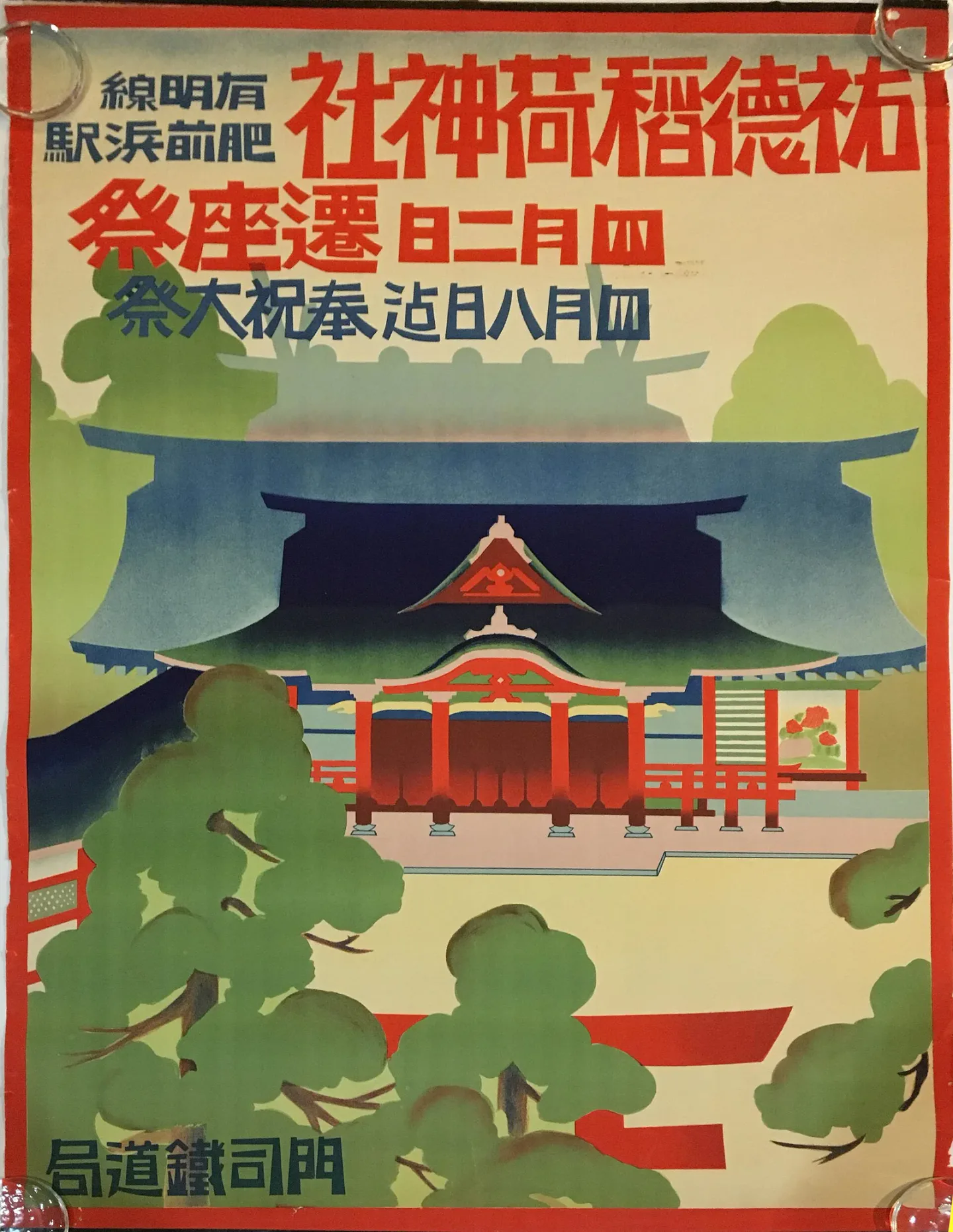
The retained image here is an illustrated Japanese poster, not a current wayfinding sign or live shrine-hours notice. Its historical visual belongs with the shrine's wider identity; do not read its printed characters as today's service timetable. The gates photograph near the start is the visual guide to the present walking environment.
Judge each route by what it actually returns
Visit length changes the trade-off across several practical dimensions. For a short first visit, consider what is distinctive, how the stop fits the route, time and weather tolerance, crowd sensitivity, booking flexibility and money cost. For a hiker, time spent on the mountain is itself the point, so the longer route may fit better than it does for someone trying to see several Kyoto districts in a day.
↔ Scroll table left or right
| Dimension | Short lower visit | Yotsutsuji or full circuit | Night lower visit |
|---|---|---|---|
| Distinct experience | Main shrine and Senbon Torii | Sacred mountain and extended torii path | Quieter visual atmosphere |
| Route and time fit | Good before Nara or another Kyoto stop | Needs a lighter second half of day | Fits an evening with a preset return |
| Weather and physical demand | Contained, though still walked | More stairs, heat and rain exposure | Navigation and light become constraints |
| Crowds and flexibility | Lower gates are most crowd-sensitive | People spread out higher, but turnaround costs rise | Grounds open; staffed services may be closed |
| Money | No admission ticket for the grounds | Same grounds, greater time cost | Same grounds, return transport still matters |
For most first trips, begin with the lower shrine and decide upward only if the walk is still the purpose. For a dedicated mountain morning, give the full circuit the time its route needs. For an evening, use a shorter path that can be found and finished comfortably. The correct end point is where the visit has delivered what the traveller came to experience, not where a completion badge might have been imagined.
For the walk itself, use the shrine map and Inariyama's sacred-site descriptions, including Ichinomine. Kyoto City's visitor page distinguishes open grounds from staffed hours, while its rail route helps with the first leg. Before photographing narrow paths, read the shrine's conduct rules. Check service times if your goal includes a staffed rite rather than only the walk.
For a visit before the busiest hours, compare rooms with a practical route to Fushimi Inari and account for the first train if you stay elsewhere in Kyoto.