
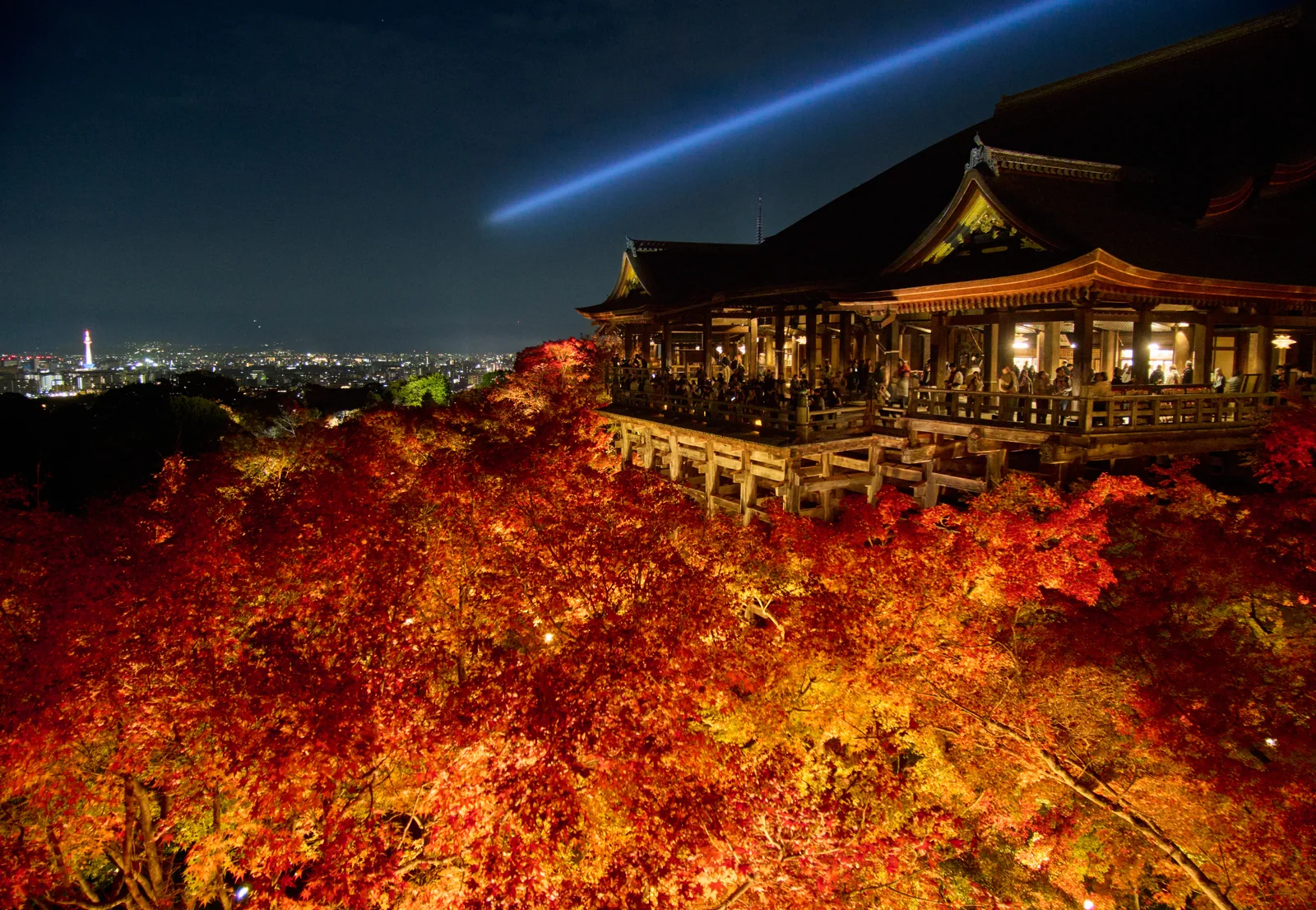
Kiyomizu-dera's autumn night opening is a specific evening commitment, not a general promise that Kyoto's temples stay open after dinner. The temple lists 21–30 November 2026 for the special viewing, with admission ending at 21:00 and the grounds closing at 21:30. If you arrive in Kyoto at 20:30 with luggage, a room advertised as “central” will not rescue the visit. The useful hotel question is whether you want the shortest walk home from the temple, or an easier departure by train the next morning.
The Hotel Seiryu Kyoto Kiyomizu is a real Higashiyama option; its access information puts Kiyomizu-dera about eight minutes away on foot. Hotel Granvia Kyoto represents the opposite geography, directly tied to Kyoto Station. These are examples for comparing locations rather than a claim that either has a room on your date. The first base reduces the walk after viewing; the second reduces the transfer before an early train. A Kyoto hotel area guide helps with the wider city, but the late temple exit makes this decision unusually concrete.
Swipe through earlier event photographs
What the 2026 admission window actually permits
The temple's night viewing notice gives the 2026 dates and the final admission and closing times. Read “last admission” literally. It is not a recommended arrival time, and you still have to get through the approach streets and the entrance. A visitor who wants to see the illuminated grounds at an unhurried pace should arrive considerably earlier than 21:00. Weather, crowd control and individual access routes can change the feel of the evening. Check the current temple notice again on the day rather than treating a prior year's social-media post as operational guidance.
The time window also changes dinner. A long restaurant booking before viewing leaves too little margin, particularly if you are transferring from a distant hotel. Eating early in Higashiyama, or visiting the temple first and choosing dinner afterward where opening hours allow, makes more sense than relying on a precisely timed bus. The Kyoto sightseeing guide can suggest neighbourhoods, but confirm the specific restaurant's hours separately. If food is your main evening event and the temple is optional, there is less reason to pay a Higashiyama location premium.
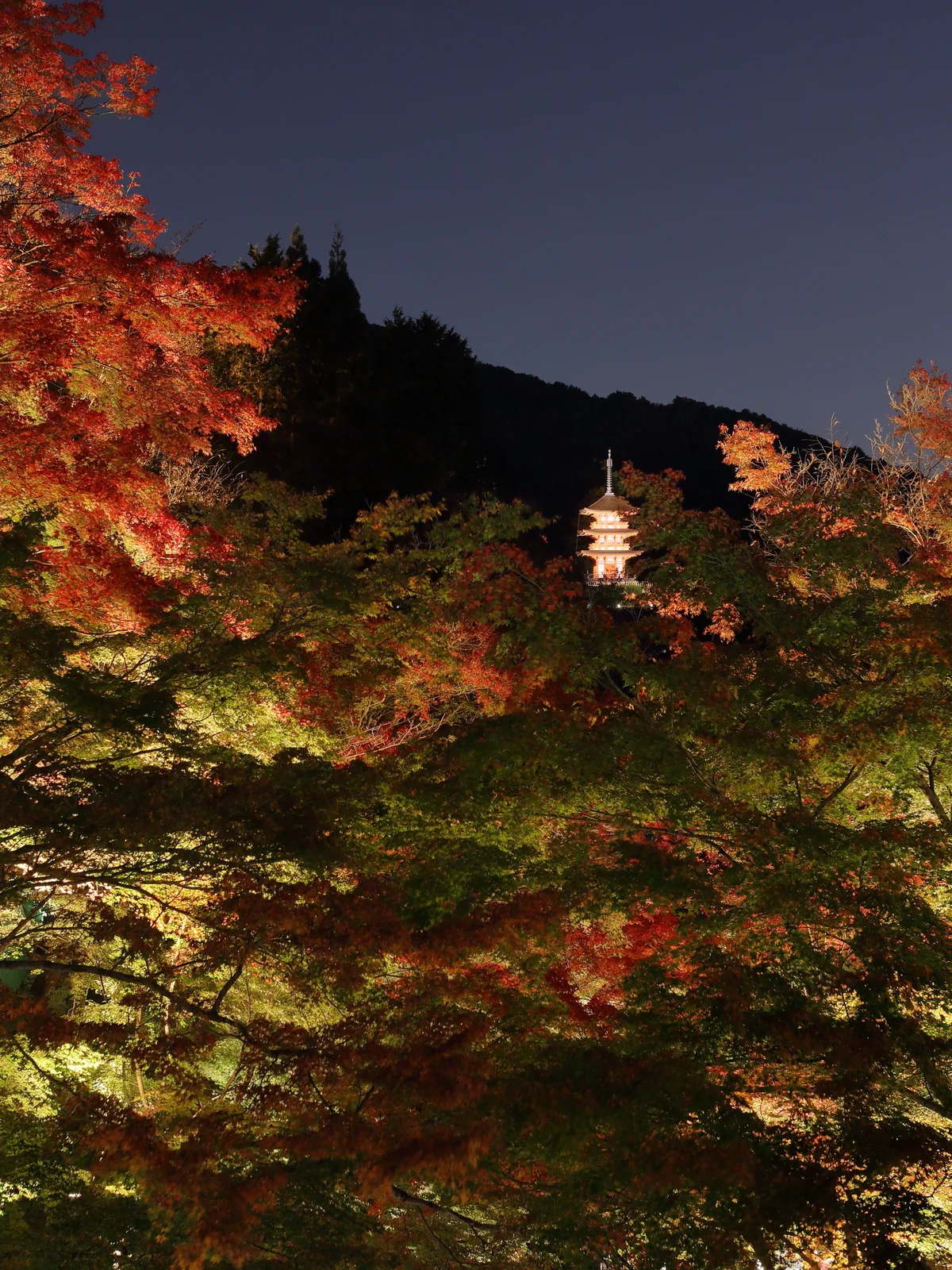
The two historical images in the gallery show the temple and its autumn setting, not a prediction of the 2026 lighting design or foliage peak. Trees do not follow a booking engine's calendar. A late-November visit may be colourful, past its peak or mixed by elevation and exposure. Treat the announced opening as certain only in the sense of the published programme; treat any promise of identical leaves on your chosen night with scepticism.
If the temple date does not fit your trip, the Kyoto autumn illumination guide compares other evening openings; the leaves by elevation guide explains why different parts of the city can look different on the same day. Neither substitutes for a current admission notice for the site you actually choose.
| Evening constraint | What it means for the room | Action before booking |
|---|---|---|
| Last entry at 21:00 | A late arrival has little recovery time | Calculate door-to-temple travel, including luggage drop |
| Closing at 21:30 | The walk home occurs after the crowd exits | Check the actual walking route and street lighting |
| Busy Kiyomizu-zaka approach | A map's straight-line distance understates walking time | Look at hotel entrance and slope, not a broad area label |
| Early next-day train | Station transfer becomes the second hard deadline | Compare the morning journey with the night walk |
The schedule offers a useful way to reject unsuitable rooms. A cheap hotel across Kyoto can work when your arrival is early and you accept a longer trip home. It is a poor fit when your train reaches Kyoto close to final admission. Conversely, an expensive room beside the temple is unnecessary if you will finish viewing before dinner and have no difficulty taking transit afterward.
Higashiyama: pay for the walk you will actually use
Staying within walking distance of Kiyomizu-dera lets you return without organising a late bus or taxi. That is especially useful if you want to linger near the lit streets after leaving the temple, or if one person in the group walks slowly. The Hotel Seiryu Kyoto Kiyomizu's official access page gives the eight-minute temple walk and acknowledges that the Kiyomizu-zaka area is busy. The walk is on sloping old streets; “eight minutes” is a location marker, not a promise for someone moving through crowds with a suitcase.
Compare Higashiyama properties by the door you will use, not merely by ward. A hotel near Yasaka Shrine or Gion may be convenient for an evening stroll but still leave a substantial uphill approach to Kiyomizu. A hotel on the wrong side of a major road can also involve more walking than its map pin suggests. Check the route in both directions, noting the climb on the way in and the descent after dark. The Kyoto Station versus Gion hotel guide and Higashiyama autumn walking guide provide nearby alternatives, but a narrow old street can change your last kilometre more than a neighbourhood label.
There is a cost to the temple-side choice. Arriving with luggage from Kyoto Station usually means a taxi, bus plus walking, or a more complicated local-rail route than a station hotel. Road traffic and crowd management near famous sights can make an apparently short car ride unpredictable. If you reach the city late, ask the hotel when you can check in and whether it will hold a bag before assuming you can drop it quickly. A room that can be reached with a long, steep suitcase walk may be less convenient than one a little farther away with a simple taxi approach.
Higashiyama also wins when the following morning is local sightseeing. You can start early on the eastern side of Kyoto, before the densest day traffic, and then move to another district. The Higashiyama autumn route is a useful continuation. For a multi-night cultural trip, the evening viewing becomes one piece of a coherent east-Kyoto stay. The location premium is easier to justify when you will use that geography twice, at night and again in the morning.
Kyoto Station: protect the next departure
Kyoto Station is the stronger base when you leave early for Osaka, Tokyo, Kansai Airport or a long-distance trip. Hotel Granvia Kyoto is attached to the station building, so it illustrates the station-side extreme. Other station-area hotels vary widely in which exit they face and how far their reception desk is from your platform. The Kyoto Station hotel comparison is a starting point, while the Kyoto Station versus Gion guide covers a broader stay. For this article, count the temple-night transfer and the morning departure as one combined cost.
One workable sequence is to check in near the station, leave luggage there and travel to Higashiyama well before the night-opening deadline. You can then walk the approach without bags and return after viewing. This is sensible if you arrive by Shinkansen in the afternoon and need to be back at the station next morning. It becomes fragile if your incoming train is late: check-in, transit and temple admission are three consecutive steps, each with its own delay. The Kyoto autumn hotel guide is useful for that risk.
Do not assume the last bus that looks convenient on an old route map will operate at the time you exit. Kyoto's sightseeing corridors can be crowded, and bus stops or routes may be adjusted for events. Consult the transport operator's current timetable and any event notice. If you plan to use a taxi, find a sensible pick-up point away from the densest pedestrian street and allow for a queue. If you prefer a fixed-cost rail route, check the walking distance to the nearest usable station; Kiyomizu-dera is not directly above a rail platform. The Kyoto one-day itinerary helps compare the modes without promising one universal best route.
| Base for the night | Evening advantage | Morning advantage | Main drawback |
|---|---|---|---|
| Near Kiyomizu-zaka | Shortest exit walk | Early east-Kyoto sightseeing | Arrival with luggage can be awkward |
| Gion or lower Higashiyama | Dinner choice and walkable streets | Flexible city exploration | Uphill temple approach remains |
| Kyoto Station | Simple intercity arrival | Fastest access to an early departure | Return from temple needs a planned transfer |
| Osaka base | Avoids another hotel move | Useful if all next-day plans are in Osaka | Longest night return and least admission slack |
Osaka deserves explicit mention because its hotels often appear cheaper in a Kyoto search. A traveller already staying in Osaka can make the viewing an evening trip, especially with an early arrival and no bags. It is a poor way to fix a late Kyoto arrival. The Osaka or Kyoto hotel-base comparison can help decide where the whole trip belongs; the temple's last-entry time should then be entered as a hard condition, not an afterthought.
Build the evening around the climb
Kiyomizu-dera sits above the approach streets. That physical fact matters more than the tempting simplicity of “ten minutes from the hotel”. Arrive in the district with enough time to walk uphill, absorb the crowd and reach the admission point. Wear shoes suitable for steps and paved slopes; a wet late-November surface can be slippery. Carry only what you need. Large luggage slows everyone and can make narrow streets unpleasant. If your hotel offers baggage storage, use it before heading up.
I would divide the evening into an arrival buffer, temple visit and exit. The buffer is deliberately unassigned: it covers a late train, a crowded bus, an unexpected queue or a slower walk. The temple visit should start early enough that a brief wait inside the grounds does not turn into a sprint to closing. The exit needs its own plan because many visitors leave within the same final window. This is a more useful way to schedule the night than writing a minute-by-minute itinerary based on an unverified crowd forecast.
Families should decide where a tired child can stop. A stroller may be awkward on the approach and within historic grounds; check the temple's current accessibility information if that determines whether the visit is possible. Older travellers may benefit from a taxi to a practical edge of the pedestrian area, but there will still be walking. If mobility is the deciding factor, do not book a steep-side room simply because its map pin is close to the temple. The Kyoto aquarium family hotel comparison and Kyoto hotel choice for seniors can help frame the wider stay; confirm individual facilities with the property and temple.
The viewing is not a substitute for daytime Kiyomizu-dera if you want to see architectural details in natural light or continue on foot through the eastern streets. If you have two days, a daytime visit on another morning may be worthwhile. If you have only one evening, accept that the night opening is a distinct experience with its own limits. The Kyoto autumn three-day itinerary can be adjusted around an evening rather than treating the temple as a full-day stop.
The room-rate calculation is about two transfers
Compare the total cost of the two locations, including transfers and the time they consume. A station room might be cheaper and give you breakfast before a departure, but add a return taxi from the temple. A Higashiyama room may cost more yet eliminate that ride and allow a relaxed walk. The relevant comparison is the actual refundable rate on your dates, not a generic average price. The Kyoto sold-out hotel guide is useful for discovering cheaper districts; it cannot tell you a 2026 autumn room rate without a live search.
If you are travelling as two adults, a taxi cost divided in half may make a station hotel attractive. A family needing a larger vehicle or two separate rooms faces a different equation. Ask whether breakfast is included only after deciding whether you will be at the hotel when it opens. A buffet is little value if you must be on a 06:00 train. Cancellation terms matter because the foliage and your own transport may change. A refundable booking can be worth more than a small prepaid discount if the night viewing is the only reason for the stay.
There is also a one-night versus two-night difference. For a single Kyoto night with an early onward train, station convenience often dominates. For two nights spent mainly in east Kyoto, hotel changes and repeated station transfers cost more, and a Higashiyama base becomes more appealing. If you are splitting nights between cities, the Osaka and Kyoto split-stay itinerary shows why a change of base needs a purpose. Do not switch rooms merely to save an estimated twenty minutes after the temple if it creates a lost morning packing and checking in again.
Before you pay, open the hotel's exact map position, compare the walk from the temple gate and the trip to your next train, and check what time reception will hold luggage. A room description saying “Kiyomizu area” may refer to a wider zone than you expect. Ask the hotel about the route if you need a step-free approach. If an offer names a temple-view room, read the room category carefully; proximity to the district does not establish a view of the illuminated grounds.
Two realistic one-night plans
For a visitor arriving in Kyoto by mid-afternoon and leaving on an early train, I would choose a station-side room, drop bags, and travel to Higashiyama before the evening rush. The admission deadline then has a generous buffer, while the next morning remains simple. The return after dark is the cost of that choice; identify the transport route before dinner. The Kyoto Station hotel for a holiday Shinkansen can serve the late return if kitchens in the temple district have closed.
For a visitor spending the next day around Kiyomizu, Gion and the eastern hills, I would stay in Higashiyama. Get to the hotel while there is daylight, travel light to the temple and walk back after the viewing. Use the following morning in the same part of town before moving to a distant attraction. The Higashiyama autumn itinerary helps order that morning. This plan still needs a realistic arrival route with baggage; the hotel location saves the late walk but does not remove the climb on the way in.
If you are deciding between those plans solely by a headline nightly rate, you are missing the part that determines whether the visit works. The published 2026 dates and 21:00 last entry are the fixed points. Your actual arrival, walking ability and next departure are the variables. Choose the room after putting those four facts on one timeline. Then verify the temple's current notice, transport hours and hotel conditions just before travel.