
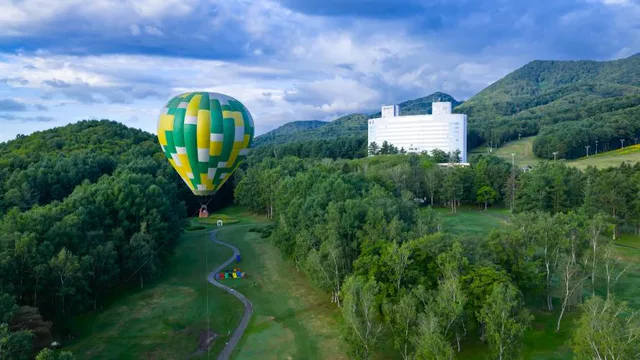
Furano uses one word, balloon, for two activities with very different demands on a trip. The warm-season ride rises on a rope above the New Furano Prince Hotel grounds for about five minutes. The winter Free Flight leaves the launch field and moves with the wind for roughly thirty minutes when conditions permit. The first can be a small addition to a day already in Furano. The second needs a reservation, an overnight base near the departure area and a morning that can survive cancellation.
On 24 October 2026, the advertised 2026 tethered season has ended; its final operating date was 12 October. The operator's winter pages say the previous season has concluded and do not yet give a confirmed 2026–27 fare or booking season. The amounts below explain what the last published pages said, not what a future winter ticket costs. If your trip is next summer, wait for the new schedule before building the day around a 06:00 launch. The one- or two-night Furano choice should be driven by the whole route, not five minutes aloft.
↔ Scroll table left or right
| What you want | Best fit | What could change it |
|---|---|---|
| A first look from a balloon basket while already in Furano | Next announced tethered season | No operating day, early alarm or unsuitable wind |
| Actual movement across a snowy landscape | Winter Free Flight once a new season opens | Weather cancellation or inability to keep the morning flexible |
| A fixed route over named sights | Choose another aerial activity | Balloon direction follows winds at different heights |
| A balloon as the sole reason for a Sapporo day trip | Usually reconsider the travel effort | Several other Furano stops make the journey useful even if grounded |
↔ Scroll table left or right
| Decision factor | Tethered experience | Free Flight |
|---|---|---|
| Ticket cost | 2026 adult fare was ¥2,800 | New winter fare not announced; concluded-season pages disagree |
| Time required | Short flight but queue and weather wait can dominate | Protect the 07:00–10:00 morning and recovery time |
| Booking | Walk-in during the finished 2026 season | Reserve once a future season opens |
| Weather | Wind can stop even a session underway | Operator reported about six in ten operations succeeded |
| Crowds | First-come queue can lengthen a short outing | Booking removes the walk-in queue but cannot remove cancellation |
| Route fit | Convenient near New Furano Prince | Best with a Furano overnight and open morning |
| Experience | Vertical view without horizontal travel | Actual wind-driven travel over the winter landscape |
Five minutes tied to the field, or a winter journey with an unknown landing point
The tethered basket rises around forty metres. It stays attached to the ground, so the view changes vertically but the passenger does not travel across the valley. The launch field is the Picnic Garden near New Furano Prince Hotel. During its concluded 2026 season, adults paid ¥2,800 and children aged three to twelve paid ¥2,500; no advance reservation was required. This was a simple purchase if you were nearby and a poor reason by itself to move hotels.
A winter free flight is a different undertaking. The operator's previous winter page described about thirty minutes in the air, a 07:00–10:00 overall operating window and a route determined by wind. The balloon can reach a much higher altitude in favourable conditions, but that is not a promised height on every flight. Landing and the return vehicle are part of the morning. Aso's balloon arrangements are another example of why an advertised flight length should not be read as the whole appointment.
The Furano Tourism Association also distinguishes the tethered summer experience from true winter free flight. Neither offers the fixed path of a sightseeing aircraft. If a particular mountain, landmark or photograph is non-negotiable, an activity steered by wind is a poor guaranteed route. The choice is whether the novelty of a brief lift is enough, or whether free movement over snowy fields is worth using a whole morning and accepting a failed attempt. A tandem flight near Fuji has its own duration and pickup constraints, which make the distinction easier to see.
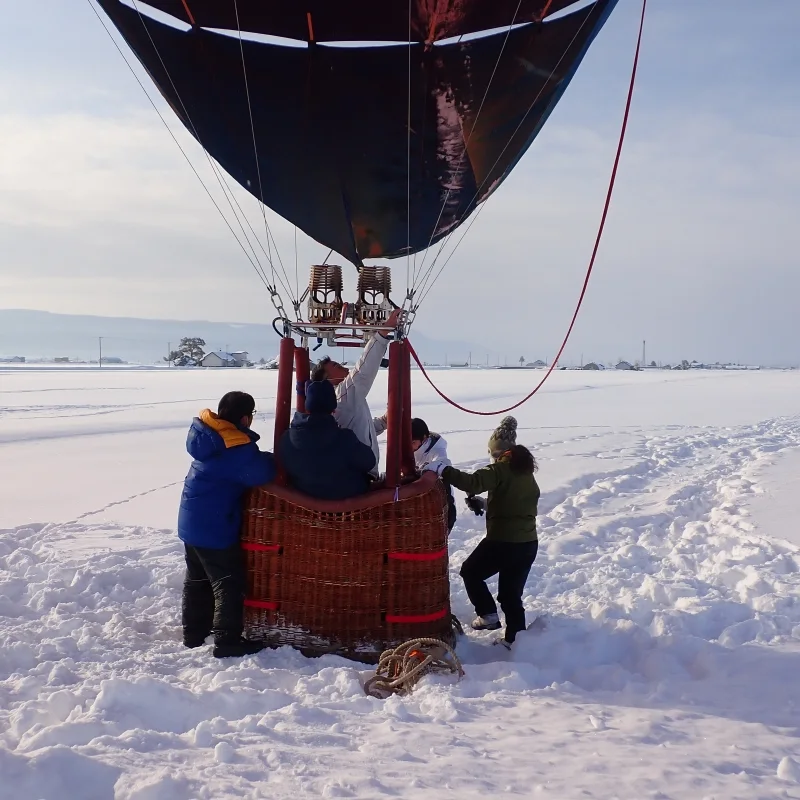
In the snowy-field photograph, crew members steady the wicker basket as people stand beside it. The scene shows why a free flight includes ground preparation and recovery rather than only minutes in the air. A sunny view from a hotel window is not enough to decide whether wind near the surface and aloft permits a launch.
What the finished 2026 tethered schedule can and cannot tell you
The operator and the New Furano Prince ski area both published 25 April–6 May, selected May weekends and 1 June–12 October for the 2026 morning ride. Morning reception ran 06:00–07:00. The evening 18:00–19:00 session was limited to July and August. The winter calendar and the next summer calendar require separate announcements; these past dates are useful for understanding the pattern, not booking a 2027 morning.
The ride itself lasts about five minutes. It is misleading to reserve only five minutes in an itinerary: travellers had to reach the Picnic Garden, see whether operations were running, queue, pay and board. The operator said it updated same-day status around 05:30 and warned that waits could approach an hour on busy mornings. It could suspend rides even after a session started. For a ride that matters to you, protecting roughly 60–90 minutes is more sensible than placing a non-refundable activity immediately after 07:00.
↔ Scroll table left or right
| 2026 published element | Planning consequence |
|---|---|
| About five minutes in the basket | Do not confuse flight duration with the queue and field visit |
| Morning 06:00–07:00 | Reach the field early only after same-day operation is indicated |
| Evening 18:00–19:00 in July–August | It can spare the morning, but the operator said morning flights operated more reliably |
| Walk-in, first-come participation | There was no advance ticket that secured an exact takeoff minute |
| ¥2,800 adult; ¥2,500 ages 3–12 | These were 2026 seasonal prices, not a promise for the next schedule |
| Weather decision around 05:30 | Keep another worthwhile Furano activity available if the balloon is grounded |
A morning attempt raises the chance of flying, while an evening slot could protect a day around flower fields. That trade-off is most relevant when both sessions are offered, as they were in July and August 2026. If the balloon is merely a bonus, use whichever future session fits the route and leave without regret when it is cancelled. If the view is a main reason to visit, staying nearby makes the 05:30 decision and 06:00 arrival less punishing than an early departure from Sapporo. Farm Tomita timing and Furano–Biei travel without a car both matter when the morning is already busy.
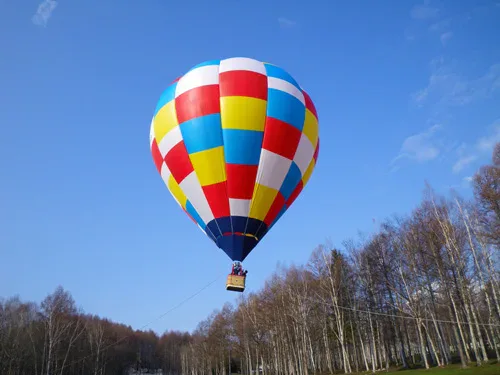
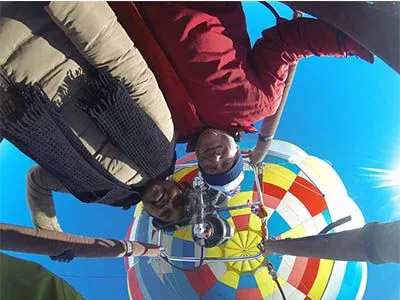
The multicoloured balloon pictured over trees is visibly connected to the ground: it illustrates height without an onward route. The other basket-level image shows passengers looking upward, which is a better reminder of the short ride's experience than a distant landscape shot that might imply cross-country travel.
Children: follow the host venue's stricter stated minimum
There was a discrepancy among first-party 2026 descriptions. The operator's English page described a free category for children under two, while the New Furano Prince venue's 2026 notice listed the experience for ages three and over. A family with a toddler should not infer eligibility from a price row. The venue's stated participation minimum is the safer working rule, and parents should ask the operator directly when the next season is announced. The regular child price in 2026 applied to ages three through twelve.
A short tethered ascent also depends on the child being comfortable with the basket, burner sound, early hour and the possibility of a wait. A free winter flight is a longer cold-weather commitment: the operator's concluded-season page limited participation to elementary-school age and above and required at least two people for operation. Neither product becomes a guaranteed family attraction simply because the calendar contains a date. A five-day summer Hokkaido route may give a family enough other stops to absorb a missed balloon ride.
The operator welcomed people who wanted to watch and photograph a tethered launch without boarding. A family need not buy four places because one child wants to ride. In the announced 2026 setting, the field was about five minutes on foot from New Furano Prince Hotel; that made the attempt easy for its guests but did not decide which hotel was best for restaurants, the rail station or the next day's drive.
A winter booking uses the full morning, and the published price is unresolved
The operator's English and Japanese Free Flight pages both say the previous season ended. They still show different figures: the English page lists ¥25,000 for an adult and ¥18,000 for an elementary-school child; the Japanese page lists ¥28,000 and ¥22,000. Neither page announces a new 2026–27 rate. Do not assume that the lower figure is current, or convert either to a precise foreign-currency budget. Wait until the operator names the new season, price, payment terms and booking availability.
The previous winter information described a period beginning 23 December and ending in March, but the English and Japanese end dates were not identical. Exact dates for the next season need a fresh announcement. The 07:00–10:00 window varied with the number of passengers and wind direction; the roughly thirty-minute flight was only one part of it. Landing location, vehicle recovery and return timing could change. A train or paid tour immediately afterward would turn an uncertain finish into an avoidable problem.
The concluded-season outline had the pilot make a weather call near 06:00, collect guests near 07:00, reach the launch area around 07:30 and aim for takeoff around 08:00. Furano-area hotels and the station were listed for complimentary pickup, reducing any need to sleep beside one field. The same operator materials gave several in-air estimates: roughly thirty minutes in the tour table, fifteen to thirty in an itinerary and about twenty in the FAQ. A difficult landing could stretch the outing to an hour or more. Treat the whole morning as occupied until your booking gives firmer instructions.
Breakfast at a hotel may be missed after such an early pickup; arrange food the night before. In favourable wind the balloon can rise to around 1,000 metres, but height varies by flight. The operator has also described guest participation in balloon inflation or packing, free photographs, and winter clothing requirements. Snowy-field preparation can be cold even before the basket lifts. Confirm pickup, clothing and any borrowed boots under the next season's terms rather than assuming an older itinerary is fixed.
↔ Scroll table left or right
| Concluded-season page | Adult figure shown | Elementary child figure shown | Use in a 2026–27 plan |
|---|---|---|---|
| Operator English Free Flight page | ¥25,000 | ¥18,000 | Historical indication only |
| Operator Japanese Free Flight page | ¥28,000 | ¥22,000 | Historical indication only |
| New-season announcement | Not yet published | Not yet published | Confirm before paying or reserving |
The operator has described an operating success rate around sixty percent. This is an estimate for its programme, not a probability for your date: wind, snowfall and visibility can change overnight. A second Furano morning may increase the chance of an attempt, but it does not guarantee a flight and should have value even if both mornings are grounded. A five-, seven- or ten-day winter Hokkaido route shows why one weather-dependent morning can affect the whole trip. Winter driving choices also affect whether reaching the launch area before 07:00 is sensible.
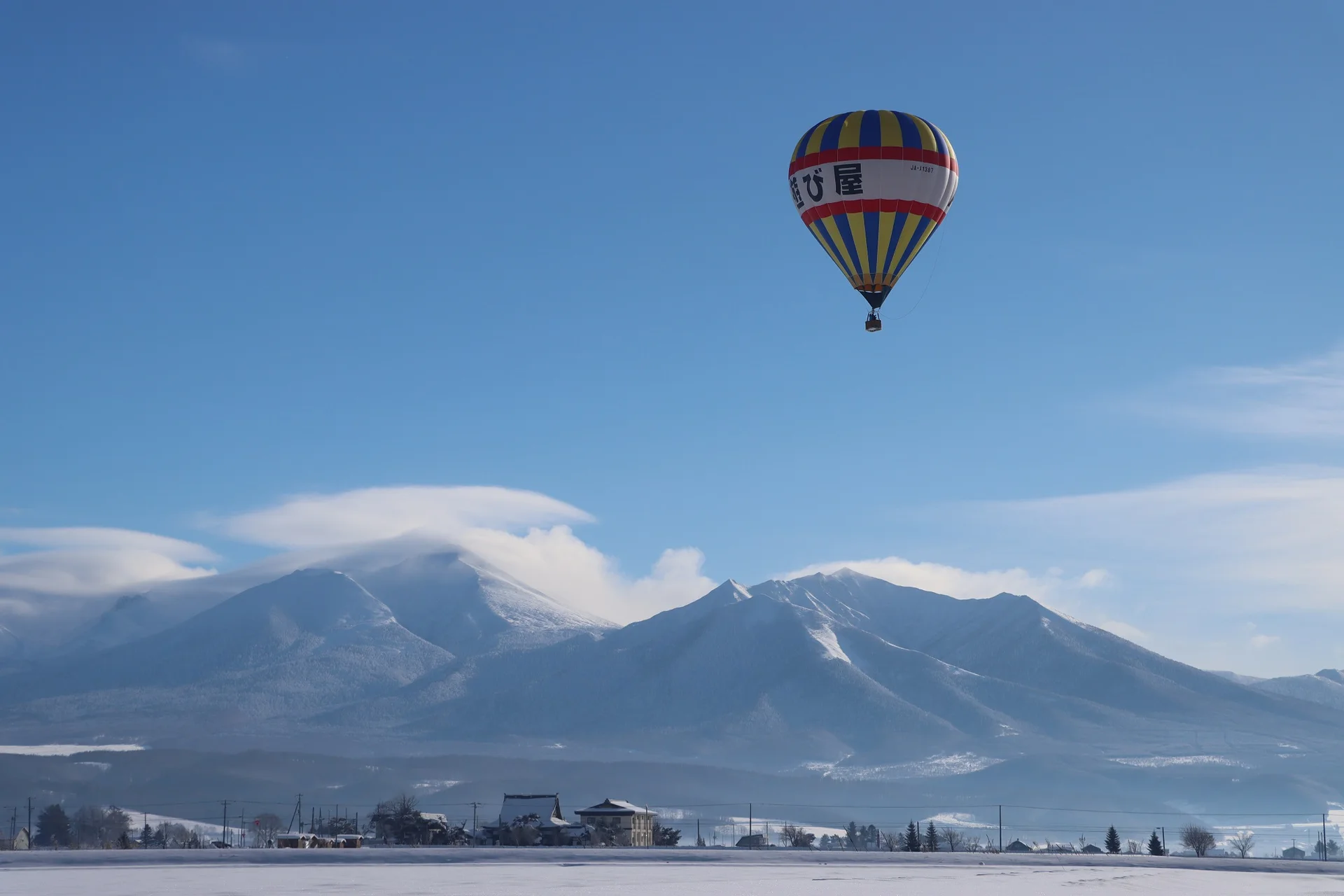
The photograph of a balloon above the snowy valley shows the kind of open view possible on a winter flight; it does not identify the day's altitude, route or landing point. Dress for standing around on snow before boarding as well as the ride itself, and check meeting and pickup instructions for the exact booking.
The overnight base should serve the rest of the trip too
A room in or near Furano reduces the cost of a 05:30 weather check followed by a 07:00 operating window. It is most defensible when you would also use Furano for skiing, sightseeing, food or access to Biei. A balloon attempt alone may not justify leaving a stronger base in Asahikawa or Sapporo, especially when cancellation cannot be removed from the plan. Compare Furano Station, Nakafurano, Asahikawa and Sapporo bases before reserving a room solely for the launch.
The next day needs a fallback that works from the same base. In summer, the 2026 tethered field beside New Furano Prince made a morning attempt easy for guests nearby, but an independent traveller should still plan the trip from the actual hotel to the field. In winter, pickup and recovery details must be taken from the new booking conditions. Furano versus Biei overnight is a more consequential choice than a single five-minute ascent. If Biei scenery is the fixed priority, a Biei overnight can be preferable to moving bases for an uncertain balloon.
Trying to put early Biei photography and the Furano balloon into the same sunrise is a common schedule mistake. Both are better before crowds or stronger daytime winds, and the basket's short airborne time does not remove check-in and waiting. Pick which morning matters more. The other can move to a different day, become an evening tethered attempt when that season allows one, or leave the itinerary entirely.
↔ Scroll table left or right
| Commitment | Reasonable itinerary | Overcommitment to avoid |
|---|---|---|
| Balloon is a bonus | Try a tethered ride when already nearby and an operating day is confirmed | Change hotels or make a dawn Sapporo run for five minutes aloft |
| One Furano highlight | Sleep locally and leave the next activity flexible | Book a fixed, non-refundable start right after the flight window |
| Winter free flight is a main goal | Wait for the season announcement, reserve, hold the morning and name a fallback | Treat clear skies or an old fare as confirmation |
For a 2026–27 ski trip, the balloon morning must also fit lift plans. Skiing can supply the fallback if a weather call stops the flight, but an expensive, fixed-time lesson can conflict with the tour's variable finish. Furano Zone or Kitanomine affects early movement around the resort, while the Niseko–Furano ski-base choice should be made on the wider holiday, not one uncertain flight.
When the basket never leaves the ground
If a tethered ride is cancelled, keep the Furano day intact: use the planned flower fields, food stops or another activity whose value does not depend on a balloon. Do not drive to the field merely because it is bright at breakfast; wind can stop operations. The operator's same-day status and venue schedule should be read together when the next season is announced. If the winter Free Flight is cancelled, use the already planned Furano or ski day rather than letting a large empty morning spread into the rest of the route.
Five common booking mistakes are avoidable. The summer basket is tied to the field, so it cannot supply a horizontal sightseeing journey. The previous winter figures are not a new-season fare. Neither the five-minute nor thirty-minute airborne period gives the full time needed on the ground. Visible sunshine does not establish flyable wind. And a hotel move made only for a low-priority attempt can cost more time than the ride would add. A season-led Hokkaido itinerary is a better framework for where Furano belongs.
↔ Scroll table left or right
| Before committing | If the answer is no |
|---|---|
| Do you want wind-driven travel rather than a brief lift? | Use a future tethered session only when the route already includes Furano |
| Can you stay nearby and leave the winter morning unbooked? | Do not make Free Flight the core of that day |
| Would the Furano day still work after cancellation? | Strengthen the backup before choosing accommodation |
| Has the operator announced the next season and fare? | Keep an estimated budget provisional and postpone booking |
The short ride is the easier addition to a Furano stay; a free winter flight is the distinct balloon journey. They share a basket but not a schedule, budget or weather tolerance. Choose the experience that matches the actual trip, then keep the rest of the day valuable even if the wind makes the choice for you. For accommodation, compare stays around Furano only after you have decided whether a local dawn matters to the itinerary.
Activity details
Related guides: Aso Hot-Air Balloon Guide: Aso Nature Land Booking, Meeting and Cancellation · Hokkaido Summer 5 Days: Sapporo & Otaru or Add Furano and Biei? · Best Outdoor Experiences in Aso: Horse Riding, E-Bikes and Hot-Air Balloons · Japan Summer Sales 2026: Department Stores, Outlets and Tax-Free Strategy · Where to Stay in Furano: Furano Station, Nakafurano, Asahikawa or Sapporo? · Hokkaido Winter Rental Car: Full Trip or Partial Rental? · Free and Cheap Things to Do in Osaka: A ¥3,000-a-Day Sightseeing Plan · Hotel Gracery Sapporo vs Hotel Emion Sapporo: Winter Luggage, Bath or Shorter Walk? · Niseko vs Furano: Which Ski Base Is Better for Your Hokkaido Trip? · Osaka Night Views: When Free Beats the Observation Deck — and When HARUKAS 300 Is Worth Paying For
Premier Hotel -CABIN- Asahikawa: Is the Overnight Hot Spring Worth a 14m² Room?
Okinawa Parasailing: Naha, Motobu, Uruma or Ginowan? Don’t Mistake Boat Time for Flight Time
Fukuoka Tower: Is the ¥1,000 Ticket Worth the Detour? Timing Changes the Answer
Mt Fuji Paragliding 2026: Tandem Flight, Pickup Package or Full-Day Tour?
Where to Stay for Kyoto Summer Events: Station, Kawaramachi, Otsu or Kibune
Other useful reading: Shin Furano Prince Hotel — 2026 tethered balloon schedule, price and age rule · Furano Nature Club — tethered balloon operations and day-of process · Furano Nature Club — English winter Free Flight page · Furano Nature Club — Japanese winter Free Flight page · Furano Tourism Association