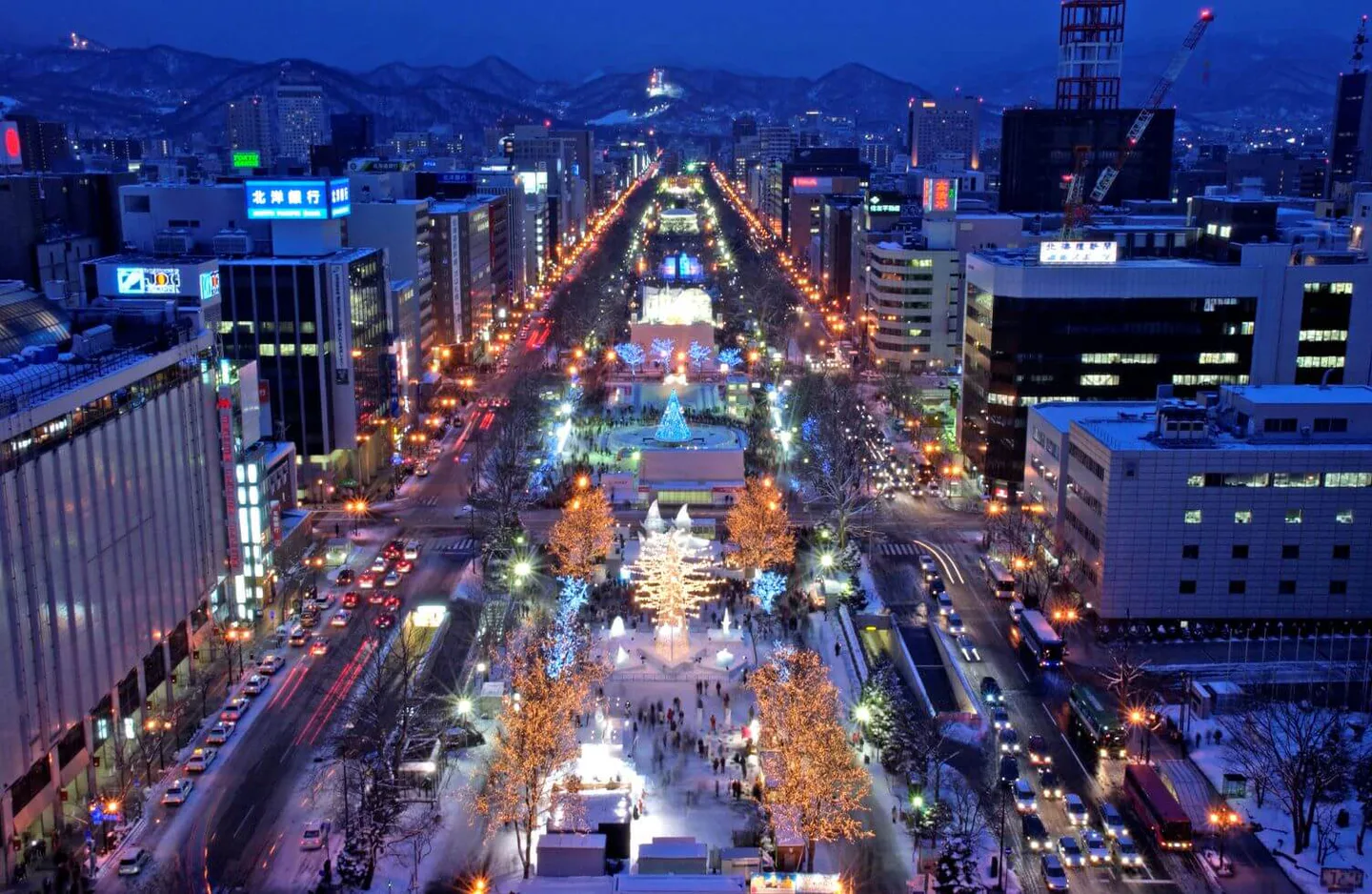
For the 2027 Sapporo Snow Festival, the best hotel area depends on where your day finishes and how often you will return to the sculptures. Odori makes a daylight visit, a warm indoor break and a later illuminated walk easy to separate. Susukino shortens the final walk after ice sculptures, dinner and drinks. A Sapporo Station room earns its keep when fixed JR departures recur. Those are three different uses for the same hotel budget; the event name alone does not decide among them.
The festival runs 4–11 February 2027 across three sites. Odori extends from West 1-chome to West 11-chome, and the initial site plan places five large snow sculptures at 4, 5, 7, 8 and 10-chome. A room advertised as “near Odori” can therefore sit near the TV Tower end while most of your desired large-sculpture walk lies farther west. Choose a block of the park before treating a district label as a short winter walk.
↔ Scroll table left or right
Trip pattern | Area to compare first | Why the room helps | Easy mistake |
Several Odori sculpture visits by day and night | Odori, with the exact chome checked | The hotel splits a long outdoor circuit into shorter visits | Assuming any Odori address is close to West 4–10 chome. |
Ice displays followed by late meals and drinks | Susukino | The evening can end near the room | Paying for nightlife access despite early returns. |
Two or three fixed JR mornings | Sapporo Station | Train access repeats more often than the festival journey | Basing all nights on one photogenic Odori evening. |
Otaru candles during 6–11 February overlap | Sapporo Station has added value | The rail return follows an evening out in the cold | Treating one Otaru night as the only hotel criterion. |
One short festival stop in a longer trip | Whichever base supports the other days | Avoids an unnecessary move for one subway stop | Changing hotels to follow a single event night. |
Tsudome snow play with a family | Keep the strongest central base | Tsudome is a separate excursion | Assuming last year’s access route will repeat. |
What an Odori hotel can save over a full festival day
An eight-day festival does not mean visitors should remain outdoors for an entire day. A nearby room is useful because it can break one long, cold circuit into two shorter visits. That benefit is strongest for families, older travellers or anyone returning after dark for a second look at the snow work.
A practical Odori day can be split at the hotel:
Daylight reveals the carving and spatial layout of the large snow pieces.
Back at the hotel, dry gloves, recharge equipment and let children or older companions rest.
After sunset, return for lighting without adding another long transfer.
The festival site currently lists Odori illumination through 22:00. Daylight makes detail easier to see; the lighting changes the appearance of the same sculptures later. A room close enough to re-enter without another long transport chain makes those two views a plausible plan rather than a test of endurance.
The premium is harder to justify if the festival is one brief stop in a rail-heavy trip. A couple of hours in Odori does not require a hotel on its edge. Pay for adjacency when it removes several cold walks or creates a usable midday reset, not because the property includes “Snow Festival” in its marketing.
The useful Odori address is a block number
The published 2027 site outline spreads the headline pieces through 4-, 5-, 7-, 8- and 10-chome. Other blocks have smaller sculpture work, winter activities and a Sapporo International Art Festival component. A room near the eastern end and one near 8-chome can produce very different repeat journeys even though both are sold as Odori hotels.
Match the room address with the park section you expect to revisit:
West 1–3 chome: closer to the eastern park and TV Tower, but farther from most of the announced large-sculpture blocks.
West 4–8 chome: a central position for several of the major 2027 snow installations.
West 9–11 chome: useful for the western sculpture and international competition area, with a longer return after a Susukino night.
These are planning inferences from the initial venue layout. Specific sculpture designs and some event programming are due later. A booking made now should rely on the block geography, not on an assumed named sculpture being outside a particular window.
Susukino works when the evening ends there
Odori and Susukino are adjacent stops on the Namboku subway line, about 0.6 km apart in the city transit table. The central corridor also has underground walking connections, though a hotel door or ice-sculpture lane may still require a surface stretch. This modest gap means a Susukino room does not prevent a daylight Odori visit.
The strongest Susukino sequence is an evening that naturally moves south:
Odori snow sculptures during the day, followed by dinner, Susukino ice work and a late bar or bowl of ramen before returning to the room.
In that pattern, the longer journey is paid while everyone is alert and daylight travel is easier. The short walk home comes at the end of the coldest, most tiring part of the day. A traveller who normally eats early and returns to the room by 19:30 would gain much less from that location.
A Susukino rate premium should correspond to actual late evenings. If the group is more likely to revisit the Odori sculptures after dark and then go straight to sleep, the cheaper or nearer Odori room may remove more real walking.

Count warm-room returns rather than map metres
The value of five minutes outdoors changes with wind, snow, luggage and the people travelling. A photographer adjusting batteries, a parent with a stroller or an older guest who needs regular indoor rests can use a nearby room several times in one day. Two adults who are comfortable remaining outside for hours may not need that same adjacency.
Think through the moments when you will actually go back inside:
Before the first daylight pass, especially with cameras or extra layers.
At midday, to warm up and let shoes or gloves dry.
Before dinner, to change clothing or collect a reservation.
Between daylight and illumination, to avoid standing outside the whole time.
After late food or the Susukino ice display, when the final cold walk matters most.
One hotel return during the festival does not support a large site-side premium by itself. Three or four returns across a stay can. At that point the hotel acts as a warm base and storage point, a more specific benefit than being “close to the festival” on a booking map.
The station wins when trains impose the fixed times
The snow sites do not erase the rest of a Hokkaido itinerary. Otaru, Asahikawa, skiing and airport movement can all make JR Sapporo Station the most repeated transport point. A festival visit can often move between afternoon and evening; a booked rail departure cannot.
Compare frequency as well as distance. Two or three early JR starts can outweigh one Odori night because each rail morning has a departure deadline and winter luggage or equipment. Conversely, a one- or two-night trip devoted almost entirely to the event gives the station less opportunity to repay a location premium.
The Sapporo Station and Susukino choice guide helps weigh the general rail-versus-evening base. Add the festival return count only after that wider pattern is clear.
For a short festival-only visit, Odori commonly pulls ahead because the room is used between site visits and the guest has few other departures. For a longer stay, write down every planned station trip before making the park-adjacent hotel the default.
Otaru candles add an evening rail return
The 2027 Otaru Snow Light Path is set for 6–13 February, overlapping the Sapporo festival on 6–11 February. Otaru’s tourism association has confirmed those dates but has not yet published the full 2027 evening timetable. Earlier descriptions of 17:00–21:00 should not be treated as a confirmed schedule for the coming edition.
The overlap still matters for hotel choice. Someone who remains in Otaru for the candles returns to Sapporo after a winter evening rather than after a normal daytime excursion. A station-connected hotel reduces the final journey after that train. The exact return time and last practical train must be checked against the event-period rail timetable once published.
One Otaru night need not dictate four or five Sapporo hotel nights. If the rest of the stay contains repeated daylight and illuminated Odori walks, shifting the entire base to the station can replace one easier late return with several extra festival commutes.
Count the fixed rail evenings and mornings against separate Odori visits. One Otaru return with three or four sculpture sessions may still favour Odori. Add another JR day and an airport-driven early start, and the station becomes a more defensible base.
An overnight in Otaru is also possible if the candle-lit streets and the next morning there are both important. That change buys more than a saved late train only when the extra night itself has value; a hotel move just to avoid one rail ride introduces packing and checkout work.
Leave the evening train choice open until the winter service pattern is published. A last-train assumption made months early is too fragile to determine a hotel booking on its own.
Tsudome is a separate outing
The 2027 festival spans Odori, Susukino and Tsudome. Tsudome holds snow-play and family activities away from the central Odori–Susukino walking corridor. A family prioritising it should reserve a distinct visit block rather than assume it is an extra park section beside a downtown room.
Choose the central hotel for the journeys repeated before and after Tsudome. The detailed 2027 access and activity arrangements may change; solve that one outing when the event transport plan is final. A central property selected for a shuttle arrangement from another year could create the wrong transfer this time.
The hotel address cannot fix an unpublished bus or shuttle route. It can still make the more certain Odori, Susukino and JR journeys easier, which is a firmer basis for booking.
One room can serve both central sites
The Odori–Susukino shift is one subway stop. Checking out of one hotel, moving luggage and waiting for another room sacrifices more time than that short transfer saves. A split city stay makes sense only if another destination changes the geography materially.
Otaru overnight, a ski resort, Jozankei or Noboribetsu can justify a genuine change of base. Odori to Susukino solely to sleep beside both festival areas does not. Pick the side that handles the most difficult final walk and visit the other from there.
Three trips and the area each favours
Two nights focused on the festival
Odori is the first area to compare. The hotel can divide a daylight sculpture circuit from an illuminated one, and the stay is too short for several rail departures to dominate. Check the exact chome before paying for proximity; only an unusually tight train or airport schedule shifts the calculation toward the station.
Four nights with one Otaru candle evening
Odori and Sapporo Station both deserve a quote. Otaru’s 6–13 February event overlaps six evenings of the Sapporo festival, so a late rail return has weight. Yet several separate Odori visits across the other nights can still make an Odori room the better daily base. Do not assign a 2027 candle-lighting time until the programme states it.
Four nights of ice sculptures, restaurants and bars
Susukino reduces the repeated last walk after three late evenings. Reaching Odori earlier in the day is a smaller inconvenience than repeatedly returning south in the cold after dinner. If the group abandons the late-night plan, reconsider the area before booking a non-refundable rate.
The hotel choice rests on repeated journeys
Odori is strongest when the sculptures bring you back in daylight and after illumination, with a warm room between. Susukino suits a night that continues through ice, food and bars. Sapporo Station gains value with several fixed JR starts and an Otaru candle evening during the 6–11 February overlap. Tsudome needs its own visit plan whichever central base wins.
Within Odori, the numbered block is part of the decision. The initial 2027 plan puts large sculptures in five separated chome, so a room at the eastern edge need not be close to the western piece you most want to revisit. Match your hotel pin with the actual festival walk before accepting a district-level description.
With your festival nights set, compare rooms around Odori against Susukino and the JR station walk.
Related routes and hotel bases
Area comparison: Sapporo Station and Susukino; trip length: days to allow in Sapporo; wider winter routing: Hokkaido winter itinerary.
Dates, sites and transport information
2027 venue blocks and dates: Sapporo Snow Festival site plan; illumination and central venue guidance: Sapporo visitor event guide; Otaru dates, with evening hours still to come: Otaru Snow Light Path; one-stop central subway distance: Sapporo subway distance table.
Other base decisions: Sapporo area guide · Sapporo or Niseko · Kyoto Station or Gion · Shinjuku or Shibuya · Beppu or Yufuin · Nikko or Kinugawa · Sapporo shopping hotel base · Happo or Echoland · Furano or Biei · Ueda or Bessho Onsen.
More regional hotel comparisons